

How to Get Rid of Blackheads on Cheeks: A Safe Routine
Are you sure the dots on your cheeks are blackheads, or are you treating normal pores as if they're clogged? If you've scrubbed, squeezed, or switched treatments without much change, that distinction matters more than adding another exfoliant.
Learning how to get rid of blackheads on cheeks starts with identifying the dots, then introducing pore-clearing treatment without overwhelming your skin. Expect gradual improvement over weeks, not an instantly poreless face.
Confirm the Dots on Your Cheeks Are Blackheads
Cheek blackheads are open comedones, clogged follicles whose openings remain exposed to air. A sensible starting approach is gentle cleansing, consistent use of a leave-on salicylic acid treatment, and no scrubbing or squeezing.
Inside the follicle, sebum, your skin's oil, mixes with retained dead skin cells. When those cells accumulate instead of shedding normally, a process called follicular hyperkeratinization, they can form a plug. The exposed material oxidizes and darkens. It isn't embedded dirt.
That's why Neutralyze Exfoliating Pads, clinically formulated with salicylic and mandelic acid, are one leave-on option to consider after establishing a comfortable baseline routine. Ingredient evidence supports the treatment approach, but it doesn't guarantee an individual result.
Acne is common: the Global Burden of Disease Study 2010 estimated an all-age prevalence of 9.38%, as described in Scientific Reports. Comedonal acne can involve the cheeks as well as the forehead, nose, and chin, according to Cleveland Clinic's comedonal acne guidance.
Cheek Dots May Have Different Causes
Use this comparison as an observation aid, not a diagnosis.
Cheek Dots: Blackhead or Look-alike
| Look-alike | How It Looks | How It Differs | What Helps |
|---|---|---|---|
| True open blackhead | Small dark dot, flat or slightly raised, with a visibly open pore | Dark from an oxidized plug, not surface dirt | Gentle cleansing and consistent salicylic acid |
| Sebaceous filament | Fine yellowish or grey lines within the pore area | Normal oil structure rather than an acne plug | Leave it alone; scrubbing won't permanently remove it |
| Enlarged pore | Round, shallow opening without a dark plug | Visible texture rather than a blocked follicle | Consistent skincare and sunscreen; don't try to extract an empty opening |
| Inflamed follicle or folliculitis | Red, tender bump, sometimes containing pus | Inflamed lesion, not a simple open comedone | Dermatologist review before extraction |
For a closer comparison, use our guide to sebaceous filaments versus blackheads.
Small, painless dark dots without pus may be open comedones, but appearance alone isn't definitive. Red, tender, pus-filled, or widespread bumps deserve professional assessment rather than more exfoliation.
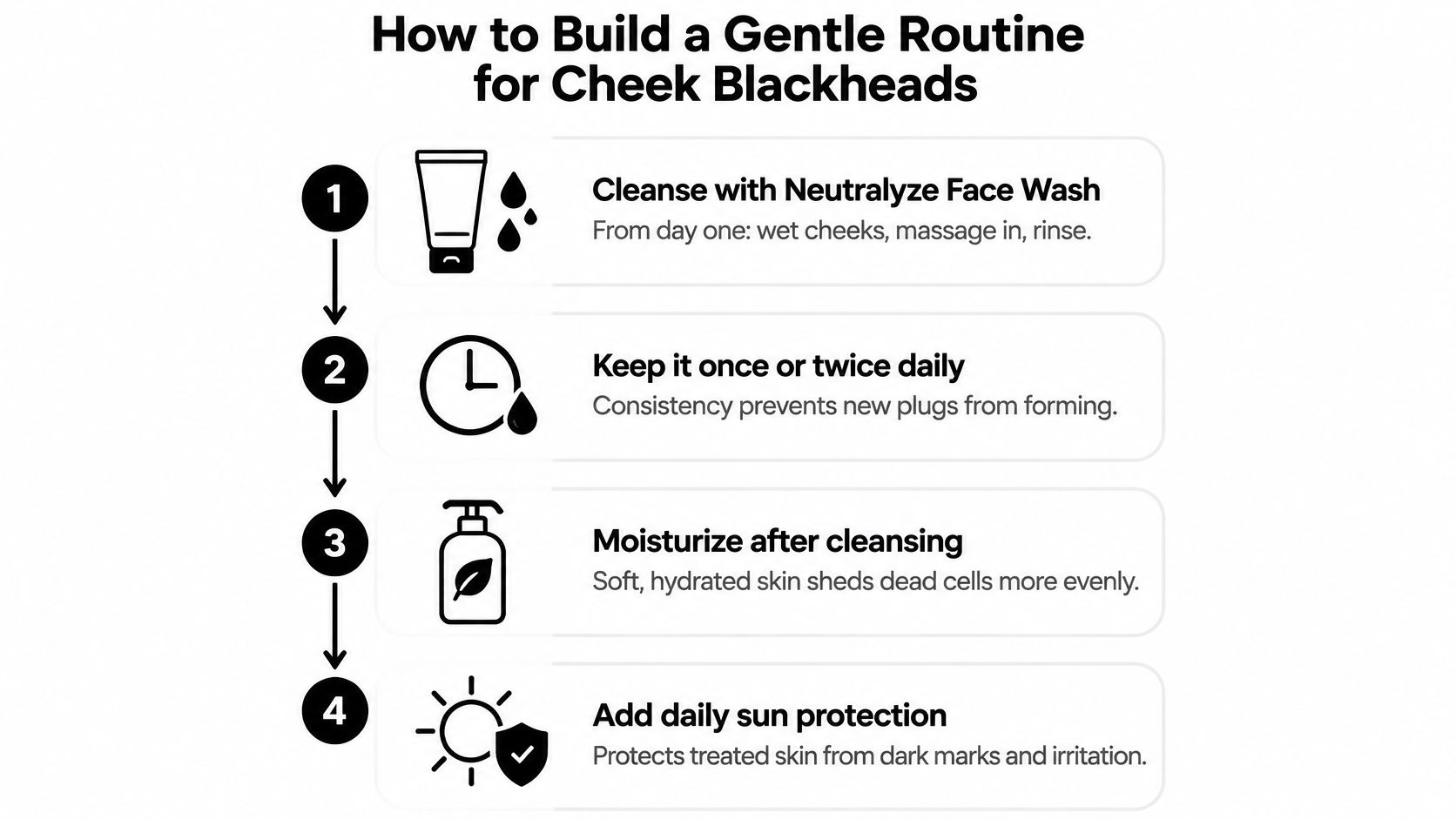
How to Build a Gentle Routine for Cheek Blackheads
Build the routine around tolerance first, then consistency. Neutralyze's clinically formulated cleanse, exfoliate, and renew approach uses salicylic acid for follicular buildup and mandelic acid for surface exfoliation, but introducing the whole routine at full frequency can still irritate skin.
The American Academy of Dermatology's treatment guidance identifies salicylic acid as particularly useful for unclogging pores in blackhead and whitehead acne. Mandelic acid serves a different role, supporting surface shedding and texture.
Introduce Each Step Deliberately
- Start with cleansing. With Neutralyze Face Wash 2.0, wet your skin, massage a small amount gently for 1–2 minutes, rinse thoroughly with warm water, and pat dry. Start once daily. Although its directions allow building to one to three uses daily as needed, more washing isn't the target; NHS acne guidance recommends washing no more than twice daily.
- Add moisture support without ignoring the actives. Neutralyze Renewal Complex is an acne moisturizer containing salicylic and mandelic acid, not a bland recovery cream. Introduce it after cleansing once the cleanser feels comfortable. If your cheeks are sensitive, use a plain non-comedogenic moisturizer while testing treatment products separately. Our guide to moisturizer after salicylic acid explains the sequencing.
- Consider the pad from week three, not automatically. If your skin remains comfortable and congestion persists, sweep the leave-on pad lightly over clean, dry cheeks at night. Don't scrub or rinse off the film, and avoid eyelids and broken skin. Because the treatment moisturizer already exfoliates, adding the pad increases total acid exposure.
- Finish the morning with sunscreen. Choose a non-comedogenic sunscreen you can wear consistently. It's a protection step, not another exfoliating treatment.
Introduction Schedule for the First Eight Weeks
| Phase | Frequency | What to Use | What to Watch |
|---|---|---|---|
| Days 1–3 patch test | Once daily on a small area | Cleanser only as the new treatment | Stinging, redness, or itching |
| Weeks 1–2 | Cleanse once daily initially, up to twice if comfortable; moisturize nightly | Cleanser and a separately introduced moisturizer | Dryness or peeling |
| Weeks 3–4 | Pad nightly only if tolerated; every other day if sensitive | Cleanser, pad, and moisturizer, with reduced active layering if needed | Comfort and fewer new red bumps |
| Weeks 5–8 | Hold the tolerated frequency; don't increase automatically | The same tolerated steps | Fewer recurring plugs in the same area |
| After week 8 | Reassess | Continue or discuss a change with a dermatologist | Persistent or inflamed lesions |
This is a suggested introduction schedule, not a requirement to reach every step by a deadline. Patch-test each new formulation separately before broader use.
Practical rule: Introduce one new leave-on treatment at a time. Comfortable skin is a reason to maintain the routine, not an obligation to increase it.
The Cochrane review of topical acne treatments characterizes salicylic acid evidence as limited and low-certainty. That's a reason to assess your own response carefully, not assume that combining acids guarantees faster clearing.
Fixing Irritation, Picking and Other Setbacks
The most common wrong turn is squeezing or scrubbing harder because the dots remain visible. The American Academy of Dermatology's breakout guide specifically warns that scrubbing blackheads can worsen acne. Mechanical force doesn't solve recurring follicular blockage and can leave an injured spot more noticeable than the original dot.
Match the Change to the Symptom
Setbacks, Likely Causes and the Next Move
| Symptom | Likely Cause | What to Change |
|---|---|---|
| Stinging or burning after application | Acid on irritated skin or excessive frequency | Pause treatment; restart only after skin settles, at a lower frequency |
| Peeling or tight dryness | Too many active layers or overly frequent use | Reduce to every other day and use a plain moisturizer |
| New tender red bumps | Inflamed acne or a folliculitis look-alike | Stop extraction and seek dermatologist advice |
| Dots unchanged after three weeks | Too early to judge, or the dots aren't blackheads | Keep a comfortable routine steady through the evaluation window |
| Squeezed spot turns dark or sore | Mechanical trauma | Stop picking, protect it from sun, and ask about professional extraction |
The FDA labeling for a 2% salicylic acid acne product starts with one daily application, allows increases only if needed, and advises reducing to once daily or every other day if bothersome dryness or peeling occurs. The same label warns that another topical acne medication can increase irritation and dryness. That framework isn't a reason to apply every acid-containing product at its maximum frequency.
Don't dismiss burning as proof that treatment is working, or assume every new inflamed bump is harmless purging. Pause the suspected irritant, simplify your routine, and seek advice if symptoms persist. Keep acids away from eyelids, raw areas, and recently squeezed skin.
Interrupt the Picking Cycle
If you examine your cheeks closely and then start squeezing, change the setting: put away extraction tools, step back from the magnifying mirror, and keep your hands occupied. Our practical guide on how to stop picking at pimples offers ways to break that habit.
A sore cheek isn't a sign that you need a stronger exfoliant. It's a reason to reassess what your skin can tolerate.
Don't use Neutralyze right after a chemical peel. Follow your treating clinician's recovery instructions before restarting exfoliating products. Persistent dryness despite reduced use, or painful, widespread, or scarring lesions, should change the plan from home experimentation to professional care.
Habits That Keep Cheeks Clear Between Flare-Ups
A treatment routine is easier to evaluate when the rest of your skincare stays predictable. You don't need to sterilize your surroundings or treat your cheeks as dirty; focus on reducing avoidable product buildup and friction.
- Check products that touch your cheek line. Choose makeup, sunscreen, and hair products labeled non-comedogenic. Pay attention to rich styling creams or conditioners that repeatedly sit against your cheeks. Change a suspected product individually so you can tell whether it makes a difference.
- Notice repeated contact. Wipe your phone according to its manufacturer's cleaning directions, change soiled pillowcases, and avoid resting your cheek in your palm. These habits reduce contact with oil, residue, and friction, but they aren't substitutes for acne treatment. Blackheads don't mean you're unhygienic.
- Make sun protection easy to repeat. Keep a sunscreen beside your morning skincare rather than saving it for beach days. Pick a texture you'll wear. Sun protection matters especially when you're also managing irritation or lingering post-acne discoloration.
- Keep a maintenance routine after improvement. Don't stop everything at the first clear-looking week, then restart aggressively when dots return. Maintain the simplest comfortable routine that helps control new plugs. Acne can persist into adulthood, as the American Academy of Dermatology's acne statistics overview explains, so maintenance isn't evidence that you've failed.
Maintenance mindset: Aim for fewer new plugs and comfortable skin, not the disappearance of every visible pore.
For a visual companion to everyday skincare habits:
Keep these habits stable while tracking your cheeks. Changing your sunscreen, makeup, cleanser, and treatments together makes it harder to identify what's helping or irritating.
Judging Progress and When to See a Dermatologist
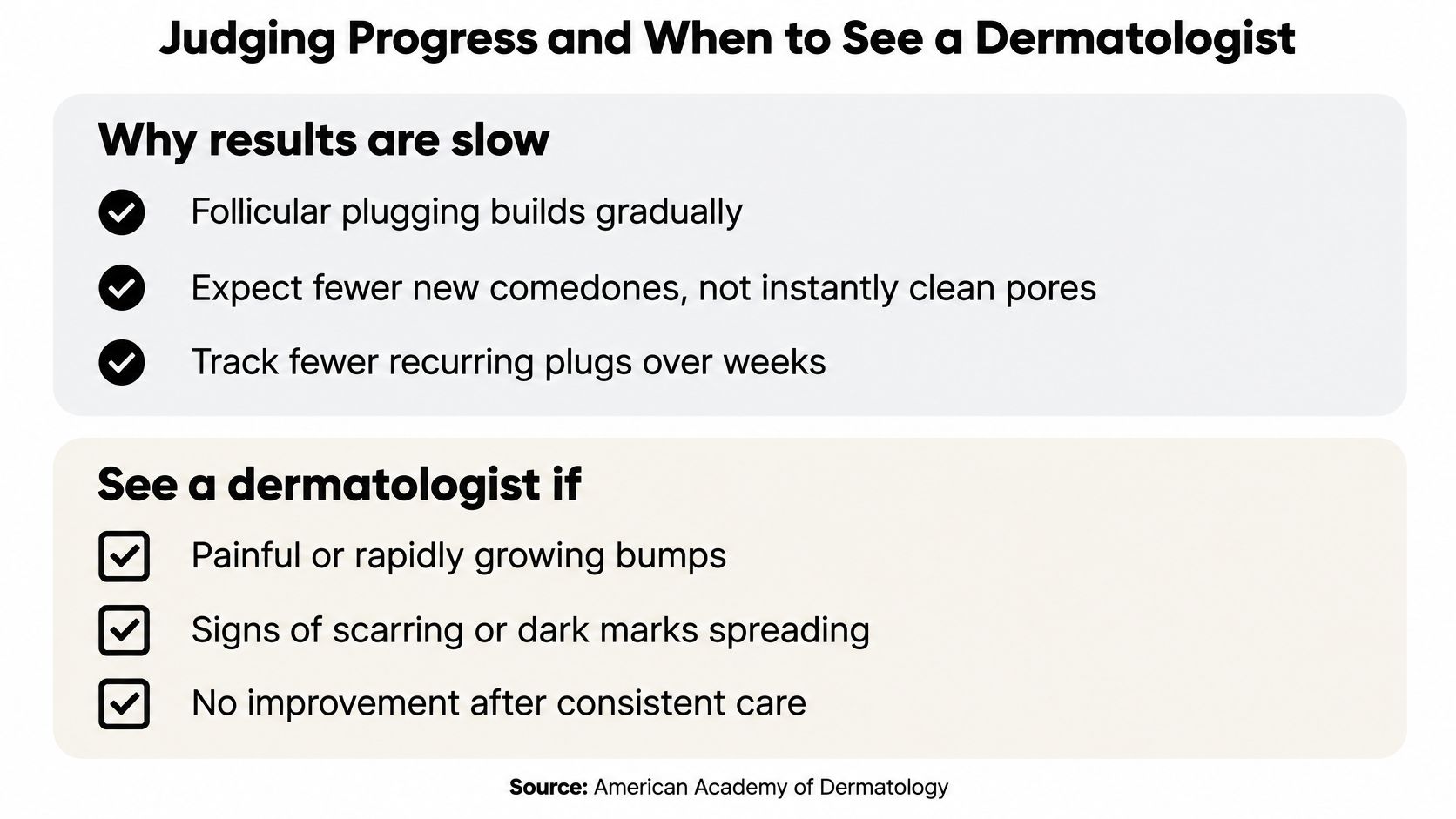
Begin with a record you can compare, not a memory of how your skin looked under different lighting. The American Academy of Dermatology advises allowing six to eight weeks before judging an acne product, alongside its updated acne-management guidance. That's an evaluation window, not a promise that every blackhead will disappear.
Follicular plugging develops gradually, and treatment needs repeated use to reduce retained cells and oil. The useful benchmark is fewer new comedones and fewer recurring plugs, rather than pores that look empty immediately after application.
Track the Same Cheek Area
Use this suggested photo schedule: baseline, then weeks two, four, six, and eight. These are practical check-in points, not validated diagnostic cutoffs.
- Choose a fixed zone. Select a recognizable patch of one cheek, using a freckle or another stable landmark to frame it consistently.
- Keep photographs comparable. Use the same room, lighting, camera distance, and angle. Turn off beauty filters and photograph clean skin without makeup.
- Count visible dark dots separately. Record only dots within that fixed zone. Don't expand the area on a day when you're worried about your skin.
- Log new red bumps independently. Note tenderness, swelling, or pus rather than combining all lesions into one total.
- Record comfort and routine changes. Write down burning, tightness, peeling, missed applications, sunscreen use, and any new products.
A simple note can read: Cheek area photographed; dot count recorded; no tenderness; mild tightness after treatment; no new product added. You don't need a complicated app.
At each check-in, ask whether your skin is comfortable, whether the same pores refill less often, and whether texture feels smoother. An early improvement may be less dryness, not fewer dots. Better tolerance makes consistent treatment possible, but it doesn't by itself prove that congestion is clearing.
Separate Active Plugs From Leftover Marks
An open comedone is material within a follicular opening. A post-acne mark is residual discoloration after a lesion or irritation has settled. If a spot is flat and no longer contains an obvious plug, continuing to squeeze or intensify acids may injure skin without addressing the discoloration.
Mark fading is a different treatment goal and can take longer than controlling active breakouts. Don't use the persistence of a brown or red mark as your only measure of whether pore treatment is working. Track marks separately from new plugs.
Use a Clear Decision Rule
Continue a tolerated routine if your comparison photos show gradually fewer plugs and your skin remains calm through the evaluation window. Don't add another acid merely because some pores remain visible.
Arrange a dermatologist visit if lesions are painful, spreading, inflamed, scarring, or unchanged despite consistent use. You don't need to finish a home trial before seeking help for significant symptoms. If you've already tried several over-the-counter and prescription treatments, bring a list of their names, duration of use, and side effects rather than starting another cycle without a plan.
A dermatologist can confirm whether the dots are open comedones, identify look-alikes, and discuss professional extraction or treatment beyond non-prescription products. Acne-related inflammation involves more than visible blockage, and tender lesions need a broader assessment than a blackhead routine alone.
A clinically formulated salicylic and mandelic acid system can support structured care for acne-prone skin, including people dealing with moderate-to-severe breakouts. It doesn't replace diagnosis or individualized treatment for persistent or severe acne.
Take one practical step today: record your start date, photograph the baseline cheek area, and set a reminder for your first formal reassessment. Let comparable observations, not a frustrating evening in front of the mirror, guide your next move.
Neutralyze offers a clinically formulated cleanse, exfoliate, and renew system built around salicylic acid and mandelic acid for acne-prone skin. Visit Neutralyze to explore the routine and choose a gradual starting approach for cheek blackheads, with skin comfort and consistent tracking at the center.