

Moisturizer After Salicylic Acid? Yes, and How to Do It
Quick Answer
Yes, apply moisturizer after salicylic acid once it has dried, choosing a fragrance-free, non-comedogenic formula. Moisturizer helps your skin retain water and tolerate an acne treatment that can otherwise leave it tight, flaky, or irritated. It doesn't cancel the acid's pore-clearing action. But if you're layering several acid products, hydration alone won't make an overly aggressive routine comfortable. Persistent burning or peeling means it's time to cut back.
If your acne routine leaves your skin tight, is the answer really more exfoliation? Often, the missing step is better moisture support, or less frequent acid use, rather than another treatment.
That distinction matters if you've already tried several over-the-counter products or prescriptions. A routine you can tolerate consistently is more useful than one you repeatedly stop because your skin hurts.
Why Salicylic Acid Leaves Skin Tight and How a Moisturizer Helps
Salicylic acid is an oil-soluble beta hydroxy acid, or BHA. It helps loosen the connections between dead skin cells, including those accumulating inside follicles.
That buildup is called follicular hyperkeratinization. When shed cells mix with sebum, they can obstruct pores and contribute to blackheads and whiteheads. Acne also involves inflammation and Cutibacterium acnes, formerly called P. acnes, so unclogging a pore addresses part of the process, not every cause of acne.
Pore Clearing and Water Retention Are Different Jobs
Think of salicylic acid as a broom loosening debris inside a pore. Moisturizer is more like a lid that helps keep water from escaping afterward. The analogy isn't exact, but it explains why the products can serve complementary purposes.
The outer skin layer, the stratum corneum, helps retain water. Excessive exfoliation can disturb that barrier, leaving skin tight, uncomfortable, or flaky. That isn't proof the treatment is working better.
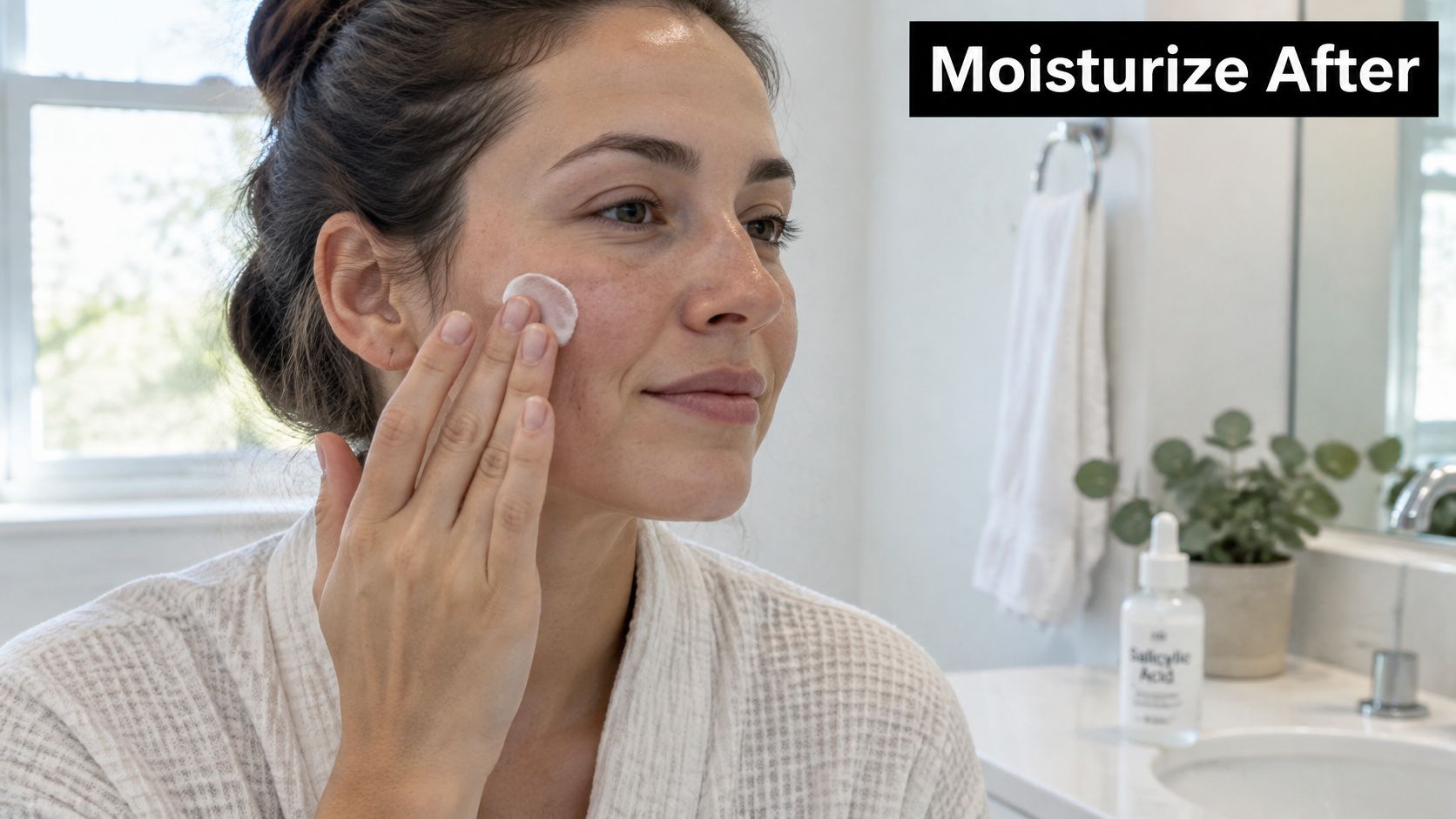
The American Academy of Dermatology recommends daily moisturizer for acne-prone skin because it can help people tolerate drying acne treatments, including salicylic acid.
One clinically formulated option is Neutralyze Renewal Complex, an acne moisturizer with time-released salicylic and mandelic acid. It's an active treatment moisturizer, not a cure or an acid-free recovery cream.
Practical rule: Judge an acne routine by whether your skin can tolerate it, not by how tight it feels afterward.
Oiliness and dehydration aren't opposites. You can have a shiny forehead and still lose too much water from your skin. Skipping moisturizer because you produce sebum doesn't necessarily solve that problem.
Using moisturizer after salicylic acid helps limit the discomfort that makes people abandon treatment. If you're using multiple acids, however, reducing the total treatment load may matter more than adding a heavier cream.
What to Look for in a Moisturizer for Acid Routines
Start with the label, then consider how the product fits into your routine. The best choice isn't automatically the richest cream or the product with the most acne ingredients.
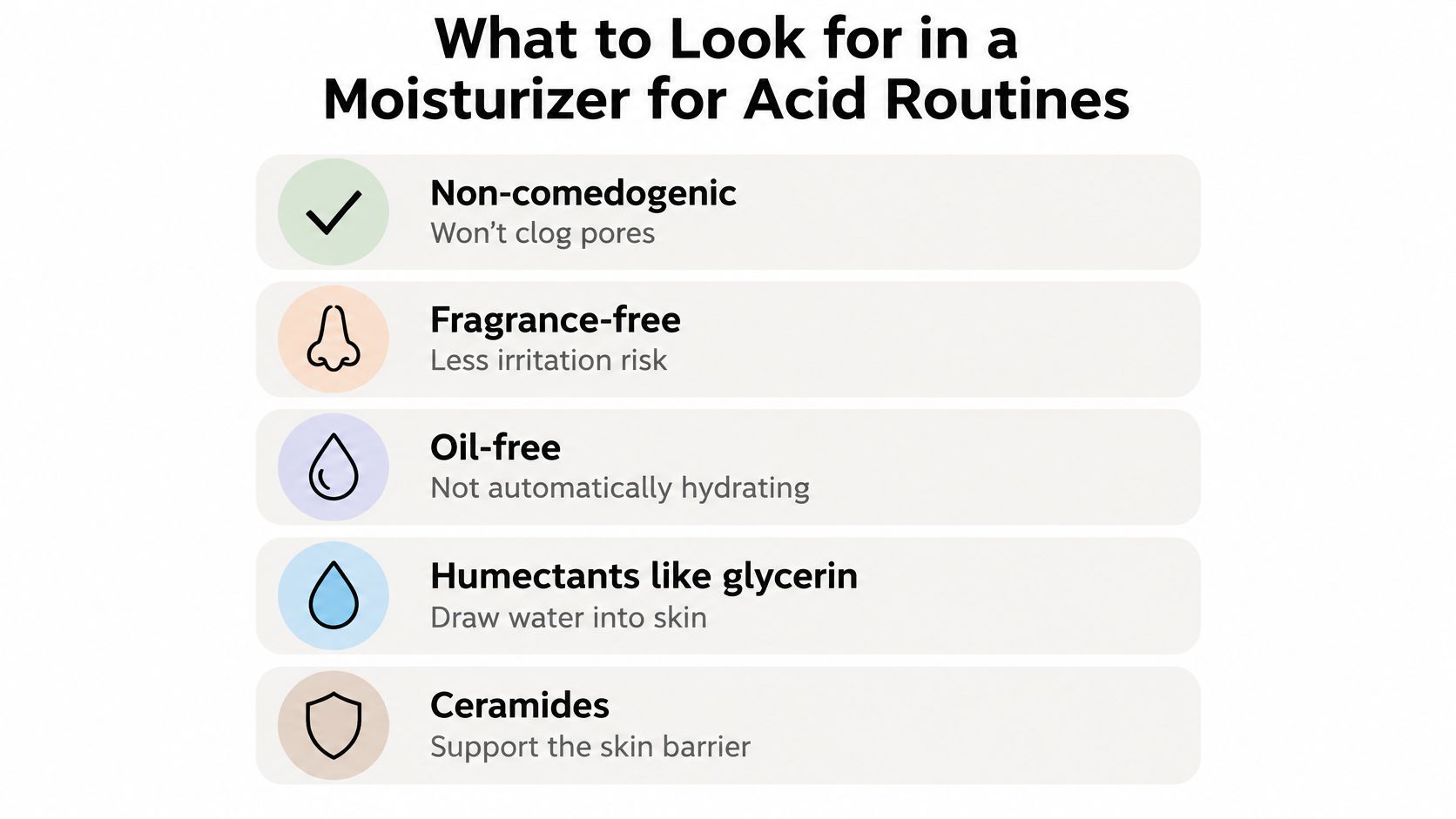
- Non-comedogenic: Look for wording indicating the product is formulated not to clog pores. It isn't a guarantee that every person will tolerate it.
- Fragrance-free: Avoid unnecessary fragrance when your skin is already reacting to treatment.
- Humectants: Glycerin and hyaluronic acid help bind water in the outer skin layer.
- Barrier-supportive ingredients: Emollients and lipids, including ceramides in some formulas, can help soften skin and reduce discomfort.
- An appropriate texture: A lightweight gel or lotion may feel better on oily skin. A cream may suit dry areas better.
Oil-Free Doesn't Automatically Mean Hydrating
An oil-free label tells you something about the formulation, but not whether it provides enough water-binding or softening ingredients for your skin. A gel can feel pleasant yet leave you tight. A lotion can provide better comfort without feeling greasy.
For a closer look at label language, use this guide to choosing a non-comedogenic moisturizer for acne-prone skin.
Separate Formulation Evidence From Product Promises
A randomized, vehicle-controlled maintenance study evaluated a moisturizer containing 1% salicylic acid over 12 weeks in people with mild-to-moderate acne and reported efficacy and safety. That supports the feasibility of combining moisturization with acid treatment in a formulation designed for tolerability.
It doesn't establish that every acid-containing moisturizer is interchangeable, or that adding one to an existing acid routine will be comfortable. It also doesn't establish results for moderate-to-severe acne.
A plain moisturizer and an acne-treatment moisturizer aren't the same tool. If your cleanser and pads already contain acids, check whether your moisturizer adds another exfoliating step.
Try a new moisturizer on a small area before applying it broadly. Check for discomfort, persistent tightness, or new bumps, and keep observing after you expand use. A brief trial can reveal immediate irritation, but it can't guarantee that a product won't contribute to breakouts later.
The Order to Layer Moisturizer With Your Acid Products
Where Each Product Goes in a Salicylic Acid Routine
| Product or step | Position | Wait before next step | Why it goes there |
|---|---|---|---|
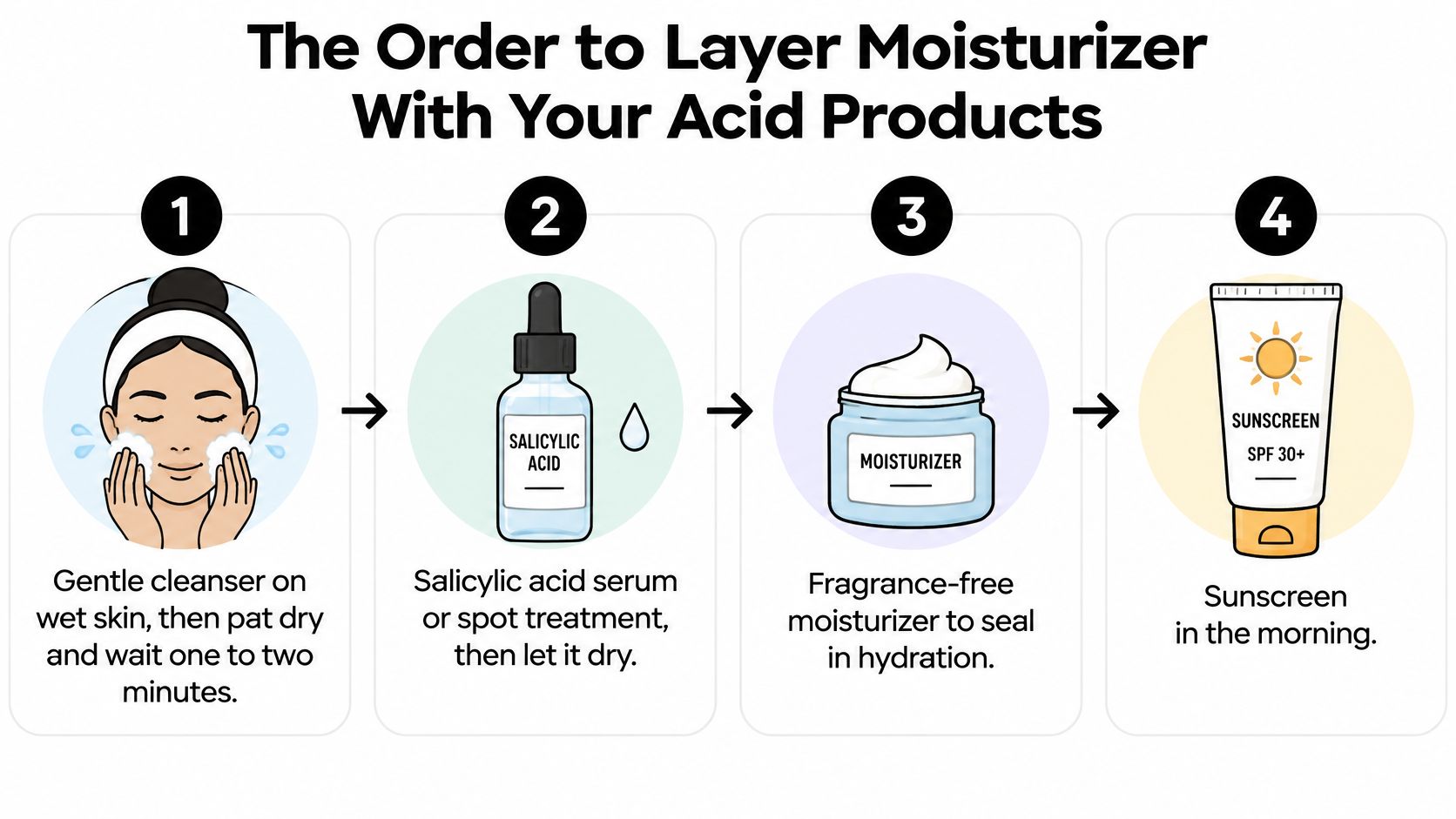
| Gentle cleanser | First, on wet skin, then rinse and pat dry | Until skin is fully dry | Removes surface oil and debris |
| Salicylic acid serum or spot treatment | Next, on clean, dry skin | Until it no longer feels wet | Allows an even treatment layer |
| Exfoliating pad | Replaces the serum that night | Let the leave-on product dry; don't rinse | Avoids adding a duplicate exfoliating step |
| Moisturizer | Last in the evening | Let it settle before applying makeup or other layers | Helps retain water and improve comfort |
| Sunscreen in the morning | Final skincare layer | Follow its application directions | Provides daytime ultraviolet protection |
Use Skin Dryness, Not a Stopwatch
Cleanse gently, rinse thoroughly, and pat rather than scrub. Before applying a leave-on acid, let your skin dry fully. Damp skin can make some treatments sting more, so rushing this step isn't helpful when you're already sensitive.
Apply your acid evenly without repeatedly coating the same area. If you're using a pad, treat it as the exfoliating step rather than an addition to a separate salicylic acid serum.
Then apply moisturizer once the treatment has dried. There isn't a universal, evidence-based waiting interval for every formulation. You don't need to leave uncomfortable skin bare while waiting for an arbitrary timer.
Can Moisturizer Go Before the Acid?
The straightforward order is cleanse, acid, moisturizer. A moisturizer applied first can change how a leave-on treatment spreads and contacts the skin, although the effect depends on the formulations.
Moisturizer applied afterward doesn't chemically neutralize salicylic acid or switch off its pore-clearing action. Its purpose is to support comfort and water retention, not remove the treatment.
Don't use a long waiting period as a test of toughness. If your skin burns, stop adding treatment.
If mild discomfort appears, apply your plain moisturizer promptly after the acid dries. If burning persists, rinse off the irritating product and pause it rather than trying to seal it under more skincare.
Finish your morning routine with sunscreen. This is particularly relevant when your routine also includes an alpha hydroxy acid such as mandelic acid. Use protective clothing and limit unnecessary sun exposure, too.
Build Up Your Routine Over Two Weeks
A cleanse, exfoliate, and renew system gives each product a role. It doesn't mean your skin must tolerate every step at full frequency immediately.
Neutralyze's clinically formulated system uses salicylic acid inside the pore and mandelic acid for surface exfoliation. Ingredient evidence supports that mechanism, but your response still depends on formulation, frequency, and the condition of your skin.
Introduce the System in Measured Stages
- Begin with a sensitivity test. Follow the initial three-day patch test on small affected areas. Introduce unfamiliar products separately so you can identify which one causes discomfort.
- Establish the cleansing step. Neutralyze Face Wash 2.0 contains 2% salicylic acid and 1% mandelic acid. Apply to wet skin, rinse, and let skin dry fully before other treatment steps.
- Add leave-on exfoliation cautiously. Neutralyze Exfoliating Pads are swiped over clean skin and aren't rinsed off. Don't pair a pad with an additional acid serum merely to speed results.
- Finish with hydration. An acid-containing renewal moisturizer can replace your usual moisturizer when tolerated, but it still counts toward your acid exposure. Use a plain, fragrance-free moisturizer instead when your skin needs a non-exfoliating option.
After the patch test, the brand's starting direction is once-daily use, with increases only if needed and tolerated. That isn't a requirement to increase, and reactive skin may need a slower introduction.
Let Comfort Set the Pace
During the rest of your first week, avoid increasing several products together. In the second week, consider increasing only the step you've already tolerated without persistent stinging, redness, or peeling.
More products in a system don't mean more applications are always better.
Use the guide to using salicylic acid for acne to keep application consistent. Expect gradual change rather than judging the routine by immediate dryness.
Treating active clogged pores is also different from fading flat post-acne marks. Persistent discoloration doesn't automatically mean you need stronger acne exfoliation, and indented scars need a different conversation with a clinician.
Telling Irritation From Normal Dryness and When to Cut Back
Brief tightness that resolves with moisturizer is different from burning, persistent redness, or visible peeling. Even mild symptoms deserve attention if they recur or get worse after each application.
The American Academy of Dermatology's acne-moisturizer guidance supports using an oil-free, non-comedogenic, or non-pore-clogging moisturizer to improve treatment tolerance. It doesn't mean moisturizer can make unlimited exfoliation safe.
Match the Response to the Symptom
Symptoms, Likely Causes and What to Do
| Symptom | Likely cause | What to do |
|---|---|---|
| Brief tightness after cleansing | Drying from cleansing or treatment | Moisturize and monitor; adjust if it keeps recurring |
| Brief stinging after an acid | Treatment sensitivity or an already irritated barrier | Don't increase frequency; reduce use if it repeats |
| Dryness, flaking, or peeling after repeated applications | Cumulative irritation, possibly from stacked acids | Reduce acid frequency and remove extra exfoliants |
| Persistent redness or burning | Irritation or a reaction to the formulation | Stop the irritating product; seek advice if it doesn't settle |
| Breakouts in familiar acne-prone areas | Ongoing acne or possible treatment-associated worsening | Monitor without assuming every breakout is purging |
| New breakouts in unfamiliar areas | Possible product intolerance or another cause | Reassess the new product and simplify the routine |
These are decision aids, not diagnoses. You can't identify the cause of every rash or breakout by location alone.
Peeling Is a Reason to Reduce Treatment
The FDA's over-the-counter acne-drug monograph advises reducing use to once daily or every other day when bothersome dryness or peeling occurs. If you're already using it less often and still reacting, pause rather than treating that schedule as a minimum.
Our guide to over-exfoliated skin and acne can help you recognize when adding treatment is making the routine harder to tolerate.
Purging isn't a reason to ignore pain. Breakouts in familiar areas can occur while acne treatment is being introduced, but burning, an itchy rash, and worsening redness shouldn't be dismissed as necessary adjustment.
Seek medical advice for severe burning, blistering, swelling, or symptoms that don't settle after stopping the product. Moderate-to-severe acne, painful deep lesions, scarring, or acne that isn't improving also warrants clinician guidance rather than repeated increases in acid use.
Special Cases for Body Acne and Large Treated Areas
Treating a patch of facial acne isn't the same as covering your chest and back with leave-on acid. The vehicle, meaning the formulation carrying the ingredient, and the condition of your barrier both affect tolerability.
Body care also makes it easier to overlook how much skin you're treating.
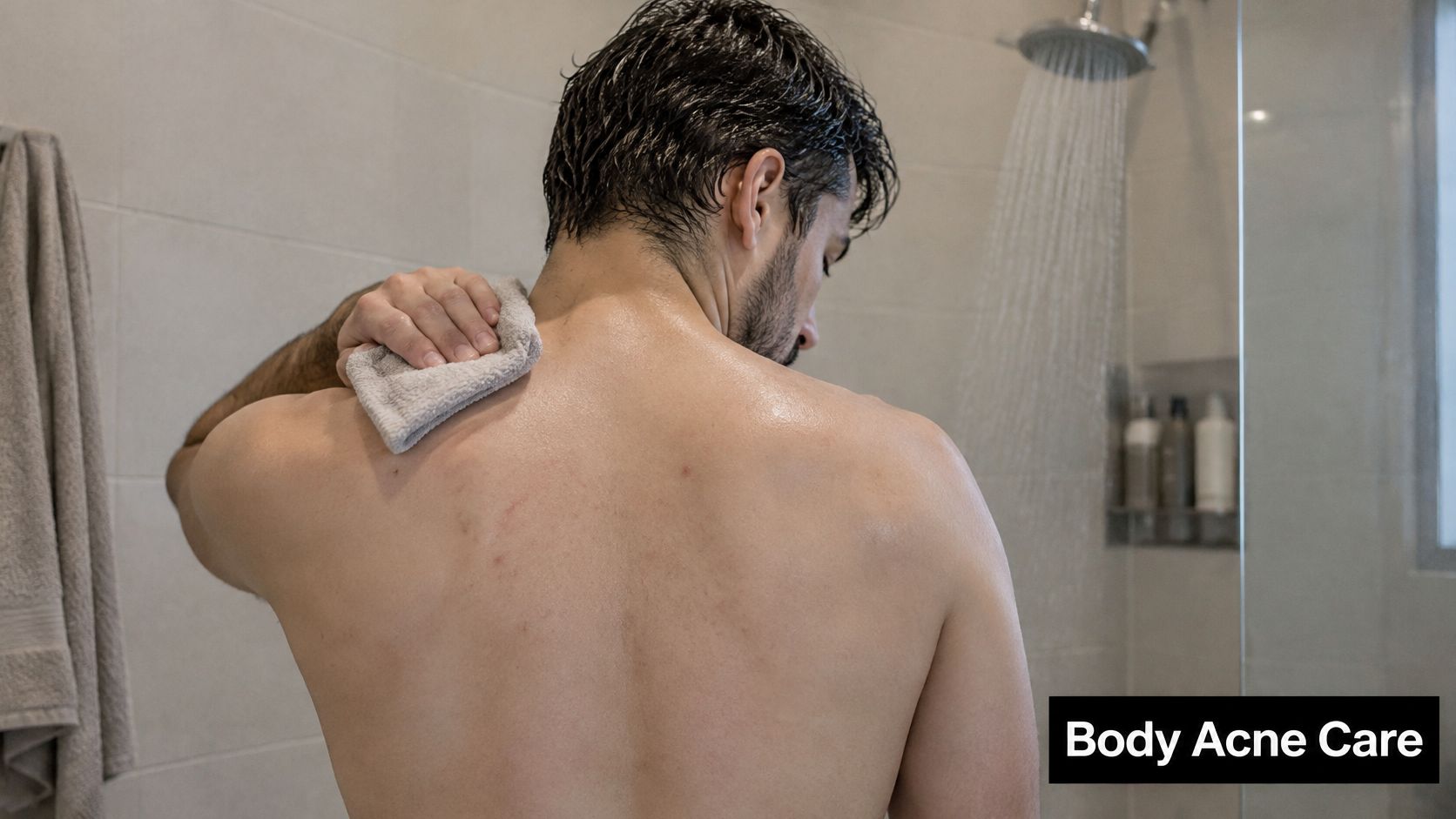
A peer-reviewed review of salicylic acid describes differences in irritation between conventional and more emollient formulations. It also discusses rare systemic toxicity, called salicylism, as a concern when salicylates are used extensively, particularly with an impaired skin barrier.
Check the Product, Area, and Barrier
- Identify what stays on your skin. A rinse-off cleanser, a leave-on pad, and an acne moisturizer create different exposures. An acid-containing moisturizer belongs in your treatment inventory, even if it feels hydrating.
- Consider the treatment area. Don't assume instructions for a small facial area authorize unrestricted application across the torso. For extensive body acne, ask a clinician how much skin to treat and which formulation to use. Working in sections doesn't automatically eliminate absorption risks.
- Respond to peeling promptly. Once a leave-on product dries, follow with a plain moisturizer if needed. If the treated area becomes flaky or uncomfortable, reduce or pause the acid instead of applying more over the same skin.
- Stop on damaged skin. Don't continue applying acid to raw, broken, or blistering areas. Large areas of burning or significant skin damage need medical assessment.
Before following any demonstration, check that its product type matches yours.
A moisturizer can improve comfort, but it doesn't make extensive acid application risk-free.
Keep body routines simple enough that you can inspect treated areas and notice a reaction. If you can't comfortably reach or see your back, avoid repeated passes that unintentionally coat the same patch.
This framework supports medical advice; it doesn't replace it for widespread lesions or damaged skin.
Confirm Your Moisturizer and Start the Acid Tonight
Moisturizer reduces the discomfort of acid treatment; it doesn't replace treatment or justify pushing through irritation.
Before tonight's application, decide whether your moisturizer is plain hydration or another active acne step. Renewal Complex can take the place of a regular moisturizer when tolerated, but its exfoliating ingredients still count.
For blackheads, whiteheads, and clogged pores, Neutralyze Exfoliating Pads offer a clinically formulated salicylic and mandelic acid option. Treat the pads as your leave-on exfoliating step rather than adding them to several competing acid products.
If you have moderate-to-severe acne, especially painful lesions or scarring, check with a clinician before stepping up your routine. Change one thing at a time so you can tell what helps and what irritates.
Neutralyze offers a clinically formulated salicylic and mandelic acid system for cleansing, exfoliating, and moisturizing acne-prone skin. Visit Neutralyze to review the Exfoliating Pads and build a routine that pairs pore-clearing treatment with thoughtful moisture support, one tolerable step at a time.