

Salicylic Acid and Retinol Together: Can You Layer Them?
Quick Answer
Yes, salicylic acid and retinol together can work, but don't apply both on the same night at first. Start one active, build tolerance for a few weeks, then add the second slowly on separate nights or mornings. That spacing gives you pore-clearing benefits from both without stacking dryness, peeling, and burning on skin that hasn't adapted yet.
You're standing at the sink with two products you bought for good reasons, wondering if layering them will clear you faster or just leave you red by Friday. That's the right question to ask before you apply either one. The answer isn't about a dangerous clash. It's about total irritation load, and how much your barrier can handle right now.
Whether Salicylic Acid and Retinol Can Share a Routine
Salicylic acid and retinol together make sense on paper, because both clear clogged pores through different routes. The catch is tolerability, and that depends on frequency, product type, and the current state of your barrier. Stack two turnover-driving actives on skin that has adapted to neither, and the irritation can outrun what your barrier repairs overnight.
Plan your routine around contact time. A rinse-off cleanser touches your face briefly before washing down the drain. A leave-on acid sits on skin and keeps working for hours. Same ingredient, very different dose, and that difference explains why some pairings feel easy while others end in peeling.
Four Workable Patterns
| Routine pattern | Same night? | Schedule | Best fit |
|---|---|---|---|
| Separate nights | No | Salicylic on selected mornings, retinol on non-consecutive nights | Anyone starting both actives for the first time |
| Alternate days | No | Salicylic one day, retinol the next | Sensitive or dry skin |
| Same-night layering | Yes | Salicylic, then retinol after skin is fully dry, moisturizer last | Experienced retinol users with tolerant skin |
| Cleanser-only salicylic | Yes | Rinse-off salicylic cleanser in the morning, retinol at night | Lower exposure when leave-on acids are avoided |
The cleanser-only row is the gentlest entry point if you're new here. Neutralyze Face Wash fits that slot: 2% salicylic acid and 1% mandelic acid, no retinol, and it cleanses without stripping. You massage it in, rinse it off, and the retinoid you apply later that night isn't sitting on top of another leave-on active.
Practical rule: Pick one starting pattern, run it for a few weeks, and only then decide whether you need a second active at all.
Skin that stays calm enough to keep going is the true test, so judge the pairing over weeks rather than by night three. A routine you can repeat beats an intense one you quit. Consistency is what gives either ingredient the time it needs to change how pores behave.
How Each Active Clears a Clogged Pore
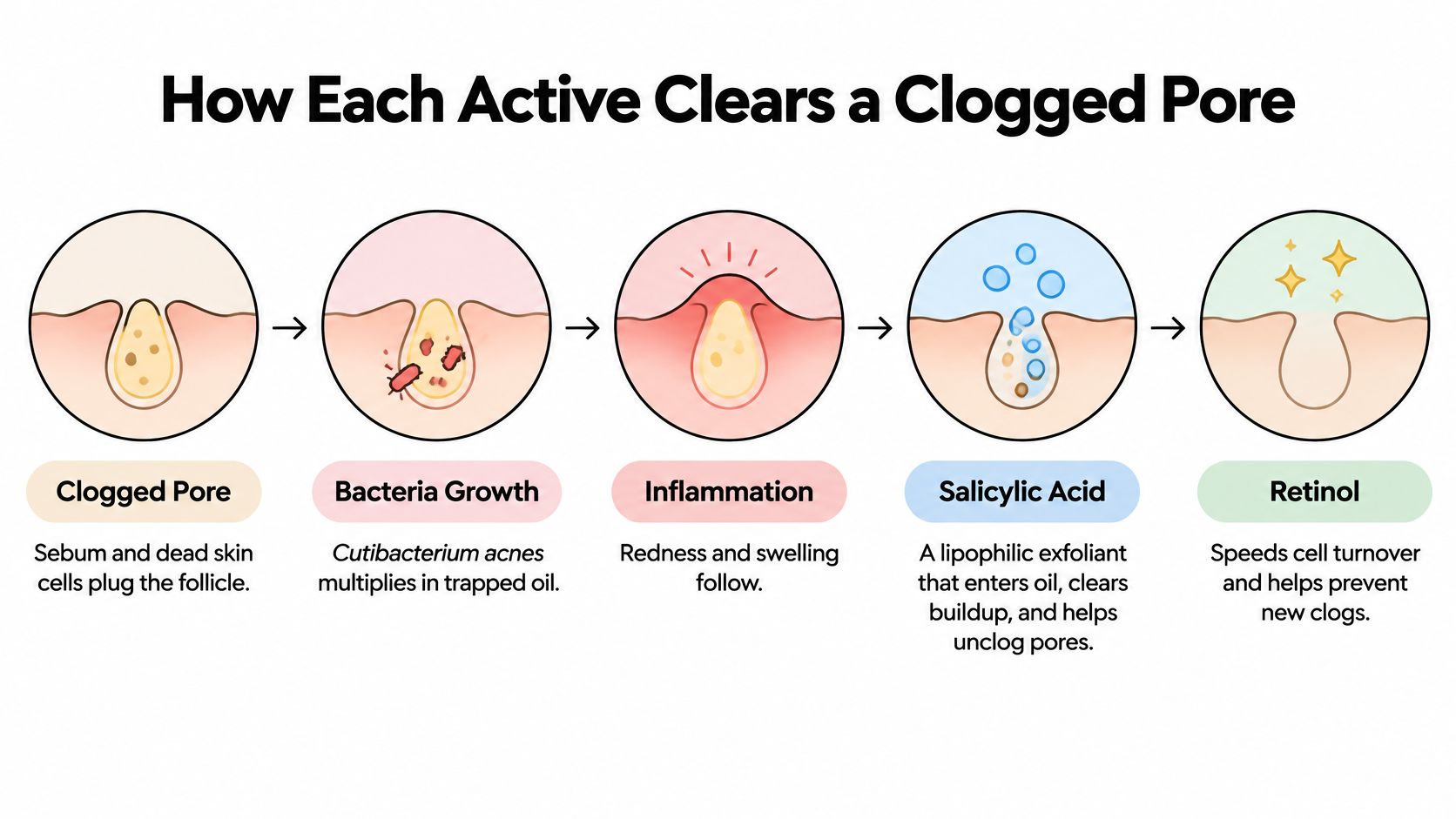
Say one pore on your chin is about to become a breakout. Your oil gland keeps making sebum, but shed skin cells inside the follicle aren't clearing normally. They stick together, mix with oil, and form a plug. That's follicular hyperkeratinization in plain terms, cells building up where they should have shed.
Once that plug traps oil, Cutibacterium acnes multiplies in the low-oxygen space. Your immune system responds, and inflammation follows. A quiet blackhead can become a red, tender bump, even though the first problem was a clog.
What Salicylic Acid Does Inside the Plug
Salicylic acid is a lipophilic beta-hydroxy acid, which means it mixes with oil instead of sitting only on watery skin surfaces. The American Academy of Dermatology guide to adult acne describes salicylic acid as an ingredient that unclogs pores and exfoliates, while retinoids unclog pores, reduce inflammation, and help prevent new lesions. Inside a sebum-rich follicle, salicylic acid helps loosen corneocyte cohesion, the bonds holding dead cells together, and remove keratinous material that's already packed in.
For a closer look at that pore-level action, see what salicylic acid does to acne. In short, it works on the plug that's already there.
What Retinol Changes Over Time
Retinol works differently. Your skin converts it into active retinoid metabolites that normalize abnormal follicular keratinization. Instead of mainly dissolving today's plug, retinol changes how cells line the follicle so fewer sticky plugs form in the first place. It also supports reduction of inflammation over weeks, not overnight.
Here's the analogy to keep. Salicylic acid clears the drain. Retinol changes how the pipe is lined so it clogs less often.
Both actives act on keratin inside the follicle, so combined use adds exfoliation and irritation rather than canceling either ingredient out.
Before you choose a schedule, sort what you're seeing. Mostly blackheads and whiteheads points to plugged pores leading the problem. Mostly red, inflamed bumps means prevention and inflammation matter more. That sorting tells you which active should lead, and which one, if any, you add later.
What the Clinical Evidence Shows So Far
It's easy to assume two proven acne ingredients must work twice as well together. The evidence doesn't say that, and the two ingredients don't carry identical proof. The American Academy of Dermatology acne guidelines recommend topical retinoids because they help unclog pores and reduce inflammation, while salicylic acid receives a conditional recommendation because its supporting evidence is more limited.
That distinction matters. Retinoids sit closer to the core of most acne routines. Salicylic acid is a useful supporting active for clogged pores, but you shouldn't expect the same depth of evidence behind it.
Reading the 2016 Combination Study
A 12-week randomized, evaluator-blinded study published in 2016 tested a topical formulation containing 1% salicylic acid and retinol alongside a 445/630-nanometer light-therapy mask in people aged 12 to 35 with mild-to-moderate facial acne, across Fitzpatrick skin types I to VI, according to the 2016 study report.
- Inflammatory lesions: The combination plus light improved 22.7%, compared with 24.4% for the light mask alone and 17.2% for 2.5% benzoyl peroxide.
- Noninflammatory lesions: The combination improved 4.8%, compared with 19.5% for the light mask and 6.3% for benzoyl peroxide.
- Global assessment: Investigator Global Acne Assessment improved 13.9% with the combination, versus 19.0% for the light mask alone and 4.7% for benzoyl peroxide.
Those numbers should slow down any hype. The combination didn't beat the light mask alone on those endpoints, and because salicylic acid and retinol were part of a broader light-based regimen, the study cannot isolate what the pair itself did. It was generally well tolerated, which supports historical clinical use together, but tolerability inside a set protocol isn't the same as layering two strong leave-on products at home.
The fair takeaway is narrow. This pairing is studied and workable with a protocol, but no evidence here shows it beats a single well-chosen active used consistently.
Check Exclusions and Pick Your Starting Pattern
There is no universal safe or unsafe verdict here. Each person needs a screen first, then a schedule, because the same two actives can sit comfortably on one face and sting on another depending on dose, product type, and barrier status.
Pause and Ask a Clinician First
- Teenagers: Get clinician-specific guidance before using retinoids.
- Pregnant or trying to conceive: Don't start a retinoid without medical advice.
- Eczema, a damaged barrier, or highly reactive or rosacea-prone skin: Your tolerance threshold is lower, and irritation can escalate quickly.
- Already using a prescription retinoid or benzoyl peroxide: Adding another active changes your total load.
- Taking oral prescription skin medication: Ask your doctor before adding new exfoliating products.
Your barrier works like a budget. Every active you add spends from the same reserve, and two spending at once drains it faster than one.
For everyone outside that list, tolerability depends more on formulation, dose, frequency, and barrier support than on the pairing itself. A 12-week study in 40 participants with Fitzpatrick skin types I to VI evaluated retinol paired with site-specific salicylic-acid delivery for moderate-to-severe acne and reported no erythema by week 12, no edema, and no significant itching, burning, tingling, or stinging, according to the PubMed study record.
Hold that result loosely. The sample was small and the delivery system was specific, so a drugstore serum layered under your own retinol may not behave the same way. Retinoid adverse effects still include dryness, burning, erythema, exfoliation, peeling, and pain, and reduced frequency plus emollient use can help mitigate them.
Pick Your Pattern
If no exclusion applies, choose conservatively. Separate nights suit a standard routine. Alternate days suit sensitive or dry skin. Same-night layering is reserved for experienced retinol users whose skin is already calm and tolerant.
Whatever you pick, patch-test new products, add only one active at a time, and begin retinol two nights weekly. Don't apply salicylic acid to visibly irritated or peeling skin.
If you'd rather care for breakout-prone skin without retinol while you work through this screen, the Neutralyze routine (Face Wash, Exfoliating Pads and Renewal Complex) runs on DuoClear, a 2% salicylic acid plus 1% mandelic acid system, with no retinoid involved.
Build a Separate-Night Schedule Week by Week
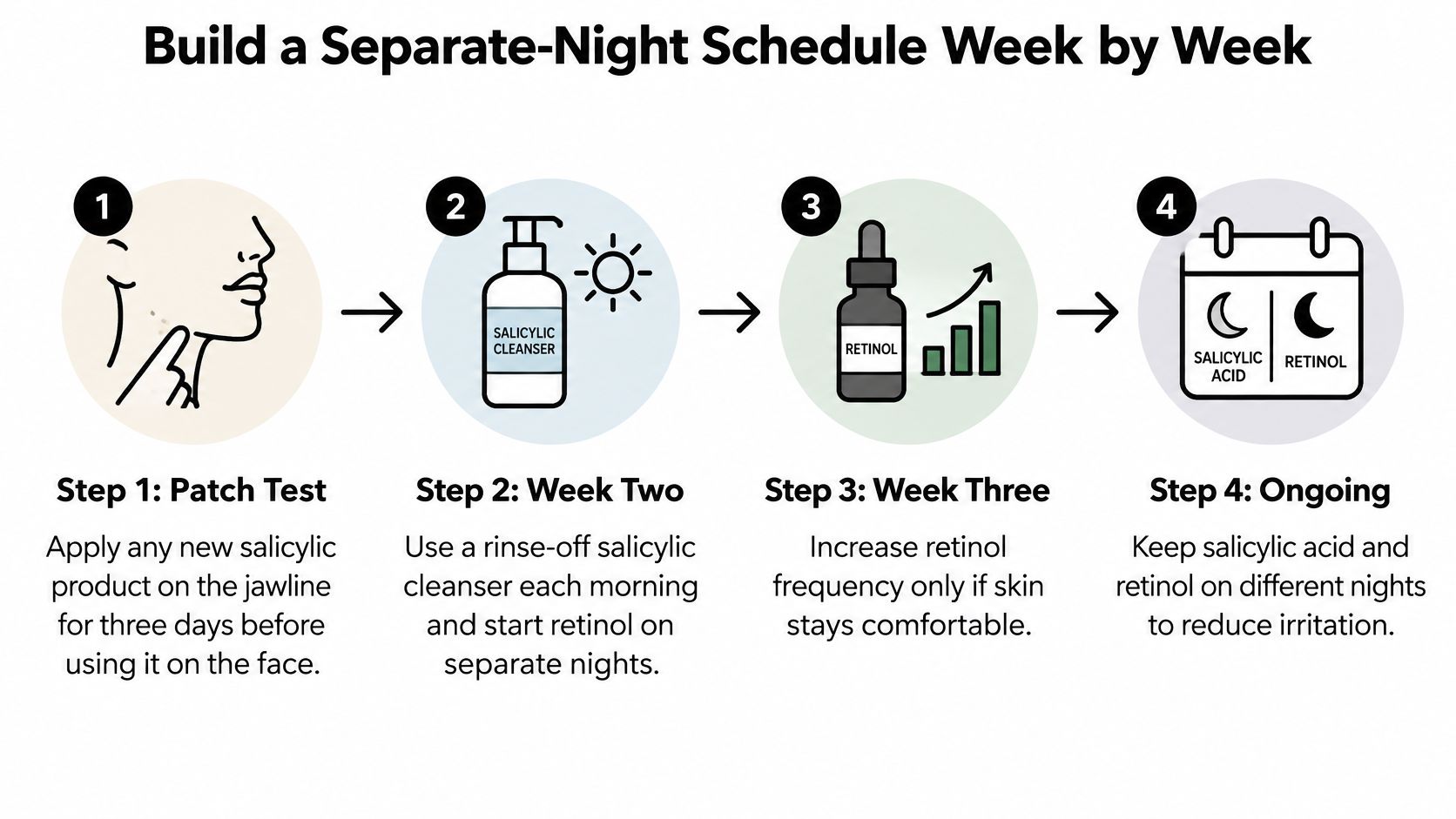
A gradual ramp does two jobs. It lets your barrier adapt, and it tells you which product caused a problem if one appears. If you start both at full strength on Monday and you're peeling by Thursday, you've learned nothing useful.
The Four Steps
- Patch test first: Apply any new salicylic product on your jawline for three days before using it on your full face. After that 3-day patch test, our Face Wash, Exfoliating Pads and Renewal Complex are used once a day, then built up if needed.
- Week two: Use a rinse-off salicylic cleanser each morning and add retinol on two non-consecutive nights. Don't use a leave-on acid such as a pad or serum on any retinol night.
- Week three: Move to three retinol nights only if your skin is calm, with no persistent burning or stinging.
- Week four onward: Keep up to three retinol nights and the same morning cleanse. Apply retinol to fully dry skin, then a bland moisturizer.
We recommend not using Neutralyze at the same time of day as benzoyl peroxide, retinol or prescription tretinoin, and consulting a dermatologist first. That timing rule is exactly why the rinse-off morning cleanse works in this schedule. Your salicylic step is finished hours before retinol goes on.
| Week | Retinol nights | Salicylic use | Watch for |
|---|---|---|---|
| Week 1 | None; patch test only | Patch test on jawline for 3 days | Redness, itching or swelling at the test spot |
| Week 2 | 2 non-consecutive nights | Rinse-off cleanse each morning; no leave-on acid on retinol nights | Dryness or mild tightness |
| Week 3 | 3 non-consecutive nights if calm | Same as week 2 | Persistent burning or stinging |
| Week 4 onward | Up to 3 nights | Same as week 2 | Flaking that lasts beyond the morning |
Apply a broad-spectrum sunscreen every morning. Retinoid use and exfoliation can increase photosensitivity concerns, and unprotected sun exposure can also darken post-acne marks you're trying to fade.
Keep a simple log of nights, sensations, and skin changes. Memory is unreliable at week six, and a log turns guessing into evidence you can act on.
Calming Burning, Peeling and Dryness Without Quitting
A gradual start is how controlled routines are designed, not just a cautious habit. In a 2024 split-face trial, 37 adults with mild-to-moderate acne used salicylic acid with graduated retinol and azelaic acid over 12 weeks, and 21 of the 37 completed the study. That completion number keeps its irritation findings thin, and it cannot show the routine beats benzoyl peroxide. Its graduated design is still the useful lesson for home use.
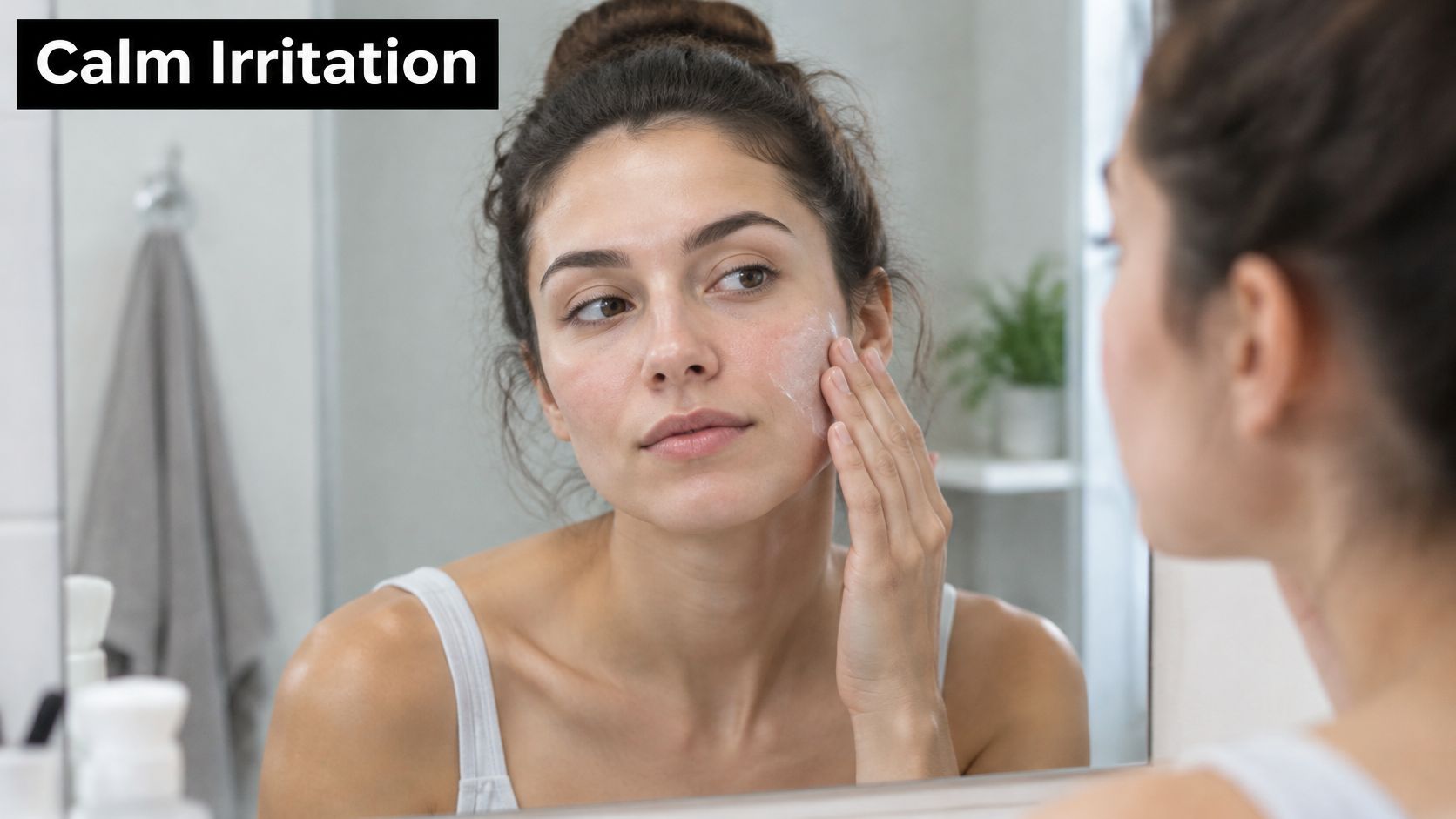
Most setbacks follow a pattern you can read. Stinging within minutes often means an active went onto damp or freshly irritated skin. Wait until skin is fully dry next time, and use less product. Dryness and flaking after two or three days usually means frequency climbed too fast, so move one active to alternate nights.
Persistent redness and burning is a stronger signal. Pause retinol for one to two weeks, keep cleansing gentle, and moisturize until your skin feels normal again. Peeling near the eyes and lips often means product migrated or you applied too much where skin is thin, so buffer those spots with moisturizer first and keep actives away from them.
A rash or swelling lasting beyond a few days is a different category. Reactions like that sit outside ordinary irritation, so the right move is to stop both actives and see a clinician rather than wait it out. If your barrier feels raw in general, how to repair a damaged skin barrier covers the recovery basics.
Moisturizer applied before or after actives reduces the load, since it limits how aggressively product reaches irritated skin. Neutralyze Renewal Complex, a salicylic and mandelic acid moisturizer, or your usual moisturizer goes on after skin is dry as the final step. For very sensitive skin, a 1% mandelic acid step is a gentler starting point than a 20% glycolic one.
How Long Before Results Show Up
Give this routine the same window researchers used. The 12-week trial described earlier is a fair benchmark for your own decision, because that is the span needed to measure lesion changes against a defined baseline. Skin responds on that slower rhythm, and two people using the same two actives can still land at different endpoints because frequency and barrier status shape the pace.
What Early Weeks Usually Mean
In weeks one to three, redness, dryness, and tightness usually signal irritation. Treat that as feedback about frequency, and hold your schedule steady while your barrier settles. Calm skin is your permission to continue.
Once skin stays comfortable, look across roughly eight to twelve weeks for fewer new blackheads, whiteheads, and inflamed bumps. A rough weekly count in consistent lighting tells you more than a daily mirror check, which mostly tracks your mood.
Separate active breakouts from post-acne marks when you count. A clogged pore can clear while the dark or red mark it left behind fades much more slowly, sometimes over several months of consistent care and daily sunscreen. If you lump them together, a routine that is preventing new lesions can look like it is failing.
If breakouts aren't improving by twelve weeks on a routine you can tolerate, or irritation keeps returning at low frequency, book a clinician visit instead of buying something stronger.
Start With One Active and Check Your Skin
Everything so far comes down to one decision: which single active goes on your face tonight. Pick the one that matches your main concern. Salicylic acid suits clogged pores, blackheads, and oily skin because it works inside the pore itself. Retinol suits texture, uneven tone, and longer-term cell turnover. Starting both at once leaves you unable to tell which one caused a reaction, so one variable at a time is the rule.
Before that first application, patch test the new product on a small area for a few days, then begin at the lowest frequency your schedule allows. Calm skin is your green light to keep going and eventually add the second active on a separate night. Persistent burning is your signal to pull back.
If retinol feels like one step too many right now, Neutralyze Exfoliating Pads combine 2% salicylic acid with 1% mandelic acid in a dual-textured leave-on pad, so the salicylic acid works inside the pore while the mandelic acid smooths the surface.