

How to Repair Damaged Skin Barrier: A Practical Guide
To get a damaged skin barrier back on track, you need to hit the reset button on your skincare routine. This means shelving the harsh, active ingredients for a while and getting back to basics: gentle cleansing, serious hydration with restorative ingredients, and non-negotiable sun protection. This simple, focused approach gives your skin the breathing room it needs to heal itself, calming down the redness, dryness, and irritation over time.
What a Damaged Skin Barrier Really Means
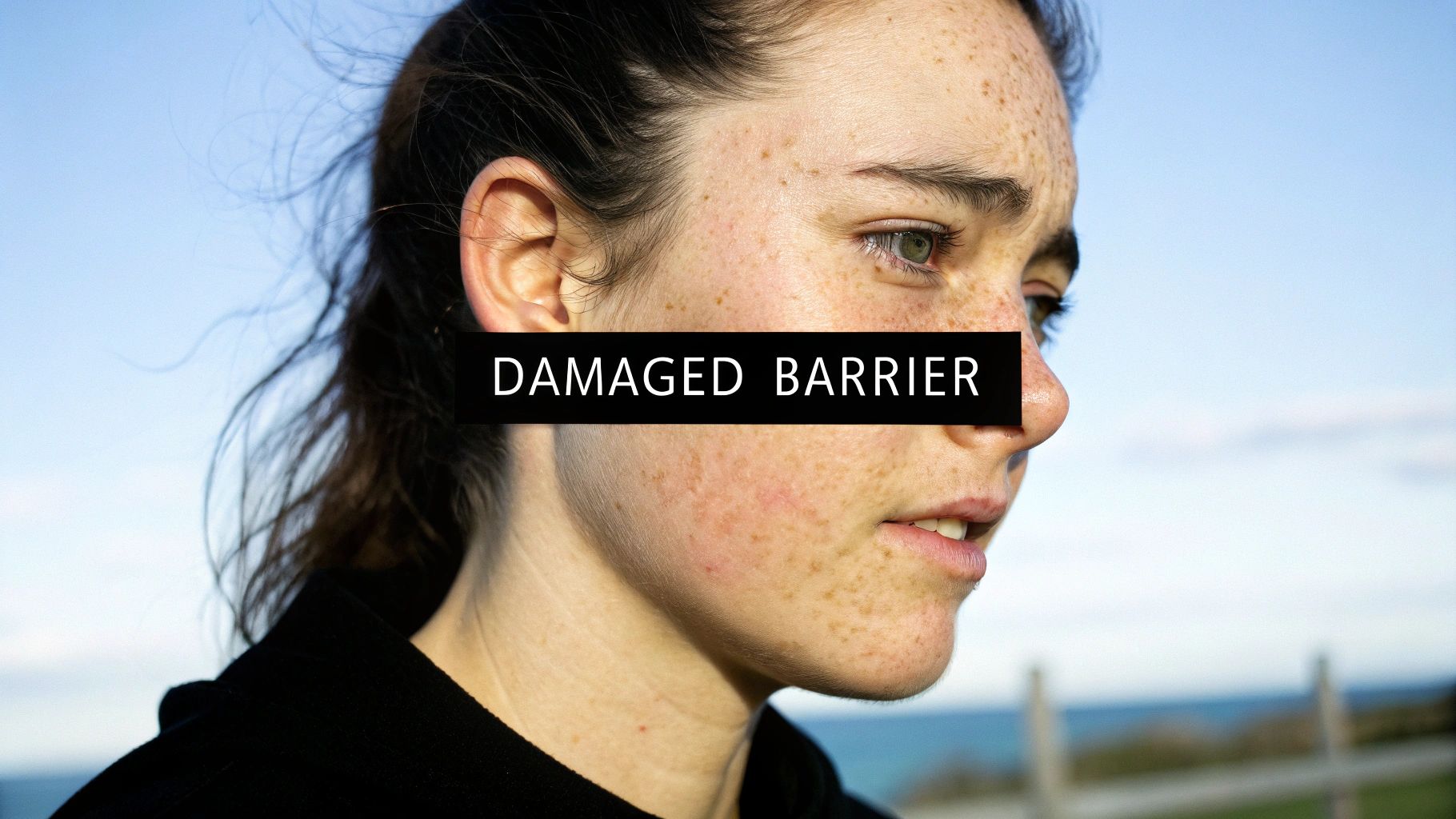
I like to think of the skin barrier as a bouncer for your face. This outermost layer, called the stratum corneum, has two critical jobs: it locks in all the good stuff (like water) to keep your skin plump and hydrated, and it keeps out all the bad stuff (like irritants, pollution, and bacteria).
Picture a brick wall. The skin cells are the bricks, and they’re held together by a lipid “mortar” made up of ceramides, cholesterol, and fatty acids. When that wall is solid and well-maintained, your skin is happy—it’s calm, hydrated, and can handle whatever the day throws at it. But when that wall starts to crumble, chaos isn't far behind.
The Telltale Signs of a Compromised Barrier
A damaged barrier can't do its job properly. This creates a state of chronic irritation and sensitivity. Suddenly, products that your skin used to love might start to sting or cause redness. You might also notice your skin feels constantly tight and parched, no matter how much moisturizer you slather on.
It’s usually pretty obvious when your barrier is calling for help. Here’s what to look for:
- Increased sensitivity or a stinging sensation when you apply products.
- Persistent redness or blotchy patches that just won't fade.
- Dryness, flakiness, or a rough texture when you touch your skin.
- A feeling of tightness, even right after you’ve moisturized.
- An uptick in acne breakouts, often driven by inflammation.
If this sounds familiar, you're not alone. This is an incredibly common issue. For people with conditions like eczema or psoriasis, keeping the barrier healthy is a constant battle. In the United States, about 31.6 million people have some form of eczema, which really drives home how vital barrier repair is.
The science is clear: when the barrier is compromised, it can’t hold onto water, leading directly to the dryness and irritation you feel. You can dive deeper into the statistics and their impact over at the National Eczema Association.
Sometimes it's helpful to see the differences side-by-side. Here’s a quick rundown of what you should be seeing versus what you might be experiencing.
Healthy vs Damaged Skin Barrier At a Glance
| Symptom | Healthy Skin Barrier | Damaged Skin Barrier |
|---|---|---|
| Feel & Texture | Smooth, soft, and supple | Rough, flaky, or tight |
| Appearance | Even-toned, calm, and radiant | Red, blotchy, and dull |
| Hydration | Feels hydrated and plump | Looks and feels dehydrated or dry |
| Product Reaction | Products absorb well without issue | Products may sting, burn, or tingle |
| Resilience | Bounces back from minor irritants | Becomes easily inflamed or irritated |
| Breakouts | Infrequent and manageable | More frequent or inflamed breakouts |
This table makes it easy to spot where your skin currently stands. If you’re checking more boxes in the “Damaged” column, it's a clear signal to start a barrier repair routine.
Common Culprits Behind Barrier Damage
So, how did your skin’s security system get breached in the first place? More often than not, the culprit is lurking in our own daily routines.
Over-exfoliating is a big one. Going too hard with harsh physical scrubs or high-strength chemical acids literally strips away those essential lipids that hold your barrier together.
The most common reason for barrier impairment I see in my practice is the overuse of active ingredients. People get excited and pile on too many products at once, which overwhelms the skin and compromises its natural defenses.
But it’s not just about products. Environmental factors like pollution and UV exposure chip away at your barrier over time. Even simple things like washing your face with water that’s too hot or dealing with high levels of stress can weaken your skin’s defenses.
For those with acne, it can feel like a frustrating cycle. You use strong treatments to clear breakouts, but those same treatments damage the barrier, which in turn leads to more inflammation and—you guessed it—more breakouts. This is exactly why understanding how to support your skin with the right ingredients is so important.
Crafting Your Barrier-Repair Skincare Routine
Think of this as a "skincare diet" for your stressed-out skin. The goal is to strip everything back to the essentials, focusing purely on healing. That means hitting pause on all the harsh stuff—no strong retinoids, no physical scrubs, and definitely no high-strength exfoliating acids for now. Simplicity is your new best friend.
Your entire routine should be built around three non-negotiables. First, a gentle, pH-balanced cleanser that cleans without stripping away your natural oils. Second, a deeply hydrating moisturizer loaded with restorative ingredients to rebuild the "mortar" holding your skin cells together. And finally, a broad-spectrum mineral sunscreen to shield your vulnerable skin from UV rays, which are a major barrier-wrecker.
These three simple steps will be the foundation of your routine, both morning and night.
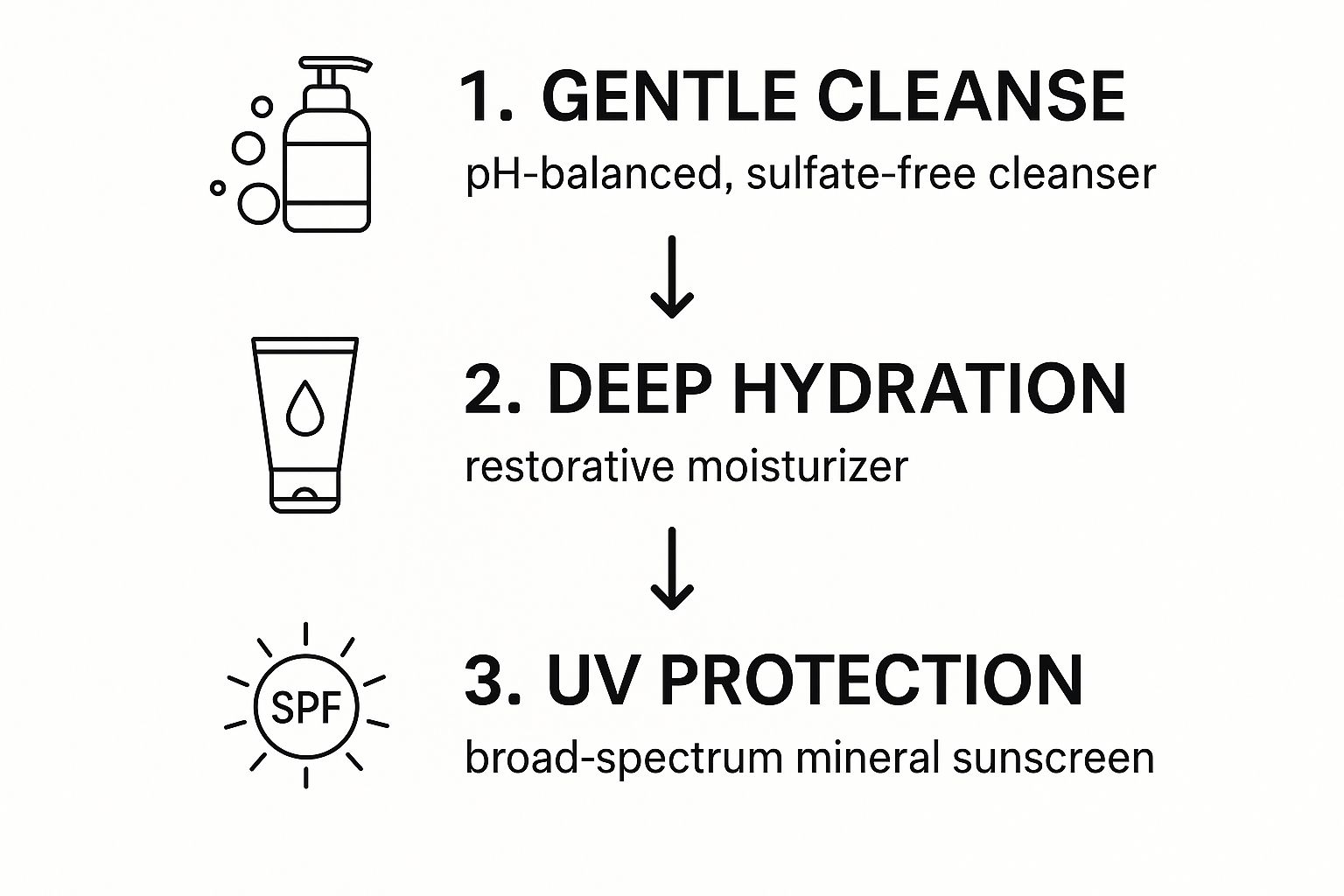
This visual guide really nails the essential flow. By sticking to this simple, repeatable process, you give your skin the consistent, gentle support it needs to heal without getting overwhelmed by too many products or steps.
Your Morning Barrier Repair Ritual
The morning is all about protection. After a night of recovery, your job is to hydrate your skin and defend it against whatever the day throws at it.
- Gentle Cleanse: Start with a splash of lukewarm water. If you feel like you need a bit more, use just a tiny amount of a creamy, sulfate-free cleanser.
- Hydrating Moisturizer: While your skin is still a little damp—this is key for locking in moisture—apply a generous layer of your barrier-supportive moisturizer.
- Sunscreen: This is the most important part of your morning. Apply a mineral-based, broad-spectrum sunscreen with at least SPF 30. Mineral formulas with zinc oxide are usually much kinder to compromised skin.
If you're acne-prone, dialing back on "acne-fighting" products can feel wrong. But trust me on this: when the barrier is damaged, inflammation is a huge driver of breakouts. A simple, supportive routine actually calms that inflammation, which often clears up skin faster than an aggressive attack.
Your Evening Barrier Repair Ritual
At night, your skin's focus flips from defense to repair. Your evening routine is all about helping it along by cleansing away the day and packing in as much deep, sustained hydration as possible.
- Cleanse Thoroughly (But Gently): Use your cream or milk cleanser to wash off sunscreen, makeup, and the general grime of the day. No harsh rubbing—just gentle, circular motions.
- Moisturize Again: Apply another layer of your barrier-repair moisturizer. You can be really generous here since your skin will drink it up while you sleep. For an extra healing boost, try layering a thin coat of something like La Roche-Posay's Cicaplast Baume B5 over your moisturizer.
This simplified approach is everything. It removes all the potential troublemakers and floods your skin with the soothing, hydrating ingredients it’s crying out for. Be consistent, and you should start to see less redness, feel less tightness, and notice an all-around calmer complexion in just a few weeks.
The Best Ingredients for Skin Barrier Repair
If you really want to learn how to repair a damaged skin barrier, you've got to get comfortable with reading ingredient lists. This isn't about jumping on every new, trendy ingredient that pops up on social media. It's about giving your skin the fundamental building blocks it's crying out for.
Think of it like this: your skin barrier is a wall, and right now, it's got some holes in it. Your job is to supply the construction crew (your skin cells) with the best materials to patch it up. That means focusing on ingredients that hydrate, soothe, and replace the natural fats that have been stripped away.
The Holy Trinity of Barrier Repair
When your skin is in full-blown crisis mode, you can lean on three powerhouse ingredients that get the job done, time and time again. I've seen these work wonders for clients. They’re gentle enough for seriously compromised skin but powerful enough to make a real, visible difference.
- Ceramides: Honestly, these are the true MVPs. Ceramides are lipids (fats) that already make up over 50% of your skin's structure. They act like the mortar between your skin cell "bricks," keeping moisture locked in and irritants locked out.
- Hyaluronic Acid: You've probably heard of this one, and for good reason. It’s a hydration superstar, famous for its ability to hold up to 1,000 times its weight in water. It pulls moisture into your skin, giving it that immediate plump, dewy look while providing the deep hydration needed for healing.
- Niacinamide (Vitamin B3): This is the ultimate multitasker. Not only does niacinamide encourage your skin to produce more of its own ceramides (strengthening the barrier from the inside out), but it’s also a fantastic anti-inflammatory. That means it gets to work calming down the redness and sensitivity that come with a damaged barrier.
Finding a single product that combines these three can seriously speed up the healing process. They work together beautifully to bring your skin back into balance.
A common mistake I see is people throwing a dozen different products at their skin, hoping something will stick. The truth is, a single, well-formulated moisturizer with ceramides, hyaluronic acid, and niacinamide is often all you need to get back on track.
The Gentle Giant for Acne-Prone Skin: Mandelic Acid
Okay, so what if you're dealing with acne and a damaged barrier? This is where things get tricky. The usual go-to acne fighters like salicylic acid or benzoyl peroxide can be way too harsh, making the irritation even worse and slowing down the repair process.
This is where a gentler approach is non-negotiable.
Enter Mandelic Acid, an alpha-hydroxy acid (AHA) that comes from bitter almonds. What makes it so special is its molecular size—it’s larger than other AHAs like glycolic acid. This means it penetrates the skin much more slowly and evenly, which translates to far less irritation. It's a game-changer for sensitive, compromised skin.
This ingredient is a cornerstone of why Neutralyze formulations are so effective. By making Mandelic Acid the star of our acne-fighting systems, we provide a solution that encourages cell turnover and keeps pores clear without inflaming an already-stressed skin barrier. It gently exfoliates to prevent breakouts while respecting your skin’s primary need for healing and support.
It's a smart, strategic approach based on a deep understanding of skin science. At Neutralyze, we know you can't treat acne by creating more damage. Our formulas, centered around Mandelic Acid, allow you to address acne while actively supporting skin health, breaking that frustrating cycle for good.
Lifestyle Habits That Support Healthy Skin

As crucial as your skincare routine is, it's only half the battle. What you do every day—the food you eat, the water you drink, even how hot your shower is—has a massive impact on your skin's health. True barrier repair comes from the inside out and the outside in.
Think of it this way: your skincare is the dedicated crew fixing the cracks in a wall, but your lifestyle is the foundation that wall is built on. If the foundation is unstable, the patches will never hold. By tweaking a few daily habits, you can create an environment that not only speeds up healing but also builds skin that’s resilient for the long haul.
Nourish Your Skin from the Inside Out
Your skin barrier is largely made of lipids (fats), which are the "mortar" holding your skin cells together. The best way to support this structure is by giving your body the right building blocks through your diet.
Focus on foods packed with healthy fats, especially omega fatty acids. These are famous for their anti-inflammatory benefits and their role in fortifying skin cells.
- Fatty Fish: Salmon, mackerel, and sardines are loaded with omega-3s, which help calm down inflammation and keep skin supple.
- Avocados: A fantastic source of healthy monounsaturated fats and vitamin E, a powerful antioxidant that protects your skin.
- Nuts and Seeds: Walnuts and flaxseeds are excellent plant-based sources of the essential fatty acids your skin craves.
Don't forget to hydrate, either. When your body is dehydrated, your skin is one of the first places it shows. The entire repair process slows to a crawl. I always tell my clients to aim for 1.5 to 2 liters of water a day to keep everything functioning optimally.
Adjust Your Daily Environment
It's surprising how many common habits can unknowingly weaken your skin barrier over time. One of the biggest offenders? A long, scorching-hot shower. It might feel amazing, but that high heat melts away the protective lipids right off your skin, leaving it dry and vulnerable. Make a conscious switch to lukewarm water—your skin will thank you.
The air around you plays a role, too. Dry, centrally heated air in the winter is notorious for sucking moisture right out of your skin.
One of the easiest and most effective things you can do is run a humidifier in your bedroom at night. It adds moisture back into the air, preventing your skin from drying out while you sleep.
Be mindful of the fabrics that come into contact with your skin. Rough towels or scratchy sweaters can create friction and irritation. Whenever you can, choose soft, breathable fabrics like cotton for your clothes, towels, and pillowcases to minimize any physical stress on your healing skin.
Finally, you absolutely have to manage your stress. This isn't just fluffy advice; it's a critical part of figuring out how to repair a damaged skin barrier. High levels of cortisol (the stress hormone) kick off an inflammatory response throughout your body that directly weakens your skin's defenses. It can even trigger breakouts. Finding something that works for you—meditation, a walk outside, or just 15 minutes with a good book—can make a visible difference in your skin's health.
How to Reintroduce Actives Without Wrecking Your Progress
So, you’ve put in the work. After weeks of nurturing your skin with gentle, hydrating products, it finally feels comfortable, plump, and happy again. The redness is gone, the tightness has subsided, and that old bottle of retinol is calling your name.
I get it. The temptation to jump right back into your full-strength routine is huge. But hold on—this is where so many people accidentally send their skin right back to square one. Rushing this step is the fastest way to undo all that patient healing.
Think of this phase as a careful experiment. You need to introduce one thing at a time, watch closely for the results, and adjust based on what your skin is telling you. This isn’t just about getting back to your old routine; it’s about building a smarter one that won’t compromise your barrier in the future.
Start Low and Go Slow
This is the golden rule, and it's non-negotiable: reintroduce only one active ingredient at a time. If you try to add back your vitamin C, glycolic acid, and tretinoin all in the same week and your face freaks out, you'll have no idea which product was the problem.
Choose the one active that targets your biggest concern. Let's say you've been missing your retinoid for managing breakouts. Here's how to ease it back in:
- Go for a low frequency: Start by applying it just once or twice a week. Make sure those days aren't back-to-back.
- Try the "sandwich" method: To be extra cautious, apply a layer of moisturizer, let it sink in, then apply your retinoid, and follow up with another layer of moisturizer. This creates a buffer that can seriously minimize irritation.
- Watch and wait: Pay close attention to your skin for the next 48-72 hours. Are you seeing any new flushing, stinging, or flakiness?
If your skin is perfectly happy after a couple of weeks, you can slowly bump up the frequency to three times a week. This methodical pace gives your newly healed barrier the time it needs to acclimatize.
A huge mistake I see people make is thinking that just because their skin feels good, it’s ready for an all-out assault. A freshly repaired barrier is strong, but it's not invincible. Continue to treat it with the same respect you did during the healing process to build true, lasting resilience.
For those tackling acne, reintroducing a retinoid can sometimes cause a temporary flare-up. It's crucial to know if this is irritation or "purging." We break down the difference in our guide: Does Adapalene Cause Purging.
Learn to Read the Signals
Ultimately, this whole process is about becoming fluent in your skin's language. Some days, your skin might just feel a bit more sensitive. Maybe you didn't get enough sleep, you're stressed out, or the weather took a turn.
On those days, it is completely fine—in fact, it’s smart—to skip your active. Just focus on hydration and support.
This isn't about sticking to a rigid, unforgiving schedule. It's about building a flexible, intuitive routine that works for your skin in real time. Choosing balance over aggression is the real secret to keeping your skin barrier healthy and happy for the long haul.
Unpacking Skin Barrier Repair: Your Top Questions Answered
When you're trying to figure out how to repair a damaged skin barrier, a lot of questions pop up. It's totally normal. Getting straight, reliable answers is what will give you the confidence to stick with a new routine long enough to see it work. Let's dig into some of the most common questions I hear.
How Long Does This Actually Take?
This is the big one, and the honest answer is: it depends, but you need patience. You’ll likely feel a difference pretty quickly. That tight, irritated, angry feeling often calms down within the first 1-2 weeks of being consistent with a gentle, supportive routine.
But for a full-on, deep repair? You need to give it more time. Your skin’s natural turnover cycle is about 28 days, and that’s a good minimum to aim for. That's how long it takes for new, healthy skin cells to make their way to the surface and for your lipid barrier to really rebuild. If the damage is more significant—say, from years of over-scrubbing or a stubborn skin condition—you could be looking at a few months. The most important thing is not to give up if you don't see perfection in 30 days.
Can I Treat My Acne While My Barrier Is Healing?
Yes, you can and you should! This is probably the biggest source of confusion I see. People think they have to choose: either calm their skin or fight their breakouts. The reality is that a damaged barrier almost always makes acne worse because it drives up inflammation.
The trick is to be strategic. You have to temporarily shelve the really aggressive stuff, like high-percentage benzoyl peroxide or harsh scrubs. Instead, you need to find products that do both jobs at once—tackling acne gently while supporting your barrier. This is where ingredients like Mandelic Acid and Niacinamide really shine.
Neutralyze products are built around this exact philosophy. Our science-backed expertise in these key ingredients allows us to formulate products that reduce breakouts and calm inflammation without destroying your skin's moisture barrier, making them the ideal solution when you’re dealing with both issues at once.
Is a Damaged Barrier the Same Thing as Sensitive Skin?
Great question, because the symptoms—redness, stinging, reactivity—are often identical. Here’s the key difference: sensitive skin is generally a skin type you're born with. You're just naturally more prone to reactions.
A damaged barrier, however, is a temporary condition. It can happen to anyone, even people with oily, tough-as-nails skin. It's caused by external factors like too much exfoliation, a bad sunburn, or even stress. Your skin starts acting sensitive. The best part? Unlike a skin type, a damaged barrier is something you can completely fix with the right care.
At Neutralyze, we understand the science behind a healthy skin barrier. Our authority is built on harnessing the power of key ingredients like Mandelic Acid and Niacinamide to create formulas that clear acne while actively strengthening your skin. Stop the cycle of irritation and breakouts. Discover a smarter, gentler, and more effective solution for your skin at https://www.neutralyze.com.