

Glycolic Acid for Skin Texture: Realistic Results
Glycolic acid smooths superficial roughness, and it does so on a slower clock than most product marketing suggests. A daily 5% cream produced statistically significant texture and discoloration gains against a control in a randomized trial, while a 4% regimen used twice daily needed three weeks before electron microscopy showed the outer layer shedding differently.
You know the moment. The breakouts have finally calmed down, the redness has faded, and you run a fingertip across your forehead or jaw and it still feels like fine sandpaper. So you buy a glycolic acid toner, use it three nights in a row, wake up tight and stinging, and conclude the ingredient doesn't work for you. It might work fine. The dose, the pH and the schedule were just wrong.
Here's the honest picture for glycolic acid for skin texture: it is a surface treatment with a real, measurable effect on rough and flaky skin, a partial effect on pigment and clogged pores, and very little effect on pitted scars. Getting the result you want means matching the strength to your actual concern instead of buying the strongest thing on the shelf.
Glycolic Acid Strength and Texture Results at a Glance
Glycolic acid works on surface roughness. What changes between products is how much smoothing you get, how fast it arrives, and what it costs your barrier. Concentration, pH and frequency set all three, which is why a 5% drugstore cream and a 50% clinic peel share an ingredient name and behave nothing alike.
If the texture you're fighting comes with blackheads, congestion or active breakouts, a different pair of acids may suit you better. The Neutralyze Exfoliating Pads are dual-textured pads soaked in salicylic acid and mandelic acid, clinically formulated and fragrance-free, with no glycolic acid at all. The reasoning behind that choice comes later.
| Glycolic Acid Form | Strength and pH | Typical Use | Texture Result Reported | Irritation Risk |
|---|---|---|---|---|
| Daily cosmetic leave-on | 5-10% at pH 3.5-4.0 | Every day or several times weekly | Gradual smoothing of rough, dull surface over weeks | Low to moderate |
| Unneutralized daily cream (trial) | 5% | Daily facial use against a control cream | Significant gains in general texture and discoloration | Low to moderate; unneutralized, so a brief sting on application is expected |
| Twice-daily regimen (study) | 4% | Twice daily for three weeks | Outer-layer desmosome breakdown seen under electron microscopy | Moderate; raises sun sensitivity |
| Single professional peel (study) | 50% | Five-minute contact, weekly for four weeks | Significant reduction in rough texture and fine wrinkling across 41 volunteers | High; far stronger than cosmetic products |
| Professional peel series | 30-70%, escalating | Clinic-supervised sessions | About 55% roughness improvement at six months in a case series | High; barrier disruption and pigment risk |
The everyday end of that table is well characterized. Buffered daily products around 5-12% glycolic acid at roughly pH 3.5-4.0 have been associated with only marginal, temporary increases in water loss through the skin, while professional 30-70% peels produce a marked short-term barrier disruption, according to a review in Cosmetics.
What the trials actually measured
The most useful at-home evidence comes from a double-blind randomized trial in which a daily, unneutralized 5% glycolic-acid cream produced statistically significant improvements in general skin texture and discoloration compared with a control cream, evaluated on facial and neck photoaging (Dermatologic Surgery). That's a modest strength used consistently, not a dramatic strength used rarely.
Peel data runs higher and harder. In a double-blind, vehicle-controlled trial of 41 volunteers, a 50% glycolic acid application left on for five minutes once weekly for four weeks significantly reduced rough texture and fine wrinkling, with fewer solar keratoses and slight lightening of solar lentigines (Dermatologic Surgery). A 2024 case series reported that skin roughness improved by an average of 55% six months after five VoluDerm treatments followed by glycolic-acid peels escalating from 30% to 70% (National Library of Medicine).
Timelines differ as much as strengths. Leave-on products are judged in weeks. Peel series are judged in months. Most at-home routines live in the first two rows of that table, and that's exactly where they belong.
How Glycolic Acid Smooths Rough Skin Texture
Picture a wall with too many coats of old paint. Each coat is a layer of dead cells that should have shed weeks ago but stayed put, glued to its neighbors. The surface looks dull, feels uneven, and catches light in flat patches instead of reflecting it cleanly.
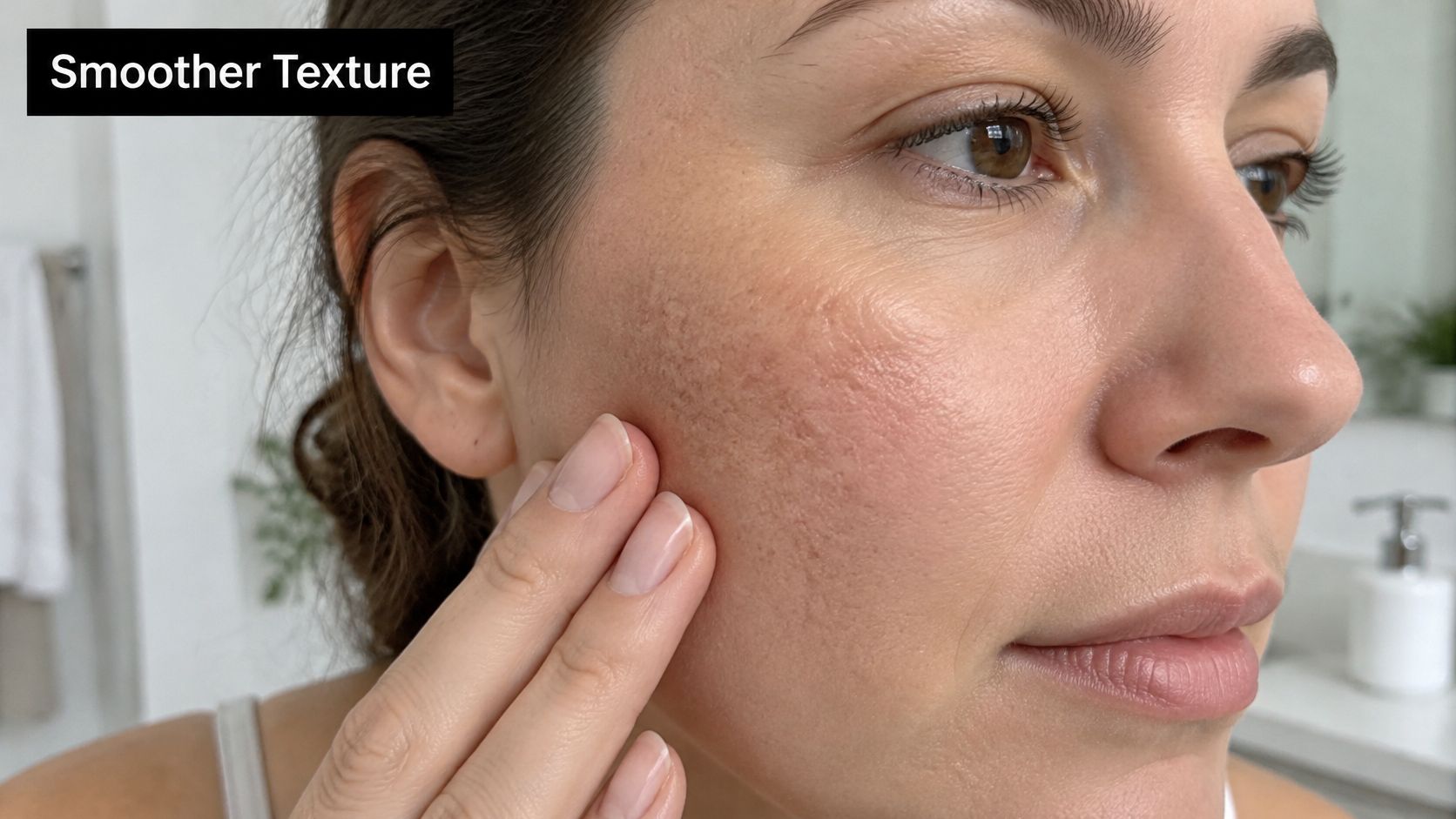
That glue has a name. The cells of your stratum corneum, the outermost layer, are held together by protein bonds called desmosomes. Glycolic acid at a low pH weakens those bonds, so the top layer releases on schedule instead of accumulating into a rough, flaky sheet.
What the microscope shows
A human volunteer study had participants apply 4% glycolic acid twice daily for three weeks. Electron microscopy afterward showed increased desmosomal breakdown and desquamation confined to the outer stratum disjunctum, while desmosomes in the deeper stratum compactum and the barrier structures stayed intact (Archives of Dermatological Research).
That last detail is the one worth remembering. Glycolic acid at a sensible strength doesn't strip your barrier indiscriminately. It edits the top layer and leaves the foundation alone.
There's a second mechanism underneath the first. Exfoliation changes how the surface sheds, and repeated use also shifts what the skin builds. In a human-skin-explant experiment, daily applications of glycolic-acid formulations adjusted to pH 4 at 8%, 10%, 15% and 25% increased total collagen at every concentration tested, with larger effects at the higher ones. A 15% gel produced a 77.0% increase in stratum-corneum thickness versus 62.8% for an equivalent cream, and at 25% treated samples showed significantly more corneocyte layers than untreated skin (PMC).
That video walkthrough covers the layering in practice.
A smoother surface also reads as a more even surface. Flatten the dead-cell buildup and light scatters across the skin instead of catching on ridges, which is why people often describe their tone as brighter before they can point to a single dark spot that faded.
Practical rule: A tingle that fades within a minute is normal. Stinging that builds, plus redness still there the next morning, means the dose is too strong for your skin right now. That is information, not a sign the product is working harder.
Matching Texture Concerns to Pores, Pigment or Scars
Before you buy anything, answer one question. When you touch the area, is the roughness surface scale, a field of clogged pores, a color difference, or a dent?
Those four problems have four different answers, and glycolic acid is a strong fit for only one of them.
| Concern | Likely Driver | What Glycolic Acid Can Do | Realistic Expectation |
|---|---|---|---|
| Rough, flaky surface | Corneocyte buildup in the outer layer | Speeds shedding of dead cells | Smoother feel within weeks of consistent use |
| Clogged pores and blackheads | Sebum and follicular hyperkeratinization | Exfoliates the surface, limited inside the pore | Partial improvement; pore-lining plugs respond better to a lipid-soluble acid |
| Flat dark marks after breakouts | Post-inflammatory pigment | Can soften tone with consistent use | Fading takes months; daily sunscreen is required |
| Depressed acne scars | Dermal tissue loss | Superficial smoothing only | Limited; dermatologist-directed treatment is needed |
| Active inflamed breakouts | C. acnes and inflammation in the follicle | Not a primary treatment and can add irritation | Control inflammation first with a dedicated acne product |
The mechanism behind row two explains the limit. Sebum production and follicular hyperkeratinization plug the pore from the inside, and Cutibacterium acnes (formerly P. acnes) feeds the inflammation that follows. A blackhead is an open plug sitting in that lining. Glycolic acid is water-soluble and works on the surface, so it reaches the opening of the pore and not much past it.
The three questions that sort it out
- Does the skin feel rough with nothing visible in it? That's surface scale, and it's the concern glycolic acid handles best.
- Are most of the bumps closed comedones or open blackheads? That's congestion. A lipid-soluble acid that gets into the pore lining serves you better.
- Are the marks flat and brown, or pink and raised? Flat brown marks are pigment and can soften slowly. Raised pink marks mean inflammation is still active and needs treating first.
One regulatory detail shapes what you'll find on shelves. The U.S. Food and Drug Administration identifies glycolic acid and lactic acid as the predominant alpha-hydroxy acids in cosmetic products, based on market surveys it ran from 1992-1996 and 1999-2000, and it notes that AHA use can increase sensitivity to ultraviolet radiation during application, with that sensitivity fading about a week after you stop (FDA guidance on AHA labeling). That matters here because irritation and sun exposure both worsen uneven tone, which can cancel out the exfoliation you paid for.
The decision rule is short. Mainly scale or flat dark marks, and glycolic acid is a reasonable candidate. Deep pitting, and you need a dermatologist rather than a stronger bottle. If congestion is your main issue, the fuller explanation of what blocks a pore is worth reading before you layer on another acid: what causes clogged pores.
How to Start Glycolic Acid Without Irritating Rough Skin
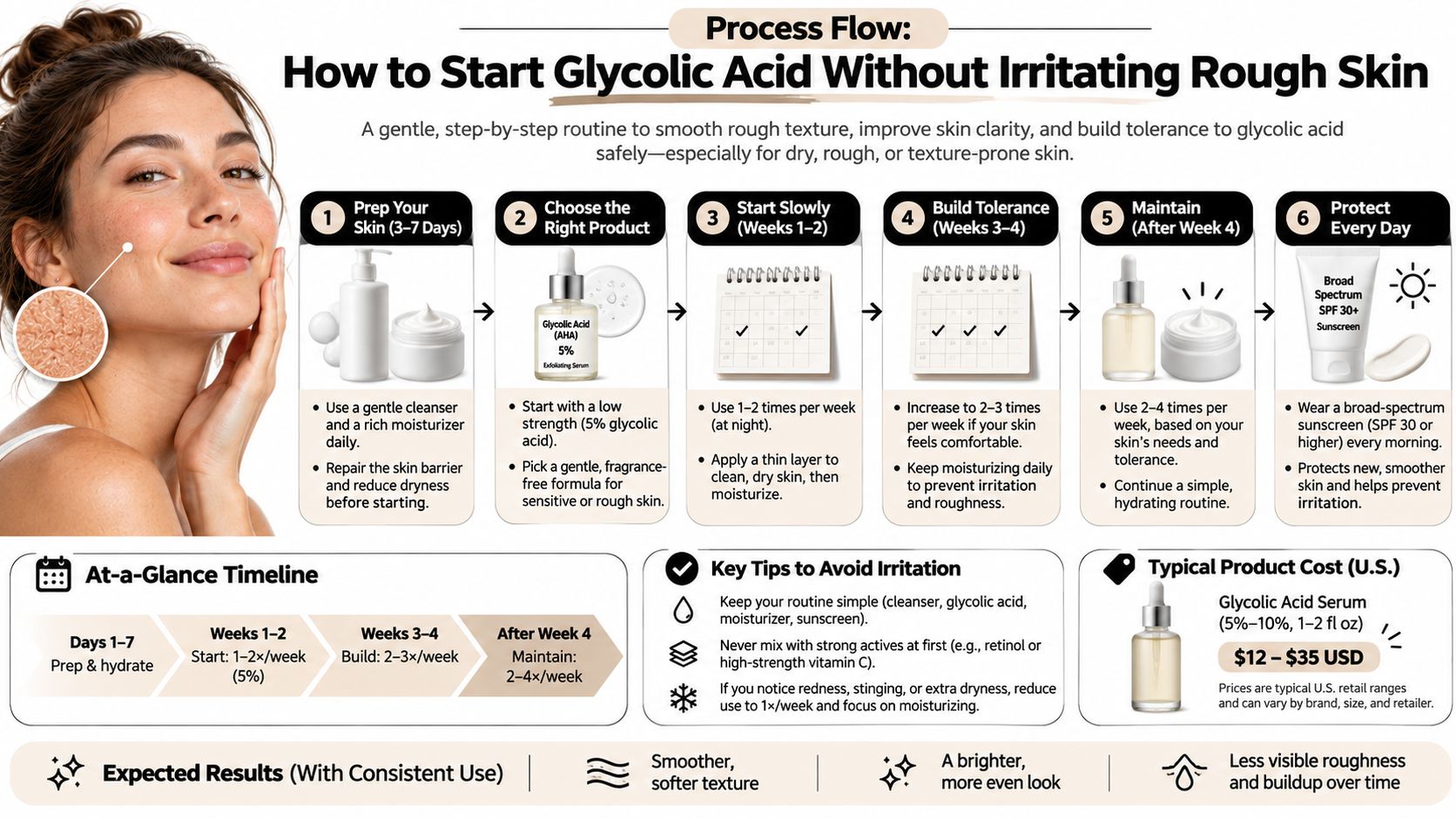
The sequence below is the difference between a routine you keep for six months and a bottle you abandon in three weeks. Each step has a reason attached.
- Patch test behind the jaw for three days. Apply a small amount to one area and leave it alone. Your jaw sees less sun than your cheek and reacts more like your face than your forearm does.
- Start at two or three nights a week with a leave-on strength of 5% or less. Frequency is the variable you control first, because it's easier to dial back than a concentration.
- Cleanse with a fragrance-free, non-acid cleanser, then rinse and pat dry. A clean, dry surface lets the acid contact your skin evenly, and keeping the cleanser acid-free stops you from stacking two exfoliants by accident.
- Apply a thin layer to intact skin only, steering around the eye area, any cuts, and anything inflamed or broken.
- Wait for the skin to be fully dry before adding anything else. Water on the surface drives the acid in faster and deeper, which is the opposite of gentle when you're starting out.
- Finish with a fragrance-free moisturizer. Barrier comfort on the nights between applications is what lets you keep going.
- Wear broad-spectrum sunscreen every morning and limit sun exposure while you use the product and for about a week afterward. This isn't a conservative extra. Evidence reviewed by the FDA found that glycolic acid concentrations as low as 4% can alter the skin's response to ultraviolet radiation after only four days, with heightened sensitivity persisting during use for up to 12 weeks, and the Cosmetic Ingredient Review's consumer-safety conditions for glycolic and lactic acid cosmetics sit at 10% or less with a final pH of at least 3.5, plus either formulation safeguards or daily sun-protection directions (FDA, alpha-hydroxy acids).
- Increase frequency only after two weeks with no persistent redness. If peeling or dryness lasts more than a day, drop back a step rather than pushing through.
The most common mistake isn't the percentage on the label. It's doing a high-strength peel at home on a Friday night, then treating the resulting redness with a scrub, a retinol and a vitamin C serum over the weekend. Two strong exfoliants on the same night don't double the smoothing. They double the irritation, and irritation in acne-prone or deeper skin tones can leave new dark marks that outlast the texture you were fixing.
If a product stings for more than a minute, wash it off with lukewarm water. Nothing you apply nightly is worth a chemical burn.
Some products cause a temporary uptick in small bumps in the first few weeks. That's a separate conversation from irritation, and the difference between the two is worth understanding before you quit: does glycolic acid cause purging.
Glycolic Acid Compared with Salicylic and Mandelic Acid
The core difference is size and solubility. Glycolic acid is a small water-soluble AHA that acts on the surface. Salicylic acid is an oil-soluble BHA that can work its way into the pore lining. Mandelic acid is an AHA with a larger molecule, which slows penetration and makes it the gentler surface exfoliant of the three.
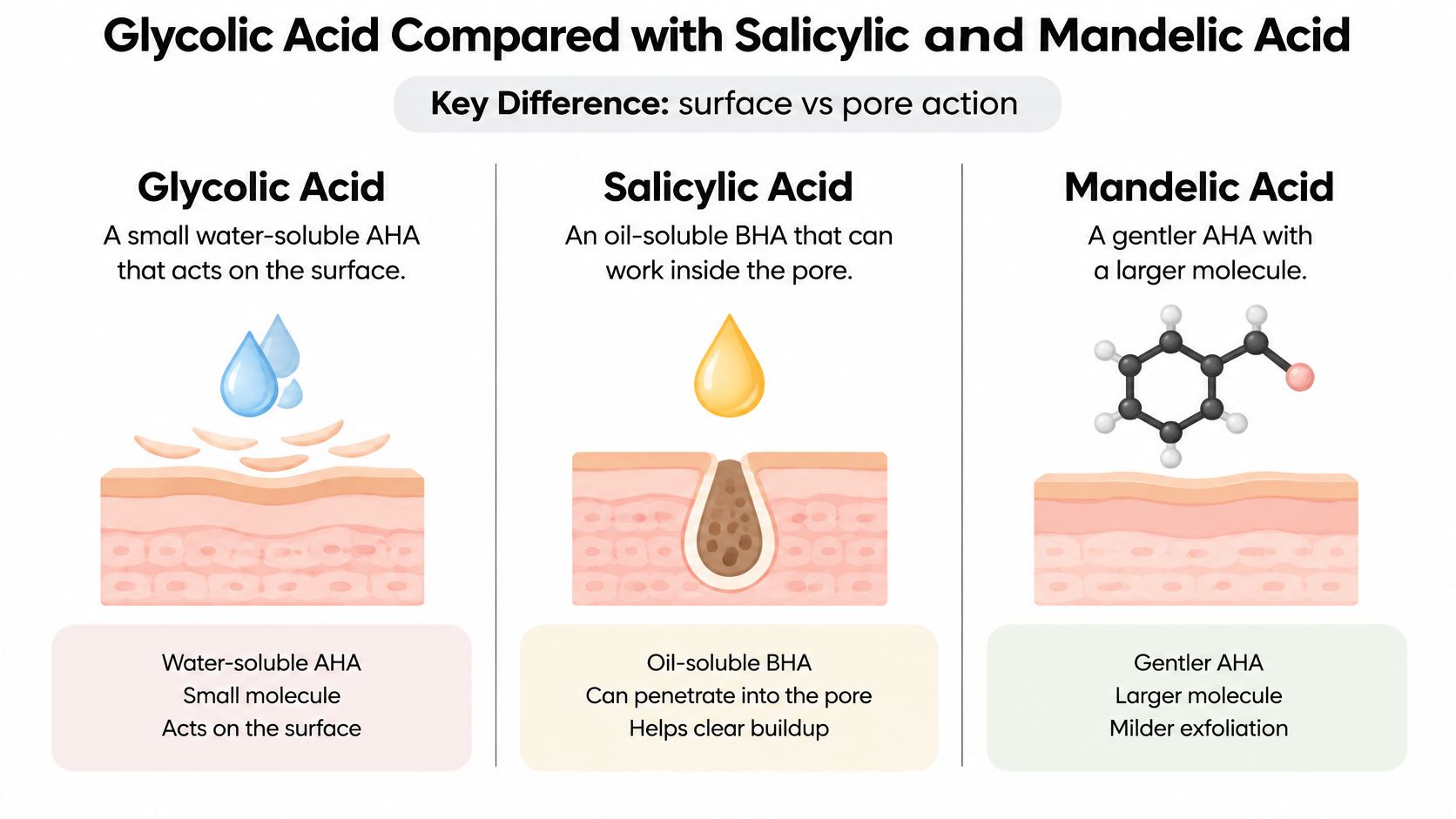
| Property | Glycolic Acid | Salicylic Acid | Mandelic Acid |
|---|---|---|---|
| Chemical class | AHA, small water-soluble molecule | BHA, oil-soluble | AHA, larger molecule |
| Where it works | Outer stratum corneum surface | Inside the pore lining | Gentle surface exfoliation |
| Typical cosmetic strength | 5-10% leave-on | 2% in the Neutralyze DuoClear system | 1% in the Neutralyze DuoClear system |
| Irritation profile | Stinging and redness rise with strength | Dryness; can irritate sensitive skin | Generally milder; a common starting point for sensitive skin |
| Sun sensitivity | Increases UV sensitivity during use | Not a major factor | The same daily sunscreen rule applies while you use it |
| Best fit for texture | Rough, flaky skin without heavy congestion | Rough skin with blackheads and whiteheads | Rough skin where gentleness matters most |
Three situations, three answers
Rough and flaky, without much congestion. Glycolic acid at a low, buffered strength is the direct fit. You're treating a shedding problem, and that's the problem it solves.
Rough with blackheads and whiteheads. Salicylic acid leads, because surface exfoliation can't clean out a plug sitting inside the pore lining. If your skin is oily and blemish-prone, a cleanser for oily, blemish-prone skin is a sensible place to build that step into your day.
Sensitive, reactive, or prone to dark marks. Mandelic acid is the usual starting point. You trade speed for tolerance, and tolerance is what gets you to month three.
Product design matters more than ingredient ranking here. The Neutralyze Exfoliating Pads are built on salicylic and mandelic acid rather than glycolic acid, which makes them a practical alternative for anyone who has reacted badly to a glycolic product but still needs help with texture and breakouts. They come as pre-soaked dual-textured pads for face and body, non-comedogenic and fragrance-free.
Combining acids raises risk, and the way to introduce a second one is one active at a time, with at least a couple of weeks between changes so you know which product earned the result and which one caused the redness.
Realistic Timelines and When Texture Is Really Scarring
Say you're three months past a rough breakout cycle. Your forehead and jaw feel coarse, the marks are flat and brownish, and you start a low-strength leave-on product, photographing your face in the same window light every Sunday.
Week one to two is unglamorous. The surface feels a little smoother and less flaky, and the photos look almost identical. Weeks four to eight are where the change shows up in good light: the roughness softens, the tone looks more level, and the flat marks begin to lose their edge. Month three is the first honest judgment point. If the surface is meaningfully smoother, you're in the range many reach with a daily cosmetic product. If nothing has moved, the strength or the diagnosis is wrong.
Professional peel series run on a longer clock and are judged over months, not weeks.
When the answer is a dermatologist, not an acid
For textural irregularity from superficial post-acne scarring, glycolic acid is used in professionally controlled peel protocols, precisely because its small molecular size allows epidermal penetration and controlled exfoliation. Clinical reviews describe peel concentrations of roughly 20-70% for superficial acne scars, and repeated sessions can promote epidermal regeneration and extracellular-matrix remodeling, though concentration, contact time, pH and skin phototype all materially affect risk (Journal of Cutaneous and Aesthetic Surgery).
Those numbers are a reason not to improvise. Higher concentrations can cause redness, peeling, barrier injury, post-inflammatory hyperpigmentation, or, if applied badly, scarring. Depressed scars involve lost dermal tissue, and a surface peel can't rebuild it. If scar revision is what you're weighing, microneedling guidance for Southern California patients explains a collagen-induction route that addresses depth rather than surface, which is the category of treatment pitted scars need.
Stop and get a professional opinion if you notice any of these:
- Pitting or marks that appear to deepen rather than flatten over time.
- Pain or blistering after an application, not just warmth or a sting.
- Redness lasting beyond two weeks despite reducing frequency.
- No change after three months of consistent, tolerated use.
Sorting which kind of mark you're looking at comes before choosing a treatment. These acne scar types with pictures make the flat-mark versus depressed-scar distinction concrete.
Choose Your Next Texture Step
Four moves, in order.
- Name the concern using the table above. Surface roughness, clogged pores, flat marks, or scarring. Write it down, because the answer determines everything after this.
- Pick the strength to match. For rough, flaky texture, a buffered leave-on at 5% or lower. For congestion or sensitivity, a salicylic or mandelic option rather than a stronger glycolic.
- Run an eight-week trial and photograph weekly in the same light. Note stinging, redness and peeling alongside the photos, because your memory of your own skin adjusts faster than your skin changes.
- Book a dermatologist if you see pitting, redness that won't settle, or no change after three months.
When the routine needs a moisturizing step rather than another exfoliant, the Neutralyze Renewal Complex is a lightweight, oil-free daily acne moisturizer built on a time-released version of DuoClear, the same 2% salicylic acid and 1% mandelic acid system used across the Neutralyze face wash, pads and moisturizer. It's designed as the renew step after cleansing and exfoliating, clinically formulated and fragrance-free, and it isn't a cure or a substitute for scar-focused treatment or dermatologist care. Individual results vary, and texture work is a months-long project, not a weekend one.
If you've been treating rough, congested, breakout-prone skin with an acid chosen by strength rather than by concern, Neutralyze offers a clinically formulated alternative built on 2% salicylic acid and 1% mandelic acid working together: the salicylic acid clears inside the pore while the mandelic acid smooths the surface, in a three-step cleanse, exfoliate, renew system that's fragrance-free and non-comedogenic. Start with the step that matches your skin today, not the strongest one on the shelf, and give it eight weeks of consistency before you judge it. Visit Neutralyze to see how the system fits together and choose your starting point.