

Does Glycolic Acid Cause Purging? What the Evidence Shows
Clinical evidence does not establish that glycolic acid routinely causes a purge. Irritation or barrier damage is the more documented cause of new bumps, so location, timing and symptoms decide which one you're seeing.
But if every early breakout is called progress, when would you ever stop a product that is hurting your skin? That question matters because breakouts already involve sebum, follicular hyperkeratinization, skin bacteria and inflammation. Adding an acid that burns or peels can make all of that look worse, and calling it a purge can keep you using it longer than you should.
What the Evidence Says About Glycolic Acid Purging
Quick Answer
Does glycolic acid cause purging predictably? Clinical evidence does not establish that it routinely does. A temporary flare is plausible when faster exfoliation brings existing microcomedones to the surface sooner. However, studies mainly record redness, burning, peeling, tightness and irritation. Judge new bumps by where they appear, how they feel and how long they last rather than by assumption.
A purge, in plain terms, means clogged pores that were already forming become visible faster. Glycolic acid is an alpha-hydroxy acid that loosens cohesion between surface skin cells, so that explanation is biologically plausible. Plausible is still a long way from proven, and worsening breakouts are no automatic sign of progress.
What Studies Recorded
In an 8-week study of 90 patients aged 17 to 21 with breakouts, pronounced erythema appeared in 6 patients, pronounced desquamation in 10 and a strong sensation of facial tightness in 11. The review of glycolic acid peel therapy reported that most symptoms settled within approximately 30 minutes after the face was washed, and it noted side effects in 5.6% of patients in one breakout study, including post-inflammatory hyperpigmentation, mild irritation or herpes reactivation.
A purge works like dust rising when you shake out a rug. Irritation is sanding too hard and leaving the surface raw.
Rare flare-ups of pimples have been reported, yet those reports do not prove purging is normal or expected. If bumps come with burning, swelling, marked redness or peeling, irritation is the first explanation to rule out. Readers who want exfoliation without glycolic acid can consider Neutralyze Exfoliating Pads, dual-textured pads with 2% salicylic acid and 1% mandelic acid that smooth rough texture. It is an alternative format you can test, and it does not guarantee you will avoid irritation.
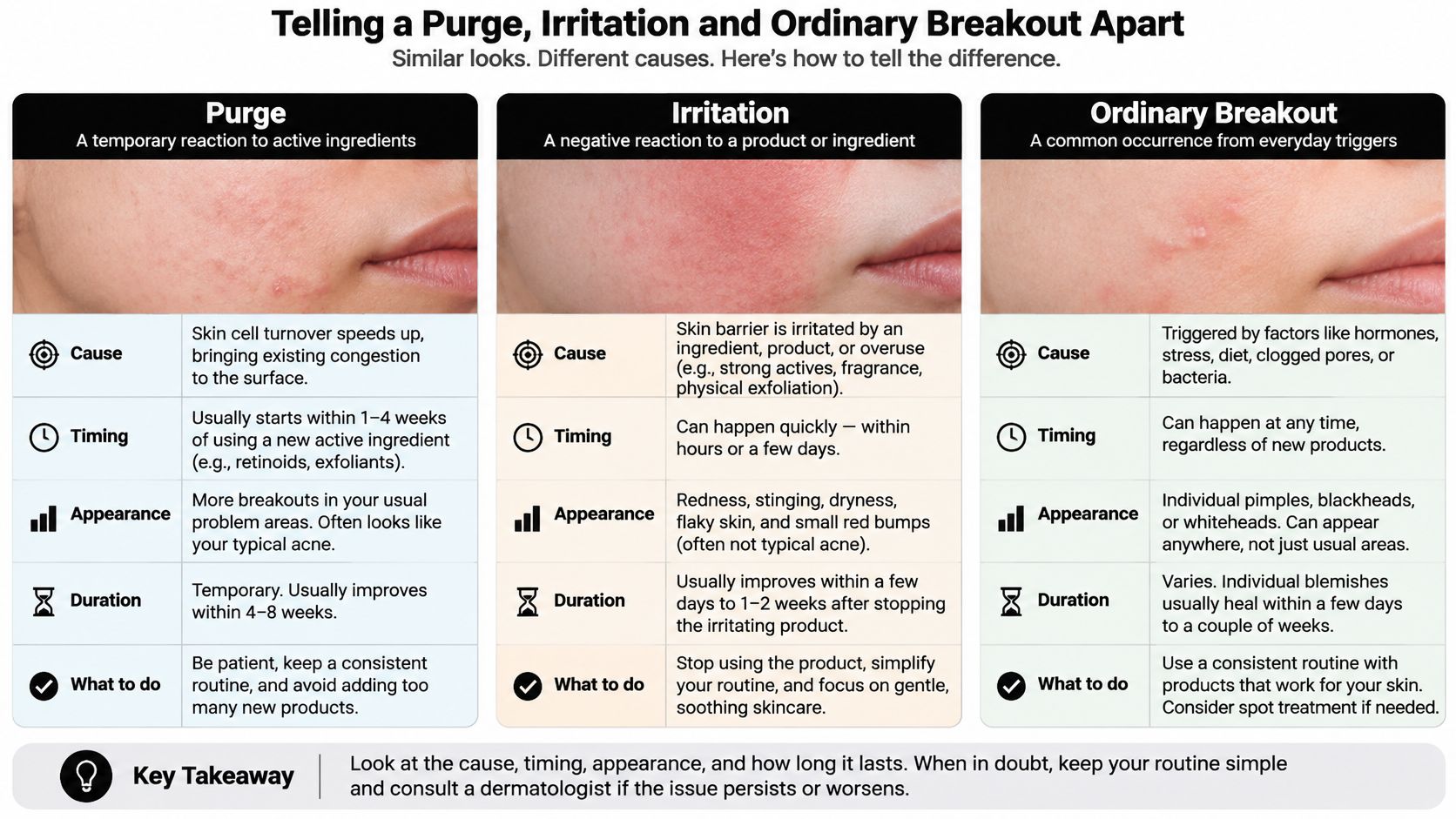
Telling a Purge, Irritation and Ordinary Breakout Apart
An early bump has three main explanations. It could be a probable purge in the areas where you usually break out, irritation from too much exfoliation, or ordinary breakouts that would've happened anyway. Location, timing and feel tell you more than the number of pimples, because sebum, follicular hyperkeratinization and bacteria-driven inflammation can look similar on the surface.
| Symptom | Likely Cause | Next Step |
|---|---|---|
| Small pimples only where you usually break out, no burning, easing within 2 to 4 weeks | Probable early purge | Keep the current routine and reassess at 6 to 8 weeks |
| Burning or stinging during use, redness across the cheeks | Irritation | Cut back to once a day or every other day |
| Bumps in areas that are normally clear | Irritation or intolerance | Stop, then reintroduce later at a lower frequency |
| Peeling, cracking or tight, dry skin | Barrier damage | Pause until skin recovers, moisturize and use sunscreen daily |
| Swelling, blistering, itching rash or dermatitis | Strong reaction | Stop and see a dermatologist |
| Deep, painful nodules that persist | Not a purge; possible inflamed breakouts | Dermatologist evaluation, not a stronger acid |
How to Read the Pattern
According to SELF's explainer on skin purging versus breakouts, a purge-like pattern starts roughly 2 to 4 weeks after introduction and settles over approximately 4 to 8 weeks, mostly in areas that already tend to break out, and a split-face study of 20 people found that six applications of 30% glycolic acid peels at two-week intervals reduced papules and pustules while causing more adverse events after the first session than salicylic acid.
The extra early reactions matter. They are one reason the first weeks on a new acid deserve closer scrutiny than the weeks that follow.
The official consumer page on alpha-hydroxy acids documents a wider reaction range, including burning, dermatitis or rash, swelling, blisters, peeling, itching, tenderness and chemical burns, and cites Cosmetic Ingredient Review parameters of glycolic acid at 10% or less with a final pH of at least 3.5. Treat these as formulation limits, not a promise that your skin will tolerate the product.
The walkthrough below applies the same three-way test, and our guide to purging versus a breakout and whether a new product is working asks the same questions of other actives in a routine.
When your symptoms sit on a boundary between rows, weigh barrier signs first: tightness, stinging during use and cracking point to over-exfoliation even when the bumps stay inside your usual zones. Then follow the next step in whichever row fits best.
Strength, pH and Frequency That Raise Irritation Risk
Strength sets the ceiling, while pH and schedule decide how much of that strength reaches the barrier at once. Read the table from daily use to clinic procedure before judging a small early breakout.
| Exposure | Glycolic Acid Strength | pH or Key Factor | Reported Outcome |
|---|---|---|---|
| At-home breakout products | Low leave-on or wash-off range | Consumer use on intact skin | Stinging and mild irritation are the expected adverse effects |
| Cosmetic benchmark | Low strength with a minimum final pH | Formulation limit for leave-on products | A tolerability benchmark, with individual response still variable |
| High-concentration peel (2025 study) | High strength, professional procedure | Supervised application and neutralization | 92.5% burning, 77.5% irritation, 62.5% post-peel cracking, 12.5% transient hyperpigmentation; no scarring |
| Adverse-event reports for alpha-hydroxy-acid cosmetics | Mixed products | Mixed formulations and use patterns | Voluntary reports listed burning, dermatitis or rash, swelling, pigmentary changes, peeling and tenderness |
The peel figures come from a supervised, high-strength procedure, so their proper use is scope: they show how quickly a strong free-acid exposure can inflame skin and why spacing and aftercare matter. Those adverse-event reports serve a different purpose. They are a reaction catalogue across mixed products and use patterns, useful for naming what can go wrong rather than estimating odds.
Practical rule: If irritation appears, reduce frequency before changing anything else.
The controllable risks are strength, pH, schedule and barrier condition. Lower pH and higher strength both increase the active dose reaching the surface, and a stressed barrier turns the same formula into a bigger hit. For pacing, use the guide on how often you should use glycolic acid and keep the setup details in the introduction steps; this section is the dose side of that decision.
Glycolic Acid Versus Salicylic and Mandelic Acid for Breakout-Prone Skin
You're rarely choosing glycolic acid in isolation. You're choosing it against salicylic acid, mandelic acid, or a system that combines exfoliants. Compare what each acid does, where it works and what concentration is normal before you switch.
The Three Acids Side by Side
- Glycolic acid: The MSD Manual clinical reference lists at-home glycolic acid at 5 to 10% as a supporting option and identifies stinging and mild irritation as adverse effects. It mainly loosens surface cells, which can help rough texture and post-breakout marks.
- Salicylic acid: This beta-hydroxy acid is oil-soluble, so it's built for work inside oily, clogged pores. It fits blackheads, whiteheads and other clogged pores better than a purely surface approach.
- Mandelic acid: This alpha-hydroxy acid has a large molecule and gently exfoliates the surface of the skin. That slower surface action is why it's often the gentler starting point for sensitive, breakout-prone skin.
The American Academy of Dermatology page on breakouts states that salicylic acid opens clogged pores and works particularly well for whiteheads and blackheads, with commonly available concentrations from 0.5% to 2%. It contrasts those with chemical peels using substantially higher 10 to 30% concentrations. Don't equate a daily salicylic product with a professional peel, and don't assume adding glycolic acid on top improves the result.
Which Direction Fits Your Skin
Say glycolic acid gives you diffuse cheek redness and peeling within days, while your main problem is blackheads on your nose and chin. More glycolic acid isn't logical. Reduce frequency first, let the barrier settle, then consider a non-glycolic exfoliant aimed at clogged pores.
Our comparison of mandelic acid versus glycolic acid lays out that trade-off in more detail. For readers who want a salicylic and mandelic route, the Neutralyze system is clinically formulated around those two actives only. Frame it as an evidence-based option to test carefully, not as a guaranteed outcome.
Compare one acid at a time. Stacking several exfoliants tells you nothing except that your barrier has a limit.
Calming active breakouts and fading post-breakout marks are also different jobs. A product that smooths surface texture may help marks look less obvious over time, but that doesn't mean it's controlling new inflammatory lesions. Judge each goal separately so you don't keep an irritating product for the wrong benefit.
How to Introduce Glycolic Acid Without Irritation
Week one often looks like this: a mild tingle along the jaw for a few minutes, two familiar whiteheads near the chin, no spreading redness. That is a different signal from burning across both cheeks with flaking around the nose. The first pattern can stay inside the experiment. The second says the barrier is paying too much.
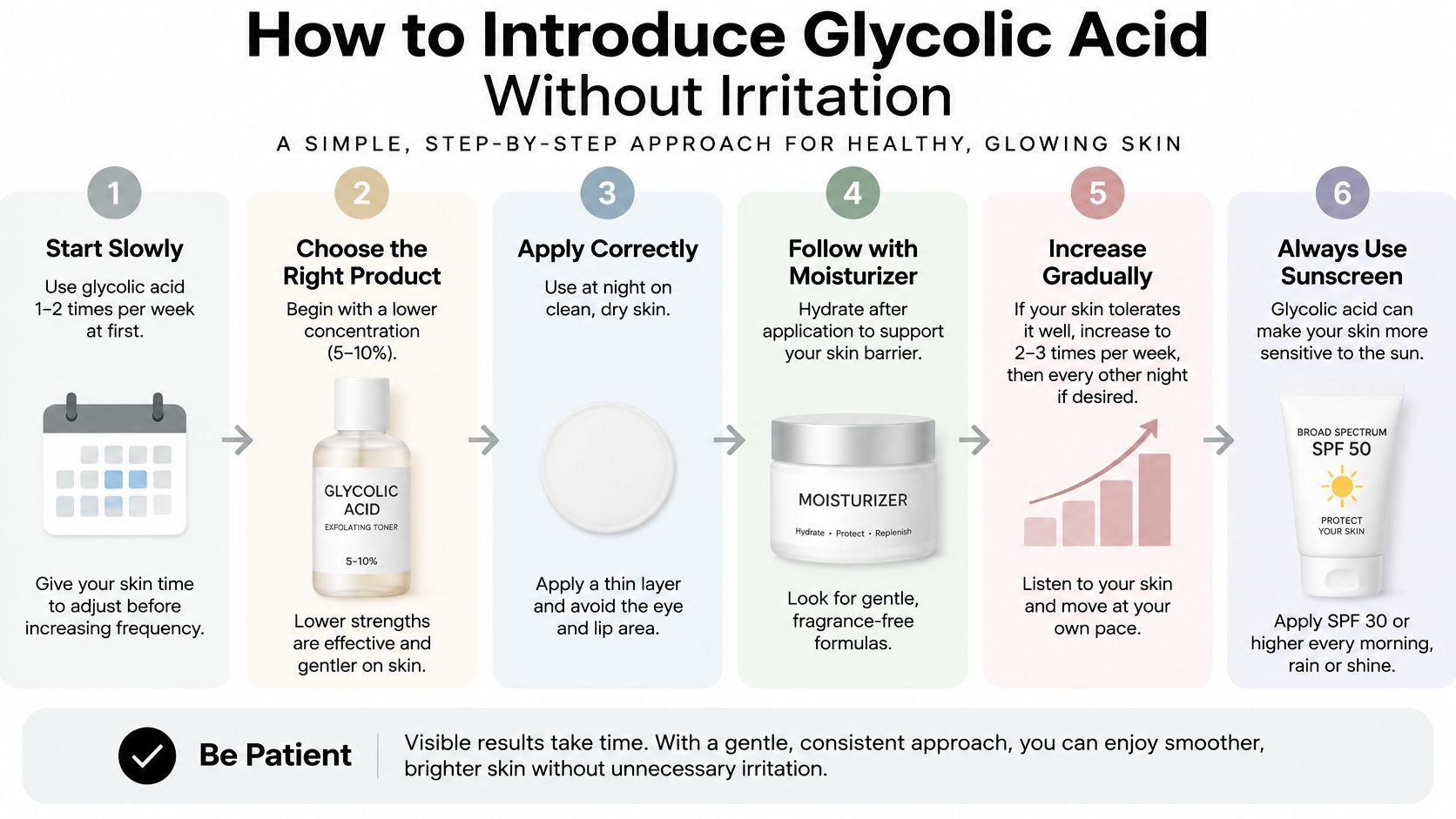
Longer-term evidence favors pacing. In a 2011 clinical study cited by a review of glycolic acid for breakout-prone skin, a 10% glycolic acid product improved mild breakouts after 45 days, with further improvement after three months of daily use. Daily use was the endpoint there; the first month is only the entry ramp.
Your First Month, Step by Step
- Choose one product only. Keep every other active unchanged for the first month, so any new bump or patch of redness has one likely cause.
- Map and photograph your usual breakout zones. Note where blackheads and pimples normally appear, such as jaw, chin or cheeks, then repeat the same lighting and angle weekly. New activity outside that map matters more than activity inside it.
- Apply to completely dry skin. Start in the evening after cleansing at a low frequency such as every other day. Damp skin can make an acid feel stronger and less predictable.
- Keep the rest gentle. Leave out aggressive exfoliants, scrubs and any new retinoid on glycolic nights so the barrier keeps a stable baseline.
- Use daily broad-spectrum sunscreen. Acids can increase sun sensitivity, and unprotected inflammation can leave post-breakout marks looking darker for longer.
- Read four dials before changing dose. Check location, timing, the strength and pH you chose, and barrier signs such as peeling or burning. Then grade the pattern with the continue-pause-stop rule instead of adding a second product or forcing frequency.
The same slow start applies if you use a salicylic and mandelic pad instead. Neutralyze Exfoliating Pads are leave-on DuoClear pads with 2% salicylic acid and 1% mandelic acid, swiped on clean skin after cleansing and not rinsed off; because contact time is built in, test them on their own evening rather than alongside a new glycolic product. For Neutralyze Resurfacing Pads, treat the margin as narrower: GlycoForte is a 20% glycolic acid system with hyaluronic acid used only in that product, and it is unsuitable for very sensitive skin or anyone sensitive to glycolic acid.
By about 3 weeks, tolerance is the open question; the full result on breakouts comes later. AHAs help by limiting follicular blockage, promoting desquamation and reducing abnormal keratinization, and that machinery needs time. Bumps that stay inside the mapped zones while skin remains calm fit a purge-like pattern better than diffuse redness, widespread peeling or burning that arrives soon after application.
Deciding Whether Glycolic Acid Fits Your Routine
Six weeks of notes answer this question better than any label claim. By now you know where bumps appear, how long they last and how your skin feels between applications, and those three signals decide whether glycolic acid stays.
Continue, Pause or Seek Care
The same location, timing and comfort checks that separated a purge from irritation now work as your keep-or-drop test.
- Continue when bumps stay in the areas where you usually break out, stinging stays mild and brief, and the count is trending down by the 6 to 8 week mark.
- Pause and cut back when redness turns diffuse or peeling, cracking and tightness spread across treated skin. Resume at a lower frequency only after several calm days.
- Stop and see a clinician when swelling, blistering, a spreading itchy rash or deep painful nodules appear, since those point to a barrier or inflammatory reaction.
Glycolic acid earns its place as an exfoliating extra inside a wider routine for breakout-prone skin. The American Academy of Dermatology clinical guideline highlights topical retinoids, benzoyl peroxide, topical antibiotics, clascoterone, salicylic acid and azelaic acid, and glycolic acid does not appear in that highlighted recommendation list. For frequent, widespread breakouts, it plays a supporting role inside a fuller plan.
If your notes push you toward a salicylic and mandelic routine instead, Neutralyze Face Wash is the first step of that approach, cleansing with DuoClear 2% salicylic and 1% mandelic acid without stripping. Introduce it the way you tested glycolic acid: one new product, patch tested, with location and comfort tracked.
Keep writing down what you observe through the full six weeks, including where each bump appears and how quickly it resolves. Bring that record to a dermatologist if the pause or stop rules ever apply. A clear log produces a better decision than memory after two frustrating months.
If glycolic acid keeps leaving you guessing between progress and irritation, visit Neutralyze to explore a salicylic acid and mandelic acid system built for breakout-prone skin. Start with one step, patch test carefully and track location, timing and comfort before you add anything else.