

Exfoliating Pads for Body: Benefits, Risks, and Safe Use
You know the pattern by now. You shower after the gym, drag a loofah across your shoulders, and by Thursday there are six new spots between your shoulder blades. The backs of your arms have stayed rough and bumpy since winter no matter how much lotion you use, and the serum you bought for your chin has never once reached the middle of your back.
Body skin doesn't follow facial instructions. It's thicker, it sits under straps and waistbands for hours, and the areas that break out are awkward to cover evenly with a dropper. That mismatch is exactly why exfoliating pads for body exist as a format of their own rather than a face product used in a bigger quantity.
Why Body Skin Needs Its Own Exfoliation Plan
The trunk carries plenty of oil glands, and it spends the day under fabric, elastic, and backpack straps. Sweat trapped against the skin, combined with friction from a sports bra or a heavy bag, keeps follicles congested on the upper back even when your face stays clear. The outer arms present a different problem: uniform, rough bumps that don't behave like pimples and don't respond to a spot treatment.
Then there's geography. A pea-sized blob of anything doesn't distribute across a shoulder blade, and a liquid runs before you reach the far side of your back. A body exfoliating pad fixes the delivery problem. It's a pre-soaked single-use wipe carrying a chemical exfoliant, usually salicylic acid, an alpha hydroxy acid such as mandelic or glycolic acid, or both, and you swipe it on and leave it rather than rinsing. Each pad spreads a measured amount of solution across a defined area. The dose you deliver still depends on how saturated the pad is, how hard you press, and how much skin you cover, so an even sweep matters as much as the ingredient list.
The format has grown well past bathroom-cabinet niche. The global exfoliating pads market was valued at USD 1,953.4 million in 2025, according to Future Market Insights.
For a starting point that matches the mechanism, Neutralyze Exfoliating Pads are a clinically formulated salicylic acid plus mandelic acid pad built for blackheads, whiteheads, clogged pores, and uneven texture on the face, chest, back, and shoulders.
A pad is a dosing device first and an exfoliant second. The format only helps you if the acid strength, the frequency, and the rest of your routine are all pointed the same direction.
Three things decide whether a pad helps or hurts on body skin: which acid you use, how much total exfoliation that patch of skin already gets, and whether the bumps are acne. Keratosis pilaris and folliculitis can both pass for a breakout at arm's length, and each responds to different chemistry. Layering a daily pad on top of a scrub, an exfoliating body wash, or a second leave-on acid is the most common way the format backfires: the irritation gets blamed on the pad when the problem is the cumulative load.
How Exfoliating Pads Work on Body Skin
A breakout on your back can start weeks before you see it. In acne-prone skin, dead cells inside the follicle stick together instead of shedding on schedule, a process called follicular hyperkeratinization. Those retained cells mix with sebum and form a plug below the surface. Because the blockage sits inside the follicle, washing the outer skin can remove sweat and oil without loosening the material that started the blemish.
Here's that sequence in visual form, from stuck cells to an open pore:
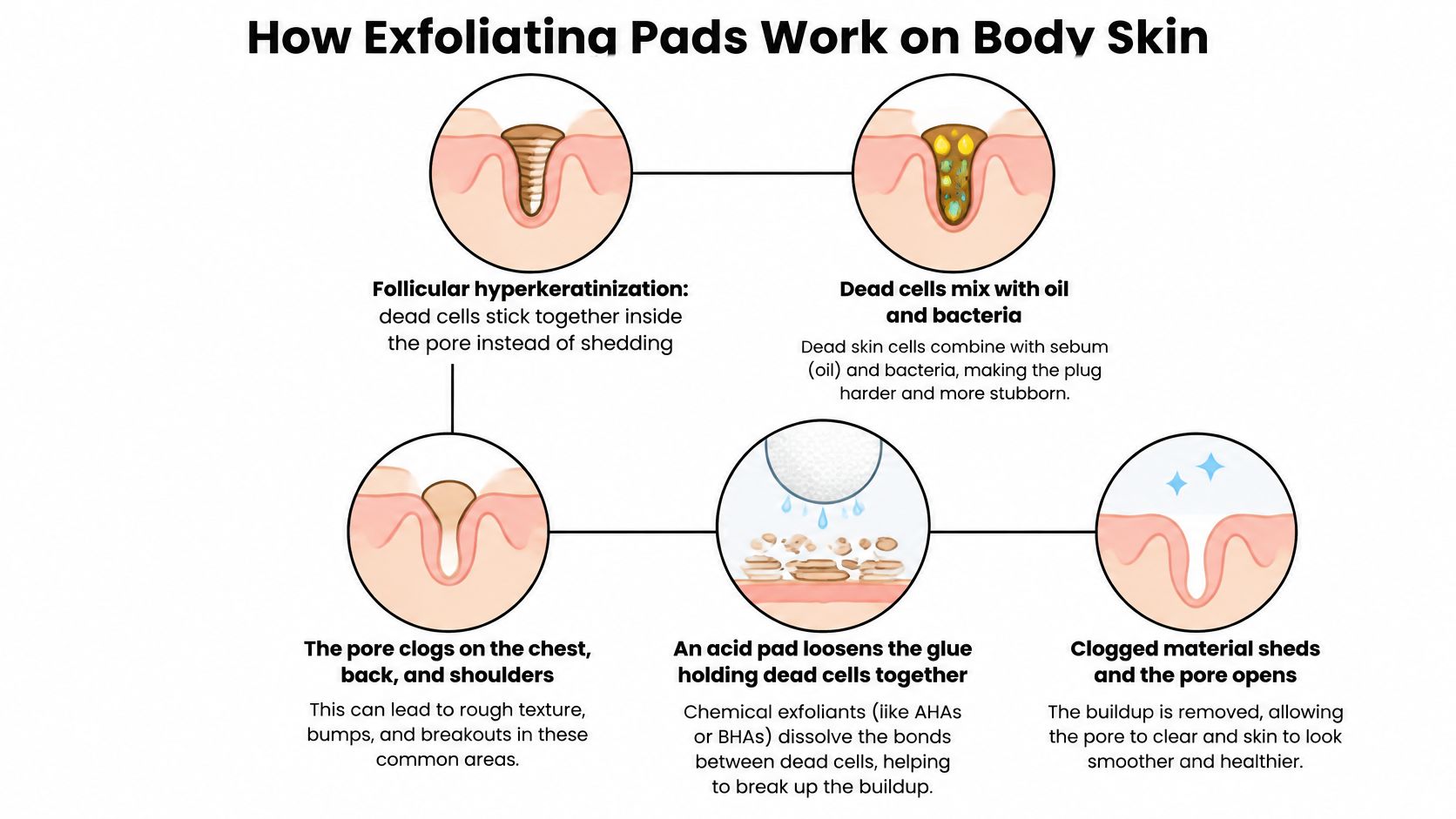
Inside the pore, salicylic acid does the unclogging. It's a beta hydroxy acid, and it's lipophilic, which means it moves through oil instead of being repelled by it. That lets it reach the follicle lining where plugs form and loosen the cohesion of the cells packed inside. It also quiets inflammation, which is why the same ingredient appears in both exfoliants and acne treatments. The FDA OTC acne monograph recognizes salicylic acid at 0.5% to 2% for topical acne products, and that's the band an everyday body pad should stay inside.
On the surface, mandelic acid handles texture. AHAs are water-soluble and act on the outer layer, loosening bonds between dead corneocytes so they shed instead of piling up. Mandelic acid has a larger molecule than glycolic acid, so it absorbs more slowly. That makes it the gentler pick for sensitive skin and for deeper skin tones where irritation can leave a mark behind. Glycolic is the smallest and most aggressive acid in the family, while lactic sits in the middle and pulls in moisture as it works.
The Bacterial Half of the Story
Cutibacterium acnes doesn't create acne on its own. It flourishes in a follicle that's already blocked and low on oxygen. Regular exfoliation keeps follicles clearer and oil moving, removing the conditions inflamed acne needs. That allows a well-matched pad to reduce new lesions rather than merely polishing the surface you can see.
What this means in practice: a pad changes the environment inside the pore so the plug can release and inflammation has less to feed on. Dark marks left after a breakout fade gradually through normal skin turnover.
What the Timeline Looks Like
Acne is common enough that a slow timeline matters. The American Academy of Dermatology reports that approximately 85% of people aged 12 to 24 experience at least minor acne, and that adult acne affects up to 15% of women.
Acids work gradually because each application loosens only part of the buildup and gives irritated skin time to settle. Judge progress over weeks, not days. Clogged, non-inflammatory lesions often improve before inflamed papules because there is less active inflammation to calm. A smoother patch can therefore appear before you see fewer new breakouts.
Pairing a BHA with an AHA has clinical support behind it. In a peer-reviewed comparison of salicylic-mandelic and glycolic peels, 44 patients received six sessions at two-week intervals with either 35% glycolic acid or a combination of 20% salicylic acid and 10% mandelic acid, and the combination produced greater improvement in most active acne lesions and hyperpigmentation at p<.001 for both outcomes, with fewer side effects. Peel concentrations are far higher than those in daily pads. Their relevance is the division of labor: salicylic acid reaches into the oily follicle, while mandelic acid works on surface roughness and post-acne marks.
Why the Same Pad Can Help or Backfire
The acid percentage on the label is only one part of your total exfoliation load. Every exfoliating wash, scrub, brush, peel, and extra pad session adds to what the same patch of skin has to tolerate. Skin that turns tight, shiny, raw, or persistently stingy is receiving more exfoliation than it can use, and irritation can make existing bumps look worse.
The identity of the bumps matters just as much. Salicylic acid can loosen acne plugs, and AHAs can smooth the keratin buildup associated with keratosis pilaris. Itchy, follicle-centered pustules may point toward folliculitis and call for a different approach. A pad works best when the acid matches the lesion and the rest of your routine leaves enough recovery time between exfoliating steps.
| Acid type | How it works | Best for | Common examples | Watch-outs |
|---|---|---|---|---|
| BHA (salicylic acid) | Oil-soluble, penetrates sebum and works inside the pore lining | Blackheads, whiteheads, oily body acne on chest and back | Salicylic acid, betaine salicylate | Dryness and stinging when stacked with other actives |
| AHA (mandelic acid) | Water-soluble surface exfoliant with a large, slow-absorbing molecule | Rough texture, post-acne marks, sensitive or darker skin tones | Mandelic acid | Slower visible results; still needs sun protection |
| AHA (glycolic acid) | Smallest AHA molecule, strongest surface exfoliation | Stubborn rough patches and keratosis pilaris bumps | Glycolic acid | Highest irritation and sun-sensitivity risk |
| AHA (lactic acid) | Surface exfoliant that also draws in moisture | Dry, rough, flaky body skin | Lactic acid | Can sting on compromised or freshly shaved skin |
Matching Pad Ingredients to Body Acne, Keratosis Pilaris, or Sensitive Skin
Many body-pad labels and routines collapse three different conditions into one word: bumps. That shortcut causes damage. A rough patch on the back of your arm and a clogged follicle between your shoulder blades can look nearly identical in a mirror, yet they have different causes, different acid matches, and different timelines. Choosing the wrong one wastes months and irritates skin that was already struggling.
Reading Location, Appearance, Symptoms, and Timing
Sort the bumps before you buy a product. Four questions do the work: where are they, what do they look like, do they itch or hurt, and when did they start?
Body acne shows up as a mix of blackheads, whiteheads, and red papules or pustules across the chest, back, shoulders, or buttocks, and it flares with sweat, workouts, tight clothing, and backpack straps. Keratosis pilaris produces uniform, goosebump-like papules on the outer upper arms, thighs, or buttocks, usually present for years and often itchier in dry weather. Folliculitis gives itchy pustules centered on hair follicles after sweating, hot tubs, or shaving. Sensitive or eczema-prone skin announces itself differently: stinging from most actives, redness, and ongoing dryness rather than discrete lesions.
For the acne pattern, salicylic acid is the ingredient with the strongest track record. The AAD's guidance on acne treatment identifies salicylic acid as effective for whiteheads and pimples and notes it comes in several strengths and formats. Pairing it with mandelic acid adds surface smoothing for texture and post-acne tone, and a dual-textured pad like Neutralyze Exfoliating Pads combines 2% salicylic acid with 1% mandelic acid to cover both jobs in one leave-on step.
| Concern | Typical signs and location | Best pad ingredients | What to avoid | Realistic timeline |
|---|---|---|---|---|
| Body acne (comedonal and inflamed) | Blackheads, whiteheads, red papules on chest, back, shoulders, buttocks; flares with sweat and friction | Salicylic acid 0.5-2%, ideally paired with mandelic acid for texture and marks | Scrubbing, loofahs, stacking other acne actives | Fewer lesions in 4-8 weeks |
| Keratosis pilaris | Uniform rough goosebump-like bumps on outer arms, thighs, buttocks; often itchy when dry | Mandelic or lactic acid for gentle smoothing, low-strength glycolic for stubborn patches | Harsh physical scrubbing, high-strength acids, dry air without moisturizer | Smoother texture in 2-3 months |
| Folliculitis | Itchy pustules around hair follicles after sweat, hot tubs, or shaving | No pad as primary treatment; gentle cleansing only | Exfoliating over active pustules, shaving the same area | Needs a clinician if persistent |
| Sensitive or eczema-prone | Stinging with most actives, redness, ongoing dryness | Larger-molecule mandelic acid, introduced every few days | Applying over flares, cuts, or sunburn; glycolic acid | Tolerance builds over several weeks |
Treating Every Bump as Acne
Escalating pad frequency on bumps that aren't acne raises your total exfoliation load without touching the cause. Your cleanser, the pad, and any lotion containing acids all count toward that load, and the barrier absorbs the sum. Aggressive rubbing irritates acne and keratosis pilaris alike and can worsen inflammation; abraded skin should get only bland moisturization until the redness settles, with keratolytic treatment introduced afterward, as this comparison of acne and keratosis pilaris sets out. The same comparison warns that excessive or prolonged salicylic acid exposure can impair the epidermal barrier, causing redness, scaling, and a paradoxical worsening of keratosis pilaris.
Rule of thumb: if a bump pattern isn't improving after six to eight weeks of correct, consistent pad use, the answer is a different diagnosis, not a higher frequency.
That distinction matters most for teenagers and adults with truncal acne who mistake folliculitis, eczema, or plain friction for a breakout. If the bumps sit specifically on your arms, this breakdown of why pimples appear on the arms walks through the patterns that separate acne from keratosis pilaris.
For sensitive or eczema-prone skin, start with the larger-molecule mandelic acid, patch test on one small area, and never pad over an active flare, broken skin, or sunburn. Give a stripped barrier moisture and time before adding any acid.
What Body Exfoliating Pads Can and Cannot Do
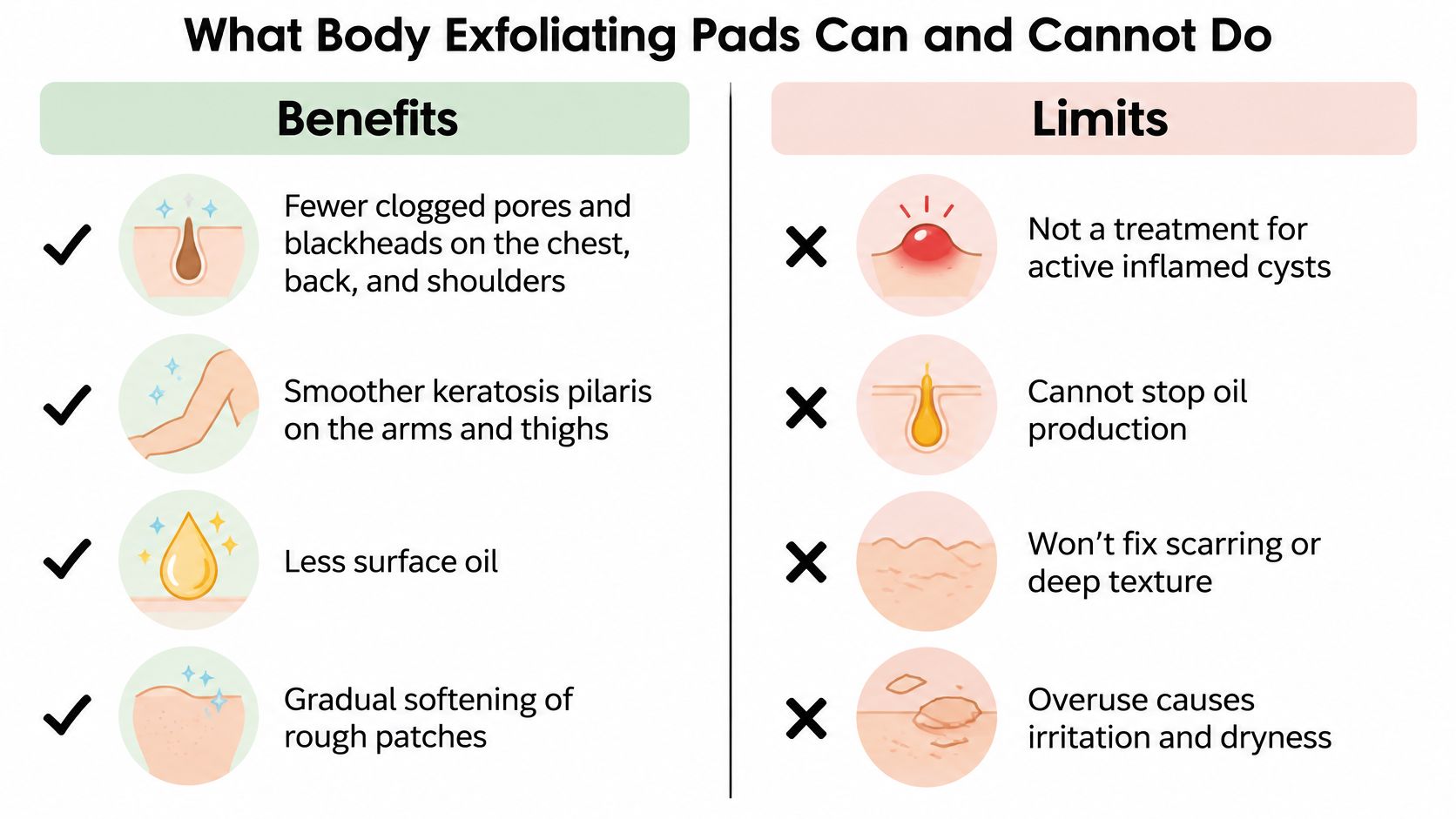
A body pad has a narrow job description, and knowing where it ends saves you from over-treating. On the benefit side, regular use reduces clogged pores and blackheads on the chest, back, and shoulders, smooths keratosis pilaris on the arms and thighs over time, cuts surface oil, and gradually softens rough patches. It also helps fade the look of post-acne marks as cell turnover speeds up.
That last point deserves its own line. Fading marks and treating active acne are different jobs. Pads support both, but if new inflamed lesions keep forming every week, a pad alone will not flatten a cyst or shut down the cycle producing them. Visible change takes weeks, so judging a pad on day five tells you nothing.
Here's the balance in one view:
Where the Risks Come From
The risks of this acid family sit in regulatory records, not rumors. Between 1992 and February 2004, the FDA received 114 adverse dermatologic-experience reports involving AHA-containing skincare products, as recorded in FDA review data compiled by the AAD: 45 cases of burning, 35 of dermatitis or rash, 29 of swelling, 15 pigmentary changes, 14 blisters or welts, 13 instances of peeling, 12 of itching, 8 of irritation or tenderness, 6 chemical burns, and 3 reports of increased sunburn, and the same records describe FDA-reviewed studies in which four weeks of topical AHA use raised sensitivity to UV-induced skin reddening by 18%.
Those findings shaped the guardrails that followed. Regulators and an independent safety-review panel set conditions for leave-on AHA cosmetics: limits on acid concentration and final pH, plus sun-protection directions on the label. Read that last part as an instruction, because it is one. Sunscreen on treated, exposed skin belongs to the same step as the pad itself.
A Pad Works at Lower Strength Than a Peel
Concentration is where marketing and chemistry part ways. A review of salicylic acid use in dermatology reports the ingredient used from 0.5% to 30%, with the low end aimed at acne and the high end reserved for supervised chemical peels, and it describes a split-side randomized study in which twice-daily 10% lactic acid reduced lesions by 66% over 12 weeks, versus 52% with 5% salicylic acid.
Your daily pad sits at the low end of that range, in the everyday acne concentrations covered in the ingredient section above. The 66% figure came from peel-adjacent dosing, and a leave-on pad cannot borrow it. Chasing peel-level results by swiping more often is how irritation stacks up: total exfoliation load, meaning the pad plus every other active touching the same skin, is the main reason body pads stop working. Raise frequency only as fast as your skin tolerates it.
How to Use Body Exfoliating Pads Safely
A pad only works if your skin tolerates it long enough to finish the job, and tolerance is the point where routines fall apart. The routine below runs on one principle: add the acid, subtract everything else that irritates the same square of skin.
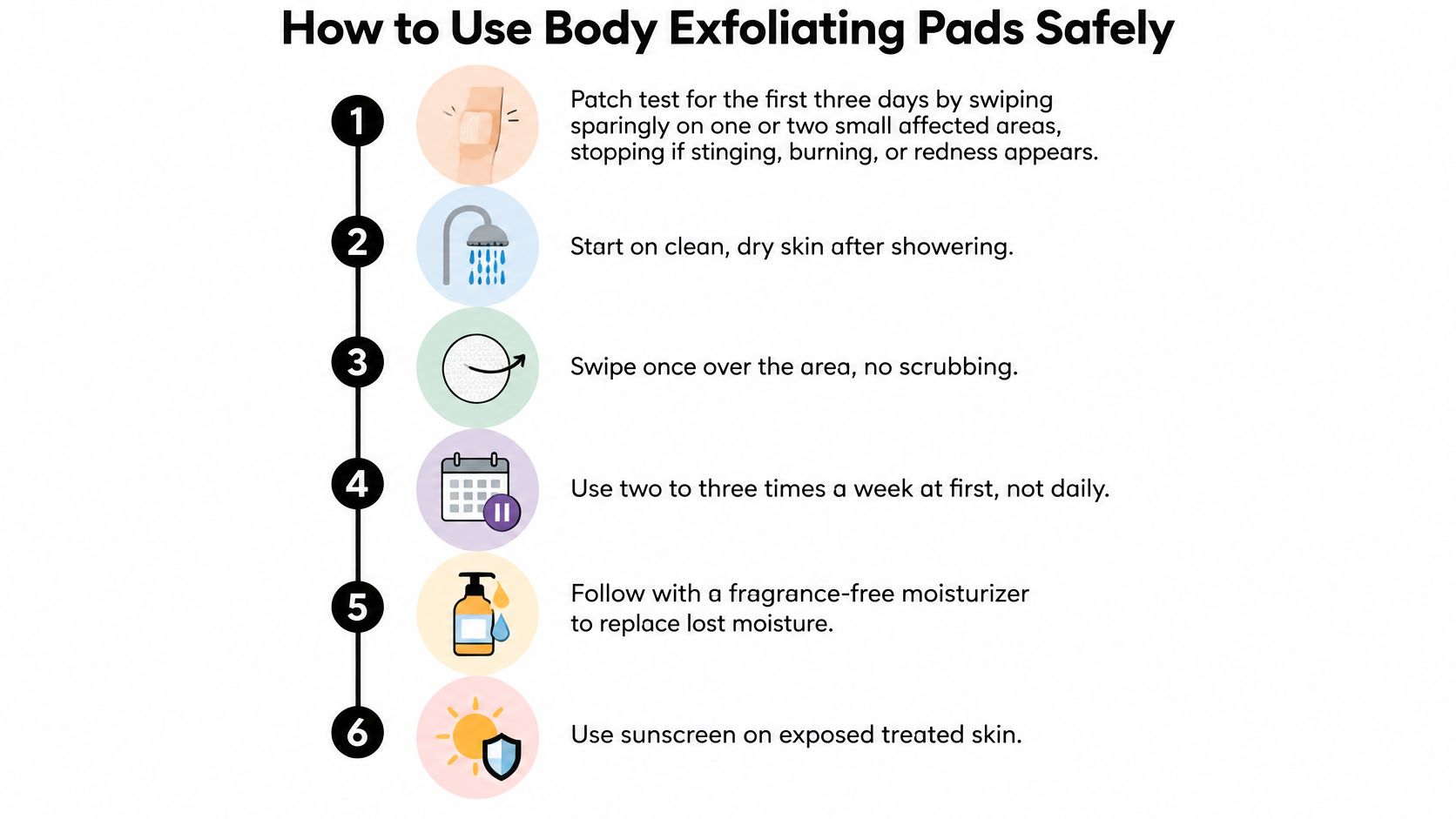
- Patch test for three days. Swipe sparingly on one or two small affected areas and stop if you feel stinging, burning, or spreading redness. Three days catches a fast reaction without wasting a jar.
- Cleanse and let the skin dry completely. Acid on damp skin stings more and penetrates unevenly. For the chest, back, and shoulders, Neutralyze Face Wash 2.0 is built for face and body, with 2% salicylic acid and 1% mandelic acid.
- Swipe one pad in a thin, even layer. Use the smooth side for coverage and keep the textured side for occasional extra exfoliation. Don't press hard, because friction adds irritation without improving how the acid works.
- Don't rinse. The leave-on contact time is the treatment. Rinsing it off removes the mechanism you paid for.
- Start with one application a day. The FDA OTC topical acne order spells out the pacing: begin with one daily application, increase to two or three only if needed, and drop back to once daily or every other day at the first sign of dryness or peeling. On a broad area like the back, keep the once-daily start and ease down to every other day only if your skin gets dry or peels.
- Moisturize afterward. Neutralyze Renewal Complex is an acne moisturizer built on the same salicylic and mandelic pairing, which keeps the exfoliation step from tipping into barrier irritation.
- Use sunscreen on treated skin that sees sun. AHAs raise UV sensitivity, and a tank top exposes precisely the skin you just swiped.
Total Exfoliation Load, the Reason Body Pads Fail
The overlooked variable is total exfoliation load: everything else landing on that skin. Dermatology-oriented sources recommend avoiding harsh physical exfoliation for routine truncal-acne care because friction creates micro-injuries and can worsen inflammation, with chemical exfoliants kept at low concentrations until tolerance is established and frequency adjusted to irritation, as summarized in this clinical guidance on combining exfoliants in truncal acne care. The same guidance favors alternating exfoliation with gentle cleansing, avoiding multiple exfoliating products, and pausing during flares, cuts, wounds, or irritation.
The pad is one line item. Count the whole load.
| Product or habit | Does it add load? | How to adjust when starting pads |
|---|---|---|
| Leave-on exfoliating pad | Yes, this is the primary acid dose | Keep it as the only strong exfoliant on the area at first |
| Acne washes and acid cleansers | Yes, especially salicylic or glycolic formulas | Alternate days rather than stacking in the same shower |
| Loofahs, scrub brushes, body scrubs | Yes, physical friction plus acid equals irritation | Retire them from treated areas while pads are new |
| Shaving | Yes, friction plus micro-cuts on the surface | Shave and pad on different days; never pad freshly shaved skin |
| Sun exposure without SPF | Yes, AHAs raise UV sensitivity | Daily sunscreen on exposed treated skin, plus clothing coverage |
Practical rule: for the first two weeks, the pad replaces whatever else was exfoliating that patch of skin. That's the trade, and it's why two people using identical pads get opposite results.
If you're pregnant and thinking about exfoliation in a different format, this gentle body scrub guide for mums-to-be covers physical scrub options and what to skip. For pacing as your skin adapts, this guide to how often you should exfoliate goes deeper on frequency.
For back or body acne specifically, the sequence is simple: cleanse, let the skin dry, swipe the pad over the area, and leave it on.
When to See a Clinician Instead of Exfoliating More
Escalating a pad from three times a week to twice a day is the wrong lever when the problem isn't surface exfoliation. Some patterns need a clinician, and getting there sooner is smart self-advocacy rather than a failure of your routine.
Seek an evaluation when bumps are painful, deep, or nodular rather than sitting on the surface. Book an appointment when acne is widespread, still worsening after six to eight weeks of consistent correct use, or starting to leave scars. Stop using the pad and get seen if it causes persistent burning, spreading redness, peeling, or blistering. Get urgent care if bumps come with fever, warmth, drainage, or rapidly spreading redness, because that pattern suggests infection rather than acne.
The lookalikes are another reason to escalate. Itchy pustules that flare after hot tubs or locker-room sessions point toward folliculitis, and a fungal cause won't respond to a salicylic pad. Rough bumps that never budge after months of gentle keratolysis may not be keratosis pilaris at all. If you're pregnant, breastfeeding, or managing something like diabetes with skin implications, confirm active-ingredient choices with your clinician first.
What to Bring to the Appointment
Bring specifics, because they shorten the path to the right answer. Note which pad you used, which acid and what concentration, how often you applied it, for how long, what else you layered on the same area, and what changed. A clinician can work with that in five minutes.
Prescription options exist for moderate-to-severe disease, including topical retinoids, benzoyl peroxide, and oral treatments. Stepping up is matching treatment strength to acne severity, not admitting defeat. If you want the background on what body acne involves and how it's usually approached, this guide to how to treat body acne covers the ground. Pads can stay in the routine as supportive care for mild-to-moderate comedonal body acne once your clinician approves.
Your Next Step for Smoother Body Skin
Here's the verdict. For body acne or rough, bumpy texture, a pad worth using is a leave-on formula in the 0.5% to 2% salicylic acid range, ideally paired with mandelic acid, applied to clean, completely dry skin, started once a day, followed by moisturizer, and protected from sun. Give it weeks, and judge the whole area rather than the one bump that keeps coming back.
The routine itself fits in a sentence: cleanse the area, swipe the pad, leave it on, then moisturize. What makes it work or fail is the total exfoliation load on that patch of skin, so keep the pad as the only leave-on exfoliant there instead of stacking it with scrubs or other acids on the same night.
On the face, chest, back, and shoulders, the pieces map cleanly: Neutralyze Face Wash 2.0 for cleansing, Neutralyze Exfoliating Pads for the exfoliation step, and Neutralyze Renewal Complex for renewal. The pads are dual-textured, carrying DuoClear 2% salicylic and 1% mandelic acid, 100 to a jar, one smooth side and one textured side, each pre-measured so every pass delivers the same dose. The whole system runs on salicylic acid and mandelic acid, nothing else doing the active work.
Ready to Smooth Breakouts From Neck to Back
Our exfoliating pads pair salicylic acid with mandelic acid in a clinically formulated leave-on format for moderate-to-severe acne-prone skin, one honest step in a routine rather than a cure.
Your back and shoulders deserve the same mechanism-first thinking you'd apply to your face, and that's what Neutralyze builds its whole line around: a salicylic acid plus mandelic acid system for cleansing, exfoliating, and renewing, formulated for moderate to severe acne-prone skin. For the first few days, use a pad sparingly on one or two small areas, then settle into once a day and build only if your skin asks for it. Treat the pad as one step in a routine rather than the entire plan.