

How often should you exfoliate: A Clear Guide for Your Skin Type
Figuring out how often to exfoliate isn't a simple, one-size-fits-all rule. It really comes down to your unique skin type. For most people, a good starting point is exfoliating 2-3 times per week. This frequency is usually enough to give your skin’s natural renewal process a boost, helping to clear away the dead cells that clog pores and trigger breakouts without overdoing it.
Your Guide to Exfoliation Frequency for Every Skin Type
Think of exfoliation as a delicate balancing act. When you get it right, you’re on the fast track to clearer, calmer skin. But if you get it wrong, you can wind up with irritation and a damaged skin barrier. For anyone dealing with acne, striking this balance is even more critical. The real goal is to gently lift away the surface gunk so your acne treatments can actually do their job.
Knowing what your skin needs is the absolute first step. This breakdown will help you find a safe and effective starting point for your routine.
Exfoliation Frequency Quick Guide by Skin Type
This table is a great cheat sheet for figuring out where to begin. It lays out the recommended starting frequency and the best type of exfoliant for different skin profiles. Remember, this is a guide—the most important thing is to pay attention to how your skin responds and adjust from there.
| Skin Type | Recommended Frequency | Best Exfoliant Type |
|---|---|---|
| Oily / Acne-Prone | 2-3 times per week | Chemical (Salicylic Acid, Mandelic Acid) |
| Combination | 2 times per week | Chemical (Salicylic Acid on oily areas) |
| Dry | 1-2 times per week | Chemical (Lactic Acid, Mandelic Acid) |
| Sensitive | Once per week or less | Gentle Chemical (Mandelic Acid) |
Once you've found your starting point, you can fine-tune your routine to perfectly match what your skin needs.
Fine-Tuning Your Routine
If you have a more delicate complexion, finding the right cadence is everything. Leaning on gentle but effective products, like those often seen in Japanese skincare for sensitive skin, can be a game-changer.
Consistency over intensity is the key. When it comes to managing acne, gentle and regular exfoliation with the right ingredients will always give you better results than aggressive, occasional scrubbing.
At the end of the day, think of this guide as your personal skincare road map. When you understand why your skin’s needs should direct your routine, you can exfoliate with confidence and get one step closer to consistently clear skin.
Why Exfoliation Is a Game-Changer for Acne-Prone Skin

To really get why exfoliation is so essential for acne, think of your pores as tiny drains. Every single day, they have to deal with a mix of your skin’s natural oil (sebum), dirt from the environment, and dead skin cells that are supposed to fall away. When that stuff gets together, it can form a stubborn plug deep inside the pore.
This clog, technically called a comedone, creates the perfect home for acne-causing bacteria to multiply. It’s a cozy, low-oxygen hideout where they can throw a party, leading to the inflammation, redness, and frustrating breakouts you know all too well. This is ground zero for most acne flare-ups.
Giving Your Skin’s Natural Cycle a Helping Hand
Your skin is constantly renewing itself through a process called cell turnover. New, healthy cells are born in the deeper layers, and the old, dead ones are shed from the surface. In balanced skin, this whole cycle takes about 28 days. But for those of us with acne-prone skin, that process is often slow and inefficient.
Dead cells end up sticking around for far too long, contributing to clogged pores and giving your skin a dull, rough texture. Exfoliation is like hitting the fast-forward button, clearing away the buildup of dead cells that your skin is having trouble shedding on its own. It's not about scrubbing your face raw; it's about strategically clearing the path so fresh, healthy skin can come through.
By keeping the surface clear, you stop that initial clog from ever forming in the first place. You’re essentially stopping breakouts before they even start.
Making Your Acne Treatments Actually Work
Here’s maybe the most important reason to exfoliate: it makes your other acne products work so much better. Imagine that layer of dead skin as a wall. If you put your expensive spot treatment or serum on top of it, the active ingredients have to battle their way through that wall of dead cells just to get to the pore where they need to be.
A lot of their power gets lost in the process. When you exfoliate, you knock down that wall, creating a clear, direct path for your treatments to sink in deep and get to work quickly.
By getting rid of that surface-level congestion, you’re allowing powerful, science-backed ingredients to target acne at its source. The result? Faster, more noticeable improvements from your entire routine.
Take the core ingredients in the Neutralyze system: Salicylic Acid and Mandelic Acid. Both are scientifically selected to work inside the pore and on the surface. Salicylic Acid, a Beta-Hydroxy Acid (BHA), is oil-soluble, which means it can cut through your skin’s oil to dissolve the gunk that causes clogs.
Mandelic Acid, a gentler Alpha-Hydroxy Acid (AHA), works closer to the surface to dissolve the "glue" holding dead cells together, which also helps fade the look of old acne marks.
The Neutralyze Philosophy on Exfoliation
A smart exfoliation strategy is what lets these powerhouse ingredients do their best work. At Neutralyze, we formulate our products around this principle. Without clearing the path first, even the most effective formulas can’t live up to their potential.
-
Salicylic Acid (BHA): This is the undisputed champion for oily and acne-prone skin, which is why it's a cornerstone of our acne-fighting systems. Its main job is to dive deep into pores and clean house. Regular exfoliation makes sure it can get where it needs to go without anything blocking its way.
-
Mandelic Acid (AHA): Known for its larger molecule size, Mandelic Acid gives you a gentler exfoliation on the surface. We include it in our formulas to smooth out skin texture and ensure that any treatments you apply afterward are absorbed evenly for better results, making it ideal for sensitive skin.
Ultimately, exfoliation isn't just an extra step—it’s a foundational part of any successful acne treatment plan. By keeping pores clear and boosting the performance of key ingredients, you create an environment where your skin can finally heal and thrive.
Choosing Your Exfoliant: Chemical Peels vs. Physical Scrubs
When you're trying to figure out how often to exfoliate, the type of exfoliant you choose is a massive piece of the puzzle. Not all methods are created equal, and for acne-prone skin, this choice can mean the difference between a healthy glow and an angry flare-up.
Let's break down the two main players: physical and chemical exfoliants.
Physical exfoliation is exactly what it sounds like—a manual job. You’re using something with a gritty texture, like a scrub made with sugar or ground-up seeds, or maybe a tool like a brush, to physically buff away dead skin cells. Think of it like sanding a piece of wood to smooth out the rough patches. It's all about friction.
Chemical exfoliation, on the other hand, is a much smarter, hands-off process. It relies on gentle acids to do the work for you. These ingredients dissolve the "glue" holding dead skin cells together, allowing them to shed evenly and naturally. No harsh scrubbing required, just smooth, bright skin revealed from underneath.
The Problem with Physical Scrubs for Acne
That satisfyingly scrubby feeling can be tempting, I get it. But for anyone with active acne, it's a risky move. Inflamed breakouts are already sensitive and compromised, and the sharp particles in many scrubs are just too aggressive.
This harsh friction can create microscopic tears in the skin. Not only does this damage your skin's protective barrier, but it can also spread acne-causing bacteria across your face, making your breakout situation even worse.
Even products that seem natural, like an apricot face scrub, can be too rough for skin that's already under stress. When your skin is fighting a battle with acne, a gentle approach is always the best strategy.
When you have acne, your primary goal is to calm inflammation, not create more of it. Abrasive scrubbing just adds fuel to the fire, triggering more redness and irritation that can set you back on your journey to clear skin.
This is where the precision of a chemical exfoliant really shines. It works on a microscopic level to provide a consistent exfoliation across your entire face—even getting into areas a scrub would miss—all without causing physical trauma to your skin.
The Power of Smart Chemical Exfoliants
For managing acne, chemical exfoliants are the gold standard. They're powerful yet gentle, working with your skin’s natural renewal cycle instead of against it. The two most effective families you'll hear about are Alpha-Hydroxy Acids (AHAs) and Beta-Hydroxy Acids (BHAs).
-
Alpha-Hydroxy Acids (AHAs): These acids are water-soluble, meaning they work their magic on the surface of your skin. They're incredible for smoothing out texture, fading those stubborn post-acne marks, and boosting overall radiance. Mandelic Acid, a star ingredient in Neutralyze formulas, is a fantastic example of an AHA that's both effective and gentle enough for sensitive skin.
-
Beta-Hydroxy Acids (BHAs): These are oil-soluble, and that's their superpower for acne. Because oil and water don't mix, BHAs can cut right through the sebum in your pores to exfoliate from the inside out. Salicylic Acid, the cornerstone of the Neutralyze system, is a BHA renowned for its ability to clear out the gunk that causes blackheads and whiteheads.
This intelligent, targeted approach is becoming the norm. In fact, 57% of people who exfoliate now do so one to a few times a week, ditching the aggressive daily scrubs for a more consistent, gentle routine. With the oily/acne-prone skin category making up 35% of the market, it's clear that people are looking for smarter, science-backed solutions.
Chemical vs. Physical Exfoliation: A Comparison for Acne
To help you choose the best path forward for your skin, let's put these two methods side-by-side. This table breaks down the key differences, specifically with acne-prone skin in mind.
| Feature | Chemical Exfoliants (AHAs/BHAs) | Physical Exfoliants (Scrubs/Brushes) |
|---|---|---|
| Mechanism | Dissolves the bonds that hold dead skin cells together. | Uses friction to manually scrub away dead skin cells. |
| Best For | All skin types, but especially acne-prone and sensitive skin. | Resilient, non-sensitive skin with absolutely no active breakouts. |
| Risk of Irritation | Low when used correctly. Can cause sensitivity if you overdo it. | High. Can easily cause micro-tears, irritation, and spread bacteria. |
| Acne Suitability | Excellent. BHAs are amazing at clearing pores from within. | Poor. Can seriously aggravate inflammation and active pimples. |
| Key Ingredients | Salicylic Acid (BHA), Mandelic Acid (AHA). | Sugar, salt, ground seeds, microbeads, or brush bristles. |
For anyone dealing with moderate to severe acne, the choice is pretty clear. A chemical exfoliant, especially one featuring a BHA like Salicylic Acid, gives you the safest and most effective way to unclog pores and keep future breakouts at bay. It respects your skin's delicate state while delivering the powerful results you need—a philosophy that's at the very heart of the Neutralyze approach to clear skin.
How To Find Your Exfoliation Sweet Spot
Navigating the world of exfoliants can feel complicated, but it doesn't have to be. The flowchart below is a great starting point for figuring out whether a chemical or physical exfoliant is the right fit for your skin.
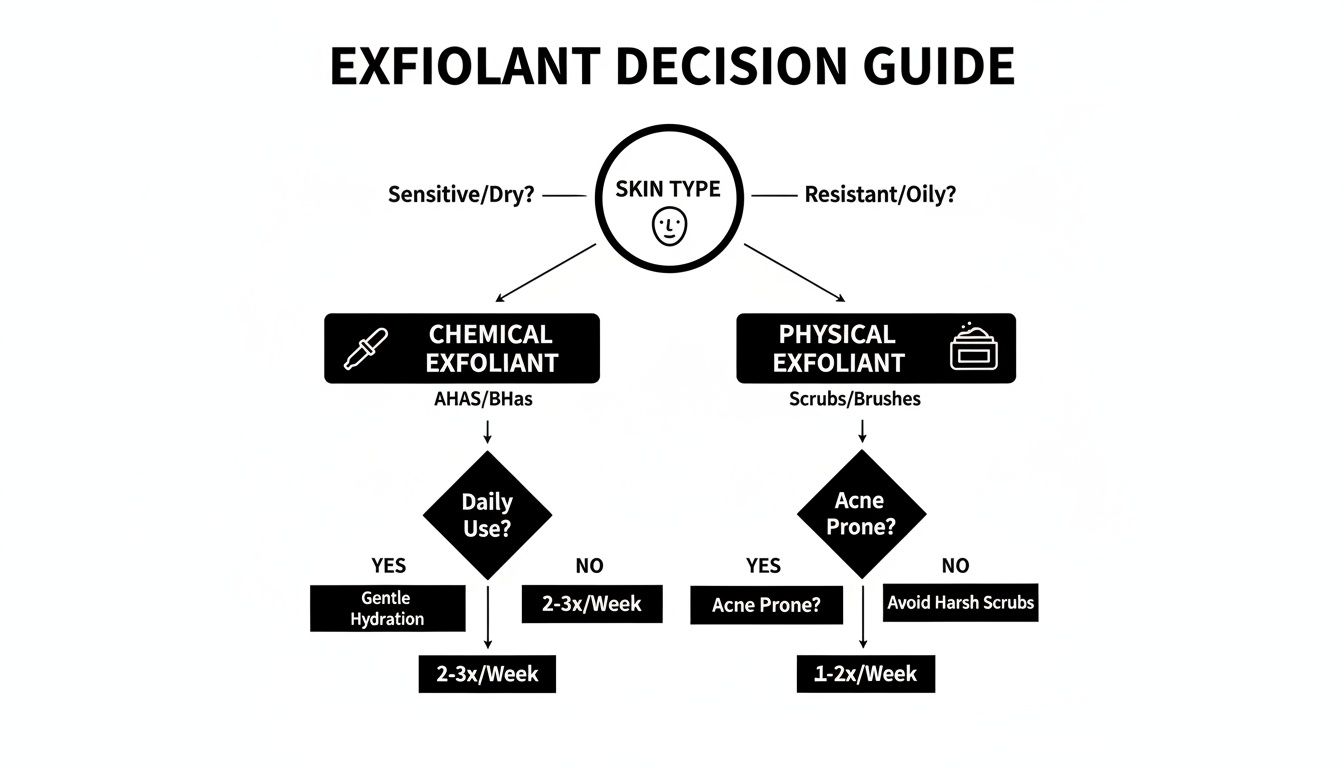
As you can see, acne-prone and oily skin types generally do best with chemical exfoliants, while more resilient skin might handle a physical scrub just fine.
Now that you have an idea of what to use, let's talk about how to use it. We'll walk through how often you should exfoliate and the safest way to make it part of your routine.
Getting Started: A Safe and Steady Approach
Before you dive in, it’s always smart to test a new chemical exfoliant on a small, discreet patch of skin. Give it 24 hours to see how your skin reacts.
Think of this initial phase as a test drive. You're learning how your skin handles the new product, allowing you to fine-tune the "speed" without causing a crash-and-burn of irritation.
- Start slow: For sensitive or dry skin, begin with a once-weekly application of a gentle exfoliant like Mandelic Acid.
- Always patch-test first: This simple step can save you from a full-face reaction.
- Apply to clean, dry skin: This helps the product absorb effectively and reduces the risk of irritation.
This step-by-step method helps your skin build tolerance gradually, setting you up for success.
How Often to Exfoliate Based on Your Skin Type
Once you’re comfortable, you can start tailoring the frequency to your skin’s specific needs.
A good rule of thumb is that oilier skin can handle more frequent exfoliation. For instance, an acne-prone T-zone that gets slick by midday often needs more regular clearing than dry cheeks.
- Oily or Acne-Prone Skin: A BHA like Salicylic Acid is your best friend here. Start with 2-3 times a week.
- Combination Skin: Use a chemical exfoliant about twice a week, focusing on the oily areas and going lighter on the dry patches.
- Normal Skin: Exfoliating 1-3 times per week is usually enough to maintain a healthy glow without going overboard.
Remember, if your cheeks are on the drier side, over-exfoliating them can leave them feeling raw and tight. Listen to your skin and adjust. For more on this, check out our guide on how often you should use glycolic acid.
The Neutralyze Approach to Exfoliation
At Neutralyze, we are experts in formulating with powerful, science-backed exfoliants. Our products are powered by Nitrogen Boost™ Skincare Technology to ensure they work effectively without causing irritation.
- Salicylic Acid (BHA): This is our go-to for targeting the deep-down pore congestion common in oily and acne-prone skin. It's a hero ingredient for clearing out existing breakouts and preventing new ones.
- Mandelic Acid (AHA): For those with more sensitive skin, this gentle giant provides fantastic surface exfoliation without irritation. We utilize it to help smooth texture, reduce redness, and fade post-acne marks.
These ingredients are core to what makes our formulas so effective, delivering a multi-level attack on acne.
The secret to successful exfoliation isn't intensity—it's a gradual, consistent approach that helps you find your skin's perfect balance.
Reading the Signs: How to Listen to Your Skin
Your skin will tell you if you're overdoing it. Keep an eye out for redness, excessive tightness, or any peeling.
Think of your skin like a mood ring—it changes based on what you put it through. Paying attention to these signals helps you avoid pushing it past its limit.
If you see signs of irritation, here's how to course-correct:
- Hit pause. Stop all exfoliation for a few days to let your skin's barrier heal.
- Hydrate. Stick to a simple, soothing moisturizer to help your skin recover.
- Reintroduce slowly. When you're ready, start back with a lower frequency or a gentler formula.
How to Safely Use Exfoliants with Other Acne Treatments
If you’re also using potent actives like retinoids or benzoyl peroxide, it's crucial to give your skin a break. The best strategy is to alternate nights to avoid overwhelming your skin.
| Time of Day | Your Focus |
|---|---|
| Morning | Hydration and SPF |
| Night | Exfoliant OR Other Acne Actives |
- In the morning: Focus on hydrating serums and, most importantly, sunscreen.
- At night: Apply your exfoliant or your other acne treatment, but never both at the same time.
This simple schedule lets you get the benefits of each active ingredient without compromising your skin's health.
Troubleshooting Common Issues
Even with the best plan, sometimes your skin needs a little adjustment.
Let's take a common scenario: Sarah started exfoliating three times a week but noticed persistent redness. She scaled back to twice a week, and the redness disappeared. After a few weeks, her skin had adapted, and she was able to increase the frequency again without any issues.
- Flaking or tightness? That’s a clear sign to reduce your exfoliation days.
- Still seeing congestion? You might try increasing to three sessions a week, but perhaps with a lighter formula.
- New breakouts? Try spot-treating with your exfoliant instead of applying it all over.
This troubleshooting mindset puts you in the driver's seat of your skincare routine.
Advanced Tips for a Clearer Complexion
Once you've got the basics down, you can start refining your approach.
For those with stubborn acne, try gradually increasing your BHA use. Add an extra session every other week, giving your skin plenty of time to adapt without shocking its barrier.
- Follow up with hydration. After you exfoliate, apply a serum with hyaluronic acid to replenish moisture.
- Always wear SPF. This is non-negotiable. Exfoliation makes your skin more sensitive to the sun, so daily sunscreen is a must.
- Alternate your acids. Once your skin is happy with a BHA, you can introduce a mild AHA like Mandelic Acid on different nights. This tackles both clogged pores and uneven texture for a comprehensive treatment.
Think of it like a workout routine. You need rest days to let your skin recover and rebuild. Consistency will always beat intensity.
Recognizing the Warning Signs of Over-Exfoliation
While consistent exfoliation is a powerhouse move against acne, it’s a classic case of "too much of a good thing." Pushing your skin past its limits doesn’t speed up results—it backfires, leading to a damaged skin barrier and, ironically, even more breakouts. A huge part of learning how to exfoliate correctly is knowing when to stop.
Think of your skin's top layer (the stratum corneum) like a well-built brick wall. The skin cells are the bricks, and the natural fats and lipids are the mortar holding it all together. This barrier is your personal security guard, keeping moisture locked in and pollution and bacteria locked out. Over-exfoliation is like taking a sledgehammer to that wall, creating cracks that leave your skin exposed and vulnerable.
Key Symptoms of Over-Exfoliation
When this protective barrier gets compromised, your skin will send out some pretty clear distress signals. Catching these signs early is the key to preventing long-term issues and getting your skin health back on track.
If you notice any of the following, it’s a major red flag that you’ve gone too far:
- Persistent Redness and Irritation: Your skin looks and feels constantly flushed or angry, even hours after you've touched it.
- A Tight or ‘Waxy’ Sheen: Your face feels uncomfortably tight, almost like it's stretched, and might have a strange, shiny film that isn't oil.
- Increased Sensitivity: Products that used to be your holy grail—like a favorite cleanser or moisturizer—suddenly sting or burn upon application.
- Unusual Peeling or Flaking: This isn't the gentle shedding you want. We're talking about patches of dry, flaky skin that signal deep dehydration and distress.
- New Breakouts: A weakened barrier can't properly defend against acne-causing bacteria, often resulting in an eruption of small, red, inflamed pimples.
At its core, the Neutralyze philosophy is all about finding a healthy balance. That means respecting your skin’s natural limits and understanding that aggressive treatments are rarely the path to lasting clarity.
Your Skin Rescue Plan
If those symptoms sound alarmingly familiar, don't panic. The first and most important step is to immediately press pause on all exfoliation. Your skin needs a break to rebuild, and you can help it along with a simple, back-to-basics routine.
When your skin is over-exfoliated, the goal is to stop taking things away and start adding things back. Focus entirely on gentle cleansing, hydration, and protection until your barrier has fully recovered.
Here’s your step-by-step game plan to bring your skin back to a calm, happy place:
- Stop All Exfoliants Immediately: Put away the AHAs, BHAs, scrubs, and exfoliating cleansers. No exceptions. Give your skin a complete rest for at least one to two weeks, or until every last sign of irritation is gone.
- Simplify Your Routine: Strip your routine down to the bare essentials. All you need is a gentle, sulfate-free cleanser, a simple hydrating serum (think hyaluronic acid), a nourishing moisturizer, and a broad-spectrum sunscreen every single day.
- Focus on Barrier Repair: Look for products with ingredients that rebuild that "brick and mortar" structure. Ceramides, niacinamide, and glycerin are all-stars for soothing inflammation and helping your skin heal itself.
- Reintroduce Exfoliation Slowly: Once your skin feels 100% back to normal, you can slowly bring an exfoliant back. Start with just once a week, using a gentle formula like our Mandelic Acid pads, and see how your skin responds before even thinking about increasing the frequency.
Putting It All Together for Consistently Clear Skin
When you're fighting acne, it's easy to think that more aggressive treatments will get you faster results. But the truth is, the real secret to clear skin lies in smart, consistent care. The single most important thing you can learn is how to find the right exfoliation frequency for your unique skin—that’s what makes the rest of your routine actually work.
By choosing gentle chemical exfoliants, you’re essentially clearing the path for your other acne-fighting ingredients to penetrate deeper and be more effective. This is where science-backed formulas like those from Neutralyze come in, taking the guesswork out of building a routine that finally gets you results.
Your Toolkit for Clear Skin
Think of your skincare routine as your personal arsenal against breakouts. To win the battle, you need the right tools and a solid game plan.
Neutralyze arms you with a powerful one-two punch. Salicylic Acid gets down deep into your pores to break up the oil and dead skin cells that cause clogs. At the same time, Mandelic Acid works on the surface, gently resurfacing your skin to smooth out texture and help fade those stubborn post-acne marks. It’s a multi-pronged attack that leads to calmer, clearer skin.
The goal isn’t just to treat existing pimples, but to create an environment where new ones can’t even form. Consistent, proper exfoliation is the cornerstone that makes everything else possible.
The Dermatologist-Approved Approach
This isn't just a hunch; it's a strategy endorsed by the experts who know skin best. Dermatologists are big proponents of gentle, regular exfoliation, especially for those of us with oily and acne-prone skin.
In fact, a national survey revealed that a staggering 88.7% of dermatologists consider it the number one reason to exfoliate. Why? Because they know it helps control oil, stops blackheads and whiteheads before they start, and smooths skin texture. For anyone battling breakouts, that’s a huge deal. You can read more about what dermatologists think about daily exfoliation at cosmoderma.org.
When you build your routine around these principles, you're not just trying random products—you're adopting a professional-level strategy for managing your acne for good. You now have the knowledge and the tools to get the calm, clear skin you've been working for.
Your Top Exfoliation Questions, Answered
Even with the best game plan, it's natural to have a few lingering questions as you figure out the right exfoliation rhythm for your skin. Let's clear up some of the most common concerns so you can move forward with confidence.
Can I Exfoliate If I Have Active Breakouts?
Yes, you can—and you should—but your technique is everything. Reaching for a harsh, gritty physical scrub when you have inflamed pimples is one of the biggest mistakes you can make. That kind of friction can actually rupture breakouts, which spreads bacteria and makes the inflammation even worse.
This is where gentle chemical exfoliants really shine. An ingredient like Salicylic Acid is perfect for this. It doesn't scrub the surface; instead, it gets down into the pores to dissolve the gunk that's causing the clog in the first place. This approach helps active breakouts heal faster and prevents new ones, all without aggravating your already-sensitive skin.
Should I Exfoliate In The Morning Or At Night?
While there's no strict rule against it, exfoliating at night is almost always the better choice. Think about it: exfoliation sloughs off old, dead cells to reveal fresh, new skin underneath. That new skin is more delicate and susceptible to sun damage.
By exfoliating in the evening, you give your skin the entire night to repair and soak up any treatments you apply afterward, all without the added stress of UV exposure.
Pro Tip: I always tell my clients to think of their evening routine as their "repair and treat" session. Using your exfoliant before bed gives your skin a full night to recover and regenerate. Just remember to be diligent with your sunscreen the next morning—it's non-negotiable!
How Do I Combine Exfoliation With Other Acne Treatments?
This is a crucial question, especially if you're using other powerful active ingredients. Things like retinoids (retinol, tretinoin) or benzoyl peroxide also speed up cell turnover, so layering them with an exfoliant on the same night is a recipe for irritation. The secret isn't to stop using one; it's to give your skin a little breathing room.
The safest, most effective strategy is to alternate your treatment nights.
- Night 1: Use your chemical exfoliant.
- Night 2: Use your retinoid or other active treatment.
- Night 3 (Optional): Give your skin a break with a simple, hydrating routine (cleanser, moisturizer).
This "skin cycling" approach lets you reap the full benefits of each ingredient without overwhelming your skin barrier. It’s a smart, sustainable way to manage acne that prioritizes the long-term health of your skin—which is exactly what we're all about at Neutralyze.
Ready to exfoliate the smart way? With Neutralyze, you get expertly formulated products featuring powerhouse ingredients like Salicylic and Mandelic Acid, designed to deliver clear, calm skin without the guesswork. Take control of your acne journey today.


