

Does Pre-Workout Cause Acne? What the Evidence Shows
No single pre-workout has been shown to cause acne, and your risk depends on specific ingredients such as whey protein, high-dose micronutrients, or undisclosed performance ingredients, along with your baseline skin. That answer challenges the most common advice you'll hear in the gym, which is to throw away every tub the moment a breakout appears. A smarter approach is slower. You read the label, you watch the pattern, and you separate what happened after a product from what the product caused.
Why Pre-Workout Gets Blamed for Acne
Starting a pre-workout and seeing a breakout soon after can feel like a clear cause-and-effect story. You add a scoop, then notice more spots on your forehead, jaw, chest, or back. The timing catches your attention, but acne often develops gradually before it becomes visible.
Acne is common among the young people most likely to use these products. A dermatology review of acne epidemiology in young people reports that nearly all people experience some acne between ages 15 and 17. It also notes that approximately 15–20% of young people have moderate-to-severe acne. Historical U.S. estimates put prevalence at 85% among ages 12–24, with 40–50 million people affected overall.
Timing Can Mislead You
A new scoop lands on skin that may already be changing. Acne can build beneath the surface, so a breakout that appears after you start a supplement may have been developing beforehand.
The supplement can also arrive alongside other changes. You may increase protein, train harder, sleep differently, wear hats or straps against sweaty skin, or wait longer to shower. These factors can coincide with a flare, making it harder to identify what played a role.
Practical rule: A breakout after starting a supplement is a clue to track, not a verdict on every pre-workout formula.
What You Can Control First
You can care for a current breakout while you work out whether a particular ingredient is involved. Washing after training removes surface sweat, oil, and debris before they remain on acne-prone areas.
A cleanser can address what sits on the skin, but it cannot establish whether a supplement caused the flare. Keep those questions separate: look at the timing and ingredients, while also caring for your skin.
That way, you can investigate a possible trigger without automatically abandoning training or continuing a formula that seems to be linked to breakouts.
How Sebum, Clogged Pores, and Inflammation Connect to Supplements
A clear photo of early clogging can look deceptively minor, which is why the process underneath matters more than the bump you see today.
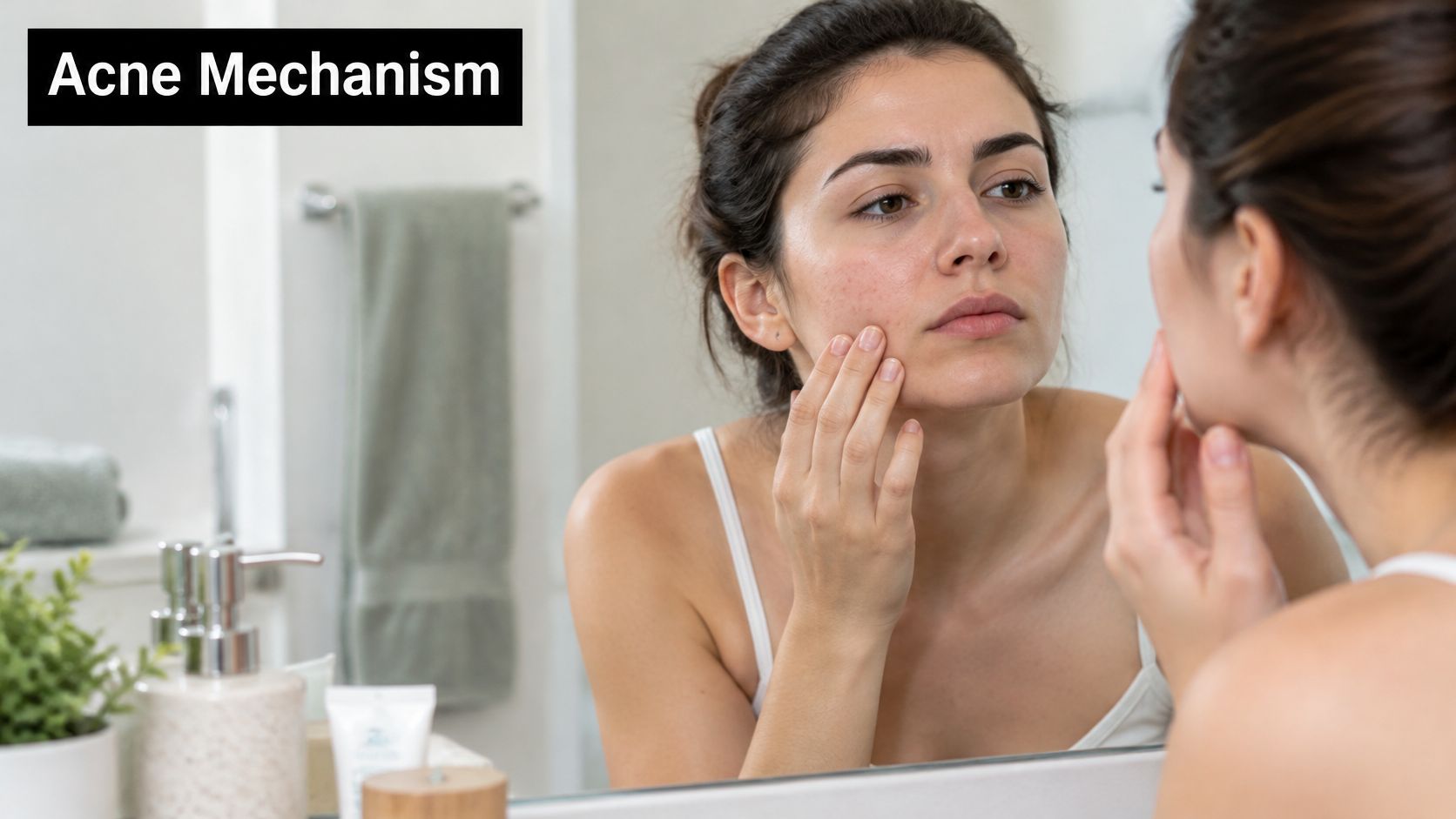
Picture each pore as a narrow drain. Your sebaceous glands pour in sebum, the skin's natural oil. Skin cells are supposed to shed and wash out through that drain in an orderly way.
When the Drain Narrows
In acne-prone skin, cells stick together instead of shedding cleanly. Dermatologists call this follicular hyperkeratinization. The stuck cells mix with sebum, the opening narrows, and you get a plug.
That plug can stay quiet as a blackhead or whitehead. It can also become a better home for Cutibacterium acnes, often shortened to C. acnes, a bacterium that normally lives on skin. When your immune system reacts inside that blocked follicle, inflammation turns a clog into a red papule or a painful pustule.
- More sebum: more material moving toward the opening
- Stickier cells: a narrower outlet for that material
- More inflammation: a clog that becomes visible, sore, and slow to settle
The short video below is a useful pause point before you connect that drain model to anything you drink before training.
Where a Supplement Could Fit
For whey, the proposed pathway involves stimulation of insulin and insulin-like growth factor-1 signaling, which may increase sebaceous-gland activity, follicular keratinization, and inflammatory acne pathways, as described in a review of whey protein and acne mechanisms.
In drain terms, that would mean turning up the faucet while also making debris stickier.
That's a plausible mechanism, not a promise that you'll break out. Your baseline oil production, hormones, genetics, and pore behavior decide how much room that drain had to spare. That is why a training partner can use the same scoop without a single new lesion while you notice a steady flare.
Which Pre-Workout Ingredients Have the Strongest Evidence
Pre-workout is a product category, not a single acne trigger. Two tubs can share the same label and contain very different ingredients, so the useful question is which parts of the formula have a stronger signal.
Ingredients With a Weaker Signal
The reviewed evidence does not establish ordinary caffeine, citrulline, beta-alanine, or creatine as direct acne-causing ingredients, so the stimulant base is rarely the first suspect. The rest of the formula still matters: a product can pair those ingredients with whey, added vitamins, or a proprietary blend.
If you want to simplify your routine without giving up training, a guide to balanced workout fuel offers ideas for choosing workout fuel before reaching for a long ingredient list.
Ingredients That Deserve a Closer Look
The clinical review of supplement-associated skin eruptions points more often to whey protein, vitamins B6 and B12, iodine, and some muscle-building products. Undisclosed performance-enhancing ingredients are harder to assess because you cannot judge what a label does not identify.
Whey has the clearest, though conflicting, signal in the evidence discussed here. In a small observational study summarized in a dermatology review of protein supplementation and acne outcomes, 30 participants were followed for 60 days. Whey was used by 22 of the 30; the proportion with acne rose from 56.7% at baseline to 100% after two months, while the share with none or mild acne fell from 93% to 26.7%.
Those results deserve attention, but the study was small and uncontrolled, so they cannot show that whey caused the change. The same linked review describes a double-blind randomized trial with 25 acne patients on whey and 24 on a non-whey supplement. After six months, investigators found no significant difference in acne lesion counts or severity. That result complicates the picture rather than proving whey has no effect for anyone.
| Ingredient Family | What the Evidence Shows | Practical Label Check |
|---|---|---|
| Caffeine, citrulline, beta-alanine, creatine | Not established as direct acne causes | Check what else is added around them |
| Whey and milk-derived protein | Strongest and most conflicting signal | Look for whey, isolate, concentrate, milk protein |
| Vitamins B6 and B12, iodine | More plausible supplement associations | Note high-dose blends and total stack intake |
| Muscle-building or undisclosed blends | Harder to assess, possible hidden exposures | Avoid proprietary blends you cannot parse |
Whey may also come from a shake rather than your pre-workout scoop. This explainer on whether whey protein can affect acne-prone skin covers that related source.
Separating Supplement Triggers From Sweat and Friction
Your back breaks out under a barbell pad. Your forehead flares under a hat. Your chest gets uniform itchy bumps after hot sessions.
Those patterns don't all belong in the same bucket, even if they all appeared during the same training block.
Four Looks That Get Lumped Together
Acne vulgaris is the familiar mix of comedones, papules, and pustules driven by clogging and inflammation. Acne mechanica comes from heat, pressure, occlusion, and rubbing, so tight clothing, helmets, straps, and equipment are central clues.
Folliculitis is inflammation around hair follicles that can mimic acne, often with more uniform, itchy, or tender bumps. Supplement-associated acneiform eruptions can look acne-like without following the usual comedone-first pattern, which is one reason a clinician's eye matters when the picture doesn't fit.
A clinical review of workout-related and supplement-associated skin eruptions notes that whey-associated eruptions have been reported as severe or extensive and may affect the trunk, and one observational report described lesions beginning within two weeks of protein supplementation with acne formation in most users by four weeks. Those are observational signals, not proof for your skin.
Timing Gives You the First Sort
Ask when the bumps appear, not just where.
- Hours after training: friction, occlusion, contaminated contact surfaces, or sweat left on skin move up your suspect list
- Progressively over several weeks: a dietary ingredient or another changing exposure becomes more plausible
- Only where gear touches: look at the strap, bench, helmet, or shirt before you blame the scoop
- Itchy, uniform, widespread, or painful: consider folliculitis and get examined rather than guessing
Sweat by itself is a weak explanation. Sweat trapped under fabric, rubbed by equipment, and left to sit while you drive home is a much stronger one.
Shower after training, change out of saturated clothing, and clean equipment-contact areas before your skin presses into them. For a fuller routine around training days, see our practical guide to managing gym-related breakouts without skipping workouts.
This sort saves you effort. A friction problem needs fabric and shower changes, while a formula problem needs label testing, and confusing the two can keep both unsolved.
How to Test Your Own Triggers Without Quitting Training
You can keep training while testing whether a supplement affects your skin. The key is to change one variable at a time and give your skin time to respond, like changing one setting in an experiment while keeping the others steady.
The infographic summarizes the process. Use it as a starting point, then record the details that matter to your routine.
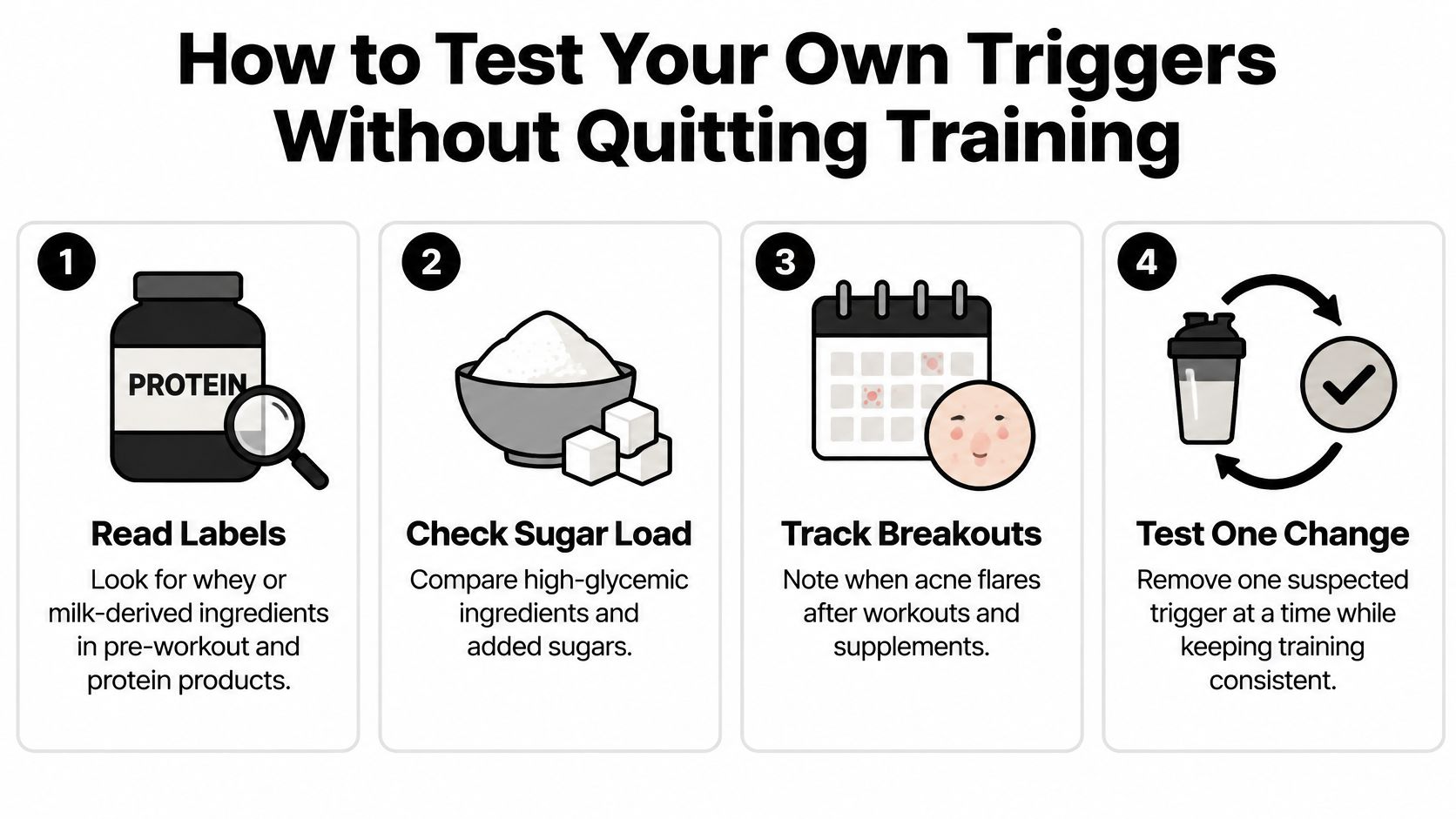
Read Labels and Check Sugar Load
Read the labels on every product you take, including the pre-workout, protein, bars, and ready-to-drink shakes. Look for whey or other milk-derived ingredients, high-glycemic carbohydrates, added sugars, and added B vitamins. Pre-workout is a category of different formulas, so checking the full stack can help you identify a more plausible suspect.
A case-control study summarized on PubMed on whey use in male teenagers and young adults with acne included 201 participants. Whey use was reported by 47% of participants with acne and 27.7% of controls, and the association remained significant after multivariable analysis. That association helps point your investigation toward whey. It cannot tell you whether whey causes your acne.
Check your overall sugar intake, too. A sweetened pre-workout plus a mass gainer later in the day may contribute more to your dietary pattern than caffeine alone.
Track Breakouts and Test One Change at a Time
Treat your log like training data. Photograph your face, chest, and back weekly in the same lighting and from the same angle. Record training days, gear, how long sweat stays on your skin, new lesions, and each supplement you use.
Then remove one suspected trigger while keeping your skincare, diet, and training broadly stable. As a practical testing recommendation, try 8–12 weeks without whey before judging the change. Two workouts are too short a comparison because some lesions may have already been forming.
- Choose the likeliest suspect: whey or a high-dose micronutrient blend may be reasonable starting points.
- Remove only that variable: if whey is in your shake, you can keep using your pre-workout.
- Compare new inflammatory lesions: track what appears rather than changes in older marks.
- Look for a pattern: improvement followed by a return after reintroduction provides stronger personal evidence, though it still does not prove a cause.
If creatine is also under suspicion, read the evidence on creatine and acne concerns before deciding whether to remove it.
Topical care can address clogged pores and inflammation, while your log helps you assess possible dietary triggers. These approaches have different jobs, and neither guarantees clear skin.
Building a Cleanse, Exfoliate, and Hydrate Routine After Workouts
After training, a useful skincare routine follows the same simple logic as changing out of damp clothes: clear away what has collected on your skin, then care for the surface without overdoing it. Each step has one job. Cleansing removes sweat and surface buildup, exfoliating acids help loosen pore congestion, and moisturizer supports comfort so you can keep the routine steady.
Cleanse after you rinse off, rather than leaving sweat on your skin until bedtime.
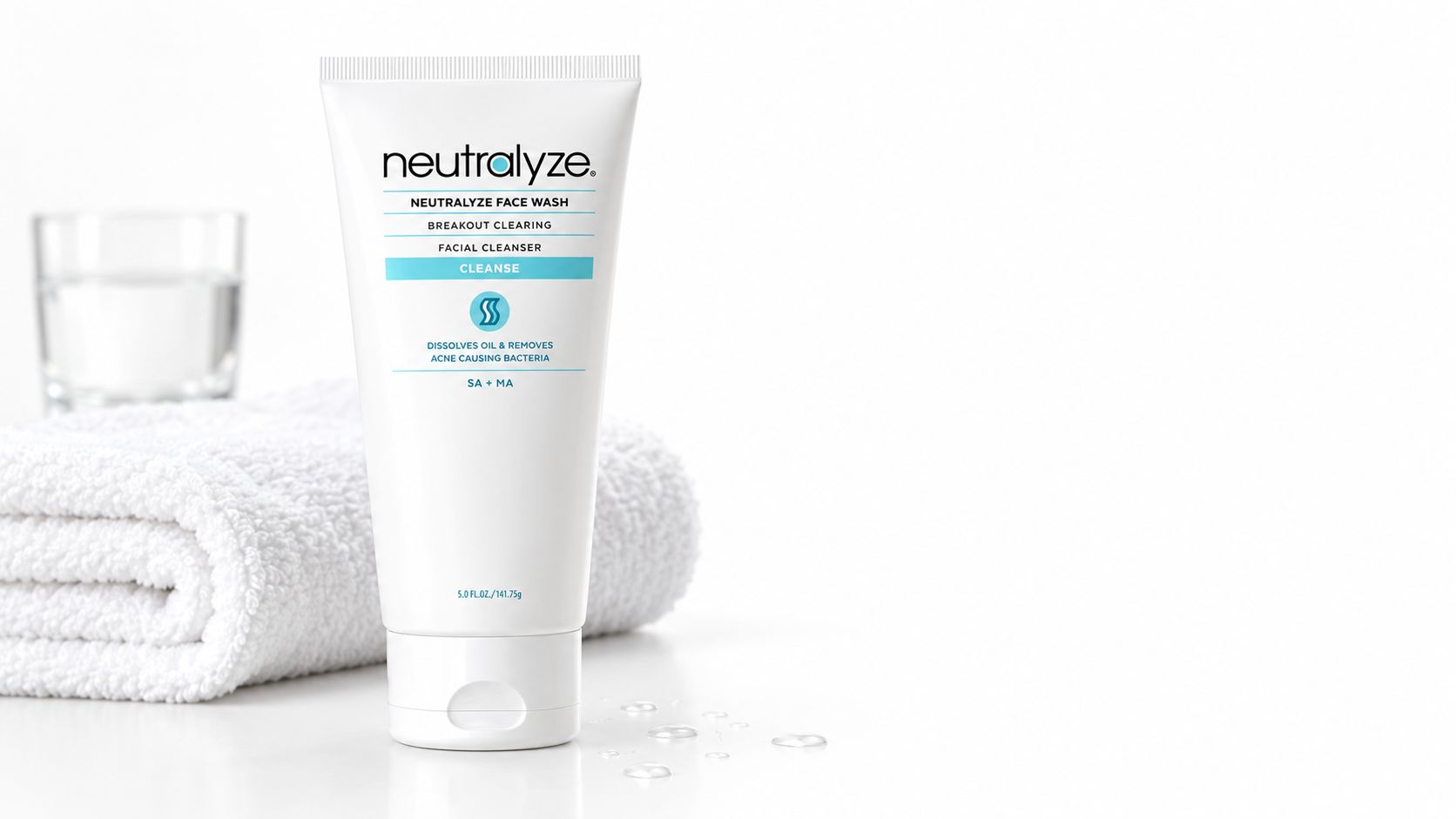
Cleanse After You Train
Use your cleanser on your face and, if needed, on your chest and back where sweaty fabric rested. Pat your skin dry, change your shirt, and avoid reusing workout gear just because it feels mostly dry.
Exfoliate and Hydrate on Purpose
After cleansing, Neutralyze Exfoliating Pads for clogged pores and uneven texture combine salicylic acid and mandelic acid in a leave-on pad format. They may suit skin with blackheads, whiteheads, roughness, or congestion on the shoulders and back.
Finish with the Neutralyze Renewal Complex moisturizer with salicylic and mandelic acid. Moisturizer supports hydration and barrier comfort while exfoliating acids do their work. That comfort can make it easier to use a routine consistently instead of stopping and restarting when skin feels dry.
Routine rule: Introduce one new topical at a time. If dryness or improvement follows, you'll have a clearer idea of which change may be responsible.
Compare the steps by their purpose. The cleanse removes surface buildup after training, the pads target pore congestion and texture, and the moisturizer supports comfort. Used in sequence, the three products deliver salicylic acid and mandelic acid at three points in the routine. No topical routine can guarantee that it will prevent breakouts if another trigger is still affecting your skin.
Keep the routine gentle and repeatable. A steady approach gives you a clearer way to judge how your skin responds than using harsh products whenever a new bump appears.
When to See a Dermatologist and Your Next Step
Self-testing can help identify a possible trigger, but some breakouts need a clinician's assessment. Persistent or unusual bumps deserve more than another round of changing powders.
Signs to Book an Appointment
Arrange an evaluation for bumps that are painful, widespread, itchy, or strikingly uniform. Folliculitis can look like acne but may need different treatment. Deep lesions, spreading inflammation, scarring, dark marks that keep multiplying, or breakouts that persist despite consistent care are also reasons to seek help.
Bring a clear record. Dated photos taken in similar lighting can show how your skin changes over time, including on your face and trunk if both are involved. List every supplement you use, such as pre-workout, protein, vitamins, bars, and muscle-building products. Note when you started each one, when lesions changed, and what you stopped. Include your cleansers, exfoliants, prescriptions, and how often you use them.
A dermatologist can help plan a controlled discontinuation and rechallenge. They can consider your nutrition, training goals, acne severity, and treatment options together, which makes the results easier to interpret than changing several products at once.
This week, take a dated photo and begin the log. Check the labels in your gym bag, then cleanse promptly after your next workout.
At your appointment, bring the exact product labels or photos of the ingredient lists, and mark which products you paused and when. That record can help your dermatologist assess possible triggers and choose the next step.