

Does Creatine Cause Acne? What the Evidence Shows
There is no strong clinical evidence that creatine directly causes acne. A small hormone study raised a possible androgen question, but it never measured pimples, oil production, or acne severity, so timing alone doesn't prove the powder caused your breakout.
Does Creatine Cause Acne or Just Line Up With It
You're a few weeks into a new routine. You're training harder, you're shaking up a drink after every session, and now there's a cluster along your jaw, across your chest, or between your shoulder blades that wasn't there last month.
It's easy to connect those dots in the bathroom mirror. The tub arrived, the spots arrived, so the tub must be to blame.
That timeline feels convincing, but it isn't a test. When you ask does creatine cause acne, you're really asking two different questions. Did something change in your blood, and did that change show up as a clogged pore or an inflamed lesion on your skin?
Why the Gap Matters if You Already Have Acne
If you've dealt with moderate to severe acne for a while, you've probably already cycled through at-home options and maybe prescriptions too. You know your skin can flare for reasons that overlap. A new supplement rarely arrives alone.
Training volume goes up. You sweat more. You might add a flavored blend or a gainer at the same time. Sleep shifts, stress shifts, and a breakout that was already forming under the surface becomes visible right on schedule with the new scoop.
Learning to separate those pieces keeps you from ditching a supplement that isn't the problem, or from ignoring a habit that is.
Not Every Mark Is a New Breakout
Look closely at what you're seeing before you judge it.
- Active lesions: Raised, tender, red, or pus filled spots, plus fresh blackheads and whiteheads, mean follicles are blocked and inflamed right now.
- Post acne marks: Flat brown or red discoloration where an older spot healed isn't a new lesion, and it doesn't tell you anything new about creatine.
Treating a lingering mark like a fresh side effect will confuse your timeline. Count what's active, note what's just fading, and keep those categories separate from day one.
While you sort out the cause, you still have skin to wash after training. A practical first step is a consistent cleanse with Neutralyze Face Wash, a clinically formulated 2% salicylic acid and 1% mandelic acid cleanser you can use on breakout prone areas without adding a pile of new actives at once. That gives you a stable baseline while you check the claim, the lookalike causes, and your routine one at a time instead of changing everything in a panic.
What the Creatine and DHT Studies Actually Measured
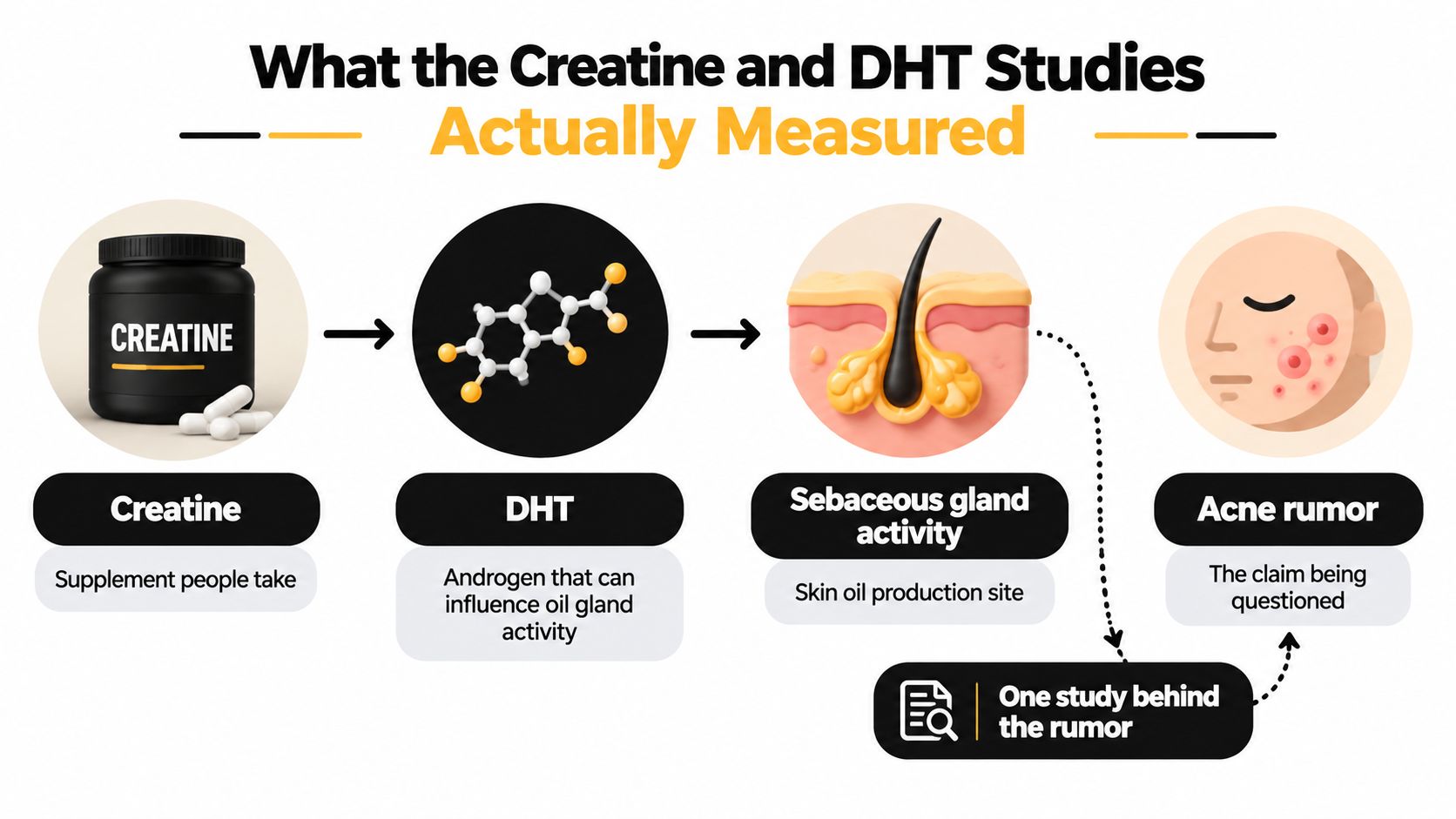
The rumor traces back to one hormone, dihydrotestosterone, usually shortened to DHT. DHT is an androgen, a hormone that can influence sebaceous gland activity. Those glands make sebum, the oil that, in excess, can help block a follicle.
That pathway is real in acne biology. If you want the broader picture of how androgens interact with oil glands, our guide on how to treat hormonal acne walks through that mechanism in plain language.
Think of DHT like a volume signal in the blood. Turning a signal up in a blood test isn't the same thing as watching a pore clog on your chin. A study has to measure skin to prove a skin effect, and that's where the famous study stops short.
The diagram below maps the theory people repeat online, from supplement to hormone to oil gland to rumor.
The 2009 Rugby Study, Step by Step
The study behind most of the discussion was a double blind, placebo controlled crossover trial in 20 university aged male rugby players, where participants took 25 grams of creatine monohydrate daily for 7 days, then 5 grams daily for 14 days in the 2009 trial record on PubMed.
After that loading week, blood DHT rose by 56% from baseline and stayed 40% above baseline after maintenance, while testosterone did not change in that same trial. The DHT to testosterone ratio rose 36% after loading and stayed 22% above baseline during maintenance, according to the same reported results.
Those percentages sound dramatic, which is exactly why they travel so well on social media. What rarely travels with them is the list of things the researchers never recorded.
A hormone change in blood is not an acne outcome on skin. Until someone counts lesions, oil, or severity, you have a possible mechanism, not proof of pimples.
The participants' acne lesions weren't counted. Their oil production wasn't measured. Their acne severity wasn't scored, and the study didn't report anyone developing acne or other skin changes.
It was also small, male only, and short. Twenty young rugby players over three weeks can't tell you what happens to a woman's skin, a teenager's skin, or your skin over months of standard use.
A short researcher discussion helps put that single result in context before you treat it as settled fact.
So what can you repeat from that study? Creatine loading moved a DHT number in a small group. It didn't demonstrate more sebum, more clogged pores, or worse acne in anyone.
Why Later Trials Do Not Confirm an Acne Link
One small positive finding should get retested. If creatine reliably raised androgens, longer and larger trials should keep finding the same signal. They haven't.
The broader safety record started earlier. In 2007, the International Society of Sports Nutrition concluded that creatine monohydrate used within established guidelines was safe and effective, with no scientific evidence of detrimental effects from short or long term use in otherwise healthy individuals in its position stand on creatine supplementation.
What the Follow Up Evidence Shows
A summary of randomized trials covered 10 studies with 218 participants using about 3 to 25 grams per day for up to 12 weeks, and found no statistically significant effect on testosterone across those trials. That doesn't directly answer the DHT question, but it undercuts the idea of a broad, predictable androgen surge.
The most direct modern test came in 2025. Researchers randomized 45 men to 5 grams per day of creatine monohydrate or 5 grams per day of maltodextrin for 12 weeks, and found no significant differences in DHT or testosterone between groups.
That trial used the standard daily dose commonly taken, ran much longer, and still didn't reproduce the earlier hormone jump.
| Evidence | Who and Dose | What Changed | Acne Measured |
|---|---|---|---|
| 2009 crossover study | 20 male rugby players, 25 g for 7 days then 5 g for 14 days | DHT rose, testosterone unchanged | No |
| 10 randomized studies summary | 218 participants, about 3 to 25 g per day for up to 12 weeks | No significant testosterone effect | No |
| 2025 placebo controlled trial | 45 men, 5 g creatine or maltodextrin daily for 12 weeks | No significant DHT or testosterone difference | No |
The Honest Limit of That Reassurance
Read that table carefully. The last column never changes.
None of these trials reported an acne outcome, so they can't prove acne never happens after supplementation for any single person. They also can't rule out a rare individual sensitivity.
What they do show is narrower and still useful. The commonly cited androgen explanation is inconsistent, and a direct creatine and acne relationship remains unconfirmed. When someone asks does creatine cause acne, the accurate answer isn't a guarantee for every face. It's that standard dose creatine hasn't been demonstrated to cause acne, and the hormone story used to support the claim didn't hold up in a longer placebo controlled test.
How Training Habits Can Look Like a Creatine Breakout
Leave the lab for a moment and rebuild the week your breakout showed up. You started creatine, but you probably also started training like someone who just bought creatine.
Harder or longer sessions mean more sweat, more friction, and more time in tight, damp clothing. Add a commute home before you shower, and you've created warm, occluded skin on your face, shoulders, chest, and back for hours.
Those conditions can aggravate acne in exactly the places lifters complain about. Our breakdown of gym acne and post workout skin habits covers why the workout environment itself deserves scrutiny before the supplement does.
Sweating isn't the same as making more sebum, and available evidence doesn't show creatine directly worsens acne as summarized in this Healthline review of creatine and acne. The sweat, occlusion, and delayed cleansing around training are the indirect pathway worth fixing first.
The Product in Your Shaker Might Not Be Just Creatine
Many people aren't taking plain creatine monohydrate. You're taking it inside a pre workout, a mass gainer, a protein shake, or a flavored blend that arrived in the same order.
That stack can bring new additives and a higher glycemic diet along with it. If three products start on Monday and your forehead reacts on Friday, pointing at the one ingredient you recognize isn't a clean conclusion.
Training changes complicate it further. If you're following an adaptive weight training app that keeps pushing volume up, your skin exposure changes every week too, more sessions, more sweat, more contact with benches and straps.
Hold These Variables Still First
- Product label: Switch to pure, single ingredient creatine monohydrate so you know what you're testing.
- Dose: Avoid mega dosing beyond evidence based use, since bigger scoops add noise without adding information.
- Shower timing: Shower soon after exercise and change out of damp clothing instead of sitting in it.
- Skin products: Use non comedogenic products so your routine isn't adding pore clogging ingredients.
- Other triggers: Note hormonal variation, diet, stress, genetics, and skincare changes that could explain the same flare.
No high quality trial has quantified how often these alternatives explain a given breakout. That uncertainty is a reason to control what you can, not a reason to assume the powder is guilty.
How to Track Breakouts Before You Blame Creatine
Guessing from memory will mislead you. Acne fluctuates, marks linger, and you'll remember the worst day more clearly than the baseline. A simple log over several weeks gives you something better than a feeling.
There are no high quality clinical trials comparing acne rates in creatine users and non users, so your careful personal record matters more than another forum anecdote as noted in this Creatine Today overview of creatine and acne. You're building the acne endpoint the trials never measured, at least for your own skin.
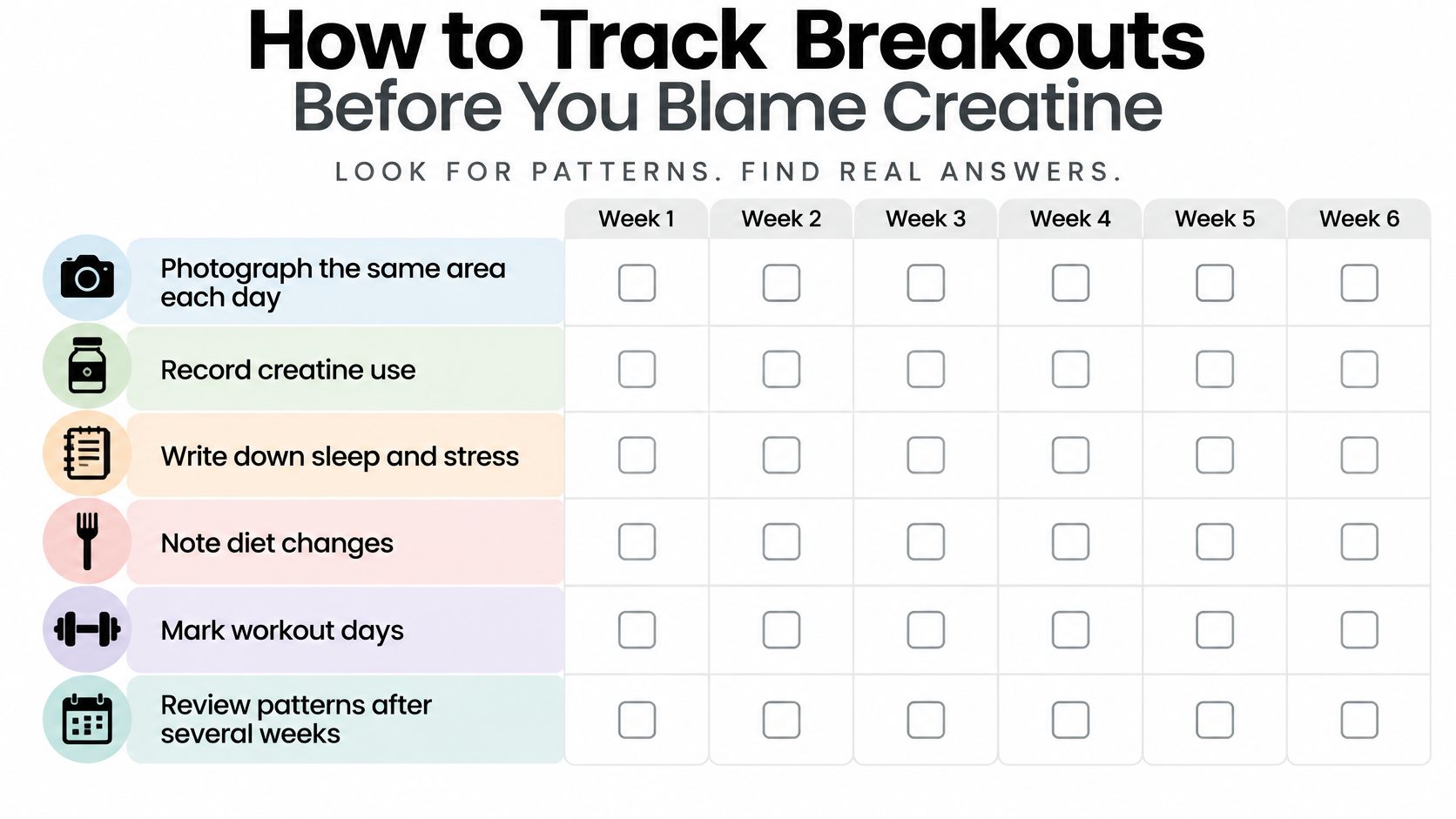
The tracking chart below shows the basic fields worth capturing each week.
What to Record Each Week
Photograph the same sites in similar light, at the same distance. Count inflammatory lesions separately from blackheads, whiteheads, and flat marks, and write down the body location so a back flare doesn't blur into a jaw flare.
Record the exact product name, whether it's single ingredient creatine monohydrate, and your daily dose. List any pre workout, gainer, or protein product started in the same window, since questions like those in our article on whether whey protein can cause acne often overlap with a new creatine routine.
Add training days, how long damp clothes stayed on, and when you showered. If you're already using workout tracking with Strive Workout Log, you can line your skin notes up against session dates instead of guessing which weeks were heaviest.
Finish each entry with sleep, stress, and diet changes. Those boring columns are often where the pattern hides.
How an Elimination Test Should Work
First verify the label and settle on a standard dose of a single ingredient product. Don't change several supplements at once, or you'll learn nothing.
Practical rule: Change one variable, keep the rest stable, and give it several weeks. Improvement after quitting only means something if your diet, routine, and training stayed the same.
Stopping creatine can be an individualized elimination test after that baseline period. If your skin improves while everything else also changed, that's not proof of causation, it's another tangled timeline.
Skip the experiment and get evaluated if you have persistent nodules, scarring, sudden widespread acne, or a severe pattern that keeps escalating. That presentation needs dermatologic care, not a supplement hunch, and earlier treatment gives you a better chance of limiting marks and scars.
How to Treat the Acne You Can See
Whatever started the breakout, the spot you see now needs direct care. You get faster relief when you treat clogged pores and inflammation instead of debating the supplement tub.
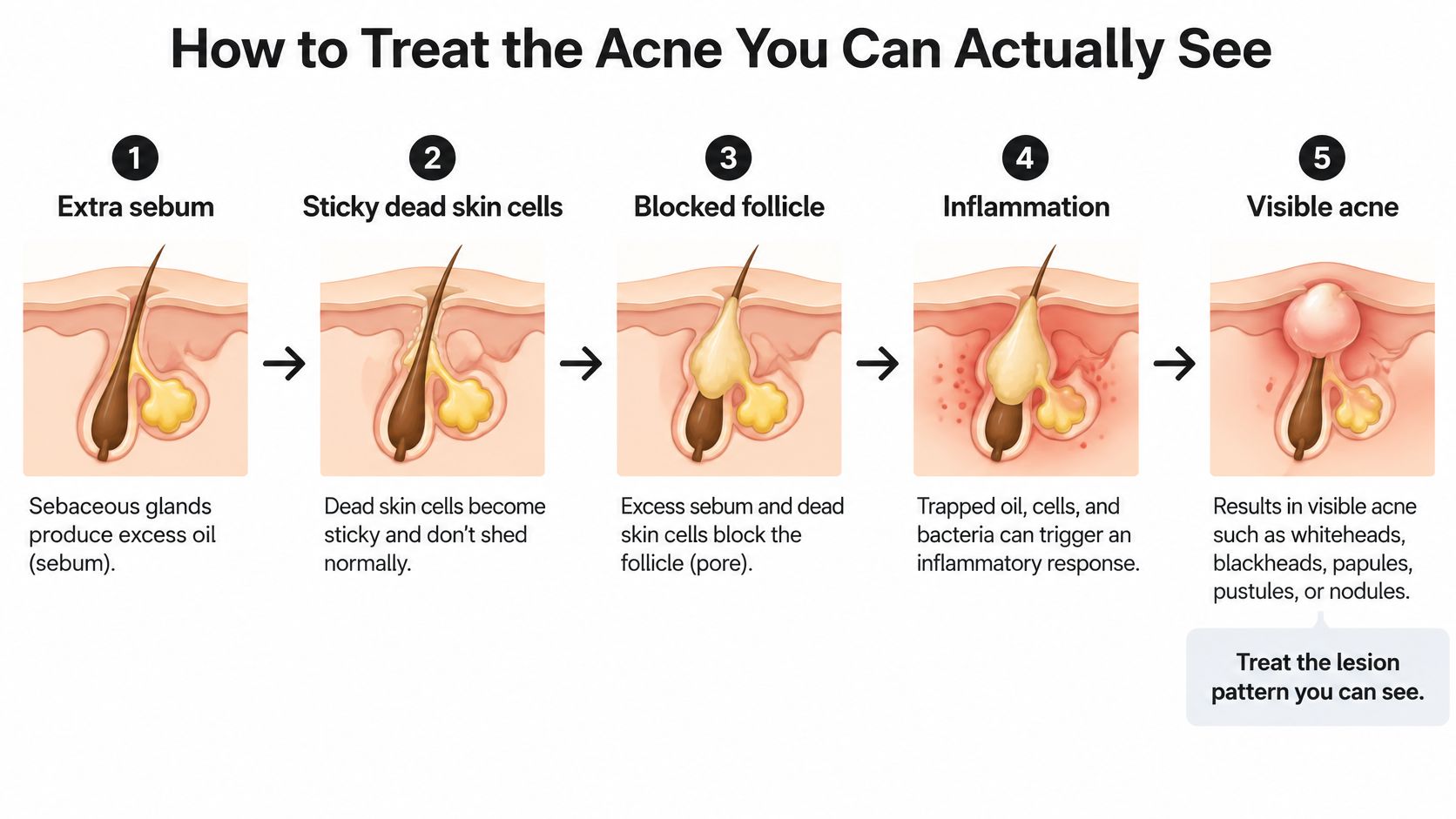
Acne builds in steps. Your sebaceous glands release sebum, dead skin cells turn sticky instead of shedding, and that mix plugs the follicle. Inside that blocked, low oxygen pocket, Cutibacterium acnes can grow, and inflammation turns the clog into a tender red bump.
The clog forms below the surface before the spot shows up, so treatment has to reach the follicle, not just the skin top. Surface washing alone cannot dissolve that plug once it sets.
The flow below shows that sequence from oil to visible lesion.
Why Salicylic Acid Fits Comedonal Acne
Salicylic acid is a topical comedolytic, meaning it helps loosen keratin that contributes to blocked follicles. The American Academy of Dermatology describes it as a treatment that unclogs pores and exfoliates skin in its updated acne management guidelines announcement. That action targets blackheads, whiteheads, and clogged pores whether your breakout appeared during creatine use or not.
Guidance lists it as conditionally recommended with certainty of evidence rated low. Use it as a reasonable at-home tool, not a quick fix. Mandelic acid, an alpha hydroxy acid, sits beside it in this routine to support surface exfoliation and texture.
A Cleanse, Exfoliate, Hydrate Routine
Start with the Neutralyze salicylic and mandelic acid face wash for your daily cleanse after training and at night. It provides the 2% salicylic acid plus 1% mandelic acid step in one wash.
Follow on breakout prone areas with Neutralyze Exfoliating Pads for leave on BHA plus AHA exfoliation aimed at clogged pores and uneven texture. People comparing leave on options sometimes also look at a Wallaby Wellness breakout serum, but keep your own routine to one new leave on step at a time so you can judge tolerance. Introduce it two to three nights per week, then build only if your skin stays calm.
Finish with Neutralyze Renewal Complex, a salicylic and mandelic acid moisturizer for breakout prone skin that also addresses the look of post acne marks. Treating an active clog and fading a flat mark are related goals, but they are not the same job. Marks need patience even after new lesions slow down.
What to Change Next If Breakouts Continue
You don't need another recap of DHT. You need a decision you can act on this week.
Use your log to pick one of three branches. Each one points to a different next move, and only one of them involves quitting creatine right away.
Branch One, Your Counts Barely Moved
If several stable weeks on a standard dose show no real change in active lesions, there's no evidence based reason to blame creatine. Your breakout pattern is behaving like your baseline acne.
Keep the supplement question closed for now and put your energy into consistent pore care, prompt showers, and non comedogenic products. Revisit only if a clear new pattern emerges.
Branch Two, Everything Changed at Once
If your log shows a new gainer, a flavored blend, later showers, and heavier training all starting together, fix those variables before you quit a single ingredient creatine monohydrate. Simplify the stack, shower sooner, and rerun your count.
That's also the moment to ask the original question more precisely. Does creatine cause acne in your case, or did the routine around creatine cause it? Your records can separate those in a way a memory of one bad week can't.
Branch Three, Lesions Are Deep, Widespread, or Scarring
Persistent nodules, scarring, or widespread inflammation aren't a supplement experiment. Book a clinician.
Current guidance evaluates acne through established mechanisms such as follicular plugging, excess sebum, inflammation, and Cutibacterium acnes activity, rather than treating creatine use alone as a diagnosis as summarized in this AAFP summary of acne management guidelines. A professional can grade severity, check for other causes, and discuss treatment intensity that matches what they see.
Keep the gym habit if the evidence supports it. Change the exposures around training, treat the clog you can see, and escalate care when lesions are severe.
That approach respects both sides of your goal. You don't have to choose between training progress and skin you feel comfortable in, but you do have to stop letting one unmeasured hormone number make the decision for you.
Keep training while you treat the clog, not the rumor. Neutralyze builds its cleanse, rejuvenate, and hydrate system around clinically formulated salicylic acid and mandelic acid for acne-prone, breakout-prone skin. Visit the site to build a consistent routine for clogged pores and post acne marks while your supplement log gives you a cleaner answer.