

Can Whey Protein Cause Acne? What the Evidence Says
Whey protein may trigger acne in some susceptible people through an insulin and IGF-1 related pathway, but the evidence isn't definitive and it doesn't reliably cause acne in everyone. That distinction matters if you've just started training harder, added a daily shake, and noticed new spots on your face, chest, or back. You're left asking whether to quit a useful protein source, change your skincare, or wait and hope it settles. The most useful answer isn't a blanket yes or no. It's understanding the plausible mechanism, what studies have and haven't shown, and how to test your own skin without changing everything at once.
The Whey Protein and Acne Question
You bought whey for recovery, not for breakouts. A few weeks after starting it, your forehead gets oilier, closed comedones appear, or painful spots show up along your shoulders. Your training partner uses the same tub and has clear skin, so the whole thing feels inconsistent and frustrating.
That pattern is exactly why people ask, can whey protein cause acne, and then find conflicting answers online. Some sources treat whey as a proven cause. Others dismiss any link because many users never break out. Both positions skip a key middle ground. A product can affect a susceptible subgroup without affecting everyone.
A Systemic Effect, Not Dirt on the Skin
Whey doesn't sit on your pores like a heavy cream. The proposed effect happens after digestion. Reviews link whey to milk's insulin stimulating effect and downstream skin changes, including increased sebaceous gland activity, faster keratinocyte growth, and follicular plugging.
Think of those three processes in plain terms. Sebaceous glands make sebum, your skin's oil. Keratinocytes are skin cells lining the follicle. If oil increases while those cells build up, the pore narrows, material gets trapped, and inflammation has an easier path in.
Whey isn't being accused of clogging pores from the outside. The question is whether signals after digestion make oil and cell buildup more likely from the inside.
Your overall routine matters too, which is why general background on timing, training, and recovery can help you separate supplement questions from skin questions. Whey Protein Recovery: What to Know is useful context if you're reviewing why you started whey in the first place. That review helps you decide what you'd need to replace if you pause it.
What a Fair Answer Sounds Like
- Timing matters: Breakouts that begin soon after starting whey deserve closer attention than acne that predates it by years.
- Susceptibility matters: A clear response in one person doesn't disprove a reaction in another.
- Proof is limited: A plausible pathway and a personal pattern aren't the same as proven population level causation.
While you sort out cause, don't abandon basic acne care. A consistent cleanse, exfoliate, and hydrate routine built around salicylic acid and mandelic acid targets clogged pores and surface buildup directly. That stability also makes any later elimination test far easier to interpret, because you won't be guessing whether a new cleanser or the whey pause changed your skin.
How Whey Protein Could Affect Your Skin
The visual below maps the main pathway in simple steps, from a shake to signals that may influence oil glands.
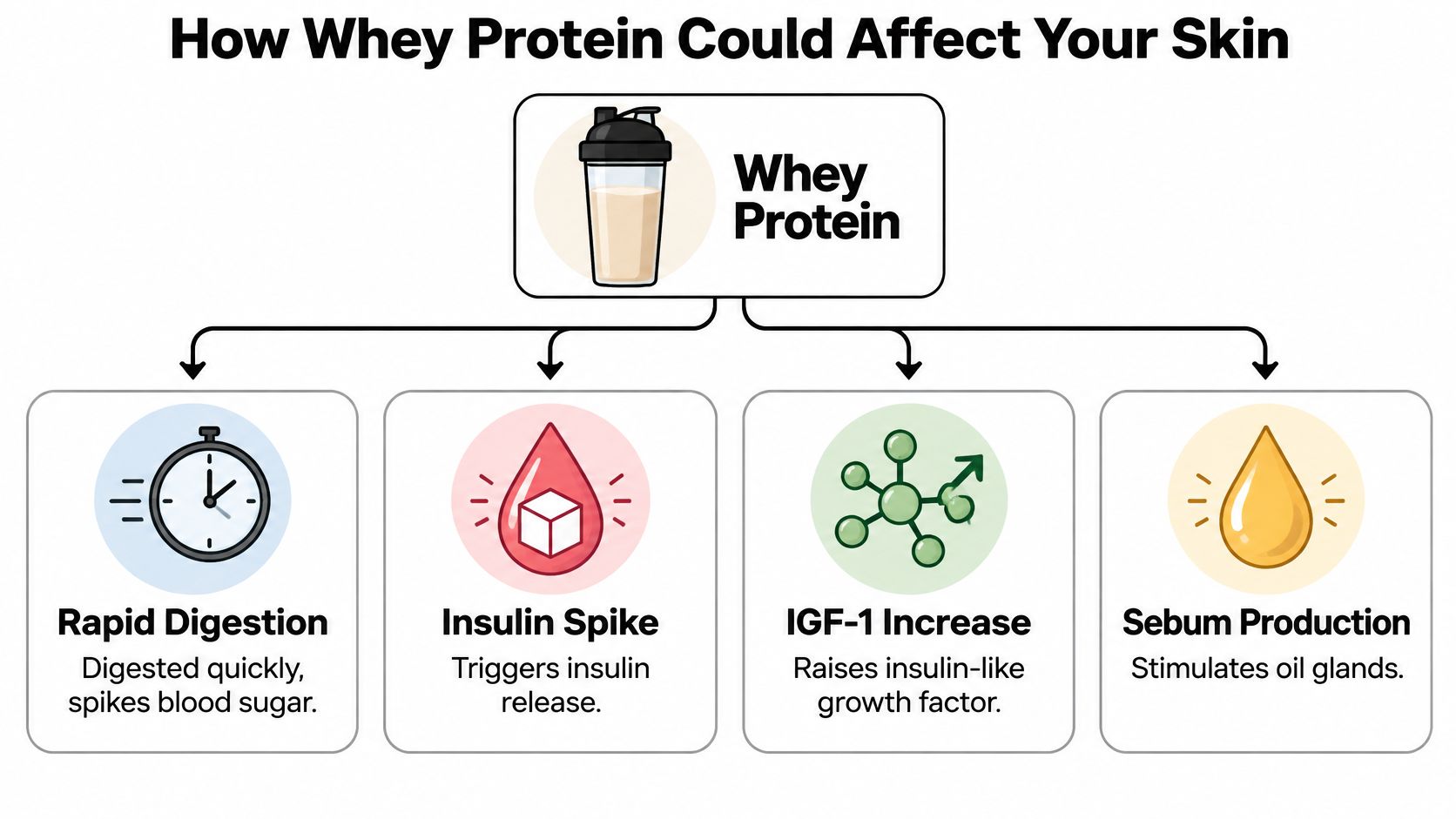
Whey is digested quickly. That rapid digestion can produce a relatively strong rise in insulin after you eat or drink it. Review evidence describes a pronounced insulinotropic effect, including a 21% increase in fasting insulin after whey without a corresponding IGF-1 increase in one study. That detail is important because it shows the story isn't a simple chain where every marker rises together in every person.
From Insulin Signal to Clogged Follicle
Doctors use insulinotropic to mean something promotes insulin release. Insulin and IGF-1, short for insulin like growth factor 1, act like growth oriented messengers. In skin, that signaling may amplify androgen activity, increase sebum output, and encourage follicular keratinization, which is excess cell buildup inside the pore.
Use a narrow tube as an analogy. If you increase the flow of oil through the tube while also thickening its lining, blockage becomes more likely. Once a follicle is plugged, C. acnes bacteria and inflammation can turn a small clog into a visible papule or pustule.
- More sebum: Oil glands become more active, so follicles fill faster.
- More cell buildup: Keratinocytes multiply or shed less cleanly, narrowing the opening.
- More inflammation risk: A trapped, oily follicle is more likely to become red and sore.
If you're comparing isolate, concentrate, plant blends, and other powders while you think this through, the Maximum Health Products protein guide gives helpful background on how protein types differ. For acne specifically, there's no established dose threshold and no proven ranking that one whey form is safe while another is harmful.
The video below expands on the same skin pathway in visual form, which can help if the hormone terms feel abstract.
A common point of confusion is assuming that because this pathway is plausible, it's proven for you. It isn't. Plausibility tells you the hypothesis is worth testing, especially if your timing fits. It doesn't tell you to cut all dairy, lower your protein, or blame whey for acne driven mainly by hormones, friction, or an inconsistent routine.
What the Research Actually Shows
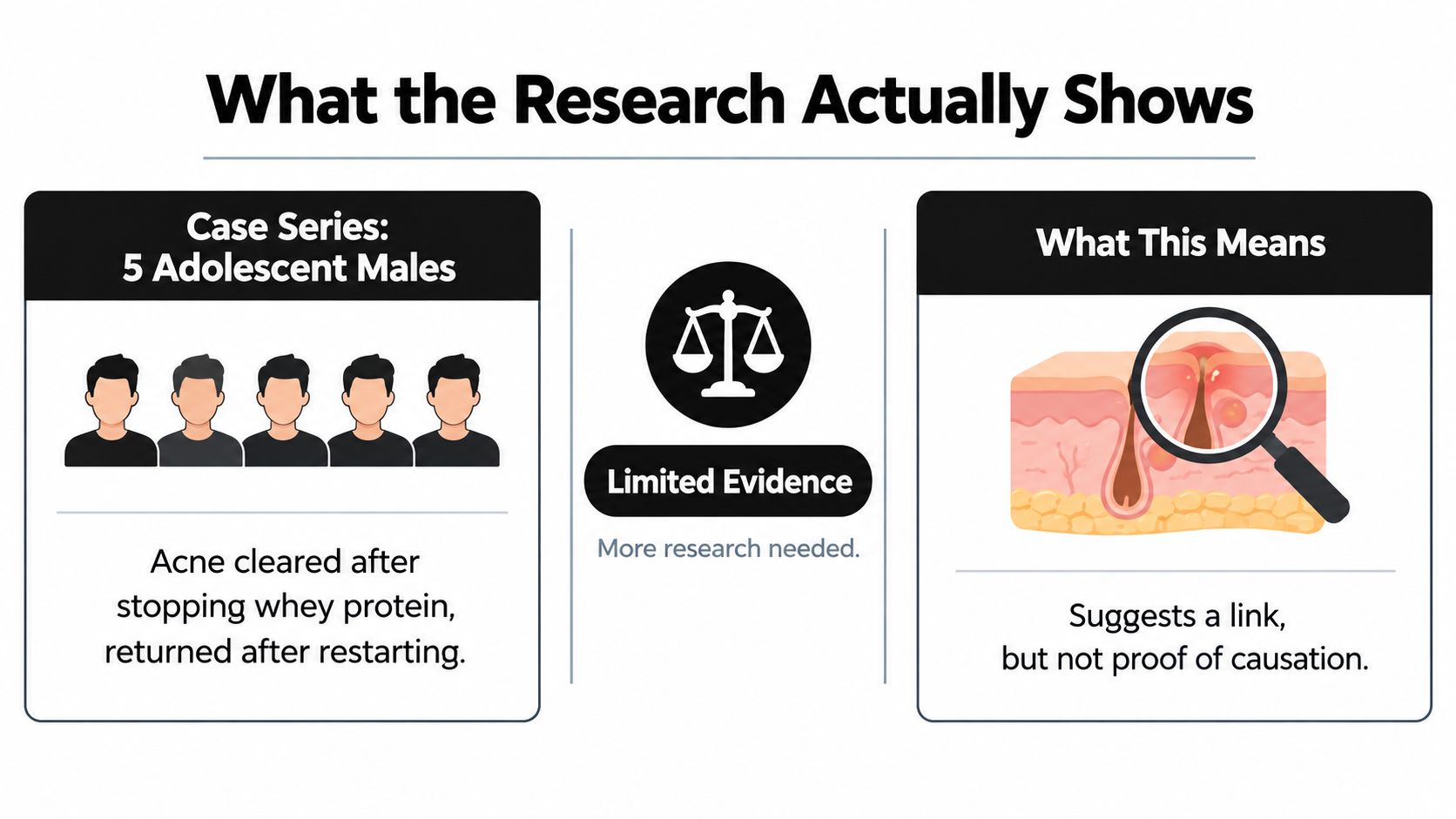
The research tells a mixed story, and that mix is the point. This summary graphic contrasts a striking case pattern with the limits of drawing broad conclusions from it.
Case Reports That Raised the Question
The strongest whey specific signal comes from a small series, not a large trial. Five males aged 14 to 18 developed acne soon after beginning whey, acne cleared after discontinuation in four, and one flared after restarting. Dermatologists call that pattern dechallenge and rechallenge. The problem improves when exposure stops and returns when exposure resumes.
A separate published account adds timing detail you'll recognize. Acne cleared after stopping whey and one patient flared within one week of reintroduction. That supports possible individual sensitivity, but five patients without a control group can't prove how common the effect is.
Another report focused on body breakouts. Six healthy males aged 16 to 18 developed acne limited to the trunk after starting whey supplements, and severity improved after discontinuation alongside treatment. Because treatment changed at the same time, you can't cleanly separate the effect of stopping whey from the effect of acne therapy.
Larger Comparisons and a Contradictory Trial
Observational work points in a similar direction but still can't prove cause. A 2024 case control study compared 100 people with acne vulgaris with 101 healthy controls and reported an association between whey supplementation and acne. Matching for factors such as age, body mass index, smoking, and steroid use strengthens it beyond anecdotes, yet people weren't randomly assigned to whey.
Against that, a small double blind randomized trial found no difference in acne count or severity between whey and non whey users. That result matters because randomization reduces some confounding. It also shows whey doesn't create acne on a predictable schedule for every user.
| Evidence Type | What It Can Show | Main Limit |
|---|---|---|
| Case series | A clear timing pattern in individuals | No control group, very small numbers |
| Case control study | An association in a larger group | Association isn't causation |
| Randomized trial | A fairer comparison between groups | Small size limits broad conclusions |
If dairy more broadly is part of your concern, our guide to dairy and acne separates milk as a food category from concentrated whey supplements. Keeping those categories distinct prevents an unnecessary jump from pausing one shake to eliminating many foods.
Practical rule: Treat the literature as a reason to run a careful personal test, not as proof that every acne prone person must avoid whey forever.
Why Some People Break Out and Others Do Not
Two people can use the same powder and get opposite results because acne isn't a single switch. Your baseline sebum, hormone sensitivity, age, genetics, and existing follicular plugging all change how much an added signal matters. If your pores are already close to blocking, a modest push may be enough. If they aren't, you may notice nothing.
Reports often involve adolescent and young adult males, including face and trunk acne. That concentration may reflect who commonly uses whey for muscle gain, and it may also reflect a life stage when hormones and sebum are already active. You shouldn't assume the risk applies equally at every age or that absence of reports in another group means there's no risk.
Cause, Contributor, or Marker
A 2024 study of 201 male teenagers and young adults at fitness centers found a strong association, while a randomized comparison of 25 whey users and 24 non whey users found no difference. Those findings can both be true if whey use travels with other habits, or if only a subgroup responds.
Starting whey often coincides with several changes at once:
- Bulking calories: More food overall, sometimes with a higher glycemic load.
- Training load: More sweat, friction from clothing, and longer time before showering.
- Supplement stack changes: Several new products begin in the same week.
- Adolescent hormones: Natural acne fluctuation overlaps with new gym habits.
That's why stopping five products, changing your diet, and starting a harsh new routine rarely gives you a clean answer. Your skin may improve, but you won't know which change mattered. Worse, you may keep avoiding foods or supplements you tolerate.
No Reliable Threshold Yet
There's no proven daily amount below which whey is acne safe, and no reliable timeline that applies to everyone. Isolate, concentrate, and hydrolysate haven't been separated clearly enough to promise that switching forms solves the issue. Flavored products add another variable, but the evidence doesn't let you assign blame to flavoring alone.
Your personal timeline is therefore useful, but it needs context. Did lesions start after whey, or after training volume, calories, and sleep all shifted? Did they appear mainly where sweat and straps sit, or as new inflammatory lesions in your usual acne zones? Those questions help you design a test rather than chase every possible trigger.
How to Test Your Own Sensitivity Safely
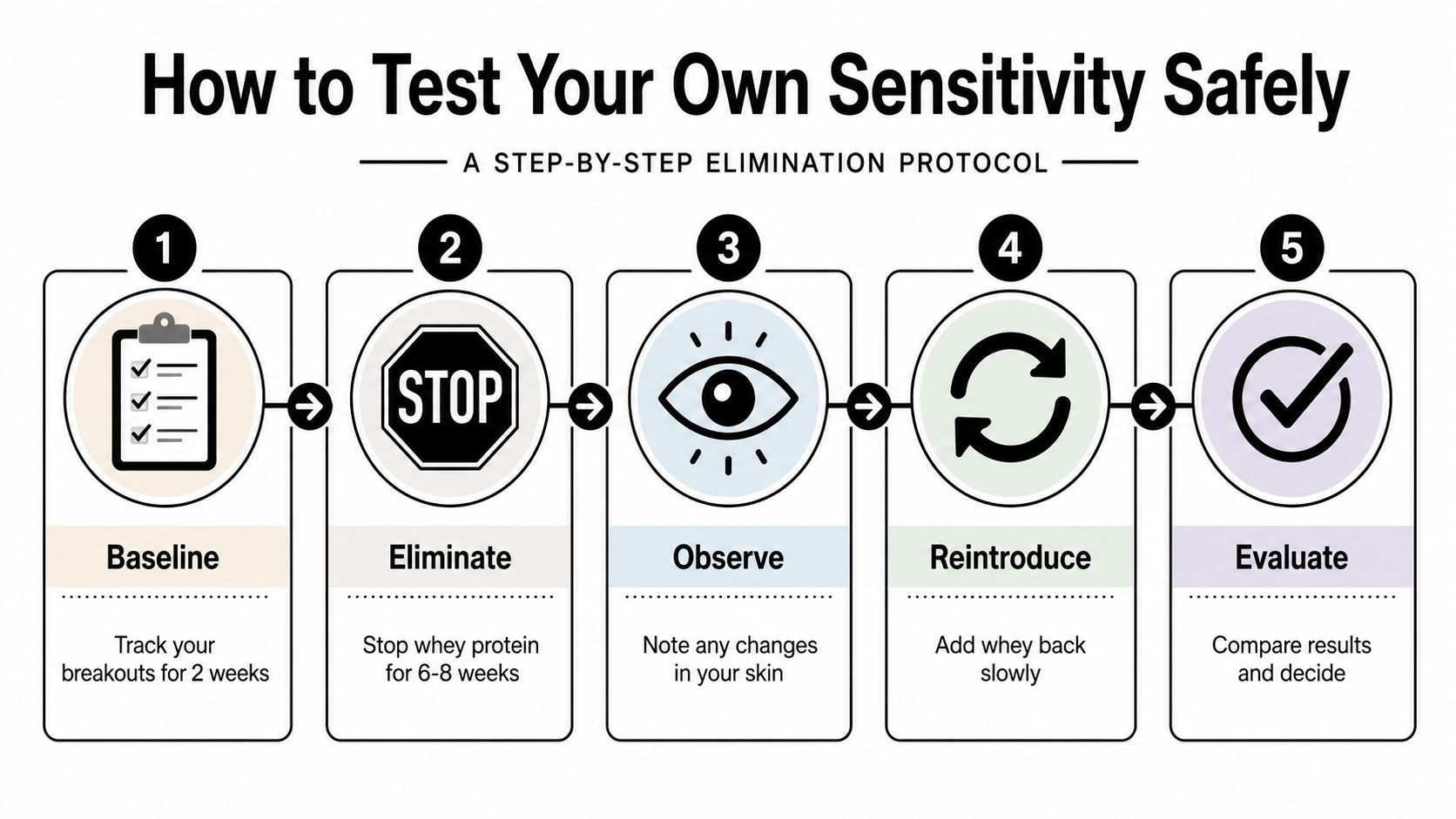
A controlled substitution is more informative than quitting protein supplementation in frustration. You're testing one hypothesis: does removing whey, while keeping nutrition and care steady, change your breakouts? The flow below outlines the sequence before you start.
Set Your Baseline First
Take clear photos in the same light and note where lesions occur, how many are inflamed, and whether new ones are painful. Record your whey amount, training schedule, calorie target, other supplements, and current skincare. This takes minutes but prevents vague memories later.
Don't introduce a new acne-prone skin care routine on day one of the test. If your routine is already established, keep it. If it's chaotic, stabilize the basics first, because an elimination trial layered onto constant product changes won't teach you much.
Run the Elimination
- Stop whey for 6 to 8 weeks: Replace it with a nutritionally equivalent non whey protein or whole food protein so total intake doesn't crash.
- Keep calories steady: A sudden calorie drop changes more than whey exposure and can confound the result.
- Keep training steady: Maintain your usual volume and post workout shower habits where possible.
- Keep skincare steady: Don't add peels, swap cleansers weekly, or stop treatment to see what happens.
- Track weekly: Use the same photos and simple lesion notes rather than judging from one bad morning.
If you need broader structure for meals during the swap, our clear skin diet guide can help you keep the rest of your eating pattern consistent. Consistency is the goal here, not perfection.
Reintroduce Only If It Makes Sense
If your skin improves meaningfully, you can reintroduce whey cautiously while other variables stay stable. Recurrence after reintroduction strengthens suspicion for you personally. It still doesn't prove causation in a scientific sense, because acne naturally fluctuates.
Don't reintroduce whey and a new pre workout in the same week. You'll lose the very information the test was built to give you.
If nothing changes after a fair trial, whey is less likely to be your main driver. Keep the protein source you prefer and look harder at routine consistency, friction, hormones, or the need for medical treatment. A negative test is still valuable because it stops you from restricting your diet without benefit.
Managing Breakouts While You Test
Some people pause their acne routine while testing whey so they can "see what happens." That muddies two things at once: the experiment and your skin. Keep treating active acne throughout the test so follicles stay clearer and moderate breakouts don't deepen while you wait for an answer.
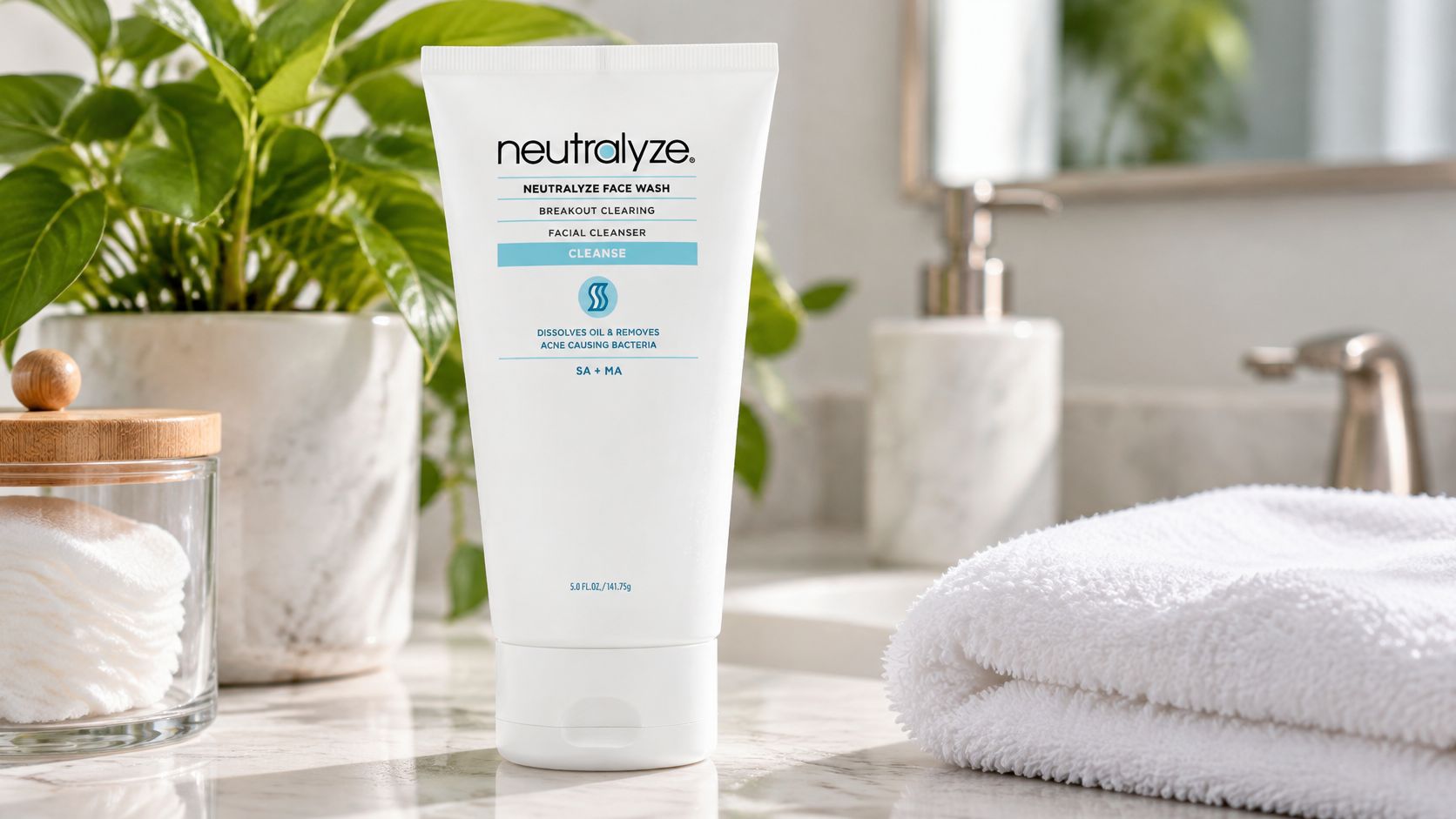
Cleanse, Exfoliate, Hydrate
Salicylic acid is a beta hydroxy acid, which means it's oil soluble. That lets it travel into a congested pore and help loosen the mixture of sebum and dead cells behind blackheads and whiteheads. Mandelic acid works differently. It's an alpha hydroxy acid that loosens dead cells at the surface, improving texture and the look of post acne marks without aggressive scrubbing.
A routine built on both actives covers three jobs:
- Cleanse: Neutralyze Face Wash uses 2% salicylic acid and 1% mandelic acid for daily cleansing of acne prone skin on the face and body.
- Exfoliate: Neutralyze Exfoliating Pads deliver salicylic and mandelic acid in a leave on pad format for clogged pores, oily zones, chest, and back.
- Hydrate: Neutralyze Renewal Complex is a time-released moisturizer with salicylic and mandelic acid designed to hydrate while continuing gentle exfoliation.
Consistency beats intensity here. Over exfoliating stings, raises redness, and pushes you to quit mid test. Treating new lesions and fading the look of old marks are also separate jobs. Reduce fresh clogged and inflamed spots first, and marks tend to improve once fewer new ones keep replacing them.
Sweat and friction can add to the load during a whey trial. Cleanse after heavy sessions, change out of tight damp clothing, and keep straps from rubbing the same inflamed spot day after day. Our practical guide to gym acne covers those mechanical triggers, which can overlap with any dietary sensitivity.
See a dermatologist if you're dealing with persistent moderate to severe acne, painful nodules, or scarring. A dietary test should never delay care for deep or scarring lesions, and a clinician can decide whether prescription treatment belongs alongside your routine.
The Bottom Line on Whey and Acne
Whey may worsen acne in a susceptible subgroup, but it doesn't reliably trigger breakouts in everyone. The biology is plausible, case patterns are suggestive, and controlled evidence is mixed. That combination calls for curiosity, not fear.
If your acne began after supplementation, run a 6 to 8 week substitution test and change only whey. Keep calories, training, and skincare stable, then judge your photos rather than your mood on a single day. If you improve and flare on cautious reintroduction, choose a non whey protein that supports your goals. If you don't improve, don't keep restricting without evidence.
Acne is multifactorial. Sebum, follicular hyperkeratinization, bacteria, and inflammation can all contribute at once, so one dietary change is rarely the whole plan. Pair a fair test with consistent salicylic and mandelic acid care, and get medical help for severe or scarring disease. You'll get a clearer answer about whey and better day to day control while you find it.
If breakouts are continuing while you test your protein, build your routine around the clinically formulated salicylic acid plus mandelic acid system from Neutralyze, with cleansing, exfoliation, and hydration steps for acne-prone skin. Explore the formulas, choose the step that fits your current routine, and keep it consistent while you track how your skin responds.