

Can Dairy Cause Acne? What the Research Says
Research suggests dairy, especially skim milk, may be associated with acne in some people, but the evidence is observational and doesn't prove that dairy causes acne for everyone. In one large study, the highest milk consumers had a 22% higher prevalence of severe acne than the lowest consumers, while the association for skim milk was 44%.
If you're dealing with persistent breakouts, it's understandable to look for something in your diet that you can change. But dairy isn't a universal acne villain, and cutting it out may not address the factors driving your spots. The more useful question is whether a specific dairy food seems to affect your skin, and how to test that without abandoning effective acne care.
What the Research Says About Dairy and Acne
The evidence points to a possible connection between milk and acne, but it doesn't establish that milk causes breakouts. A major cohort analysis published in 2005 examined high-school dietary habits recalled by 47,355 women enrolled in the Nurses' Health Study II. Women in the highest category of total milk intake had a 22% higher prevalence of severe teenage acne than women in the lowest category. The association was stronger for skim milk, at 44% higher prevalence. These results were adjusted for several factors, but the study was observational and relied partly on recalled diet, so it can show an association, not cause and effect (2005 cohort analysis).
A later meta-analysis also found a modest association. Across the observational studies it combined, milk consumers had 16% higher odds of acne than non-consumers. The estimate was stronger for skim milk than low-fat milk, and the analysis found a positive association with moderate-to-severe acne, but not a statistically significant one for mild acne (2018 meta-analysis). These are population-level averages. They can't tell you whether milk is contributing to your own breakouts.
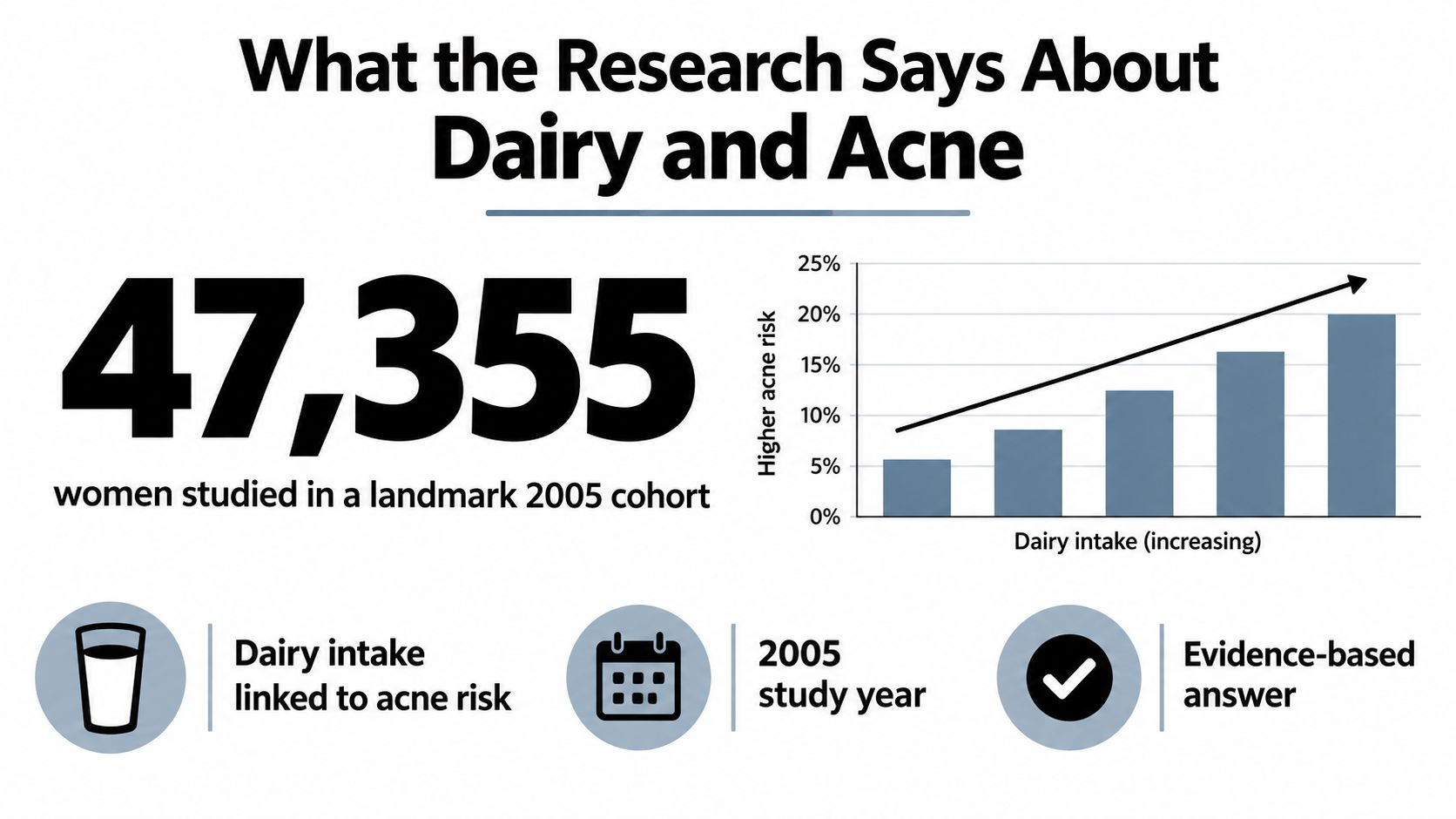
A systematic review published in 2022 found that 16 of 23 studies examining dairy reported an association between at least one dairy food and acne development or severity. Yet the studies varied in their populations and methods, and the review found no randomized controlled trials testing whether avoiding dairy prevents or improves acne (2022 systematic review).
That combination matters: the association is worth taking seriously, but it isn't a reason to assume every person with acne needs to give up every dairy food. If you're wondering whether other foods might be worth evaluating, this discussion of chocolate and pimples offers related context without turning diet into a one-size-fits-all explanation.
Does Milk Affect Acne Differently Than Cheese or Yogurt
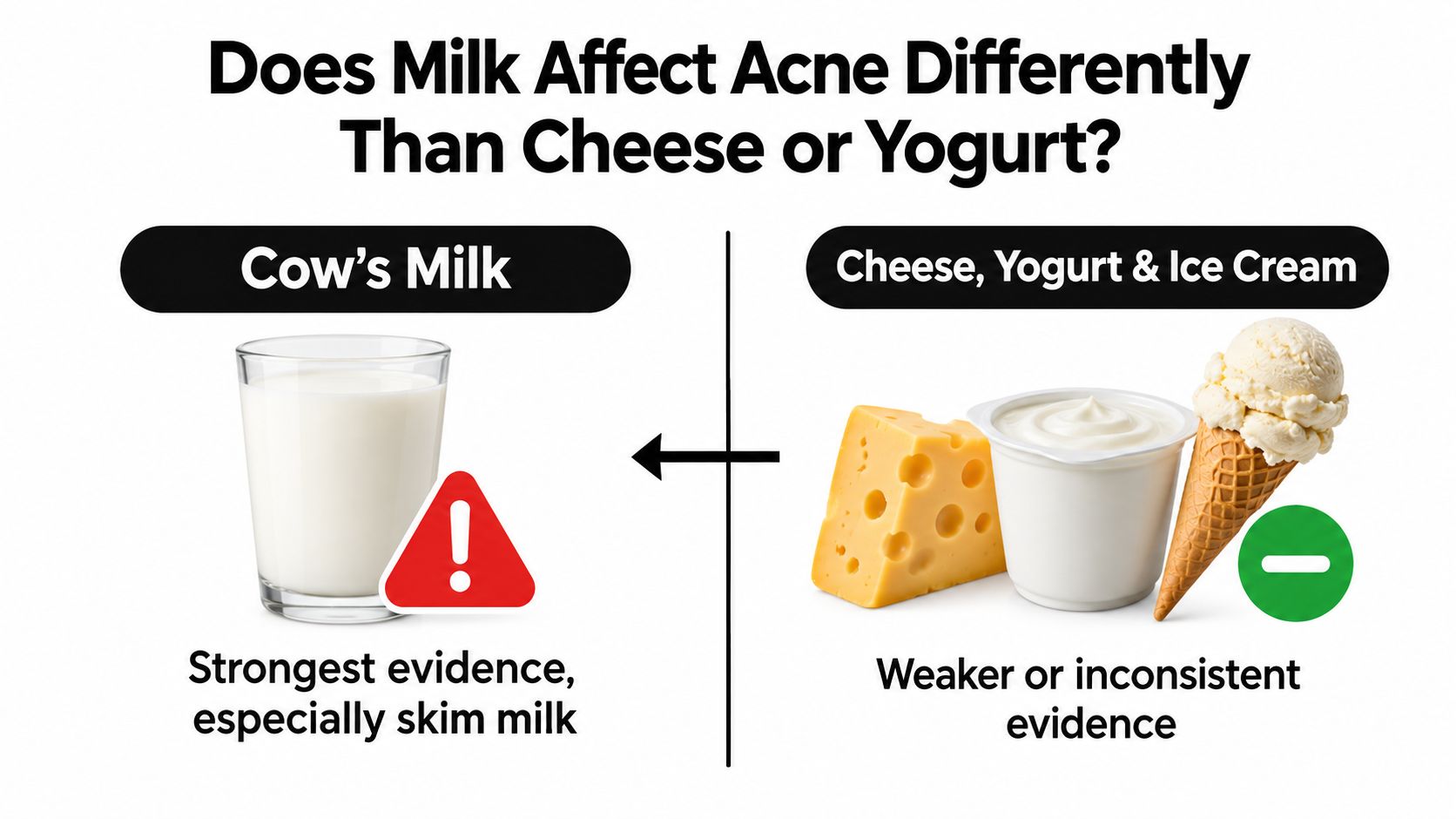
“Dairy” covers foods that differ in how they're made and consumed. The clearest signal in the acne research is for cow's milk, while evidence for cheese, yogurt, and ice cream is weaker or inconsistent. Some epidemiologic reviews report no significant association for those other products, which is why treating all dairy as one interchangeable category can lead to unnecessary restrictions (review of milk and acne evidence).
Milk types are not interchangeable
The association with skim milk can seem surprising if you assume dietary fat is the main factor. In the 2005 analysis, skim milk had a stronger association with severe acne than whole milk. The 2018 meta-analysis also reported a stronger estimate for skim milk than low-fat milk. These findings don't show that less fat causes acne. People who choose different types of milk may also differ in how much they drink, what else they eat, or other factors that the studies can't fully separate.
The practical takeaway isn't to switch from one type of milk to another and expect a predictable skin result. It's to pay attention to the particular product you consume and whether a pattern appears for you. If you regularly use whey-containing drinks or milk-based protein shakes, record those separately rather than lumping them together with yogurt or cheese. The available evidence doesn't establish that whey drinks cause acne, but noting them can make a personal trial more informative.
If you're reducing milk but want options for snacks, this dairy-free cheese snack guide from Gym Snack may help you explore alternatives. The aim is not to label foods “safe” or “unsafe,” but to make any experiment specific enough to learn from.
How Dairy Might Influence Acne Formation
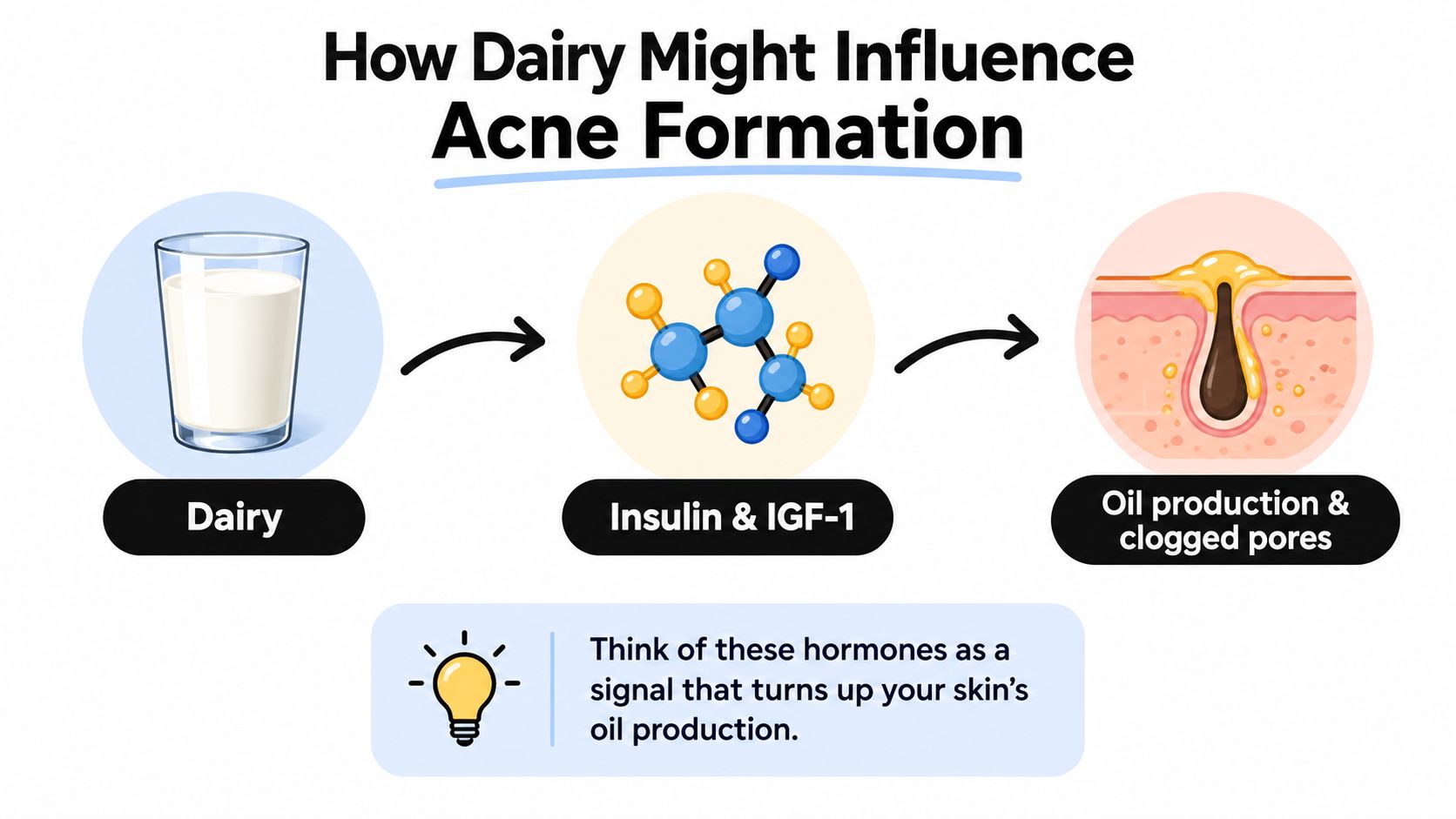
Acne develops through several connected processes, not because a pore gets dirty. Oil glands produce sebum, dead cells can build up along the pore lining, and clogged follicles can become inflamed. The skin bacterium Cutibacterium acnes also plays a role in acne lesions. Dairy has been studied as a possible influence on some of these processes, especially through insulin and insulin-like growth factor 1, or IGF-1.
A simple analogy can help. Think of hormones as signals sent to the skin's oil glands and pore lining. If certain signals encourage more oil production or faster cell growth, the conditions inside a follicle may become more favorable to clogging and inflammation. That's a plausible pathway, not proof that drinking milk will trigger those changes in every person.
What a small intervention can and can't tell us
In a short intervention involving 24 prepubertal boys, drinking 1.5 liters of skim milk daily for one week increased insulin by 105% and IGF-1 by 19% (intervention study). This result makes the hormone pathway biologically plausible, but it doesn't demonstrate that typical dairy intake causes acne in adults. The intervention was small, brief, and conducted in children.
It's also important not to confuse a proposed mechanism with a complete explanation. Insulin and IGF-1 may affect signals involved in sebum production and follicular hyperkeratinization, the buildup of cells that can obstruct a pore. C. acnes activity and inflammation are part of acne too, but this study didn't prove that dairy directly increases those processes or causes lesions.
What the mechanism tells you: It offers a reason researchers investigate milk. It doesn't provide a personal diagnosis or predict how your skin will respond.
Why the Evidence Is Not Proof of Causation
Observational research compares people's reported habits with their acne. It can identify patterns, but people who drink more milk may differ from people who drink less in ways that also matter for skin. Age, overall eating patterns, body composition, and lifestyle can complicate the picture. Researchers adjust for some factors where information is available, but adjustment can't remove every possible source of bias.
Recall is another limitation in the 2005 cohort analysis. Participants reported dietary habits from their high-school years later in life, so their recollections may not perfectly represent what they ate. This doesn't make the study useless. It does mean its findings should be read as evidence of an association, not a direct test showing that milk triggered acne.
The broader evidence has similar limits. The 2022 systematic review found no randomized controlled trials testing dairy restriction as an acne-prone skin care routine. It also noted that results varied between populations and studies, with a possible association considered more likely in young people in settings where Western dietary patterns are common than in non-Western settings. That variation argues against a universal rule.
So what does 16% higher odds mean in practice? It describes a difference between groups in observational data. It doesn't mean that every milk drinker is 16% more likely to develop acne in a way you can apply to your individual skin, and it doesn't establish what would happen if you stopped drinking milk. A figure can be statistically meaningful without being a prediction for any one person.
The most defensible conclusion is measured: milk may be associated with acne for some people, but current evidence doesn't prove that dairy causes acne for everyone. That's why a careful personal test can be more useful than a blanket rule.
How to Test If Dairy Is a Trigger for You
If you suspect a connection, make the test as clear as possible. Changing several foods and skincare products at once makes it hard to know what, if anything, affected your skin. Keep your usual routine steady and focus on one food category at a time.
- Record your starting point. For a week, note what dairy products you consume and where new spots appear. Keep the record simple: milk, yogurt, cheese, or a milk-based shake, plus a consistent description of your acne. If you want a structured way to record patterns, using Guiding Growth to log symptoms can help you organize observations.
- Choose one product to test. Because the evidence is more consistent for milk than for other dairy foods, you might begin with cow's milk rather than removing every dairy product. If you mainly drink skim milk or use milk-based protein drinks, note that specifically. A guide to eating for clearer skin can provide broader dietary context, but the experiment should stay focused on one change.
- Keep the trial time-limited. Reduce or remove that one category for 6–8 weeks, while keeping skincare and other major diet habits stable. Continue tracking your skin and intake. During the trial, plan alternative sources of calcium and vitamin D, particularly if you're a teenager, and consider asking a healthcare professional or dietitian for advice before making a substantial dietary change.
- Reintroduce and compare. After the trial, bring the food back and observe whether your acne changes in a repeatable way. One breakout alone doesn't establish a trigger. Look for a pattern that occurs alongside the food's return, and remember that acne can fluctuate for reasons unrelated to diet.
A useful test changes one variable at a time. A long list of restrictions can make the result harder to interpret, not clearer.
If the experiment doesn't reveal a consistent pattern, you don't have to keep avoiding that food. And if your acne is painful, scarring, or widespread, don't delay treatment while trying dietary changes.
Balancing Diet With Proven Acne-Prone Skin Care
Diet can be one part of acne management, but it isn't a substitute for treatment. Moderate-to-severe breakouts, painful nodules, scarring, or acne across the body deserve attention beyond a food experiment. A dermatologist can help you assess treatment options, especially if at-home products haven't helped or your current routine is irritating your skin.
A topical routine can work at the skin's surface, including on clogged pores and excess buildup. Neutralyze offers a clinically formulated salicylic acid and mandelic acid system organized around cleanse, rejuvenate, and hydrate. Its Face Wash contains 2% salicylic acid and 1% mandelic acid. The Exfoliating Pads provide a leave-on BHA and AHA step, while the Renewal Complex is a moisturizer with salicylic and mandelic acids.
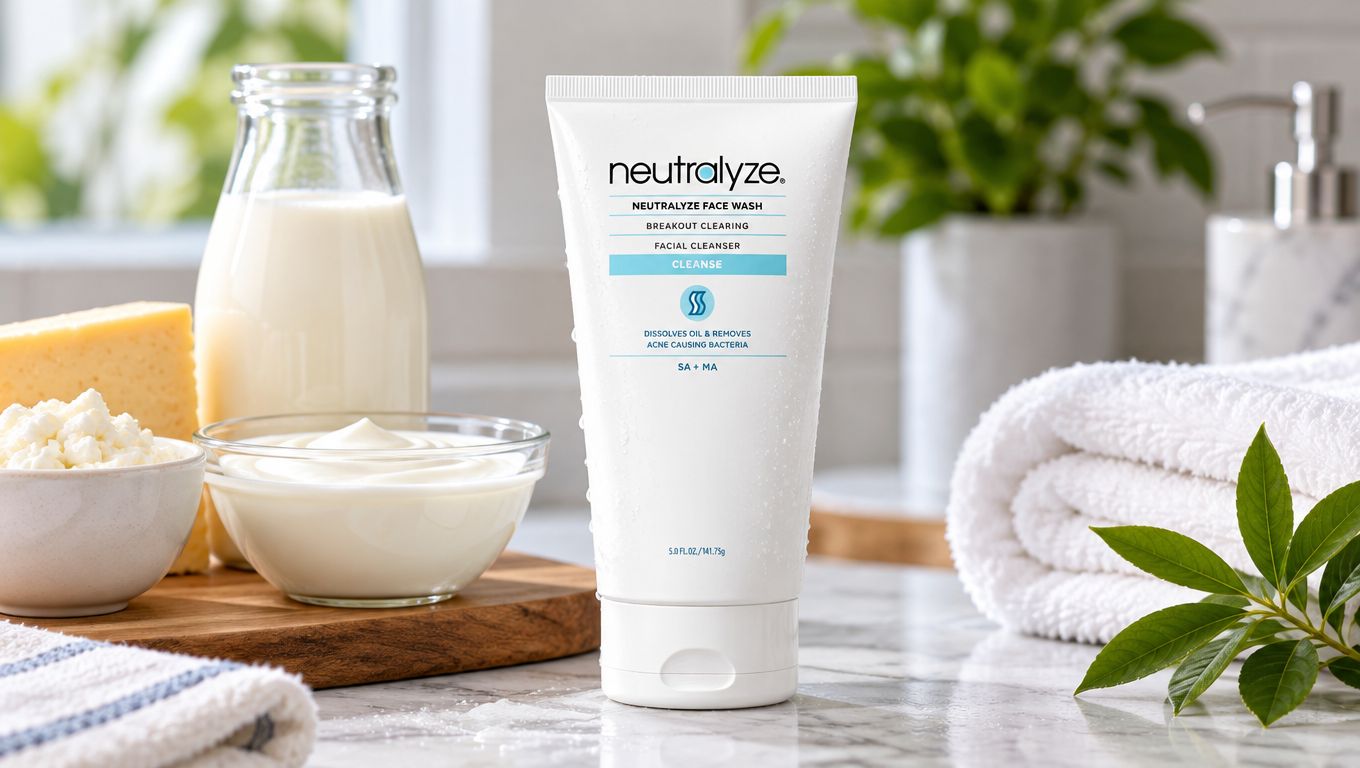
These products aren't a guarantee or a replacement for individualized medical care. If you're introducing exfoliating products, follow product directions and pay attention to dryness or irritation. The everyday skincare routine guide offers practical context for building consistent habits without making food the only focus.
Active acne and the marks left after spots heal are different concerns. A routine aimed at breakouts may also support smoother-looking skin, but post-acne marks can take time and may need their own approach. If acne is persistent or leaving scars, seek professional guidance rather than relying on dairy restriction or skincare alone.
Frequently Asked Questions About Dairy and Acne
Does lactose intolerance cause acne?
Lactose intolerance is a digestive response to lactose, not an explanation for acne. The dairy-acne studies discussed here focus on associations between foods and skin, not on lactose intolerance as a cause. If you notice a repeatable skin pattern with a particular product, assess that product directly.
Does dairy affect hormonal acne differently from comedonal acne?
The research doesn't establish that dairy affects one acne type differently in a way that predicts an individual response. Some observational findings were stronger for moderate-to-severe acne than mild acne, but that doesn't identify a personal cause. A clinician can help assess persistent or painful acne.
Do you ever need to cut out all dairy?
Not automatically. Current evidence doesn't show that everyone with acne needs to eliminate all dairy, and milk findings shouldn't be applied equally to cheese and yogurt. A focused trial is more informative than broad restriction, especially if you plan how to maintain adequate calcium and vitamin D.
Neutralyze offers a clinically formulated routine built around salicylic acid and mandelic acid, with steps to cleanse, rejuvenate, and hydrate. If you're looking for topical support while you assess whether milk affects your skin, visit Neutralyze to explore the system and choose an approach that fits your routine.