

Best Paula's Choice BHA Alternative for Acne
Stop looking for a perfect Paula's Choice BHA alternative as if the answer is just another 2% salicylic acid liquid in a different bottle. If your skin is still breaking out, getting red, or stinging after you've already tried the usual one-step exfoliant, the better question is whether your routine is missing mechanism, not brand prestige.
| Approach | What It Does Best | Main Trade-Off |
|---|---|---|
| Traditional 2% BHA liquid | Targets clogged pores and oil inside the follicle | Can be too narrow for reactive, inflamed, or barrier-impaired skin |
| Dual-acid system | Combines pore-clearing with surface exfoliation | Requires smarter pacing and the right product format |
| Three-step acne routine | Cleanses, exfoliates, and supports barrier comfort | Works best with consistency, not impatience |
A cleanser like Neutralyze Face Wash 2.0 fits that logic better than a simple toner swap because it pairs salicylic acid with mandelic acid in a format built for acne-prone skin. That matters when you're not just chasing smoother texture, but trying to reduce congestion without beating up the barrier.
Why Finding a Direct BHA Dupe Misses the Point
The idea of a “dupe” sounds efficient, but acne rarely behaves like a simple shopping problem. If you've used a famous 2% BHA liquid and still deal with recurring blackheads, inflamed bumps, or that tight, over-stripped feeling, the issue is usually not the percentage alone. It's that one leave-on exfoliant can only do one job well.
The pore problem is only half the story
Salicylic acid is valuable because it's the acne active the FDA recognizes in the 0.5% to 2% range for topical OTC products, and that makes 2% a real benchmark, not a marketing flourish FDA monograph. It helps with the oily, congested side of acne, especially when comedones and sebaceous filaments are the main problem. But if your skin is also inflamed, dehydrated, or reactive, a single acid used the same way every day can become part of the problem.
A more useful comparison is mechanism-first, not brand-first. The FDA framework helps separate a true acne active from a cosmetic exfoliant, and it also explains why a product sitting at 2% salicylic acid is already at the upper end of the OTC acne range rather than some magic “stronger” tier.
Barrier support changes the outcome
A 2025 study of a 2% salicylic-acid cleanser reported lower transepidermal water loss, reduced dryness and erythema, and no reported irritation over the study period PubMed. That's the pivot. The better question isn't “Which liquid looks most like the old one?” It's “Which formula clears pores without constantly pulling the skin barrier in the wrong direction?”
Practical rule: if your acne routine leaves you shiny, tight, and flaky at the same time, you don't need more intensity. You need better architecture.
That's where barrier-aware support matters. If redness is part of the picture, some people also pair acne care with LED therapy for redness from 3D Aesthetics Leamington Spa, especially when irritation is making the skin look angrier than the acne itself.
Understanding the 2% Salicylic Acid Benchmark
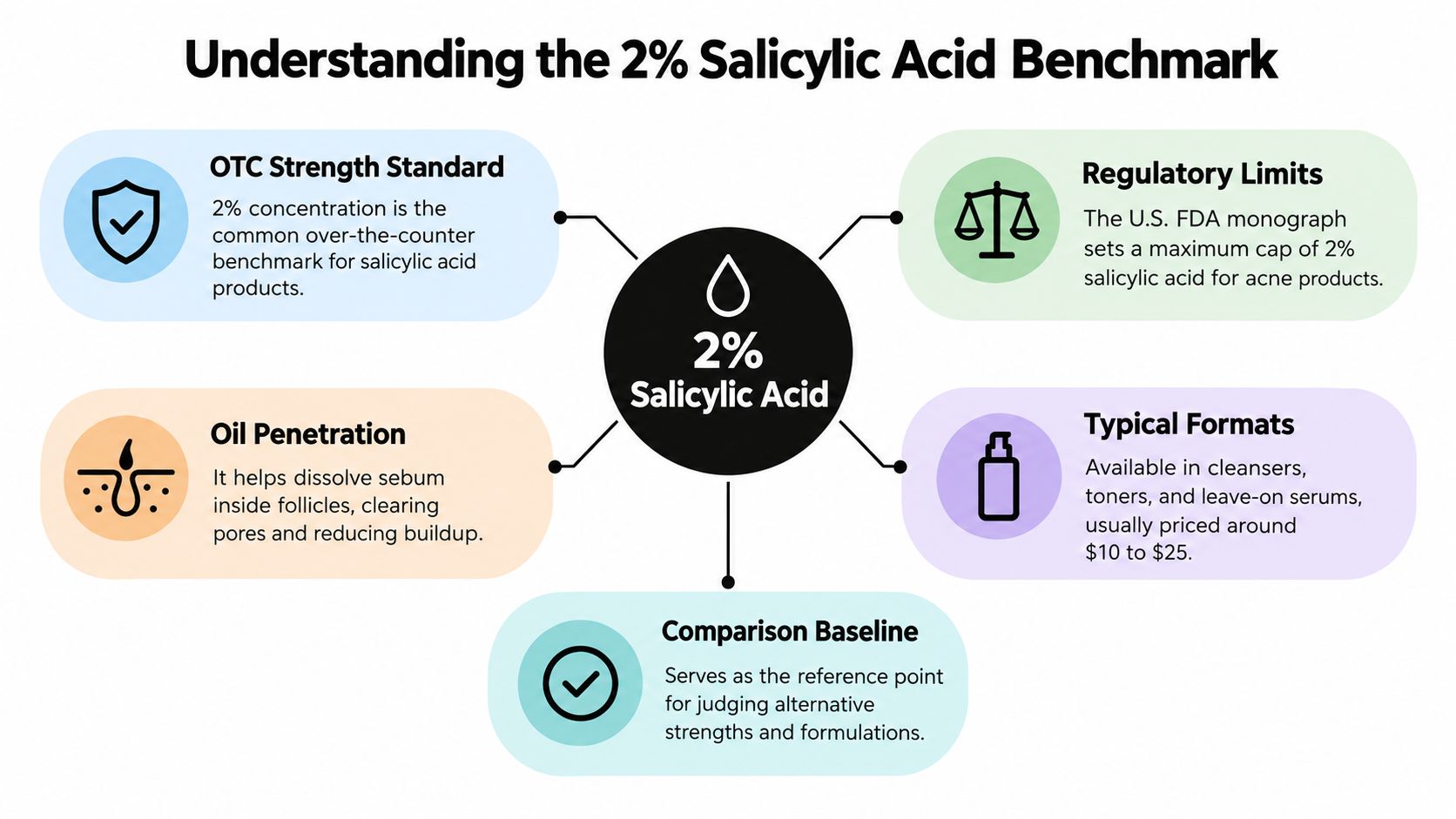
2% is the key reference point because it sits inside a defined acne-treatment framework. The U.S. Food and Drug Administration's OTC acne monograph permits salicylic acid from 0.5% to 2% in topical acne products, so that ceiling is the benchmark for judging cleansers, leave-ons, and pads used for acne FDA monograph. It also separates a cosmetic exfoliant from a product making acne-treatment claims.
A cleanser, a pad, and a leave-on liquid can all sit in the same concentration range and still behave very differently. Contact time, vehicle, pH, and how much product remains on the skin change tolerability. A wash often feels gentler, while a leave-on can hit harder even at the same percentage.
The FDA benchmark makes the comparison more honest. If a formula is below 0.5%, it may not fit the same acne-active range. If it goes above 2%, it leaves the cited OTC acne limit and no longer belongs in the same consumer category.
A 2% salicylic-acid product stays focused on sebum and follicular hyperkeratinization, which is why it helps blackheads and closed comedones. Acne also includes inflammatory lesions, post-acne marks, and barrier dysfunction, so one ingredient rarely covers the whole picture.
Neutralyze Acne Face Wash sits in that same regulatory range, with mandelic acid added as a separate surface exfoliant.
For a clear explanation of how salicylic acid works inside a clogged pore, this salicylic-acid breakdown is worth reading alongside the FDA benchmark.
If you prefer a different cleansing format, some people also compare gentle bar soap for breakouts as a format question, not just an ingredient question. The base can affect how the skin feels as much as the active does.
Comparing Standalone BHA Liquids to Dual-Acid Systems
A standalone 2% BHA liquid can work well when pore congestion is the main problem, but it rarely addresses the full acne picture on its own. A dual-acid system broadens the approach by pairing salicylic acid with a surface exfoliant, which can improve texture while giving the barrier less unnecessary strain.
| Feature | Traditional 2% BHA Liquid | Salicylic + Mandelic Acid System |
|---|---|---|
| Main strength | Deep pore focus | Pore focus plus surface refinement |
| Acne fit | Strong for blackheads and clogged pores | Better for mixed acne patterns and texture concerns |
| Tolerability | Can sting or dry reactive skin | Often easier to customize by format and frequency |
| Post-acne marks | Limited support | Better fit when marks and roughness are part of the problem |
| Routine flexibility | Usually one step | Can be built into cleanse, exfoliate, renew |
What the evidence suggests
A review of comparative peel studies found that salicylic acid reduced acne lesions effectively, while mandelic acid was associated with fewer adverse effects and no post-inflammatory hyperpigmentation in the cited comparison. That matters for skin that gets irritated easily, because tolerability often determines whether treatment can be continued long enough to help review. The point is not that mandelic acid replaces salicylic acid. The point is that each ingredient addresses a different part of the problem.
A dual-acid leave-on can be the more practical choice when acne control has to coexist with barrier care. Neutralyze Exfoliating Pads fit that logic because they combine salicylic acid and mandelic acid in a format designed for face and body use, without forcing a single-ingredient approach to carry the whole routine.
Where the trade-off actually sits
Standalone BHA liquids make the most sense when you want a direct pore-unclogging step and your skin already tolerates exfoliation well. Dual-acid systems make more sense when acne comes with roughness, uneven texture, or early signs of over-exfoliation. For moderate to severe acne, that broader approach is often more useful than chasing an exact 2% BHA liquid duplicate. It gives you a cleanse, exfoliate, renew structure that can treat congestion while supporting the skin barrier at the same time.
The Mechanism Behind Salicylic and Mandelic Acid Synergy
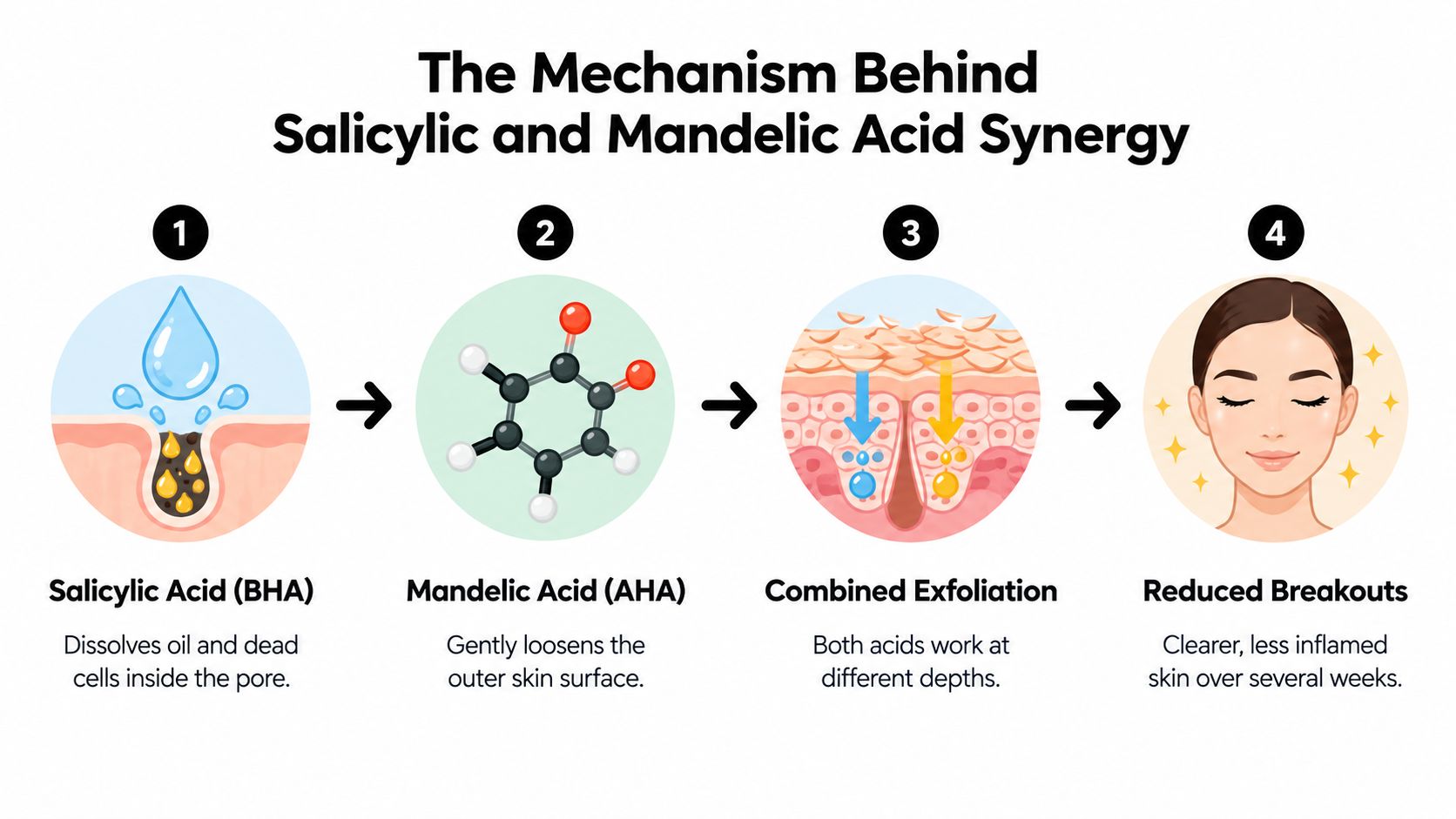
Salicylic acid and mandelic acid complement each other because they don't fight for the same job. Salicylic acid is the pore-focused ingredient, and mandelic acid works more on the surface. That division of labor is why a dual-acid system can clear congestion while staying more workable for people who don't tolerate aggressive daily exfoliation.
Different depths, different jobs
Salicylic acid is oil-soluble, so it's well suited to reaching into the follicle where sebum and dead-cell buildup collect. Mandelic acid is an AHA, so it supports surface exfoliation and can soften the look of uneven texture without forcing the same kind of pore-level action. Together, they give you a broader acne strategy than salicylic acid alone.
A PubMed-indexed comparative study of a peel containing 20% salicylic acid and 10% mandelic acid in 45 people with mild-to-moderate acne found a 74.14% reduction in acne score with significant reductions in both inflammatory and noninflammatory lesions PubMed. That's a peel study, not a daily OTC cleanser, so you can't transfer the result directly. But it does show that the combination has clinical logic.
Why synergy beats brute force
The appeal of combining acids isn't just “more active ingredients.” It's that the formula can share the load. Salicylic acid handles the oily, comedonal side. Mandelic acid supports surface turnover and may be easier to live with when irritation is the thing that makes you quit. For many acne-prone users, that's the difference between a product they tolerate and a product they abandon.
For a more direct comparison of these two ingredients, this salicylic acid versus mandelic acid guide gives a good framework for deciding what your skin is calling for.
The cleanest takeaway is simple. Salicylic acid clears the pore. Mandelic acid helps the routine stay usable. That combination is what gives a dual-acid system its edge.
Building a Barrier-Supporting Acne Routine
A stronger acne routine does not need to be harsher. It needs better sequencing. The most useful structure is usually cleanse, exfoliate, renew, because each step does a different job and keeps one product from doing too much.
Start with the right cleanser
Use a salicylic-and-mandelic cleanser to remove oil and surface debris without leaving the skin stripped. The point is to prepare the skin, not to push through congestion before the leave-on step begins. If the cleanser leaves you squeaky, tight, or oddly shiny, it is too aggressive for daily use.
A maintenance cleanser can also be useful when you are trying to reduce transepidermal water loss, which is one reason barrier support matters so much in acne care. If your skin runs dry or inflamed, a resource like reduce downtime with barrier support can help you think more clearly about repair alongside exfoliation.
Practical rule: use the least aggressive format that still gives you progress. Save the stronger contact time for the step that actually needs it.
Exfoliate with intention, not habit
Pads earn their place here. A leave-on pad can treat congested areas more evenly than a quick wash, especially on the nose, chin, chest, or back. Neutralyze Exfoliating Pads fit that use case because they combine salicylic acid and mandelic acid in a format that can be used more strategically than an all-over liquid toner.
Frequency matters more than enthusiasm. Start low, then increase only if your skin stays calm. If you feel persistent stinging, peeling, or rawness, back off instead of pushing through it.
Renew with moisture support
A moisturizer step matters because acne skin still needs repair. A formula like Neutralyze Renewal Complex gives you a salicylic-acid and mandelic-acid acne moisturizer format, which is useful when you want daily support without turning every step into a separate active. That matters when you are balancing breakouts with dryness, marks, or a compromised barrier.
The routine should work on ordinary weekdays, not only on your best skin days. If a regimen only works when you are perfect, it is too brittle to trust.
Matching the Right Alternative to Your Specific Acne Type
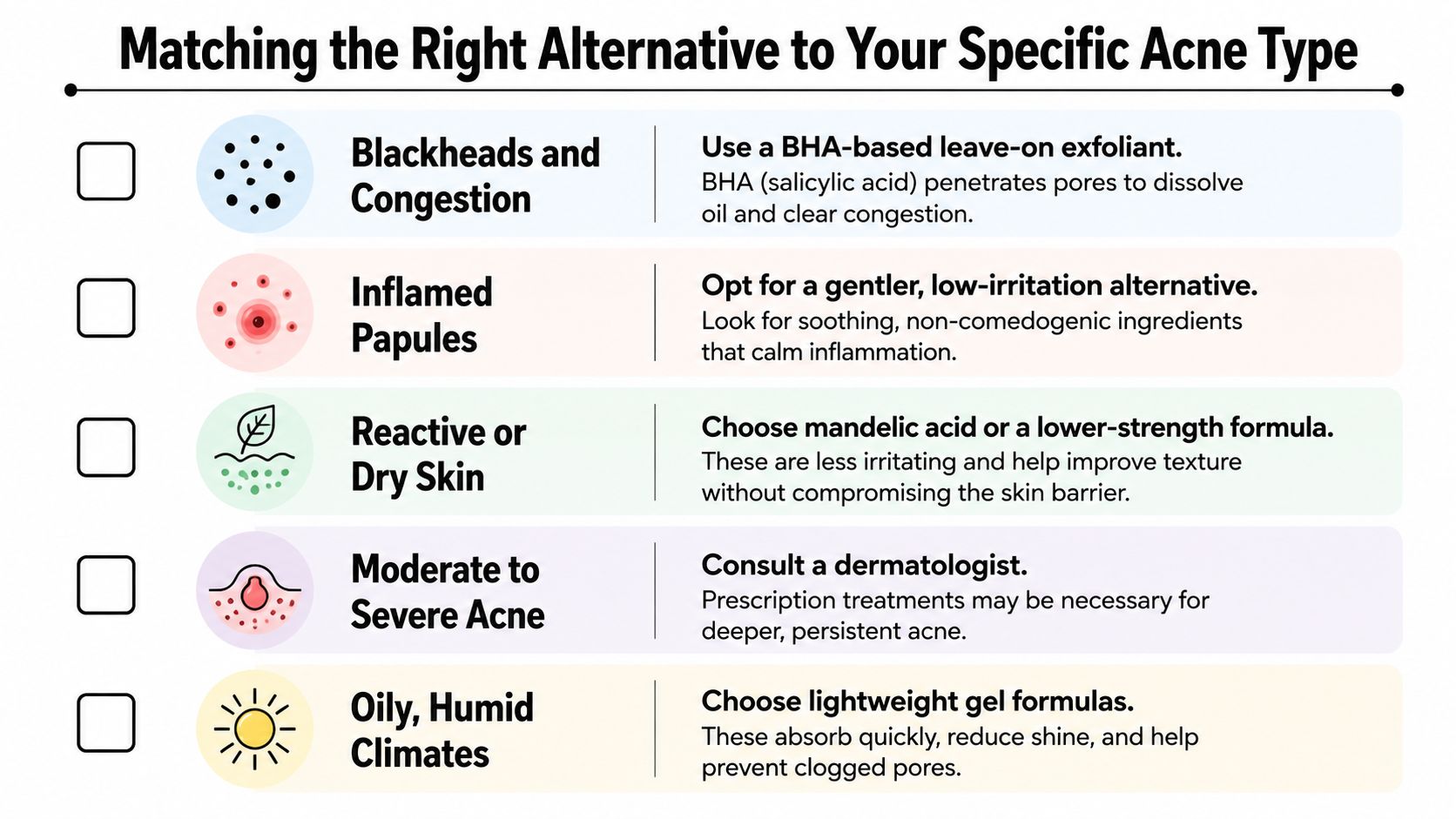
Not every breakout pattern needs the same tool. A paula's choice bha alternative that works for blackheads can be the wrong choice for inflamed papules, and a product that calms reactive skin may not be enough for persistent congestion. The best format depends on what the acne is doing, not just where it appears.
Blackheads and body congestion need contact
For blackheads, whiteheads, and chest or back congestion, a dual-acid cleanser or pad is usually more practical than a toner you use once in a while. Salicylic acid remains the pore tool, and the mandelic acid component helps keep the regimen from feeling one-dimensional. That makes wipes and pads especially useful for body acne, where surface area and convenience matter.
Inflamed acne needs restraint
Australian therapeutic guidance recommends over-the-counter topical salicylic acid primarily for mild acne, which is a good reminder that more inflamed or persistent acne needs a broader plan guidance review. If your breakouts are tender, deep, or recurring in a way that doesn't respond to OTC care, no cosmetic exfoliant should be sold to you as a full substitute for medical treatment.
Reactive or dry skin needs a lower-friction format
If your skin gets red, flaky, or stings easily, mandelic acid can be the more forgiving partner. That's where a cleanser-first or moisturizer-support approach often makes more sense than a daily leave-on acid that sits on skin for hours. The product format matters as much as the ingredient list.
Clinical reality: the same active can be helpful in one person and too much in another, because acne type and barrier state change the result.
A dual-acid system is especially useful when your skin is oily in one zone, dry in another, and breaking out across both. That mixed pattern is exactly where a mechanism-based routine beats a single-ingredient dupe.
Committing to a Long-Term Clear Skin Strategy
The people who do best with acne care usually do not chase a dramatic fix. They stay consistent long enough for the routine to show what it can do. A better alternative is not only about picking salicylic acid or mandelic acid, it is about choosing a system you can keep using when your skin is tired, reactive, or having a rough week.
What progress should look like
Early progress usually looks like stability before clarity. Fewer new clogs, less surface congestion, less redness around active spots, and fewer flare-ups from over-exfoliation are the signs that the routine is moving in the right direction. If your skin feels calmer before it looks clear, that still counts.
The 2025 cleanser study already cited shows why tolerability matters, because reduced transepidermal water loss and less dryness or erythema mean treatment is easier to maintain PubMed. In acne care, that matters as much as the number of visible breakouts.
When to adjust
A short adjustment phase is normal. Persistent tightness, recurring peeling, or stinging that does not settle points to a barrier that needs less frequency, not more product switching.
I see this pattern often. Someone moves from a single BHA liquid to a dual-acid routine, uses it too often, then assumes the whole approach failed. Often the formula is reasonable, but the schedule is too aggressive for that skin at that moment.
What a real timeline looks like
Week two should not be judged by perfect skin. It is early, and the main goal is to see whether the routine is calm enough to continue. Week eight is a better checkpoint for whether congestion is easing, breakouts are becoming less frequent, and the skin is tolerating treatment without constant irritation. For some people, texture improves before inflammation settles. For others, the skin looks less reactive first.
That timeline matters because acne treatment is a tolerance game as much as a clearing game. A routine that works only while your barrier is intact will usually fail the first time skin gets stressed.
If you are ready to move from random acid stacking to a mechanism-based routine, Neutralyze offers a salicylic-acid and mandelic-acid system built around cleanse, exfoliate, and renew. For acne-prone skin that needs pore care without constant barrier drama, that is a more useful place to start than another one-note BHA toner.


