

Non-Comedogenic Moisturizer for Acne-Prone Skin
You rinsed, patted, and leaned toward the mirror. The center of your face still looks shiny, but your cheeks feel tight, almost papery. A moisturizer seems risky. Skip it, and the tightness gets worse by lunch. Use the wrong one, and new closed bumps show up where the cream sat.
That loop is common. Drying acne care makes you cleanse harder. Harder cleansing strips the barrier, redness climbs, and the routine gets harder to keep. A non comedogenic moisturizer for acne prone skin is the piece that lets you stay consistent without feeding clogs.
Why Acne-Prone Skin Still Needs Moisture
Shine measures surface oil, not water content. Oil sits on the surface while water lives in the outer skin layers, so a face can look greasy and still feel sore after washing. Chasing that shine with another harsh cleanse usually leaves you redder rather than clearer. Dehydration and acne are easy to mix up at the sink for exactly that reason.
The American Academy of Dermatology says even oily skin benefits from moisturizer after cleansing, and it points you toward labels that read "oil-free," "non-comedogenic," or "won't clog pores." Treat those words as a screen. They tell you the maker aimed the formula away from pore blockage, which lowers one kind of risk while saying nothing about a different one: whether the texture or extras in the bottle will sting, flush, or sting a compromised barrier. Clog risk and irritation risk are separate questions, and the label only answers the first.
Acne care is a long game for a huge share of people. A systematic review tied to the Global Burden of Disease Study 2010 ranked acne vulgaris the eighth most common skin disease, with an all-age prevalence of 9.38%, according to the epidemiology review in PMC. A later analysis estimated 239.7 million prevalent cases worldwide in 2021, per the Journal of Cosmetic Dermatology burden analysis. "Just dry it out" was never a plan sized for a problem this common.
If you want one lightweight step that can stand in for a regular moisturizer, the Neutralyze Renewal Complex is a daily moisturizer whose only actives are a time-released salicylic acid and mandelic acid system. It supports hydration alongside pore-directed acids, but it is not a quick fix.
Some readers also ask about calming add-ons outside an acid routine. Before layering anything new, read up on safe topical CBD use for acne, and change only one product at a time so you can tell what caused any reaction.
The choice ahead is practical: match texture to how your skin feels this week, learn what the label does and does not prove, then layer so acids and hydration work together.
How to Match Moisturizer Texture to Your Skin
Pick the row that matches this week, not a skin type you locked in years ago. Climate, a new acid, and a run of flaking can move you one row up or down.
| Situation | Best texture | Look for | Skip |
|---|---|---|---|
| Oily comedonal skin, little dryness | Oil-free gel | Humectants, non-comedogenic, fragrance-free | Butters, thick occlusives, heavy oils |
| Combination skin with dry patches | Light lotion or gel-cream | Glycerin or ceramides, fast absorb | Fragrance and essential oils |
| Tightness from acne acids | Gel-cream on slightly damp skin | Barrier lipids used consistently | Skipping moisturizer to dry out acne |
| Very sensitive or stinging skin | Simple lotion | Fragrance-free, fewer leave-on actives, 3-day patch test | Stacking several acids the same day |
| Moderate to severe widespread acne | Lightweight treatment moisturizer | Salicylic acid 0.5% to 2% plus mandelic acid | Rich night creams |
| Humid climate | Gel | Light humectants | Occlusive balms |
| Cold climate or flaking | Lotion to light cream | More on dry zones, less on the T-zone | One heavy layer everywhere |
What each row changes
Oily comedonal skin with little dryness does best with an oil-free gel. You still need water-binding humectants. You don't need shea butter or a thick film that sits in the pore opening.
Combination skin with dry patches usually wants a light lotion or gel-cream. Glycerin or ceramides help the dry zones absorb without a greasy cast. Fragrance and essential oils are the usual sting trigger, so leave them out.
Tightness from acne acids is a timing problem as much as a formula problem. Put a gel-cream on while the skin is slightly damp, and use it every day you use the acid. Skipping moisturizer to "dry the acne out" is how the barrier gets loud.
Very sensitive or stinging skin wants the boring option: a simple fragrance-free lotion, fewer leave-on actives, and a three-day patch test on the jaw or behind the ear before you cover the face. Don't stack several acids the same day while you're still stinging.
Moderate to severe acne across the face wants a lightweight treatment moisturizer, not a rich night cream. Look for salicylic acid in the 0.5% to 2% range, paired with mandelic acid, in a texture that disappears.
Weather is its own row. Humid days favor a gel. Cold, flaky weeks favor a lotion or light cream, with more on dry cheeks and less on an oily T-zone.
Why a heavy film backfires
Think of pores as narrow doorways. A heavy film is like stacking boxes in the hall. A gel is a thin coat that still slows water from leaving. Texture is not a personality trait. It is how much film you leave behind.
Ingredient lists matter too. A 2024 case-control study in Clinical, Cosmetic and Investigational Dermatology found that 43.2% of acne patients were using moisturizers that contained acne-causing substances, compared with 27.1% of controls. If you want a plain checklist of ingredients to look for in moisturizers, BotoxBarb's guide is a useful cross-check before you buy the heavier jar.
Practical rule: A product can be non-comedogenic and still be too occlusive, too light for winter cheeks, or too stingy on a damaged barrier.
What Non-Comedogenic Really Tells You
Comedogenic means likely to help form a comedo, the clogged pore that becomes a blackhead or a whitehead. Non-comedogenic means the maker tested or formulated the finished product to be less likely to do that. It is a screening claim. It is not a personal guarantee that your skin will stay clear.
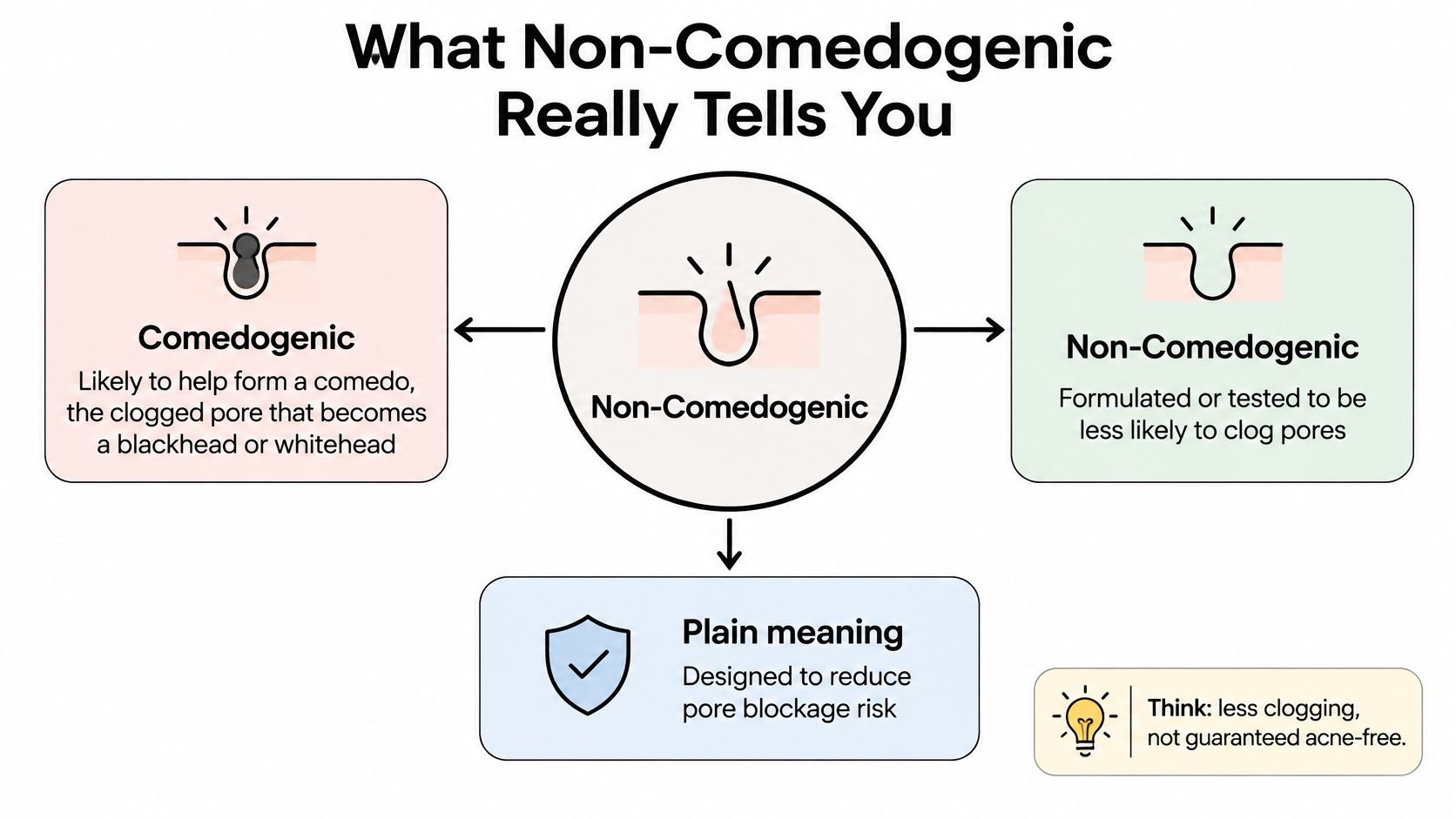
The test is on the whole jar
The Medical News Today review of the non-comedogenic label is blunt about the limits. The phrase isn't defined by any official standard. Published tests differ in model, endpoint, concentration, exposure time, and how the result is read. Older rabbit-ear assays can overestimate clogging or predict human skin poorly.
What touches your face is the finished moisturizer. Oils, emulsifiers, film-formers, how much you apply, and how that film mixes with your sebum can all change pore-plugging behavior. A single oil's reputation on a chart is a clue, not the verdict.
The same review notes that acne-friendly moisturizers are generally labeled oil-free, non-comedogenic, or "won't clog pores," and that studies commonly see acne improve over 4 to 8 weeks when moisturizer sits inside a broader treatment plan. The label itself is not the treatment. The plan around it is.
How to check it on your face
- Patch for three days. Use a pea-size amount on one small area. Stop if you burn.
- Then use it only where you plan to keep using it. Don't cover the whole face on day one if the patch was the only test.
- Watch four things for several weeks. New closed comedones, inflamed spots, shine, and sting. Write down where they show up.
Pore-clogging risk and irritation risk are different problems. A formula can avoid clogs and still burn compromised skin, or feel comfortable and still leave a film your pores don't like.
Judge the pattern on your own face. One "bad" ingredient in a light gel can be fine. A beloved ingredient in a thick layer can still clog you. For moderate or severe acne, stay with a light lotion or gel-cream, skip heavy layering, and let the lesion pattern over those weeks decide, not the front of the bottle.
Ingredients That Hydrate Without Feeding Breakouts
At the sink, oily skin can still feel tight after cleansing. Moisturizing ingredients can ease that dry feeling and support the skin's surface, while acne-focused products address clogged pores and breakouts. Different ingredients do different jobs.
Three jobs, three kinds of ingredients
Hold water. Humectants such as glycerin draw water into the skin's surface. That can ease tightness and help you avoid over-washing, which may worsen dryness.
Support the barrier. Ceramides are lipids that help reduce water loss between surface cells. A double-blind regimen reviewed in PMC paired a ceramide cleanser and moisturizer with adapalene 0.3% and benzoyl peroxide 2.5%. Participants had lower transepidermal water loss, dryness, redness, and scaling, and 97.8% reported satisfaction. The results show how barrier-supporting products can fit alongside acne-focused products; they don't establish that the same combination is right for everyone.
Treat the pore. Salicylic acid is oil-soluble and can work within pores on oil and buildup. Salicylic acid is typically used at 0.5% to 2% in acne products. The finished formula and how your skin responds matter when choosing a moisturizer, not the percentage alone.
Mandelic acid is a larger alpha hydroxy acid that works mainly at the skin's surface. It can help improve the look of rough texture and post-acne marks. Marks and active pimples have different causes, so a surface acid and a pore-focused treatment serve different purposes.
Neutralyze uses its time-released DuoClear™ system, 2% salicylic acid and 1% mandelic acid, in Face Wash, Exfoliating Pads, and Renewal Complex. Renewal Complex is a lightweight, oil-free daily moisturizer for adult acne-prone skin and can replace a regular moisturizer.
A separate 2024 split-face study in the Journal of Cosmetic Dermatology found that a ceramide- and niacinamide-containing moisturizer improved non-inflammatory, inflammatory, and total acne lesions after 8 weeks. That study offers context on barrier-focused moisturizers; Neutralyze's DuoClear formulas do not contain niacinamide.
If you're comparing clinic and drugstore options for adult breakouts, compare adult acne options in Canada through Skinsation Aesthetics Inc. Then consider which ingredients and textures your skin can tolerate.
If salicylic acid causes burning, use it less often and avoid adding another acid to the routine. A moisturizer can help with dryness, while the acne-focused product addresses the pore.
How to Layer Moisturizer in an Acne Routine
One order for morning, one for evening. Extra serums are where many people lose the plot.
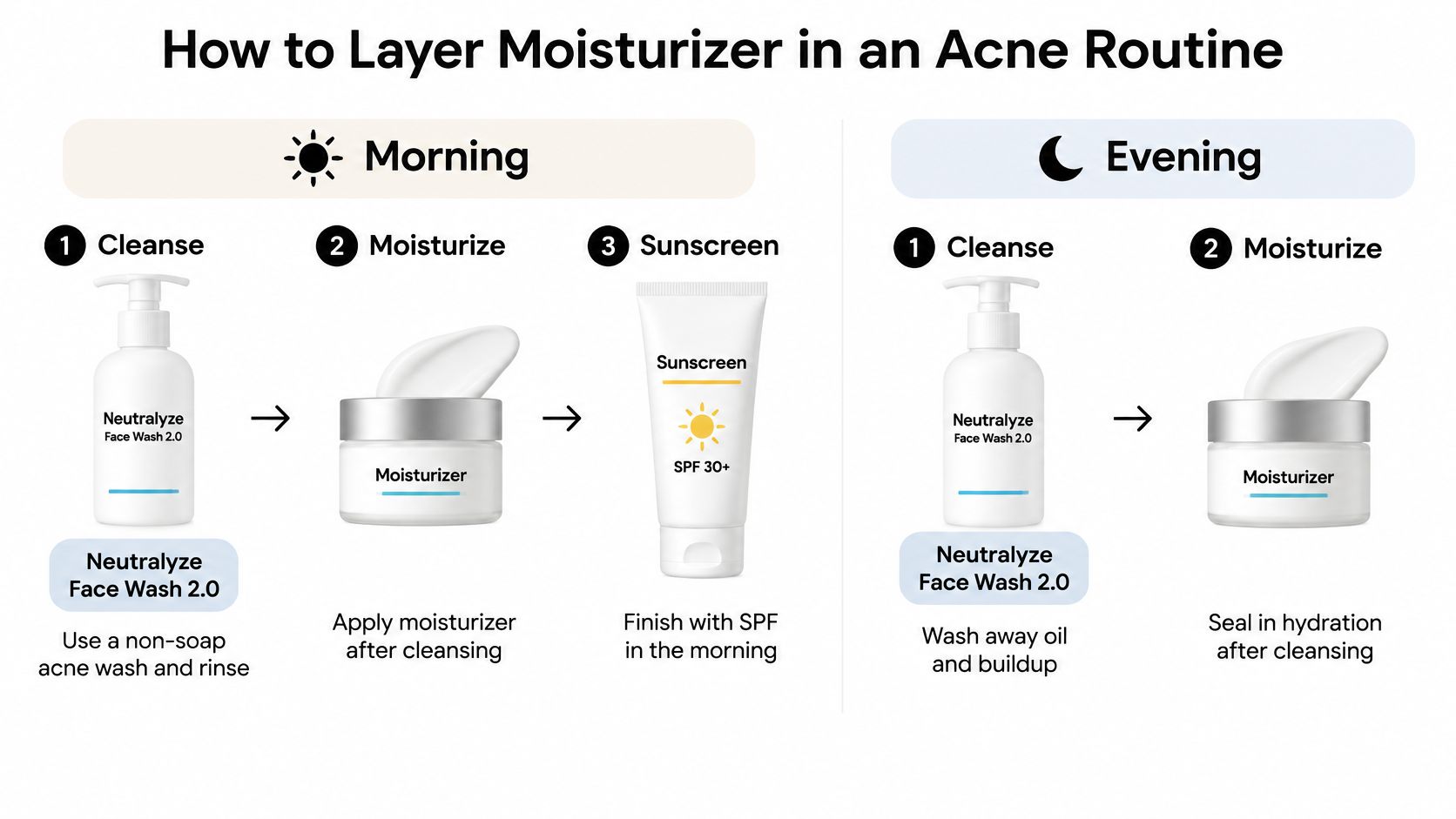
Morning and evening, same bones
- Cleanse and rinse once. Use a non-soap acne wash so you lift oil without a squeaky strip. Neutralyze Face Wash cleanses with 2% salicylic acid plus 1% mandelic acid, clearing oil and debris from inside the pore without a stripped feel. The common slip is a second cleanse "just to be sure." Once is enough if you rinsed sunscreen and sweat.
- Dry all the way. Pat dry, then wait until the skin is fully dry before any leave-on step. Water left on the face can make acids feel hotter than they need to.
- Swipe a pad only if you need leave-on exfoliation. For blackheads, rough texture, or body acne, use the Neutralyze Exfoliating Pads and let them dry. On the back or body, cleanse, dry, swipe, and leave the pad on. Skip a second acid toner afterward.
- Moisturize as the last step. A thin layer of a non-comedogenic moisturizer goes on dry skin and stays on, and Renewal Complex can take the place of your usual moisturizer here. Start once a day. If you are unsure whether a watery serum belongs under that cream, the serum or moisturizer order is the short version.
- Sunscreen in the morning only. Give the moisturizer 30 to 60 seconds to settle, then add SPF. Exfoliating while skipping sunscreen is how marks end up looking darker.
- Change the amount by zone. Less on the oily center of the face, more on tight cheeks. One thick coat everywhere is how a light formula starts to feel heavy.
What not to stack in the same sitting
Keep this routine away from benzoyl peroxide, retinol, or prescription tretinoin at the same time of day, and ask a dermatologist before combining them. If dryness or peeling gets bothersome, keep the moisturizer and space the active step out. Quitting hydration is the slip that makes the acid feel harsher the next time you restart.
Judge acid care in weeks, not overnight. A 2019 clinical study of 20 adults using a topical treatment twice daily for 12 weeks reported a 65% reduction in comedonal lesions by the final visit, in Clinical, Cosmetic and Investigational Dermatology. That kind of change came from steady use, which is the case for giving a routine a real window.
When New Bumps Mean Clogs, Irritation, or Acne
The mix-up that sends people back to a stripping cleanser is this. Tight skin after washing feels like "the acne is winning," so they add another active. New closed pores under a rich cream feel like "the acid isn't strong enough," so they add another acid. These two problems need opposite fixes, and guessing wrong makes whichever one you have worse.
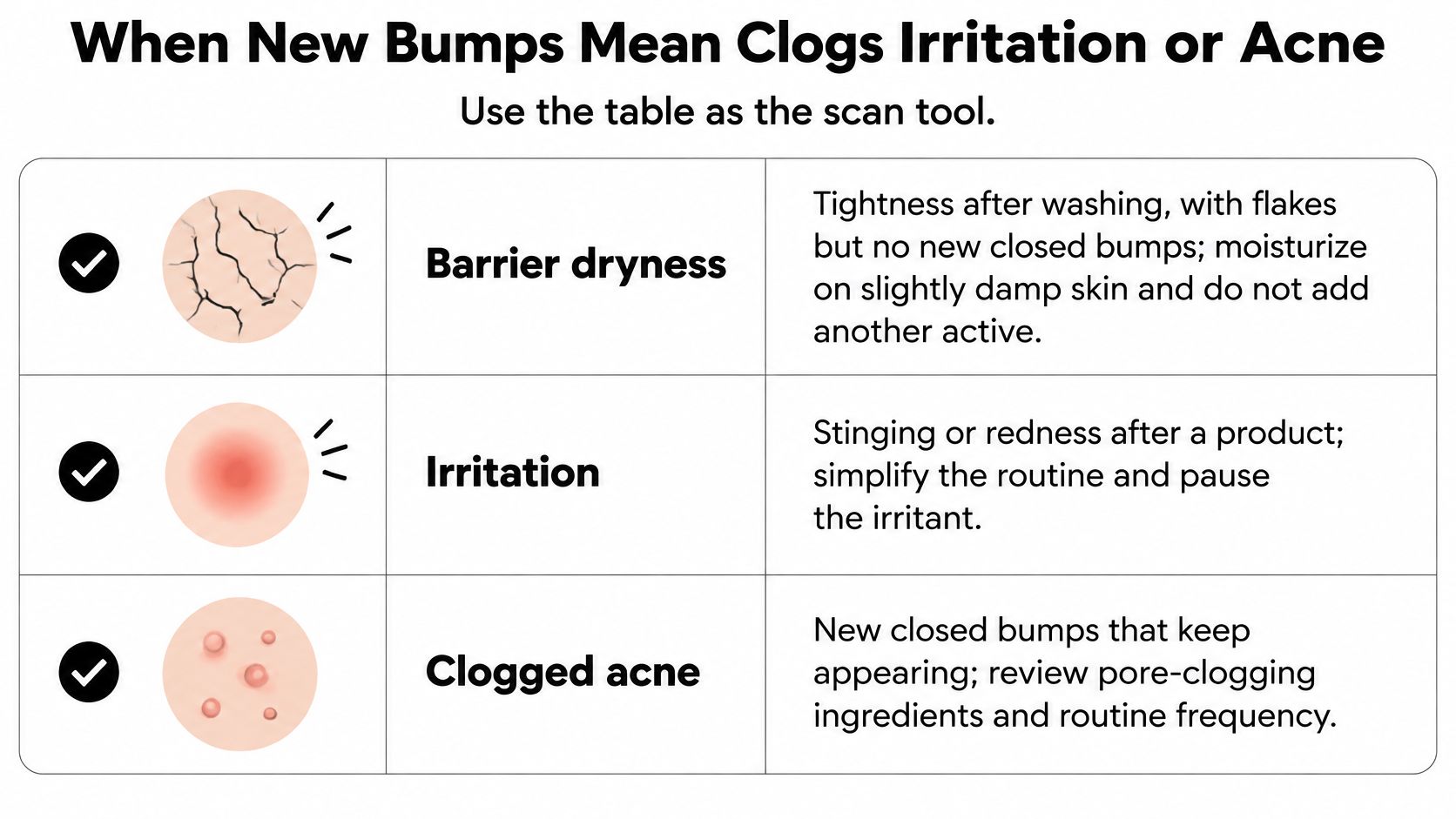
| What you notice | Likely meaning | What to change |
|---|---|---|
| Tight after cleansing, few new bumps | Barrier dryness | Moisturize on slightly damp skin and don't add another acid |
| Burning or redness where product sits | Irritation | Use the acid less often or pause it and keep a plain moisturizer |
| New closed comedones in 2 to 4 weeks only under a rich cream | Possible clogging from that formula | Switch to a lighter gel or gel-cream |
| Inflamed spots in your usual pattern | Ongoing acne, not the moisturizer alone | Keep hydration and review the full routine with a clinician if severe |
| Shine that won't settle | Too much product or too occlusive | Use less on the T-zone |
| Peeling that eases after moisturizer | Expected dryness from a keratolytic | Slow acid frequency and continue moisturizer |
Read the pattern, then change one thing
Tightness with flakes and no new closed bumps is barrier dryness. Moisturize on slightly damp skin. Leave the active count alone, because the skin is asking for water, not more exfoliation.
Burning or redness that tracks the product is irritation. The American Academy of Dermatology's oily-skin guidance says to stop salicylic acid or use it less often when irritation shows up, and still moisturize after cleansing, even if you are oily. Keep a plain non-comedogenic moisturizer while you back off the acid.
New flesh-colored closed comedones in two to four weeks, only where a richer cream sat, point at that formula, even if the jar said non-comedogenic. The label screens out likely pore-cloggers; it can't guarantee your skin agrees. Switch texture rather than piling on more acid to "push them out." If you can't tell a purge from a clog, the purging versus breakout distinction is the comparison to use before you throw the routine out.
Inflamed pimples along your usual jaw, cheek, or back are the acne you already have. They are not proof the moisturizer failed.
A compatible moisturizer supports barrier comfort without trying to do the job of an acne-focused active. Skin that feels less tight and itchy is easier to keep treating consistently, which is the whole point of hydrating during an acid routine. That supports adherence. It doesn't diagnose you.
Shine that won't settle means too much product or too much occlusion, so use less on oily zones. Peeling that feels better once you moisturize is expected dryness from a keratolytic, not a sign to scrub harder.
If you have painful cysts, scarring, or acne that isn't easing after about eight weeks of a consistent routine, see a dermatologist. Moisturizer supports tolerance. It doesn't replace prescription care.
Start With a Moisturizer You Can Keep Using
If breakouts are occasional and your skin feels comfortable, a fragrance-free, oil-free, non-comedogenic gel or lotion after cleansing is enough. You don't need a stack of actives to solve a texture problem you don't have.
If you have moderate to severe acne, blackheads, and treatment dryness at the same time, use one system so you aren't stacking unknown actives. Cleanse, then exfoliate, then hydrate. Ours is clinically formulated salicylic acid plus mandelic acid only.
Face Wash is step one. The Exfoliating Pads are the leave-on step for face or body. Renewal Complex is the lightweight, oil-free daily moisturizer, with a time-released DuoClear of 2% salicylic acid and 1% mandelic acid, in a 3.21 fl oz (95 mL) pump. It can take the place of a separate moisturizer and it layers under makeup. Results vary. This is not a quick fix. Scarring, cysts, or acne that isn't improving still belong with a dermatologist.
For the first week, patch for three days, then use it once daily. At four weeks, and again at eight, compare new clogs with comfort. If clogs rose only under a heavy film, change texture. If the skin is calmer and the bumps are slowly fewer, stay.
Pick the texture row that matches today. Then stay with it long enough to see the pattern.
A moisturizer that exfoliates and hydrates
Neutralyze Renewal Complex pairs salicylic acid and mandelic acid in a lightweight, oil-free daily moisturizer you can use in place of a separate cream.
If your skin is shiny, tight, and tired of creams that clog or cleansers that strip, Neutralyze is built as a three-step salicylic acid and mandelic acid routine for acne-prone skin, with a moisturizer that can replace the jar you don't trust. Start with the texture you can keep using, then give it the four-week and eight-week check. Visit Neutralyze when you're ready to put cleanse, rejuvenate, and hydrate in one place.