

Chemical Exfoliant for Oily Skin: What Works Best in 2026
You know the pattern. You wash your face, the shine returns before lunch, and by Friday the same three pores on your nose are clogged again. The scrub in your shower hasn't changed any of it, and the toner that stings probably made it worse.
Oily skin doesn't fail because you're not trying hard enough. It fails because oil and dead skin cells build a plug deep inside the pore, and nothing you drag across the surface reaches it. Chemical exfoliation does, provided you choose the right acid and use it at a pace your skin can hold.
Why Oily, Acne-Prone Skin Needs Chemical Exfoliation
Sebum output runs high, dead cells inside the follicle don't shed on schedule, and the two combine into a plug. That plug sits below anything a washcloth, scrub or foaming cleanser can reach.
A gritty scrub or a stripping cleanser irritates the surface while leaving the plug intact, so skin reddens, feels tight and produces more oil a few hours later. The mechanics of clogged pores explain why surface friction never clears what forms underneath, and why scrubbing harder only makes the skin angrier.
A chemical exfoliant is an acid that dissolves the bonds holding dead cells on the surface and loosens the keratin and sebum packed inside the pore, instead of scraping anything off. For oily, acne-prone skin, the job splits in two: one acid has to travel into the pore itself, and a second, gentler one smooths the surface around it.
That's why a leave-on pad built on both acids, such as Neutralyze Exfoliating Pads, does in one step what a scrub and a toner were attempting separately, and does it without the sting. The pads pair 2% salicylic acid with 1% mandelic acid, and they're swiped over clean skin and left on rather than rinsed away.
The decision comes down to three acid families, BHA, AHA and PHA, and the differences between them decide how your skin feels in week three. Choose well and exfoliation becomes the easiest part of your week. Choose badly and you'll spend a month rebuilding a barrier you stripped.
Which Chemical Exfoliant Works Best for Oily Skin
For oily, acne-prone skin, salicylic acid is the anchor exfoliant because it dissolves in oil and works inside the pore. The best partner is a gentle AHA, mandelic acid, which handles surface texture and post-acne marks without adding much sting.
| Exfoliant | Acid family | Oil soluble | Best for oily skin | Common home-use strength | Irritation risk |
|---|---|---|---|---|---|
| Salicylic acid | BHA | Yes | Blackheads, whiteheads, clogged pores, midday shine | 0.5% to 2% (FDA OTC acne range) | Low to moderate |
| Mandelic acid | AHA | Partially (large molecule) | Uneven texture, post-acne marks, reactive skin | 1% to 10% | Low |
| Glycolic acid | AHA | No | Surface dullness and rough texture | 5% to 10% | Moderate to high |
| Lactic acid | AHA | No | Gentle surface renewal with hydration | 5% to 10% | Moderate |
| Gluconolactone (PHA) | PHA | No | Very sensitive or barrier-compromised skin | 3% to 10% | Very low |
If you want the plain-English chemistry behind those two families before you buy anything, AHA and BHA exfoliation explained covers how each one loosens dead cells without the marketing gloss.
Why Stronger Isn't the Same as Better
Concentration decides less than most shoppers assume. The U.S. Food and Drug Administration's OTC acne monograph recognizes salicylic acid at 0.5% to 2% as an established acne-treatment active, with 2% as the upper concentration recognized there. Anything above that needs additional safety and effectiveness support. The same monograph defines acne as a disorder involving the oil glands and hair follicles that produces blackheads, whiteheads, pimples and blemishes, which is precisely the territory a BHA is built for.
So a well-formulated 2% product you use four nights a week beats a 10% one you can only tolerate twice a month. Format, pH, contact time and tolerability decide real-world results.
The head-to-head peel data points the same direction. In a randomized comparison summarized in BMJ Open, six treatments given every two weeks with 20% salicylic plus 10% mandelic acid produced greater improvement than 35% glycolic acid for comedones (90.2% versus 35.9%), papules (81.7% versus 77.8%), pustules (85.4% versus 75.7%) and total acne score (85.3% versus 68.5%). Those are professional peel concentrations, not shelf products, but they show where the advantage sits: oil-soluble clearing inside the pore plus gentle surface renewal.
The two outliers readers ask about most are worth naming. Glycolic acid renews the surface fastest, and carries the highest irritation risk of the group. PHAs like gluconolactone are the choice for very sensitive or barrier-compromised skin, at the cost of slower visible change.
The practical pick is unglamorous. A 2% salicylic cleanser or leave-on pad, optionally paired with 1% mandelic acid, will out-clear a shelf of half-used strong acids because you'll keep using it.
Why Salicylic Acid Reaches Where Oily Skin Needs It
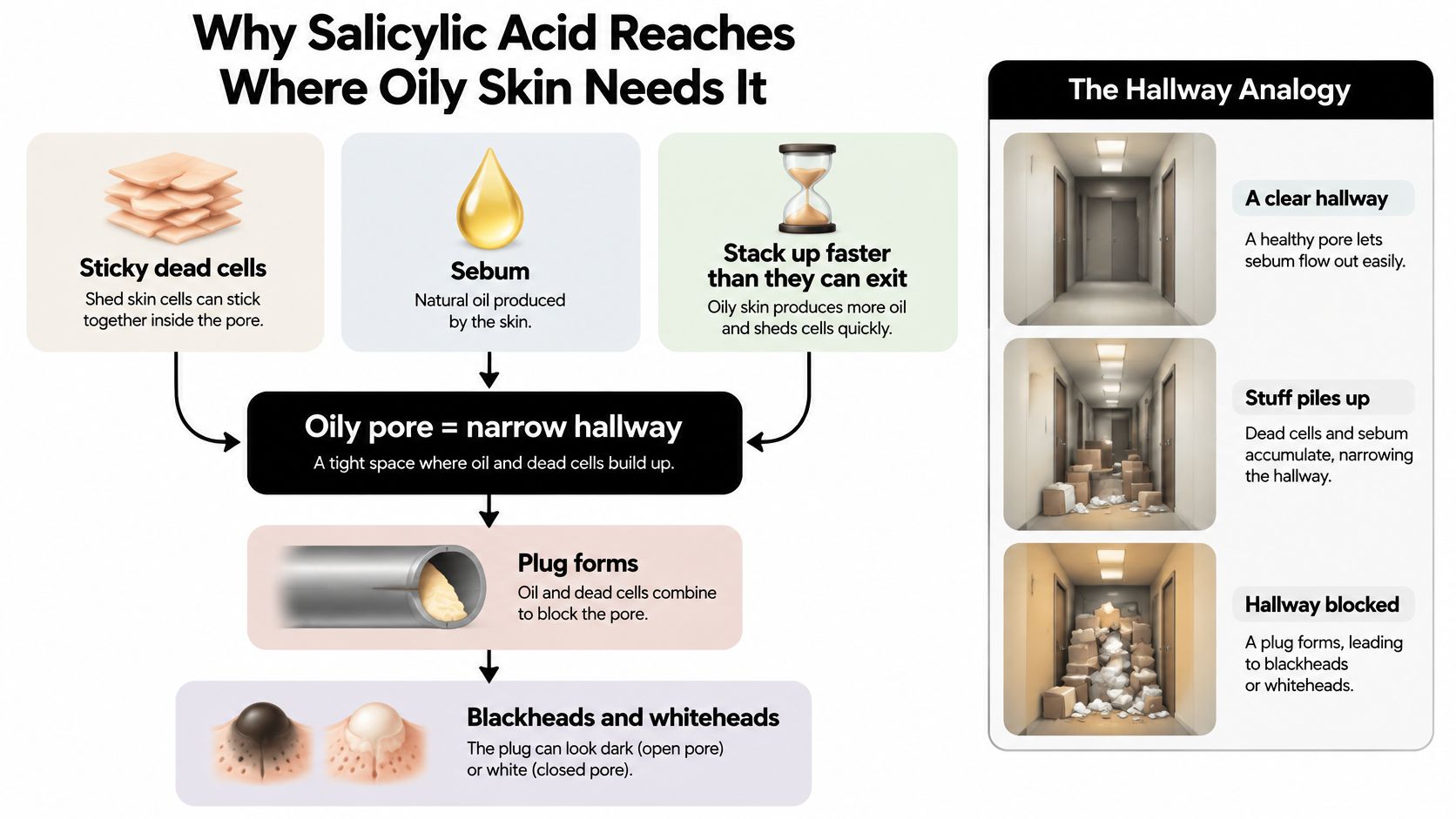
Think of an oily pore as a narrow hallway. Dead skin cells that should shed stick to the walls, sebum keeps arriving, and the two stack up faster than they can exit. Once the hallway blocks, you get a blackhead (an open, oxidized plug) or a whitehead (a closed, covered one). That process, follicular hyperkeratinization, is the step that comes before everything else in acne.
Behind the plug, the environment shifts. Sebum feeds Cutibacterium acnes, the bacterium that lives in oil-rich follicles, and your immune response to that colony produces the redness, swelling and tenderness of an inflammatory lesion. Clear the plug and you interrupt the sequence before inflammation starts.
What the Two Acid Families Each Do
Salicylic acid is lipophilic, which means it dissolves in oil. That property lets it partition into sebum-rich follicles, where it promotes corneocyte shedding and loosens the keratin and sebum plug from the inside. Mandelic acid works mostly at the surface. Its molecule is large, so it penetrates slowly and evenly, smoothing texture with far less sting than a small-molecule AHA.
The surface half has clinical support of its own. In a product study of a 10% mandelic acid formula applied once nightly for two months in 60 people aged 12 to 60, the oily-skin subgroup recorded 61% fewer pustules and a 37% reduction in seborrhea severity after 60 days. It was an open-label design with other ingredients in the formula, so the numbers aren't proof of mandelic acid alone, but they match its reputation as the AHA reactive, oily skin handles best.
The rule that decides everything else: oily skin doesn't need harder scrubbing. It needs the plug inside the pore dissolved and the surface renewed without stripping the barrier.
Guidance from the American Academy of Dermatology names salicylic acid, glycolic acid and lactic acid as ingredients that can reduce oiliness, and cautions that excessive use can cause irritation. That caution is the boundary line. For moderate-to-severe acne, exfoliation is a pore-clearing adjunct that sits alongside a full regimen, never in place of one. Painful nodules or widespread inflamed lesions need a dermatologist's input.
Comfort is not a soft metric. It's the reason people keep going long enough for the pore-level work to show.
How to Use a Chemical Exfoliant on Oily Skin
Order matters more than strength. Watch the sequence first, then read the details that make each step work.
1. Cleanse with a gentle salicylic acid face wash. Massage a small amount onto wet skin for a minute or two, rinse with lukewarm water and pat dry. The slip: grabbing a squeaky-clean, stripping wash that leaves your face tight. Tightness means the wash removed the lipids your barrier depends on while the congestion stayed put in the pore. Neutralyze Face Wash 2.0 is the model here, a cleanser built on DuoClear, 2% salicylic acid plus 1% mandelic acid, made to clear without the stripped feeling.
2. Apply the leave-on exfoliant to clean, dry skin. Sweep one pad across the face, skip the eye area, and don't rinse. After a shower, the same sweep works on the chest or upper back when body breakouts are part of your picture. Neutralyze Exfoliating Pads are dual-textured and carry the same 2% salicylic acid and 1% mandelic acid at cosmetic strength, which is why they get swiped on and left rather than washed away.
3. Moisturize about a minute later. Oily skin still needs this step. Pick an oil-free, non-comedogenic acne moisturizer, because barrier support is what keeps the acid tolerable on night two and night twelve. Neutralyze Renewal Complex fills that role in the same routine, a lightweight daily moisturizer with a time-released version of the same acid pair.
4. In the morning, keep it simple. A light cleanse, moisturizer, then broad-spectrum SPF. Exfoliating acids increase sun sensitivity, so sunscreen is part of the treatment, not optional maintenance.
5. Start with two or three nights a week. Add a night only when the current schedule feels boringly comfortable. The most common mistake is using the right acid every single night in week one.
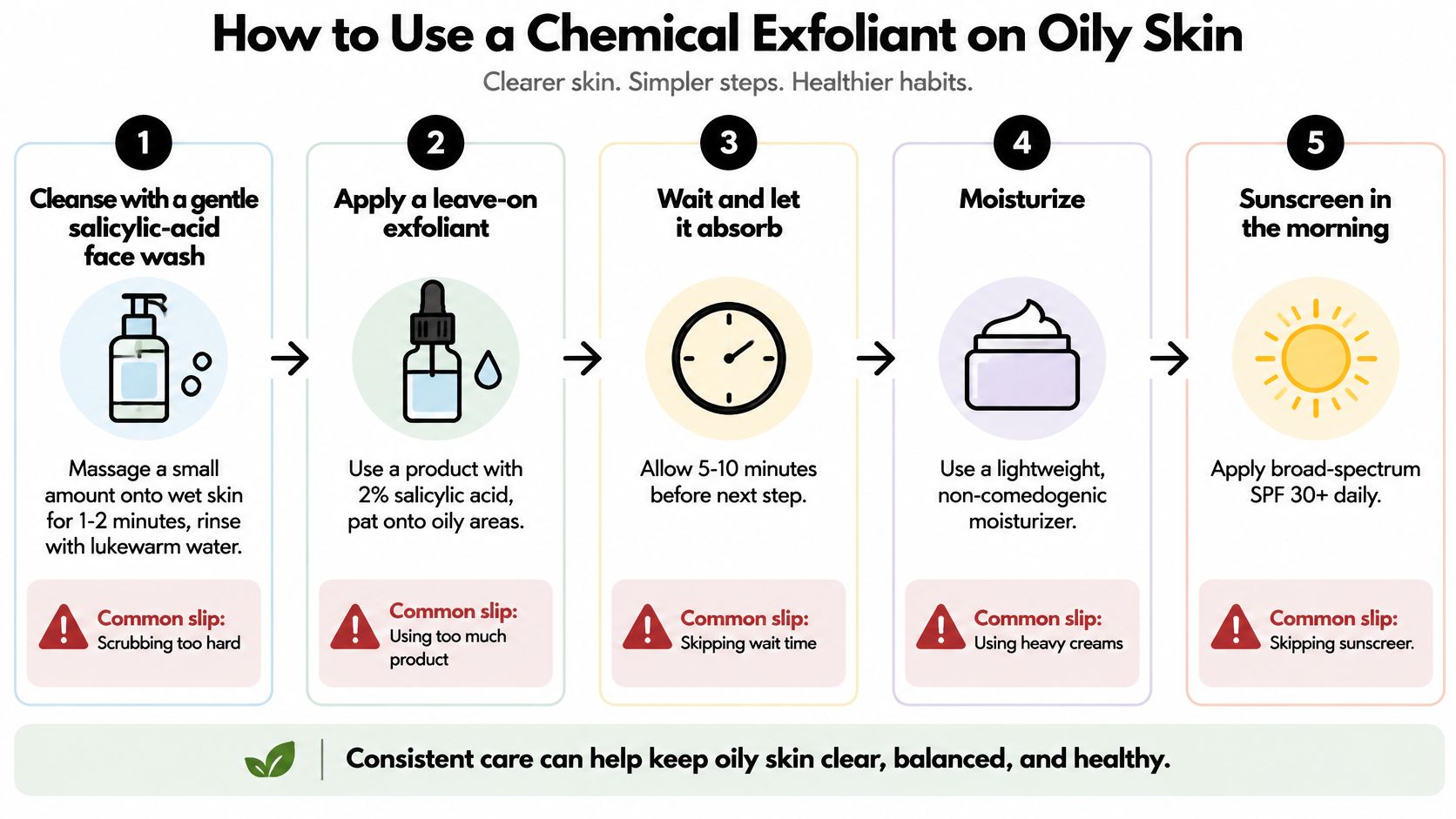
Tape this to the mirror: one exfoliating product at a time, no scrub and no second strong acid on the same night, and a patch test on one small area for the first three days.
How Often to Exfoliate Oily Skin Week by Week
Frequency is the variable that separates a routine that clears skin from one that wrecks it. Build up in phases and let your skin vote at each one.
| Phase | Frequency | What you do | What to expect |
|---|---|---|---|
| Weeks 1-2 | 2 nights per week (for example Monday and Thursday) | Cleanse, apply leave-on exfoliant to dry skin, then moisturize | Mild tingling that fades fast; no flaking |
| Weeks 3-4 | Every other night | Same three steps; add moisturizer if skin feels tight | Smoother feel, fewer new clogged pores |
| Weeks 5-8 | Nightly if skin stays comfortable | One exfoliant only; daily SPF | Less midday shine, softer blackheads |
| Weeks 9-12 | Maintain 3-7 nights per week | Track breakouts and take weekly photos | Clearer pores and fading post-acne marks for many users |
How to Read Your Skin at Each Phase
Moisturizer goes on every night, including the off nights. That single habit is what makes the ramp-up survivable. Persistent stinging means slow down. Reduced shine with no discomfort means the schedule is working.
Set expectations by concern, not by hope. Texture and smoothness often shift within one to two weeks, clogged pores and blackheads respond over four to eight weeks, and inflammatory breakouts take closer to twelve.
The timeline has a clinical reference point. A 12-week study of six biweekly 20% salicylic and 10% mandelic peels in 45 people with mild-to-moderate acne recorded a 74.14% reduction in acne score alongside a significant drop in the post-acne hyperpigmentation index (p=0.034), with no significant adverse effects reported. Home products are far gentler, so treat twelve weeks as a fair test before you judge a product or switch to something new.
Track it concretely: one photo a week in the same light, plus a two-column note of new breakouts and any irritation. A few small purge-style bumps in the first weeks happen. Worsening pain, deep cysts or spreading redness are a signal to stop and reassess.
Over-Exfoliation Signs and How to Calm Oily Skin
A mild tingle that fades within minutes is normal adjustment. Persistent stinging, tightness, scaling, burning or spreading redness is over-exfoliation, and it needs a different response than "push through".
| Signal | What it means | What to do |
|---|---|---|
| Light tingle for a few minutes after applying | Normal adjustment | Continue the current schedule |
| Persistent stinging or burning | Barrier irritation | Pause acids for 3-7 days |
| Tightness, flaking or sore shine | Over-exfoliation | Stop exfoliating; moisturize twice daily |
| Worsening redness or reactive breakouts | Irritation, not a purge | Cut back to once weekly, then rebuild slowly |
The Pause and Repair Protocol
- Stop every exfoliating acid for three to seven days.
- Keep only a gentle cleanser and a plain non-comedogenic moisturizer, twice daily.
- Skip scrubs, clay masks and any other active until skin feels calm.
- Reintroduce exfoliation at half the previous frequency once things have settled.
The mechanism explains why harsher treatment backfires. Barrier disruption raises water loss and makes oily skin more reactive even when sebum output hasn't changed, so you get the irritation without the oil control you were chasing. If you've been stacking a cleanser, a pad, a mask and a scrub, this is the week to find out which one you needed.
The evidence supports a gentler approach than the internet does. A 2025 dermatology survey found that 88.7% of dermatologists named oily, acne-prone skin the primary indication for daily gentle exfoliation, while favoring routines that pair exfoliation with barrier support. The same review details a 21-day prospective study of a salicylic acid gel that measured 23.65% less sebum, 40.5% more hydration and 49.26% lower transepidermal water loss, which is the opposite of the dry-then-greasy rebound people expect from acids.
The myth that keeps oily skin greasy: skipping moisturizer does not reduce oil. It usually produces more rebound shine, because a dehydrated surface reacts by pushing sebum harder.
If you're recovering from a course of peels or a period of deliberate over-exfoliation, this chemical peel aftercare timeline is a sensible reference for how long skin takes to settle. For a closer look at the acne side of the same problem, read about over-exfoliated skin and acne.
Sensitive and reactive skin should start at the bottom: 1% mandelic acid, once or twice a week, and no increase until two consecutive comfortable weeks have passed.
Combining Chemical Exfoliants With Prescription Acne Treatments
Can a salicylic and mandelic acid cleanser or pad sit alongside a prescription retinoid like adapalene or tretinoin? Often yes, with staggering. Both raise cell turnover and irritation at the same time, so dermatology routines typically split them across nights rather than layering both at once.
- Cleanse with a gentle salicylic acid wash and pat dry.
- On exfoliation nights, apply the leave-on exfoliant to dry skin.
- Use the prescription on the other nights, applied after moisturizing or exactly as your clinician directs.
- Add broad-spectrum SPF every morning, because both layers increase sun sensitivity.
A salicylic and mandelic acid system can stay in the routine as the non-prescription base of cleanse, exfoliate and renew while a clinician manages the prescription layer. What you shouldn't do is stack a prescription retinoid and a strong AHA on the same night and hope for the best.
Step up to a dermatologist when acne persists after twelve weeks of consistent use, when inflammatory lesions keep returning in the same areas, when deep nodules appear, or when scarring starts. Those are the signals that prescription treatment belongs in the plan, and an exfoliant can remain part of the routine afterward. If you're already layering both, this guide to adapalene with salicylic acid covers the timing rules in more detail.
Start Your BHA-First Exfoliation Routine This Week
The decision is smaller than the shelf suggests. Choose a BHA-first chemical exfoliant for oily skin, salicylic acid at 0.5% to 2% and ideally paired with gentle mandelic acid, then ramp up from two nights a week while moisturizing every single time.
This week, do four things:
- Pick one leave-on exfoliant and put the scrub in a drawer.
- Schedule two exfoliation nights, spaced apart, and put them in your calendar.
- Set out the supporting cast: a gentle cleanser, an oil-free moisturizer and an SPF you'll wear.
- Take a baseline photo in the same light you'll use for every future comparison.
Judge results at twelve weeks, not twelve days. See a dermatologist sooner for painful nodules, any scarring, or acne that's affecting how you feel about leaving the house.
Put Science-Backed Exfoliation to Work
The Neutralyze system runs salicylic acid and mandelic acid through its cleanse, exfoliate and renew steps, so the same two actives that clear your pores at night support them by morning. This is a clinically formulated routine built for weeks of consistent use, not overnight promises.
Neutralyze builds its entire system on the pairing this approach depends on: 2% salicylic acid working inside the pore and 1% mandelic acid smoothing the surface, across a cleanser, a leave-on pad and a renewing moisturizer. If you've tried drugstore acids and prescriptions without getting clear, that three-step structure gives you one consistent routine instead of five competing products. Visit Neutralyze to see how the cleanse, exfoliate and renew steps fit together and where to begin for your skin.