

BHA vs AHA Exfoliant: Which Acid Your Skin Needs
The usual advice, BHA for acne and AHA for glow, is too simple to guide an acne routine. It tells you where acids tend to work, but not whether they'll help your particular mix of clogged pores, inflamed bumps, sensitivity and leftover marks.
A better BHA vs AHA exfoliant comparison separates three questions: what the ingredient can do, what clinical trials demonstrate, and what your skin can tolerate. Salicylic acid and mandelic acid can be complementary rather than competing choices. That doesn't mean combining more products will produce better results.
Where Each Acid Works and Why
Acne involves more than excess oil. Follicular hyperkeratinization, the buildup of cells within a follicle, helps create a plug when those cells mix with sebum. Cutibacterium acnes, formerly called P. acnes, and inflammation contribute to inflammatory lesions. Exfoliation addresses part of this process. Oil production, bacteria, and inflammation remain separate drivers.
For a combined approach, Neutralyze Face Wash 2.0 is a clinically formulated cleanser containing 2% salicylic acid and 1% mandelic acid. Its DuoClear system places oil-soluble salicylic acid inside the pore and mandelic acid on the surface. That pairing is a formulation choice about where each acid acts.
BHA vs AHA Properties at a Glance
The distinctions below describe where and how these ingredients act. Finished products still differ by vehicle, pH, and leave-on time.
| Property | BHA (salicylic acid) | AHA (glycolic, lactic, mandelic) |
|---|---|---|
| Solubility | Oil-soluble | Water-soluble |
| Where it acts | Inside sebum-filled follicles, with surface exfoliation too | Predominantly at the skin surface, between surface cells |
| Typical over-the-counter strength | 0.5% to 2% | Up to 10% for glycolic or lactic in consumer products under the cited safety conditions |
| Molecule size | Small and oil-loving | Glycolic is the smallest common AHA; mandelic is larger and slower-penetrating |
| pH benchmark | No universal consumer benchmark established by the cited sources | pH 3.5 or higher for the cited glycolic and lactic benchmark |
| Sun sensitivity | A comparable increase is not established by the cited evidence; sunscreen remains appropriate | Can increase sun sensitivity; daily sun protection is necessary |
The 0.5% to 2% salicylic acid range is described in Medscape's acne-management overview. The consumer glycolic and lactic acid benchmark is 10% or less at a final pH of at least 3.5, with measures addressing sun sensitivity, according to the FDA's alpha-hydroxy-acid guidance. The benchmark applies to glycolic and lactic acid; it does not establish a limit for mandelic acid.
Solubility Explains the Starting Point
Salicylic acid's oil solubility lets it partition into sebum-rich follicles and help loosen accumulated keratin and lipid debris. AHAs weaken cohesion between corneocytes, the cells of the outermost skin layer, which makes them useful for roughness and superficial discoloration, as explained in Dermalogica's guide to exfoliating acids.
A blackhead is a follicular obstruction. A flat post-acne mark is a different target, even when both sit in the same patch of skin.
Same percentage, different job. Follicle-directed exfoliation and surface renewal do different work.
Salicylic acid also exfoliates the surface, and AHAs can contribute to acne treatment. Calling one only a pore ingredient and the other only a cosmetic brightener understates that overlap.
Molecular size adds another layer. Glycolic acid generally penetrates faster than mandelic acid at comparable concentration and pH. Mandelic acid's larger molecule supports a slower approach that can improve tolerability, although no acid is automatically gentle in every formulation.
What a Label Percentage Leaves Out
A percentage states how much acid a formula contains. Free acid, the vehicle, and contact time decide how that dose reaches the skin.
A rinse-off cleanser and a leave-on pad expose skin differently even when the listed percentages match. A lower-pH product can also behave differently from another product carrying the same nominal concentration.
Mechanistic fit and clinical certainty are separate questions. The American Academy of Dermatology's updated acne guidance conditionally recommends topical salicylic acid, reflecting low-certainty evidence rather than proof that every salicylic product works equally well. Use the mechanism to choose a sensible starting point. It does not predict a guaranteed outcome.
Matching the Acid to Your Main Concern
Choose by the problem you want to change first, rather than by whether you broadly identify as oily, dry or combination. You can have oily skin with significant irritation, or relatively dry skin with stubborn comedones.
Which Acid to Start With for Each Concern
| Main Concern | Better Starting Acid | Reason |
|---|---|---|
| Blackheads and whiteheads | BHA, salicylic acid | Oil-soluble and suited to follicular congestion |
| Noninflammatory comedonal acne | BHA, salicylic acid | Better results on noninflammatory lesions in the comparison below |
| Rough texture and dullness | AHA, glycolic, lactic or mandelic | Acts predominantly on the surface layer |
| Post-acne marks and uneven tone | AHA, used consistently over weeks | Supports surface turnover; mandelic had no post-inflammatory hyperpigmentation in the study group below |
| Sensitive skin | Mandelic acid at low frequency | Larger molecule and fewer side effects in that study |
| Mixed acne plus marks | Combined BHA and AHA | Addresses complementary follicular and surface concerns |
For blackheads and whiteheads, focus on congestion rather than aggressive all-over resurfacing. Our explanation of what causes clogged pores helps distinguish the underlying buildup from a general impression of oily skin. Skin Perfection's guide to salicylic acid for congested pores provides another practical ingredient comparison.
What the Concern-Based Choice Can and Can't Tell You
In a randomized study published in Clinical Dermatology Review, 50 people with mild-to-moderately severe acne received six treatments every 15 days, comparing 20% salicylic acid with 30% mandelic acid. Both improved inflammatory and noninflammatory lesions, but salicylic acid was more efficacious, particularly for noninflammatory acne; mandelic acid produced fewer side effects and no post-inflammatory hyperpigmentation in its study group.
These were professional peels, not ordinary home products. The results support a direction for choosing, not a guarantee that a consumer mandelic formula cannot cause irritation or pigmentation changes.
For roughness and dullness, evaluate how evenly your skin feels rather than counting blemishes alone. For post-acne marks, distinguish a flat area of discoloration from a raised or tender lesion: improving the former doesn't demonstrate control of the latter.
Sensitive skin calls for a cautious introduction, not a different acid name. If your skin is already burning, peeling or persistently red, adding exfoliation isn't the next useful experiment.
Write down your top two concerns before buying. If they fall in different rows, a combined formula may make sense, but you'll still need to establish tolerance.
What the Acne Trials Show About Each Acid
The comedone column, not a universal ranking of acids, carries most of the separation in this peel comparison.
A systematic review in BMJ Open describes a randomized trial of 40 patients, with six treatments every two weeks, comparing a peel of 20% salicylic acid plus 10% mandelic acid against 35% glycolic acid: improvements from baseline were 90.2% versus 35.9% for comedones, 81.7% versus 77.8% for papules, 85.4% versus 75.7% for pustules, and 85.3% versus 68.5% for total acne score, and the reported differences were statistically significant.
Read the Outcomes, Not Just the Winning Label
Comedones moved far apart. Papules barely did, even with a statistically significant difference. Pustules sat between those two patterns. A total score of 85.3% versus 68.5% averages those stories into one number and hides which problem changed.
Lesion categories are not interchangeable. Comedones mark noninflammatory congestion, including blackheads and whiteheads. Papules and pustules are inflammatory outcomes. A total acne score summarizes the visit, but it does not tell you whether the lesion that bothers you moved.
The protocol was a complete professional peel series. It did not separate mandelic acid's own effect, demonstrate synergy, or show that a low-strength daily product produces the same percentages. One trial in which a salicylic-plus-mandelic peel beat glycolic acid is evidence for that protocol, not a rule that every combination beats every alpha hydroxy acid.
The Wider Evidence Is Less Binary
A review of chemical peels for acne reports a split-face, double-blind randomized study of 20 people in which glycolic and salicylic acid peels were similarly effective, while salicylic acid held its effect better at two months and caused fewer adverse events. Set beside the BMJ Open trial, the acids look complementary rather than ranked: the combination's advantage showed up mainly where comedones dominated, and a head-to-head of glycolic versus salicylic did not crown a permanent winner. Tolerance still decides whether you can stay on either regimen long enough for that pattern to matter.
For home use, pick a countable target before you start: fewer new blackheads, fewer inflamed lesions, or a flatter look to existing marks. Scoring all three as "skin looks better" makes a null result and a real one look the same.
An evaluation around eight weeks is a reasonable checkpoint, not a promised finish. A 2024 randomized study in the Journal of Cosmetic Dermatology found that 62.2% of participants using a salicylic-acid-based dermocosmetic improved by at least one Investigator's Global Assessment point by day 56. That result belongs to the tested formula. If irritation is worsening, stop rather than pushing to an arbitrary date to match someone else's endpoint.
Concentration, pH and Sun Safety Limits
Concentration alone doesn't tell you how an exfoliant will behave on skin. Acid type, pH, contact time and whether the formula stays on or is rinsed off all affect exposure.
Concentration and pH Benchmarks for Consumer and Professional Exfoliants
| Product Type | Acid | Concentration Benchmark | pH or Use Notes |
|---|---|---|---|
| Consumer leave-on AHA | Glycolic or lactic | 10% or less | pH 3.5 or higher, with sun-protection directions |
| Consumer leave-on BHA | Salicylic | Below 3%; typical OTC range 0.5% to 2% | No universal pH cutoff established in the cited sources |
| Salon AHA product | Glycolic or lactic | Up to 30% | pH 3.0 or higher; trained professionals, brief contact and rinsing |
| Professional salicylic peel in the trial | Salicylic | 20% | Given every 15 days |
| Professional mandelic peel in the trial | Mandelic | 30% | Given every 15 days |
| Face Wash 2.0 consumer cleanser | Salicylic plus mandelic | 2% salicylic plus 1% mandelic | Low-pH DuoClear system; exact finished pH isn't specified here |
The first three benchmarks are summarized in the Journal of Drugs in Dermatology discussion of cosmetic acid concentrations and pH. It describes cosmetic-use AHA concentrations below 10%, BHA below 3%, and AHA pH of at least 3.5. The salon figures and professional peel schedules describe different exposure conditions, not a home-use strength ladder.
Stronger glycolic peels can increase shedding while adding barrier stress. A professional peel's concentration and schedule don't establish what a leave-on consumer product should contain.
Neutralyze Face Wash 2.0 uses DuoClear, with 2% salicylic acid and 1% mandelic acid at a low pH. The exact finished-product pH isn't specified, so “low pH” cannot support a precise numerical comparison with other formulas.
Sun Exposure and AHA Use
The FDA's AHA labeling guidance recommends sunscreen, protective clothing and limited sun exposure while using AHAs and for one week after stopping. Resurfacing Pads contain an alpha hydroxy acid, so follow those precautions while using them and for a week afterwards. For product-selection help, see this guide to sunscreen for oily, acne-prone skin.
After time outdoors, you might enjoy post-sun shower aromatherapy ideas. A shower ritual is separate from UV protection and does not treat sunburn or reverse sun exposure.
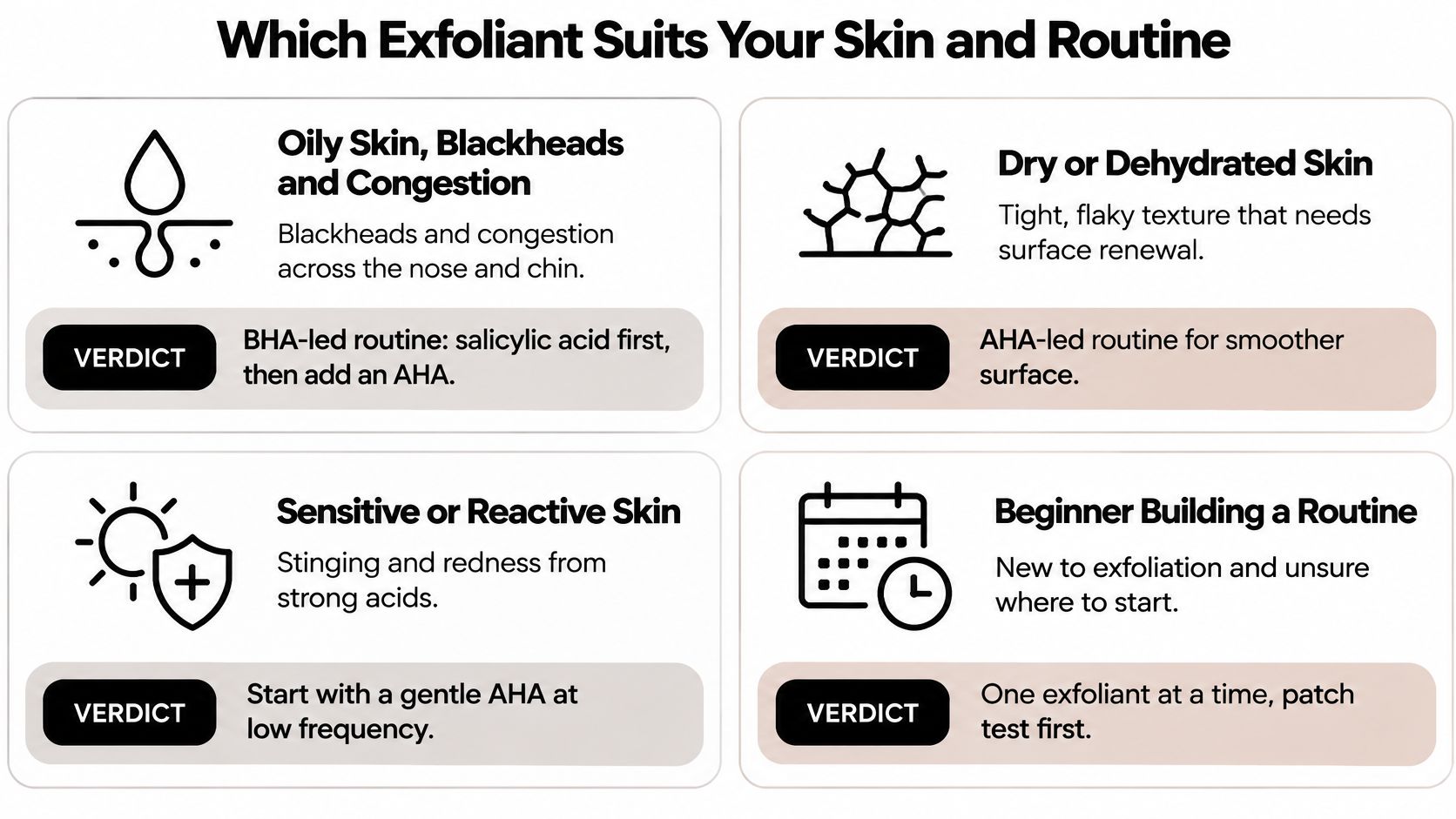
Which Exfoliant Suits Your Skin and Routine
A fixed skin-type label is a weak starting rule. Oily skin can still be raw, and dry skin can still clog. Match the acid to the concern that is active, then raise frequency only if that area stays calm.
This visual summarizes the starting choices, with the cautions below taking priority if your skin is irritated.
Congestion Versus Surface Roughness
Blackheads clustered on the nose and chin, with oil sitting in the pores. Start with a BHA-led leave-on. Salicylic acid is oil-soluble, so it works inside the pore. Bring in an AHA later only if roughness or marks are still the main issue after that pore step is tolerated.
Treat the congested zones, not the whole face by default. If the nose clears while the cheeks tighten, frequency is already high enough on those cheeks.
Dry or easily reactive skin, with rough texture and only occasional breakouts. A low-frequency mandelic start is a better first test than a strong glycolic treatment. Mandelic acid has a large molecule and stays at the surface. In DuoClear, that 1% mandelic acid is paired with 2% salicylic acid, so the pad is still a dual acid, not mandelic alone. For very sensitive skin, the 1% mandelic acid in Neutralyze Exfoliating Pads is the better starting point than Resurfacing Pads, which are aimed at rough texture, pores, or fine lines.
Dry skin that stings with moisturizer should rest before any acid is tested. The same pause applies if skin is raw or actively peeling.
Mixed Concerns Versus Acne That Needs Medical Care
Active congestion plus flat post-acne marks. One formula that pairs both acids avoids stacking a separate AHA leave-on on a BHA leave-on. Neutralyze Exfoliating Pads are dual-textured pads with DuoClear 2% salicylic acid and 1% mandelic acid: the salicylic acid works inside the pore while the mandelic acid smooths the surface. Swipe them on clean skin and leave them on. Professional-peel findings do not transfer automatically to a 2% and 1% pad. Track whether the blackheads and the marks you chose as targets change, and pause if burning or persistent redness appears.
Stacking warning: Do not use Exfoliating Pads and Resurfacing Pads on the same night. A single formulated combination is different from two leave-on acid products, and either pattern can still irritate while tolerance is unknown.
Deep, painful, or widespread inflammatory acne. Arrange a dermatologist assessment rather than treating a stronger acid as the next step. Customers taking oral prescription skin medication should ask their doctor before adding new exfoliating products.
An accessible nonprescription routine can clear milder congestion. It does not stand in for prescription care when lesions are deep or spreading. Several failed OTC and prescription courses are a reason for a treatment review, not a reason to buy another acid.
Match the ingredient to the dominant concern, then stop at the dose your skin can repeat. Moderate to severe acne, symptoms that persist, or lesions that worsen belong with a dermatologist, not with more exfoliation.
Choose Your Exfoliant and Start With a Patch Test
If you're adding Neutralyze Exfoliating Pads to your routine, start with the pads alone rather than adding several exfoliating steps at once. They're designed for acne-prone skin on the face and body, and use DuoClear, a combination of 2% salicylic acid and 1% mandelic acid.
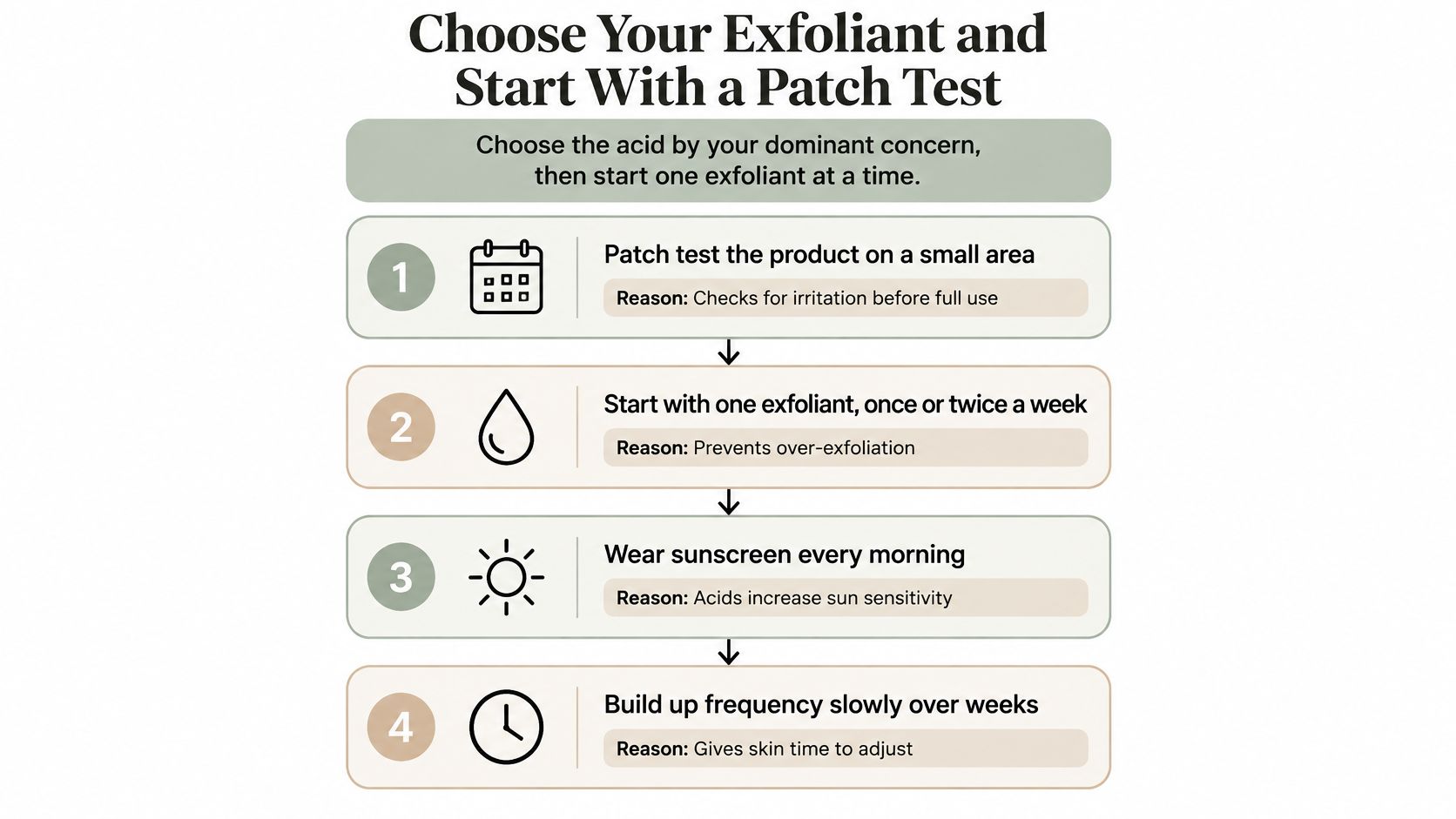
- Patch test first. For the first three days, use a pad sparingly on one or two small areas. Follow this guide to patch-testing skincare. A patch test can help assess initial tolerance, though it cannot predict every later reaction.
- Cleanse and rinse. Use Neutralyze Face Wash as the first step, then rinse and pat your skin dry.
- Apply the pads. Swipe an Exfoliating Pad over clean skin and leave it on. Start once a day; increase use only if needed and your skin tolerates it.
- Finish with Renewal Complex. This moisturizer also contains DuoClear, so introduce it separately to gauge how your skin responds to the combined routine.
- Use sunscreen. Wear sunscreen during the day. If you develop burning or persistent redness, reduce use or pause the pads.
Build the Routine Gradually
Face Wash, Exfoliating Pads and Renewal Complex all use DuoClear. Introducing each product separately makes it easier to identify which step your skin tolerates or reacts to. After the patch test, use each new step once a day before considering more frequent use.
For a video companion to your routine planning, use the player below.
Keep your routine steady and track changes in the concerns you're treating. If acne is moderate to severe, seek dermatologist guidance rather than relying on exfoliation alone.
Neutralyze's three-step routine pairs Face Wash, Exfoliating Pads and Renewal Complex around salicylic and mandelic acid. Compare the products at Neutralyze, then patch-test the step you plan to introduce.