

Acne After Shaving Face: Causes, Signs and Fixes
Bumps appearing on shaved skin within one to two days are often razor bumps rather than acne, so change your shave first.
You shave in the morning, then notice itchy bumps along your jaw and neck the next day. Reaching for a stronger exfoliant feels logical, especially if you already struggle with acne. But a freshly cut hair trapped in the skin needs a different approach from a clogged pore.
Why Your Face Breaks Out After Shaving
Quick Answer
Post-shave bumps often call for a less-close shave and gentler skincare before stronger acne-prone skin care. A curled hair can penetrate the skin and trigger inflammation without the clogged pore that starts ordinary acne. Adding acids to freshly scraped skin may increase burning without correcting the hair problem. Check where the bumps appear, what they look like, and whether they follow your shaving schedule.
A blade affects more than hair. Friction and repeated passes can leave tiny injuries, while shaving across inflamed pimples can make them more tender and easier to nick.
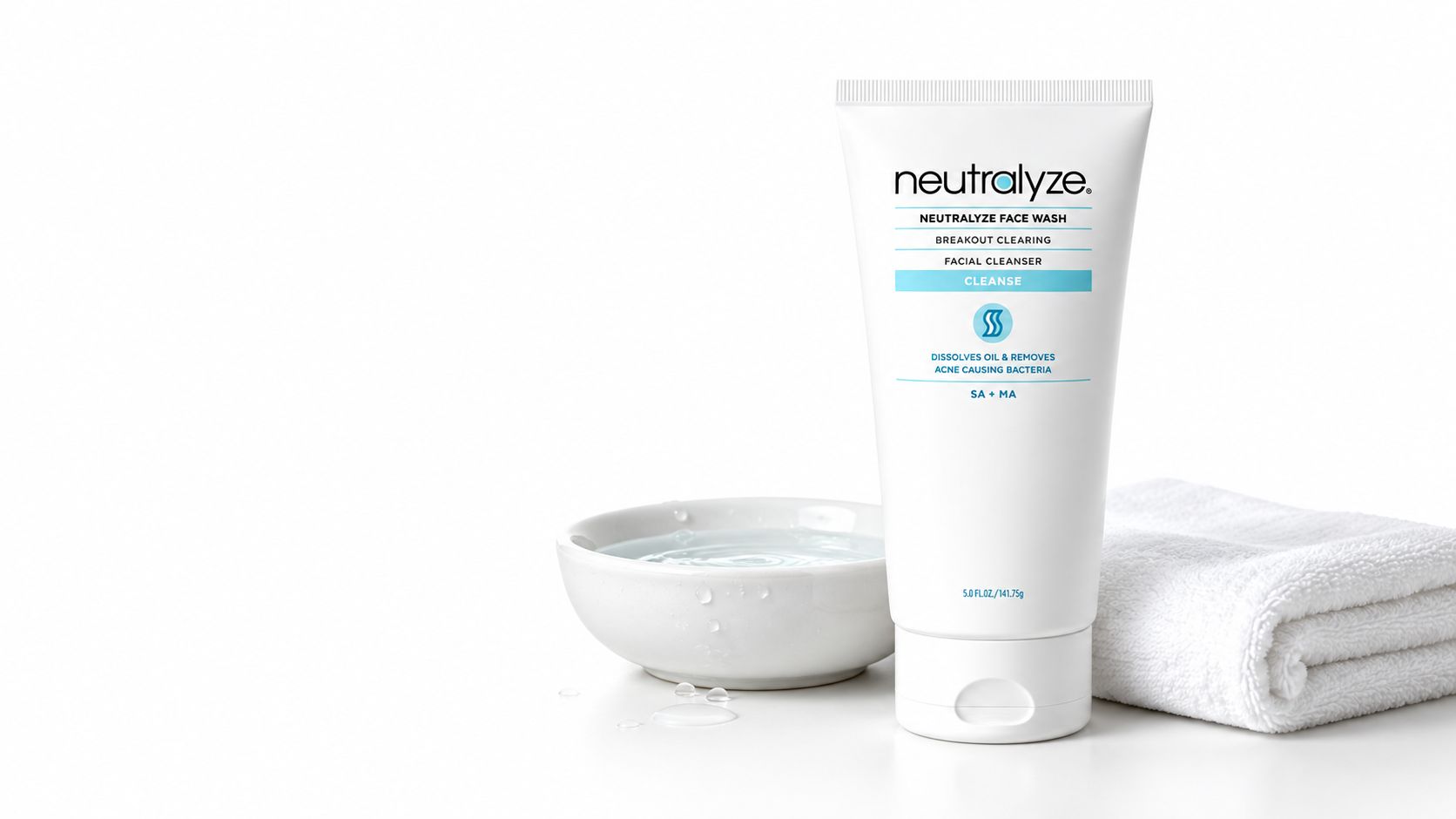
Neutralyze Face Wash contains 2% salicylic acid and 1% mandelic acid. It can help keep pores clear and skin looking clearer, but it does not address every bump that follows shaving. If skin feels raw, an exfoliating cleanser may not be the right next step.
Challenge the Acne Assumption
Salicylic acid works inside pores to clear oil and debris; mandelic acid helps smooth the skin's surface. Neither changes the direction a curved beard hair grows.
This difference matters when beard-area bumps persist despite acne products or prescriptions. A treatment aimed at clogged pores may not solve bumps that return with the same shaving pattern.
Practical rule: If your routine burns after shaving, don't treat the burning as proof that the treatment is working.
Keep a short log of shaving days, the tool used, and when new bumps appear. Note blackheads, trapped hairs, widespread redness, or pustules. Photos taken in similar lighting can help you compare changes over time.
This guide can help you choose next steps, but it can't diagnose your skin. Identify whether the problem is hair removal, acne-prone skin care, or both before choosing a product.
Acne or Razor Bumps and Why They Form
Acne, razor bumps and irritation compared
| Feature | Acne | Razor bumps (PFB) | Shave irritation or folliculitis |
|---|---|---|---|
| Where it appears | Face, including areas not shaved | Mainly shaved beard or neck | Shaved areas; may spread beyond them |
| Timing | Gradual, not consistently tied to shaving day | About one to two days after shaving | Redness and stinging within hours to days |
| Lesion type | Blackheads, whiteheads, papules, pustules | Itchy or tender papules and pustules | Uniform small red bumps or pustules |
| Trapped hair visible | No characteristic trapped hair | Often, though not always visible | Sometimes; not a defining sign |
| Mechanism | Clogged follicle, sebum and C. acnes inflammation | Cut hair curls back and triggers a foreign-body reaction | Irritation from friction or nicks; folliculitis may involve microbes |
| Best first move | Continue tolerated acne-prone skin care as directed | Pause close shaving, then use a guarded trimmer | Pause leave-on acids, use a cool compress, and seek care if spreading |
These are clues, not diagnostic tests. In particular, shave irritation and folliculitis belong together in the table because readers often confuse them, not because they're the same condition.
When the Hair Is the Trigger
Pseudofolliculitis barbae, or PFB, develops when a cut hair penetrates the follicular wall or curves back into nearby skin. The Merck Manual overview of pseudofolliculitis barbae describes this hair-driven inflammatory process, which can develop approximately 24–48 hours after close shaving; when shaving is necessary, leaving approximately 1–3 mm of stubble can help reduce penetration.
Think of the edge of a trimmed fingernail. It's small, but it can feel sharp against soft tissue. A closely cut, curved hair can act similarly when its tip turns toward the skin.
Your immune system reacts to that penetrating hair as material that doesn't belong there. You may develop a raised solid bump, called a papule, or a pus-containing bump, called a pustule. Pus alone doesn't prove that the original problem was a bacterial infection.
The strongest practical clue is a repeating pattern: close shave, regrowth, then itchy or tender bumps in the beard or neck. A visible curved hair supports that possibility, but its absence doesn't rule it out. The hair may be too short or too embedded to see.
Don't dig for a hidden hair with a needle or squeeze the bump to force it out. That adds another injury and can increase discoloration or scarring.
When the Follicle Is Clogged
Acne starts differently. Sebaceous glands produce sebum, the oil that lubricates skin and hair. Inside an acne-prone follicle, dead skin cells can stick together instead of shedding normally.
That abnormal buildup is called follicular hyperkeratinization. The resulting plug traps sebum and creates an environment in which Cutibacterium acnes, formerly called P. acnes, contributes to inflammation. This organism normally lives on skin; acne isn't evidence that your face is dirty.
A closed plugged follicle can appear as a whitehead. An open plug can look like a blackhead because material at its surface darkens, not because dirt has lodged there. Inflamed acne can then produce red papules, pustules, or deeper painful lesions.
Blackheads and whiteheads therefore provide useful clues. If they recur on your forehead or other untouched areas as well as your beard, an acne-focused routine may still be appropriate. The timing may fluctuate, but it won't consistently follow only hair removal.
Shaving can aggravate existing acne without being its original cause. Passing a blade across a raised pimple can nick it, while repeated friction can worsen surrounding inflammation.
When the Skin Barrier Is Irritated
Shave irritation often feels more like burning, tightness, or diffuse tenderness than a collection of individual clogged pores. You may notice broad redness, rough patches, or stinging when you apply products that ordinarily feel comfortable.
Dragging a dry blade, pressing hard, stretching the skin, or repeatedly chasing a perfectly smooth finish can disrupt the outer barrier. An irritating shaving cream or fragranced aftershave can add another trigger.
Folliculitis means inflammation of a hair follicle. It can resemble acne, particularly when many similar-looking pustules develop around hairs, but it may require different treatment. The American Academy of Dermatology's folliculitis guidance identifies shaving as a trigger and emphasizes that follicular eruptions shouldn't automatically be treated as ordinary acne.
Watch the behavior of the eruption as well as its appearance. Increasing warmth, drainage, spreading pustules, or worsening pain deserves medical assessment rather than another round of exfoliation.
You can have razor bumps along your jaw, acne on your cheeks, and irritated skin between them. Your whole face doesn't need the same treatment on the same night.
Active Bumps Aren't the Same as Leftover Marks
A flat brown or gray mark left after a bump settles is usually a different treatment target from a raised, inflamed lesion. Post-inflammatory discoloration reflects pigment changes after inflammation, not necessarily an active blockage or a hair still trapped beneath the surface.
Preventing new injuries comes first. Otherwise, you may keep creating fresh marks while trying to fade older ones.
Gentle skincare and sun protection support that longer-term goal. Increasing acids until the area peels isn't a shortcut, and depressed or raised scars need a different assessment from flat discoloration.
Shaving Methods and Steps That Reduce Bumps
Shaving methods compared for bump-prone skin
| Method | Closeness | Best For | Trade-off |
|---|---|---|---|
| Multi-blade disposable | Very close | Smooth results on straight hair | Greater concern for hair re-entry when curly hair is cut very closely |
| Single-blade disposable | Close | Controlled passes with a sharp edge | Still capable of cutting too closely; needs regular replacement |
| Electric foil shaver | Moderate to close, model-dependent | People who tolerate powered shaving better than blades | Pressure and repeated passes can still irritate |
| Guarded trimmer | Light stubble | Active bumps and healing skin | Won't produce a smooth shave |
Tool choice should follow your skin's response, not a promise that one blade configuration prevents every bump. This visual guide summarizes the options and technique.
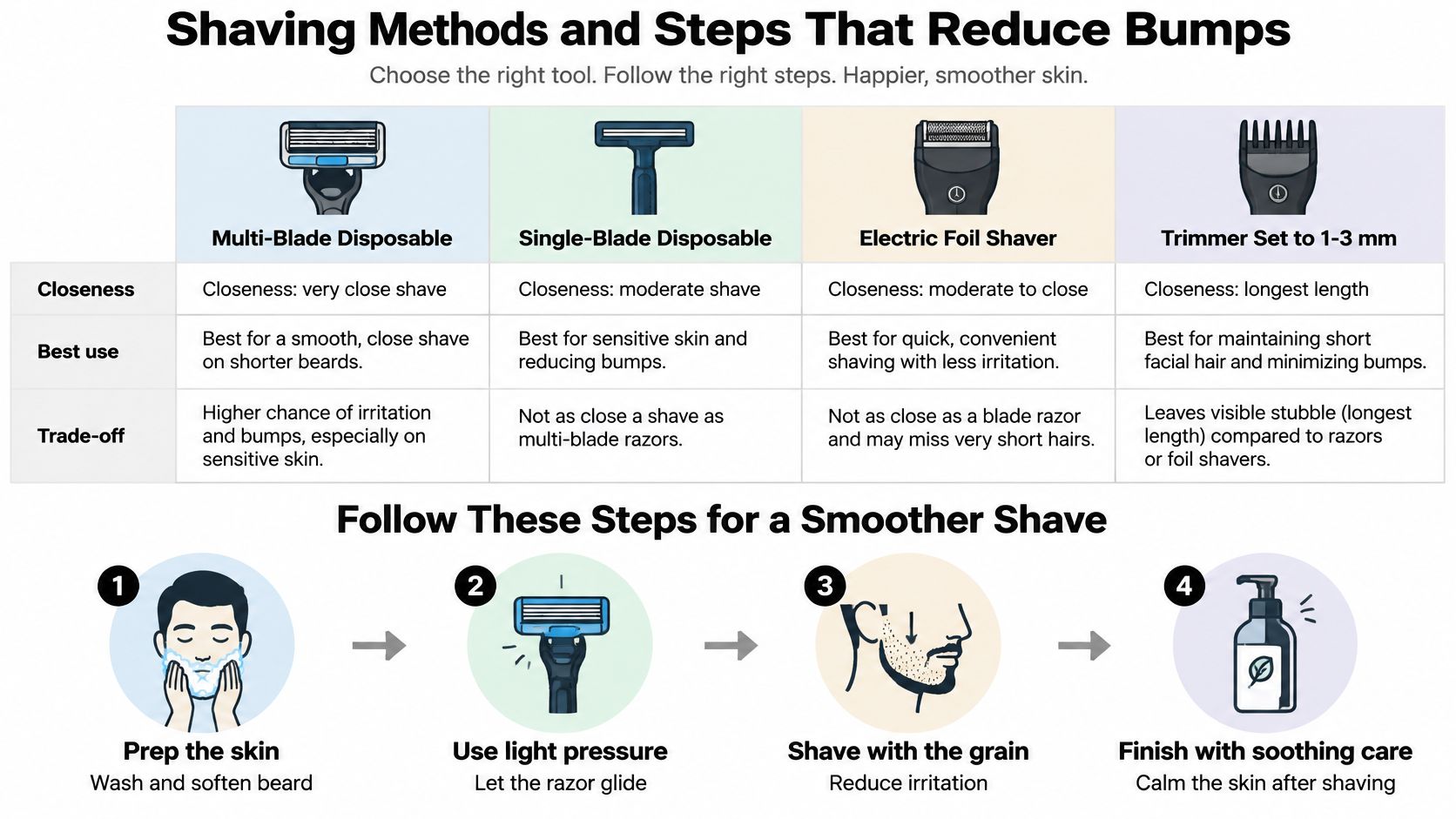
Use Preparation to Reduce Drag
- Soften the hair. Shave at the end of a shower or apply a warm, damp washcloth beforehand. Softer hair requires less force to cut.
- Apply a moisturizing shaving cream to wet skin. Give the razor enough slip that you don't need to push.
- Keep the blade sharp and clear. Rinse after every stroke so retained hair and cream don't interfere with the next pass.
- Follow the direction of growth using short, light strokes. Don't stretch the skin or make another pass to remove the last trace of texture.
- Avoid active lesions. Work around inflamed pimples rather than trying to shave them flat.
- Finish with a cool, damp washcloth and a bland, non-comedogenic moisturizer.
- Maintain the tool. The AAD's razor-bump prevention guidance recommends replacing disposable razors after 5–7 shaves, cleaning electric razors on that interval, and storing them dry.
Test Frequency Rather Than Following a Universal Rule
DermNet's PFB guidance recommends shaving with hair growth, avoiding repeat passes, considering an electric shaver, and reducing frequency to every other day.
However, frequency isn't the whole answer. A randomized study summarized in the clinical review of PFB assigned 47 men to daily or twice-weekly shaving with a three-blade razor for two months; the daily-shaving group had a greater reduction in inflammatory lesions and significantly better investigator-rated severity.
That doesn't mean everyone should shave daily. It means you should evaluate closeness, preparation, pressure, and irritation together instead of assuming fewer shaving days always produce fewer bumps.
Watch the shaving demonstration with those technique checks in mind.
Calming Your Skin Before You Add Acids
After shaving, redness and stinging are clues that the skin may need simpler care, not another active. A gentle routine can reduce friction while you watch whether the bumps settle.
Temporary adjustments for irritated skin
| Routine Step | Normal Days | Shave or Flare-Up Days |
|---|---|---|
| Cleanse | Use a gentle cleanser once or twice daily | Cleanse gently; lukewarm water is enough if the skin feels raw |
| Leave-on exfoliant | Use only if directed and tolerated | Avoid applying it to freshly shaved, nicked, or stinging skin |
| Spot treatment | Apply an appropriate treatment to visible lesions | Keep it on the lesion and avoid layering other actives over irritated skin |
| Moisturize | Apply daily after treatment | Use a bland, non-comedogenic moisturizer after shaving and at night |
| Shaving | Follow a schedule your skin tolerates | Pause close shaving or use a guarded trimmer while bumps are tender |
These are short-term adjustments, not a reason to stop prescribed treatment without advice. If a dermatologist has given you a specific plan, ask how to adapt it during shaving-related irritation.
Use Comfort as a Readiness Check
Soften the hair before trimming, avoid leave-on exfoliants over open nicks, and pat your face dry instead of rubbing. A cool compress can ease discomfort without adding another active ingredient.
Apply a bland moisturizer while your skin is slightly damp. Avoid picking, squeezing, scratchy scrubs, and alcohol-heavy aftershaves. If familiar products sting, simplifying care to help repair a damaged skin barrier can help you focus on comfort while the skin settles.
Before reintroducing an exfoliant, check that moisturizer no longer causes noticeable stinging, any nicks have closed, and the bumps are flattening rather than multiplying. These signs suggest the surface is less irritated, though they do not identify what caused every bump.
Keep stronger acids out of the routine until the irritation has settled. Even an acne-prone skin care routine that helps clogged pores can aggravate freshly shaved or raw skin, so add it only when your skin is comfortable and follow its directions.
A shaving-related bump may take weeks to improve after changing hair-removal habits. Burning that worsens is a reason to reassess sooner, rather than pushing through discomfort.
Building a Cleanse, Exfoliate and Hydrate Routine
Acids can support clearer-looking pores and smoother texture once your skin is comfortable. A shaving-related bump starts as a hair-removal problem, so changing the shave comes first. Adding exfoliants to freshly irritated skin can intensify discomfort.
Neutralyze's three-step system uses salicylic acid and mandelic acid for acne-prone skin, including skin with frequent, widespread breakouts. A published salicylic–mandelic peel comparison involved 44 patients with facial acne, post-acne scarring, and hyperpigmentation. Those professional peel findings do not establish the same outcomes for daily home products or freshly shaved skin.
Introduce Each Step Separately
Cleanse. Neutralyze Acne Face Wash contains 2% salicylic acid + 1% mandelic acid. For the first three days, patch-test a small amount on one or two small areas. If it causes no discomfort, begin once daily: massage gently onto wet skin, rinse thoroughly, and pat dry.
The cleanser is for washing, not for lubricating a shave.
Exfoliate. Neutralyze Exfoliating Pads combine salicylic and mandelic acids in a leave-on format. Swipe a pad over clean skin after cleansing and do not rinse. For a shaving-sensitive routine, use it on a non-shave night when your skin feels comfortable. Avoid applying it over fresh razor irritation.
Hydrate. Apply Neutralyze Renewal Complex, or your usual moisturizer, after skin is dry as the final step. Use a bland recovery moisturizer on raw skin and reserve Renewal Complex for comfortable days.
After the three-day patch test, begin each product once daily and build up only if needed. Introduce steps separately rather than starting them all at once.
A Cautious Reintroduction Example
This is a pacing example, not a clinically validated schedule or a substitute for your clinician's instructions:
- Week one: Cleanse as tolerated and use a bland moisturizer while adjusting hair removal.
- Week two: If skin stays comfortable, introduce Renewal Complex on non-shave days.
- Week three onward: Consider adding pads only if dryness, burning, and persistent redness are not developing.
Stay at an earlier stage longer if needed. The guide to how often to exfoliate can help you consider frequency without treating daily exfoliation as the goal.
With regular use, pores may look clearer, though individual results vary. Use daily sun protection, and don't add more applications just because older dark marks remain visible.
When to Book a Dermatologist Visit
Book an assessment if you cannot tell whether bumps are acne, ingrown hairs, or irritation, or if changes to shaving and skin care are not helping. Seek prompt medical care for rapidly spreading inflammation, substantial swelling, fever, or feeling unwell.
Arrange a visit for spreading pustules, warmth, worsening pain, or drainage, which can suggest infection. Scarring or persistent dark marks after repeated bumps also deserve attention. Bumps beyond shaved areas, deep painful lesions, frequent new breakouts, or little improvement after pausing close shaving are other reasons to consult a dermatologist.
Established pseudofolliculitis barbae may need a longer pause from close shaving, but do not delay care just to meet an arbitrary waiting period. A dermatologist can assess whether hair-driven inflammation, acne, infectious folliculitis, or contact irritation is causing the bumps, then recommend care for that cause.
Bring Your Treatment and Shaving History
Bring the names of acne-prone skin care routines you have tried, how your skin responded, and any side effects. Note your razor type, shaving direction and frequency, and bring photos showing how the bumps develop after hair removal. These details can help clarify whether shaving is driving the flare.
For more guidance on deciding when to seek care, read when to see a dermatologist. If you take oral prescription skin medication, ask your doctor before adding exfoliating products.
Stop repeating a treatment that does not match the problem.
A Clinically Formulated Starting Point for Acne-Prone Skin
Neutralyze Renewal Complex combines salicylic acid + mandelic acid in a time-released moisturizer for skin that tolerates exfoliating acids. It supports a considered skincare routine, not a replacement for shaving changes or a medical plan.