

Why Does Acne Itch? Triggers and What Helps
If acne were only a clogged pore, why would a tiny pimple itch enough to keep you awake? The missing piece is that an acne lesion sits inside living skin, where immune cells, surface cells, and sensory nerves communicate. Understanding that conversation helps you decide whether your skin needs acne-prone skin care routine, less irritation, or a different diagnosis.
Quick Answer
Acne can itch when inflammation activates sensory nerves, while barrier damage, treatment irritation, sweat, and friction amplify the sensation. Mild, occasional itching can accompany a familiar breakout. However, intense itching, identical-looking bumps, or a rash after a new product deserves a closer look. Tonight, avoid scratching and aggressive exfoliation, simplify anything that stings, and protect your skin with a fragrance-free, non-comedogenic moisturizer rather than adding more treatment.
The Itch You Keep Scratching at Night
Your jawline looks clean, but a pimple prickles beneath your mask. After a workout, a cluster of bumps feels uncomfortable enough that you rub it without thinking. At bedtime, the same spot starts tickling again, even though you've already washed your face.
It's tempting to interpret that sensation as leftover dirt or a pore that needs stronger treatment. You might scrub harder, add another exfoliant, or repeat your cleanser. But itch isn't a reliable measure of how clean your skin is, and more treatment isn't automatically the answer.
Neutralyze's mechanism-first approach to acne-prone skin starts with clinically formulated salicylic acid and mandelic acid products, including Neutralyze Face Wash. An acne cleanser belongs in a consistent routine, not in a cycle of repeatedly washing whenever a bump feels itchy.
An Overlooked Acne Symptom
You're not imagining the sensation. Reported acne cohorts included itch rates of 39.4% and 40.1%, with an average itch intensity of 3.83 on a numerical rating scale in one group, as described in research discussing acne-associated itching and sensory signaling.
The size of a visible bump doesn't necessarily explain how distracting it feels. A small lesion can sit beside irritated surface skin, and nearby nerve endings respond to that environment, not just to what you can see in the mirror.
Start tonight: Notice whether the itch comes from an individual bump, the surrounding skin, or an entire area where you applied a product.
That distinction gives you a useful starting point. A prickling inflamed pimple, a tight cheek after cleansing, and a suddenly itchy rash may feel similar, but they don't call for the same response. Before changing your routine, identify what happened just before the itch began.
How Inflammation Turns a Pimple Into an Itch
An acne lesion begins in a follicle, the small opening associated with a hair and its oil gland. Sebum, your skin's oil, combines with abnormally shed cells that accumulate instead of clearing normally. Dermatologists call this abnormal buildup follicular hyperkeratinization.
The plug enlarges the follicle and creates conditions in which inflammation can develop. That's why acne isn't material sitting on top of your face. The relevant activity happens inside and around a follicle.
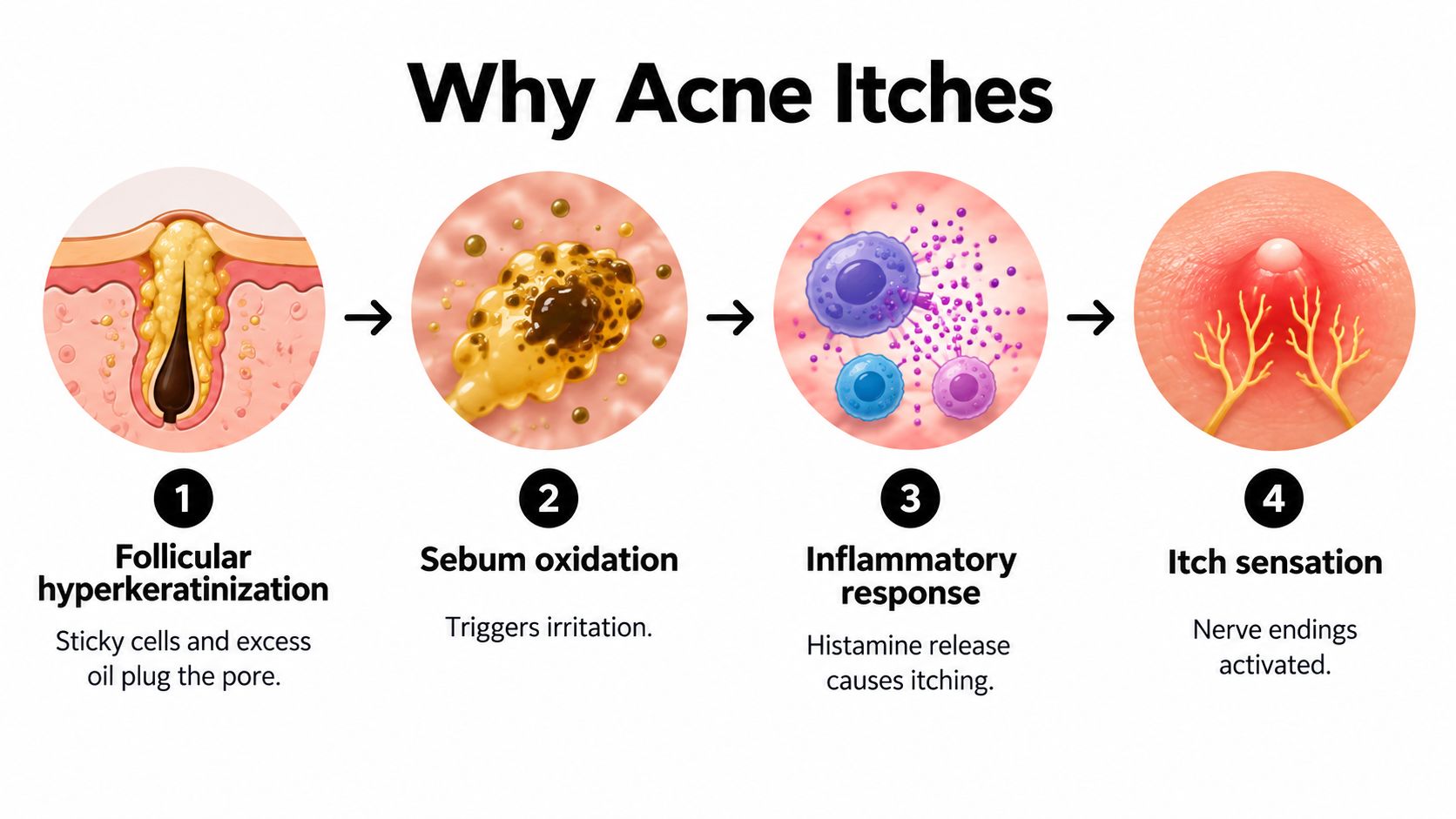
The Connection Between Immune Cells and Nerves
Cutibacterium acnes, often abbreviated C. acnes, and inflammatory cells can release enzymes called proteases. These activate protease-activated receptor 2, or PAR-2, on keratinocytes and nerve-associated cells, promoting inflammatory mediator release and amplifying local irritation, according to research on acne pruritus and PAR-2 signaling.
Keratinocytes are the cells that make up much of your skin's outer protective structure. They're not passive packaging. When stressed, they can send signals that affect neighboring immune cells and sensory pathways.
Think of a crowded room where people keep nudging one another. Inflammation is the repeated nudge; PAR-2 is one of the alarm buttons through which nearby cells respond. The resulting messages can stimulate itch-sensing nerves as well as nerves involved in pain.
This helps explain why red papules and pustules are more likely to itch than noninflamed blackheads. However, the exact contribution of microbial, immune, and neural pathways varies and remains incompletely understood.
- If one inflamed bump prickles: Leave it alone rather than trying to empty it.
- If you're tempted to scrub: Remember that surface abrasion can't switch off the immune activity inside the follicle.
- If itching escalates: Don't treat it as proof that an acne product is working.
The practical aim is to manage the acne without adding another source of irritation around an already inflamed follicle.
Sweat, Heat, Stress, and Friction
A forehead that feels comfortable indoors may itch under a warm hat. A jawline breakout can become distracting beneath a damp chinstrap after exercise. These changes don't necessarily mean that new acne has appeared; existing lesions may feel more noticeable.
In a 2008 Singapore outpatient study of 120 acne patients, 70% reported itch; sweat aggravated symptoms in 71%, heat in 62%, and stress in 31%, while 52% scratched or rubbed and 37% washed the area for relief, according to the clinical study of itching in acne.
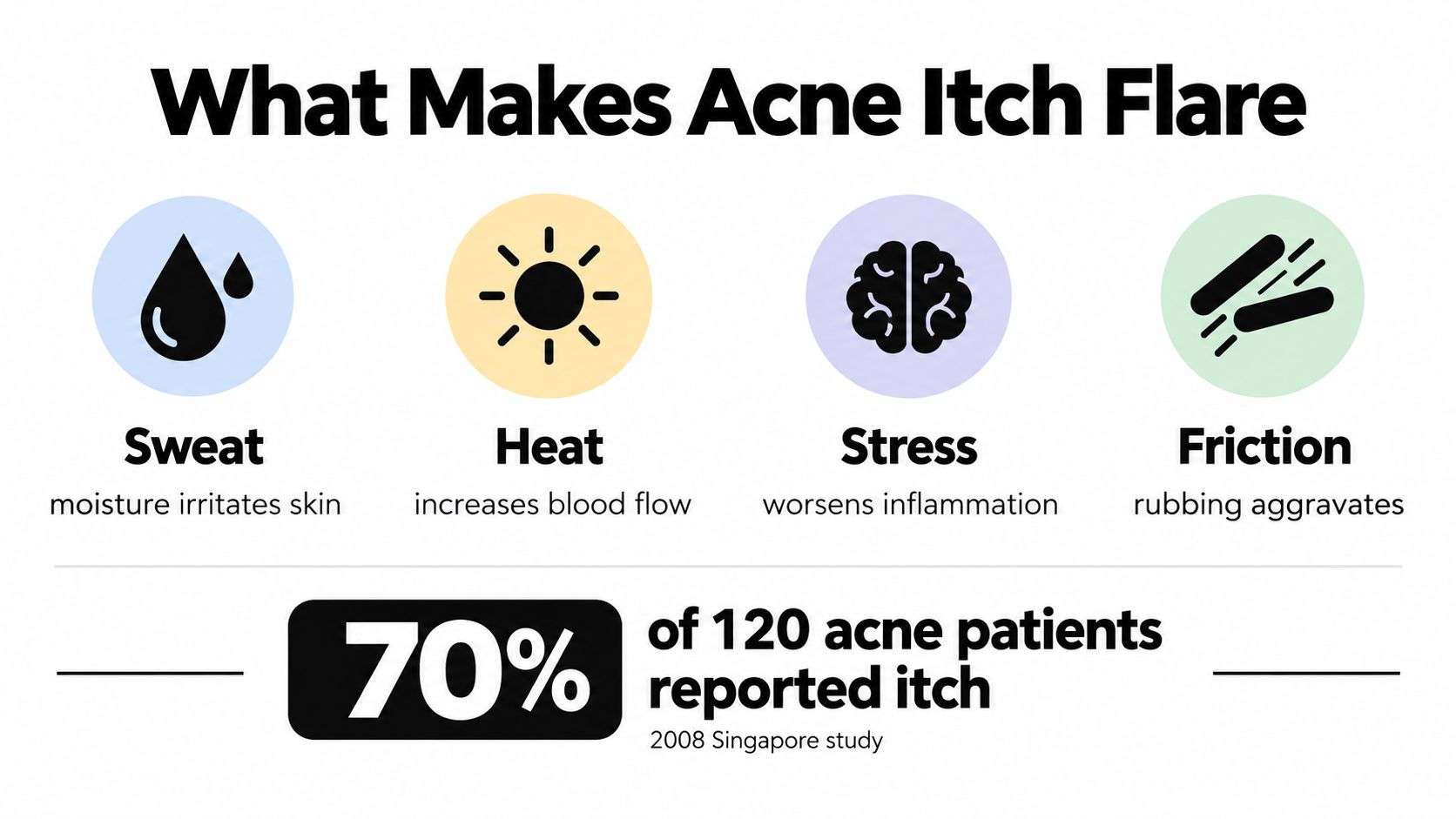
Change the Exposure, Not Just the Product
Those findings identify aggravating factors, not a universal explanation for every flare. Your useful question is whether a particular exposure repeatedly comes before the itching.
- After sweating: Remove damp equipment or clothing when practical, and clean your skin gently rather than rubbing it dry.
- During hot weather: Look for opportunities to cool down and reduce prolonged contact with sweaty hats, collars, or straps.
- Under stress: Notice automatic face-touching. Redirect your hands instead of checking each bump repeatedly.
- Where equipment rubs: Adjust the fit when possible, without compromising its protective function.
The Neutralyze guide to gym acne provides related routine context for exercise-associated breakouts. For clammy bedding, Protect-A-Bed's resource on a waterproof protector for clammy nights covers mattress protection, not acne-prone skin care.
You don't have to stop exercising because your acne itches. Focus on what stays wet, hot, or pressed against your skin afterward.
Repeatedly washing for relief can become another problem. If your skin feels tight after the extra wash, replace that response with removing the trigger and leaving the area alone. A brief note about weather, exercise, equipment, and stress can reveal a pattern that another product purchase won't.
When the Routine Itself Makes Acne Itch
Your face feels tight after cleansing, the jawline flakes, and your usual moisturizer suddenly stings. That combination suggests the surrounding skin needs attention, not stronger pore treatment.
Acne-prone skin commonly shows increased transepidermal water loss, raised surface pH, redness, altered sebum composition, and reduced barrier integrity, as discussed in a review of acne and skin-barrier dysfunction. Transepidermal water loss means water escaping through the skin's surface. A less effective barrier leaves skin more vulnerable to topical and environmental irritants.
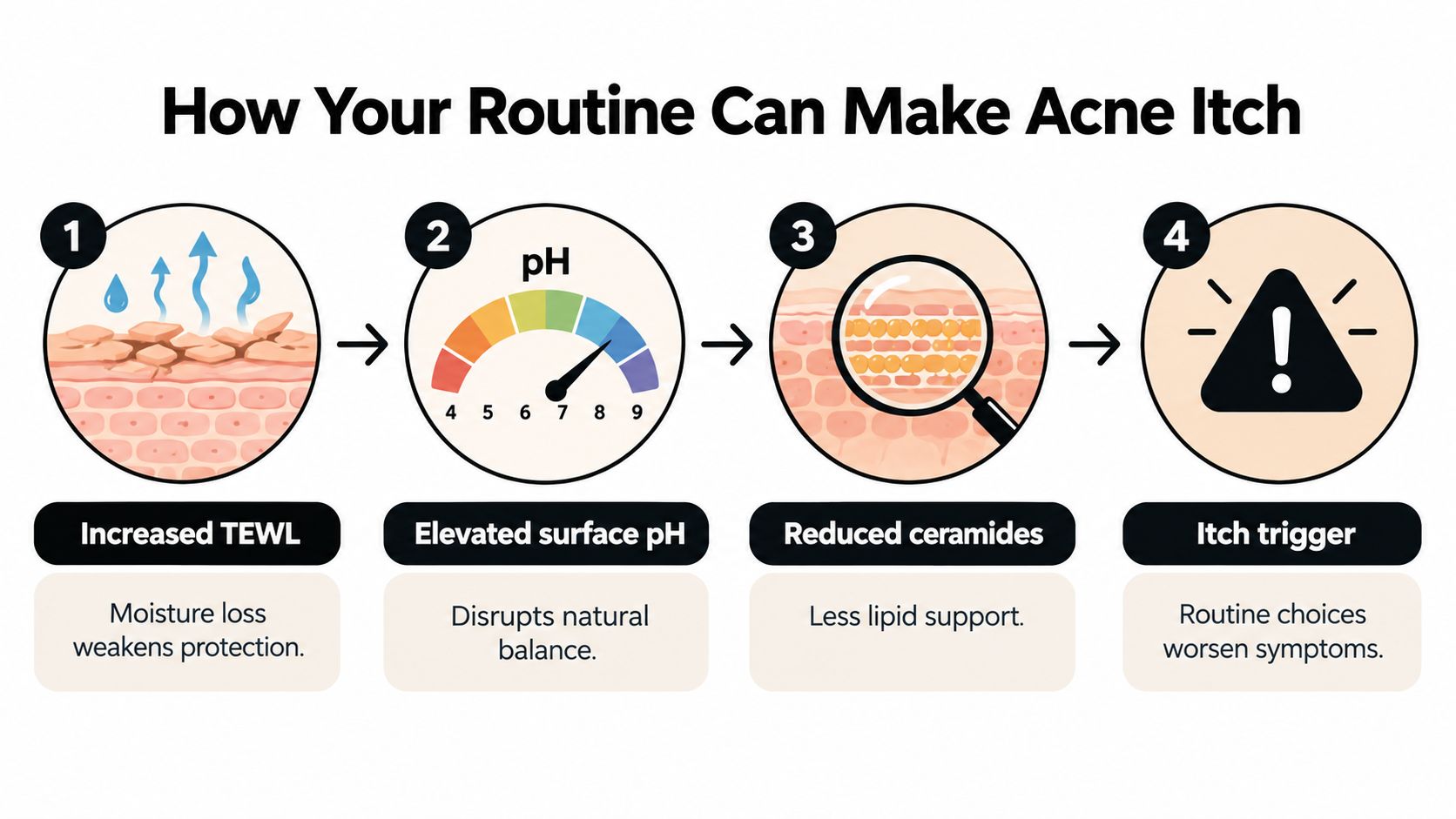
Find the Irritation Load
A routine can become excessive without any single product being unsuitable. An acid cleanser, leave-on exfoliant, abrasive scrub, and frequent washing may collectively exceed what your skin tolerates.
- Tightness after washing: Reconsider the cleanser and unnecessary repeat washes.
- Stinging after layering: Reduce the number of active products used together.
- Flaking where you scrub: Remove abrasive tools and textured rubbing.
- Persistent itch after applications: Stop assuming you need to push through discomfort.
The guide to over-exfoliated skin and acne offers related context for recognizing an overworked routine. ArtNaturals' resource to find a calm acne skincare routine is another routine-planning reference, rather than evidence that a particular formula will suit everyone.
Keep Treatment Separate From Irritation
The previously introduced cleanser contains 2% salicylic acid and 1% mandelic acid, a BHA and AHA combination described on its product page. Those actives make it an acne-prone skin care routine step, so don't treat it like an unlimited rinse whenever your skin feels uncomfortable.
Neutralyze organizes its clinically formulated system around cleanse, rejuvenate, and hydrate. That ordering doesn't mean irritated skin should immediately receive every step.
Introduce an active product separately, use the smallest effective amount and frequency, and keep a fragrance-free, non-comedogenic moisturizer available. An active-containing acne moisturizer and a plain supporting moisturizer serve different purposes. When your skin is already stinging, adding exfoliation inside a moisturizing formula may still be too much.
Itchy or Something Else
Itching isn't proof of purging. If every new bump looks alike and the itch is stronger than the tenderness, reconsider what you're treating before adding more acid.
The American Academy of Dermatology identifies folliculitis as a cause of acne-like breakouts and eczema as itchy, dry, inflamed skin in its public dermatology information on acne-like and itchy skin conditions. They're distinct problems, even when small red bumps make them look similar.
Acne Itch vs Lookalike Conditions
| Clue | Acne Itch | Folliculitis | Contact Dermatitis | Eczema |
|---|---|---|---|---|
| Appearance | Mixed blackheads, whiteheads, and inflammatory bumps | Similar-looking follicular bumps | Rash or bumps associated with exposure | Dry, inflamed, itchy skin |
| Helpful pattern | Familiar lesions of varying sizes | Uniform bumps, sometimes after sweating | Starts after a product or other contact | Dryness and a rash-like pattern |
| Distribution clue | Existing breakout areas | Forehead, chest, or back may be prominent | Areas exposed to the suspected trigger | May extend beyond individual follicles |
| Sensible response | Assess inflammation and routine tolerance | Seek assessment if persistent or intensely itchy | Stop the suspected product and seek advice | Seek evaluation rather than adding exfoliation |
These clues aren't a home diagnostic test. Yeast-associated folliculitis can be linked with sweating, occlusive products, oily skin, antibiotics, and steroid exposure, while allergy can involve inactive ingredients as well as treatment actives, as outlined in an explanation of itchy acne and alternative causes.
For related terminology, the Neutralyze explanation of fungal acne discusses the condition commonly described by that name.
Diagnostic checkpoint: A sudden change in the character of your breakout matters more than whether the bumps resemble pimples.
Mild, occasional itching alongside familiar mixed lesions may reflect acne with irritation. Sudden intense itching, many same-sized bumps, or a rash following a new product warrants professional assessment. Escalating exfoliation before clarifying the diagnosis can leave you treating the wrong problem more aggressively.
Soothing Itchy Acne Tonight and Preventing It Tomorrow
Tonight, aim for comfort without another irritation challenge. You don't need to strip every trace of oil or complete an elaborate treatment sequence before bed.
If the skin is uncomfortable, try a cool, clean compress briefly. Don't use ice directly, pick the lesion, or scrub the area. If your current cleanser or treatment stings, don't add another acid product as a rescue measure.
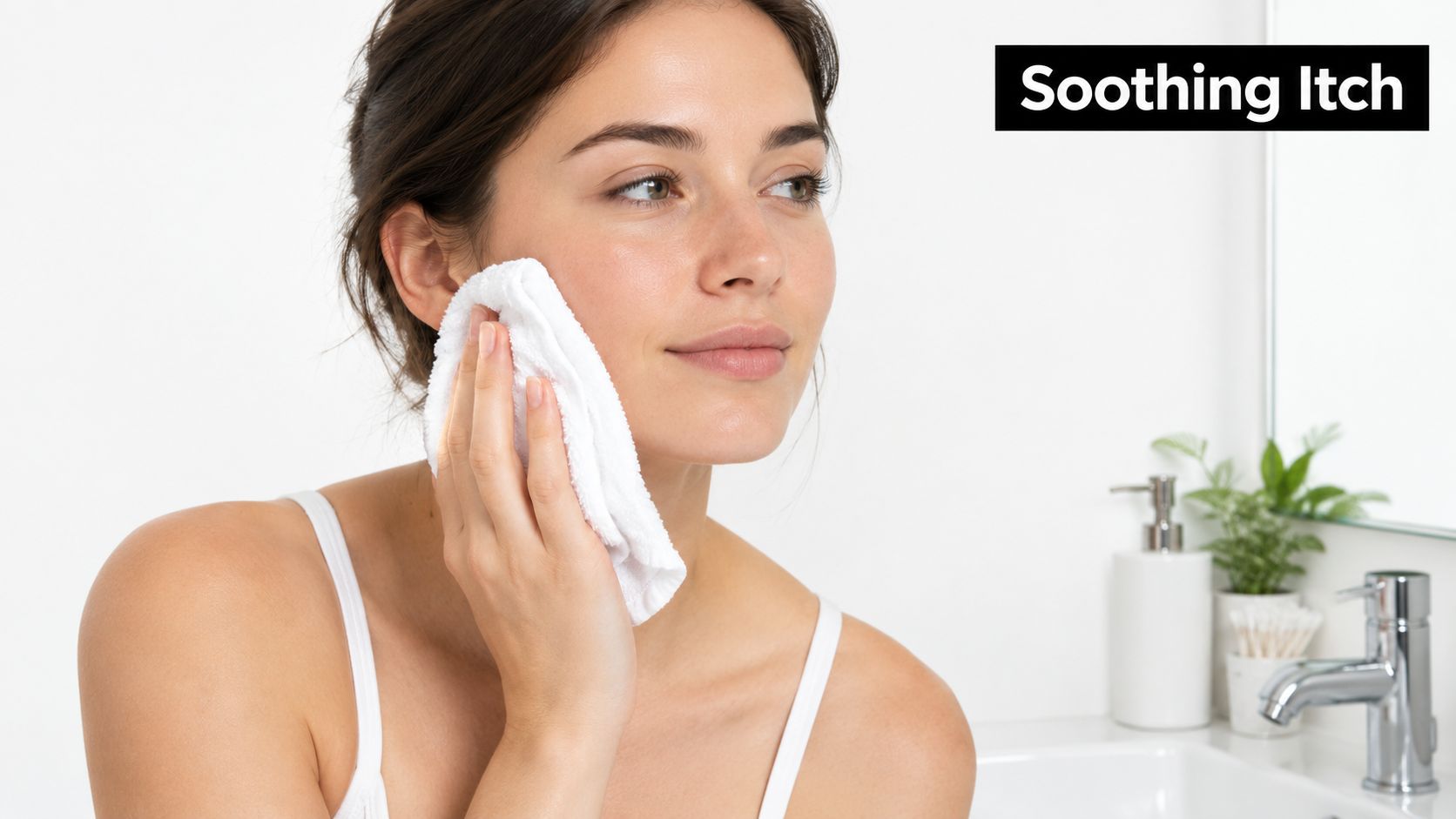
A Simple Comfort-First Evening
- Cleanse only as needed: Use a cleanser you already tolerate, massage with fingertips, rinse thoroughly, and pat dry.
- Support the surface: Apply a fragrance-free, non-comedogenic moisturizer without introducing another unfamiliar active.
- Remove avoidable contact: Keep damp straps, rough collars, and your hands away from the area.
- Pause the experiment: Don't test several new products while trying to identify what caused the itching.
Once your skin is comfortable, organize acne-prone skin care around a manageable routine rather than a rigid maximum-strength schedule.
Build the Routine Around Tolerance
In the morning, keep cleansing gentle and follow with an appropriate moisturizer and sun protection. Neutralyze Renewal Complex is a clinically formulated moisturizer with time-released salicylic acid and mandelic acid. Because it contains exfoliating actives, count it toward your total exfoliating load rather than assuming every moisturizer is inactive.
For an evening exfoliation option, Neutralyze Exfoliating Pads contain salicylic acid and mandelic acid in a leave-on pad format. Introduce them separately from other routine changes, follow the label, and reduce use if dryness or irritation develops. Don't press harder or repeatedly wipe an itchy bump.
Treating active acne and improving post-acne marks are different objectives. A flat mark isn't the same as a clogged or inflamed follicle, and lingering discoloration isn't a reason to intensify treatment on uncomfortable skin.
If you're already using prescription acne medication, ask your clinician how an acid-based cleanser, pad, or moisturizer fits before combining them. A routine that you can tolerate consistently is more useful than one you repeatedly abandon because it burns.
When to Stop and When to Step Up Treatment
You don't need to prove that you can tolerate discomfort. Product intolerance and undertreated acne require different decisions, and neither is solved by blindly increasing frequency.
Use the timing and pattern of symptoms to guide your next move. Itch that repeatedly follows the same application deserves attention, especially when it comes with visible changes.
Stop and Reassess
- Predictable discomfort: Stop the suspected product if each application brings itching or burning.
- Visible reaction: Swelling, hives, marked scaling, or oozing warrants professional evaluation.
- Changing distribution: A spreading rash or symptoms outside your familiar breakout pattern needs assessment.
- Continuing symptoms: Persistent itch despite a gentler routine is a reason to check the diagnosis.
These are not signals to exfoliate more. Bring the product names, ingredient lists, and a description of when symptoms began to your appointment.
Step Up When Acne Needs More Support
Deep nodules, cyst-like lesions, scarring, or acne that remains difficult to manage are reasons to discuss a dermatologist-led plan. The same applies when you suspect folliculitis, dermatitis, or another contributor that an ordinary acne routine may not address.
Prescription help isn't a failure of at-home skincare. It's a way to match treatment to the severity and nature of your condition, while keeping supportive skincare in its proper role.
Improving comfort and gradually decreasing visible inflammation can be encouraging, but neither establishes a guaranteed adjustment timeline. Don't use a calendar to excuse a worsening reaction.
Keep a simple symptom record: what you applied, whether you exercised, where clothing rubbed, and when itching started. Change one product at a time so you can interpret the result. Your barrier is part of the treatment plan, not something to repair only after the routine becomes unbearable.
Common Questions About Itchy Acne
How Long Does Acne Itching Usually Last?
Individual episodes can be brief. In a study of 108 teenagers, 54.9% reported itching during assessment or previously; 51.9% of episodes lasted less than one minute, and 38.9% lasted up to 10 minutes, according to the study of pruritus in adolescent acne. Those findings don't establish how long your symptoms should last or justify ignoring persistent itching.
Does Picking an Itchy Spot Make Scarring Worse?
Picking isn't a useful itch treatment. Rubbing and scratching can mechanically irritate inflamed follicles and disrupt the surface, so avoiding them is the safer approach. If a spot has already been picked, don't scrub away the damaged surface or apply extra exfoliant to compensate.
Can Post-Acne Marks Itch While Healing?
An area with a fading mark may still feel uncomfortable, but itch alone doesn't confirm healing. Ask whether there's still a raised lesion, peeling skin, or a product reaction in that location. A flat mark and an actively inflamed pimple shouldn't automatically receive the same treatment intensity.
When Should You Stop a Product Because of Itch?
Stop the suspected product when itching reliably follows its use or comes with burning, swelling, hives, marked scaling, or oozing. Don't restart several products together after the skin settles, because that makes the trigger harder to identify. Seek professional advice when the reaction is substantial or doesn't improve.
If you're looking for local consultation information, Yoyime Clinic's Dubai mens skincare acne help is a location-specific resource to review, not evidence that a particular procedure is appropriate for your itchy breakout. Ask any clinician to clarify the diagnosis before choosing treatment.
Neutralyze offers a clinically formulated salicylic acid and mandelic acid system organized around cleansing, exfoliating, and hydrating acne-prone skin. Visit Neutralyze to review the formulas and choose an exfoliating or hydrating step that fits your current routine, introducing it gradually rather than adding more exfoliation to skin that's already itching.