

Why Do I Get Blind Pimples? Causes and What Helps
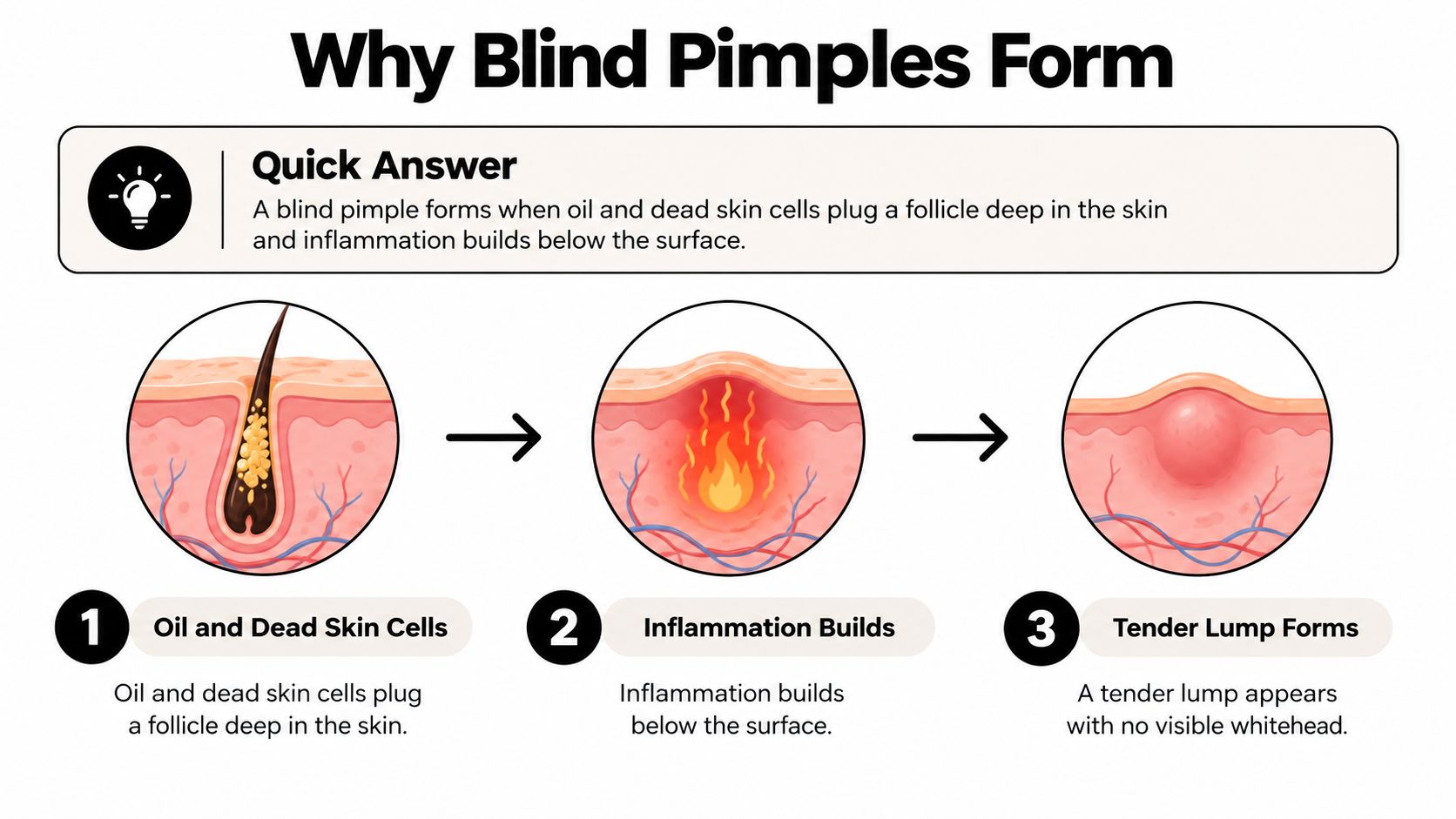
Blind pimples form when oil and dead skin cells plug a follicle deep in your skin and inflammation builds below the surface, causing a tender lump with no visible head.
You might notice it while washing your face: a sore spot along your chin or cheek that barely shows in the mirror. There's nothing obvious to pop, yet it hurts when you touch it, and your usual spot treatment seems to do very little.
That mismatch between what you feel and what you see is important. The depth of the inflammation helps explain both the pain and why a stronger, more drying product isn't automatically the right answer.
Why Clogs Form Deep Inside Your Follicles
A blind pimple usually begins inside a pilosebaceous unit, the combination of a hair follicle and its oil-producing sebaceous gland. Oil, called sebum, mixes with dead skin cells inside that structure.
A cleanser such as Neutralyze Face Wash, clinically formulated with 2% salicylic acid and 1% mandelic acid, works on the clogging side of acne care. That's different from promising to flatten an established deep lump immediately.
The Blockage Comes Before the Lump
Think of a drain with a blockage well below the opening. Trouble can develop underneath the floor before you see anything at the drain itself. Similarly, a follicle can become blocked and inflamed before an obvious surface blemish appears.
The established acne mechanisms are excess sebum, abnormal follicular keratinization, proliferation of Cutibacterium acnes, and localized inflammation. Abnormal keratinization means cells accumulate and stick together instead of shedding normally within the follicle, as described in this review of acne development and treatment.
The blockage can begin as a microscopic microcomedo, then become a closed comedone. Inflammation may produce a papule or pustule, while deeper inflammation can produce a nodule or cyst-like lesion. These aren't mandatory stages that every clogged pore passes through.
How a Blind Pimple Progresses Below the Surface
| Stage | What Happens Below the Surface | What You Notice |
|---|---|---|
| Microcomedo | A microscopic plug forms as sebum and dead cells accumulate | Nothing obvious at the surface |
| Closed comedone | The blocked follicle remains closed at the surface | A small, flesh-colored bump |
| Inflamed papule or pustule | Inflammation develops around the blocked follicle | A red bump, sometimes with a white top |
| Nodule or cyst | Inflammation extends deeper and may involve neighboring follicles | A deeper, tender lump without an obvious head |
This diagram summarizes the underlying process.
Why the Inflammation Spreads
If the follicle becomes sufficiently inflamed or ruptures, bacteria, keratin, and inflammatory lipids can enter the surrounding dermis. Your immune response then produces swelling and tenderness.
Hormonal signals, particularly androgens, can enlarge sebaceous glands and increase oil production. But oil production alone doesn't determine whether you develop a superficial clogged pore or a painful deep lesion.
How to Tell a Blind Pimple From a Regular Pimple
A blind pimple is usually a deep nodule or cyst-like lesion, while an ordinary inflammatory pimple sits closer to the surface. However, you can't confirm every lump's identity by appearance or touch alone.
DermNet separates inflammatory acne into papules, pustules, nodules, and pseudocysts. Nodules are large, often painful lumps; pseudocysts are softer, cyst-like swellings, according to its classification of inflammatory acne lesions.
Why It Hurts Without a Whitehead
The pain comes from inflammation and swelling below the epidermis, not from the presence of a visible white center. Pressure can build within and around a follicle even when there's no surface opening.
A nodule generally feels harder because it lacks a central pus-filled cavity. A cyst contains pus, but that doesn't mean it has an accessible opening or should be drained at home.
Blind Pimple Versus Surface Pimple Versus Whitehead or Blackhead
| Feature | Blind Pimple (Nodule or Cyst) | Surface Pimple (Papule or Pustule) | Whitehead or Blackhead |
|---|---|---|---|
| Depth | Deeper in the skin | Closer to the surface | A more superficial blocked follicle |
| Visible head | Often absent | A papule has no pus-filled head; a pustule does | Closed bump or dark open plug |
| Texture | Firm or cyst-like | Raised and variably firm | Small bump or visible plug |
| Pain when touched | Often tender or painful | Tenderness varies | Usually less inflamed |
| Typical duration | Variable; persistent tenderness deserves assessment | Variable | Can remain without becoming deeply inflamed |
| Response to spot treatment | Limited immediate benefit | More accessible to topical treatment | Treatment focuses on clearing and preventing plugs |
The duration row isn't a countdown. A lesion's persistence, recurrence, and effect on your skin matter more than assigning it a fixed expiration date.
A painful bump doesn't need a visible whitehead to deserve treatment.
For example, you might feel a sore jawline lump that remains tender without developing a white top. That pattern can fit deep inflammatory acne, but it doesn't prove a diagnosis.
Avoid repeatedly pressing the area to test whether it's ready to pop. The American Academy of Dermatology's acne symptom guidance identifies deep nodules and cysts as lesions that may require dermatologic treatment, particularly when they're painful or leave scars.
Immediate Care for a Painful Blind Pimple Tonight
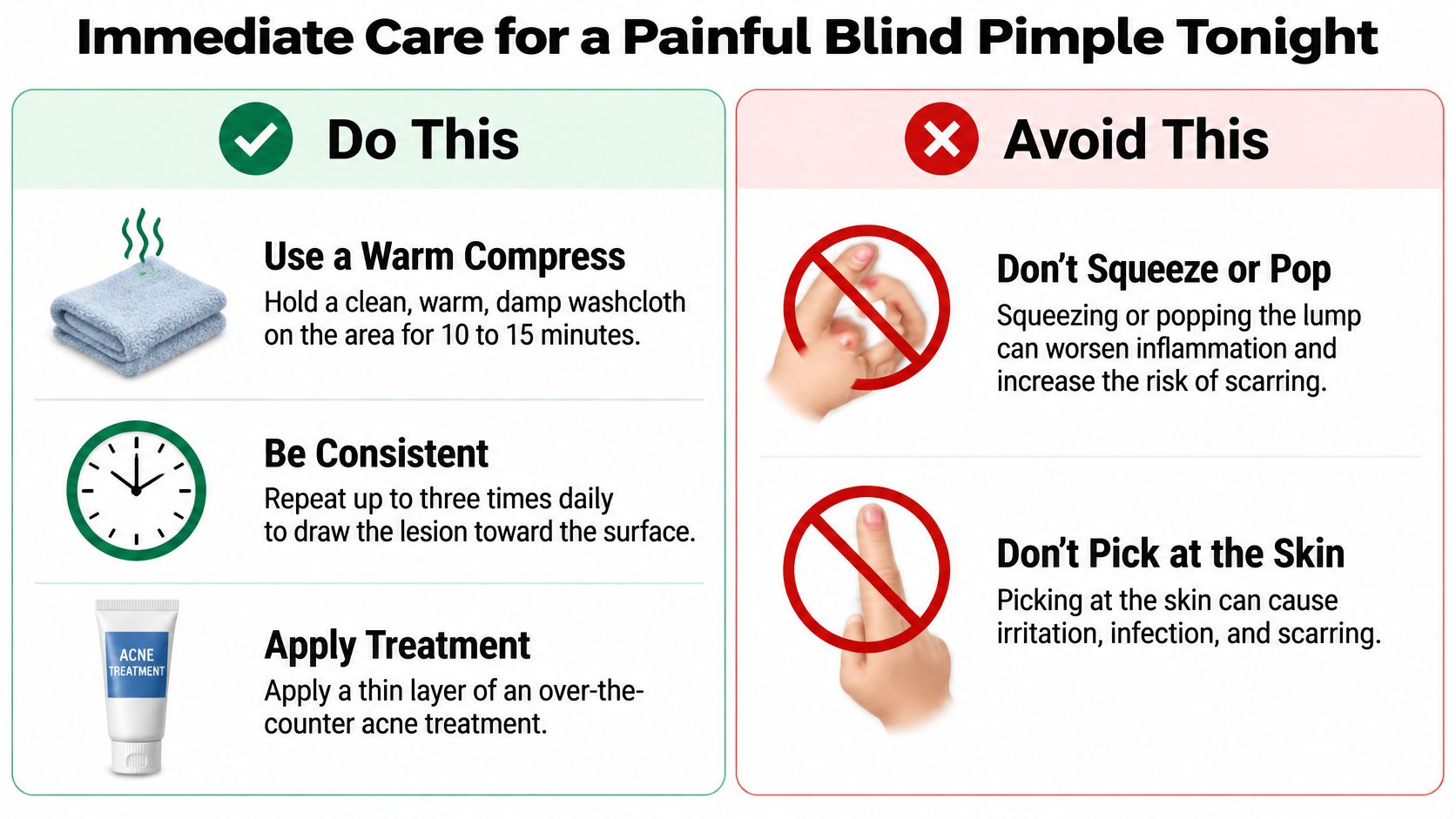
Hold a clean, warm, damp washcloth against the area for 10–15 minutes, up to three times daily. The AAD's guidance for treating a deep, painful pimple at home recommends this approach to encourage the lesion toward the surface, followed by only a thin layer of an appropriate acne-prone skin care routine.
Use comfortably warm water, not heat that hurts. You're supporting the skin, not trying to force the lump open.
The practical priorities are simple.
What to Do Without Overdoing It
- Clean gently. Use your fingertips rather than scrubbing the tender area.
- Keep treatment thin. Follow the product label instead of adding extra layers because the lump hurts.
- Check tolerance first. Test a new product on a small area according to its directions rather than experimenting across an already irritated face.
- Use patches selectively. A hydrocolloid patch has limited value when there's no surface fluid to absorb.
A patch isn't a way to pull an intact deep nodule through the skin. Likewise, a product that makes the surface feel tight or dry hasn't necessarily reached the source of the pain.
What to Leave Alone
Don't squeeze, puncture, or pick the lump. Manipulation can increase inflammation and the risk of infection, discoloration, and scarring.
Avoid vigorous scrubbing and stacking several strong treatments on the same spot. If you use makeup, don't rub repeatedly over the sore area or add layers as a substitute for care.
Practical rule: Tonight's goal is to avoid additional injury, not to make the lump disappear by morning.
A stronger spot product isn't automatically more useful because topical medicines generally work better once a lesion reaches the surface. That limitation reflects the lesion's anatomy, not necessarily a failure of the ingredient.
The video below provides an additional visual reference for home care.
Stop escalating home treatment if the pain grows, the lump enlarges, or you're developing additional deep lesions. Those changes call for assessment rather than another layer of spot treatment.
What Triggers Blind Pimples Beyond Hormones
Hormones are an important contributor, but they aren't the whole explanation. If you're asking, “Why do I get blind pimples?” the useful distinction is between the mechanism inside the follicle and the circumstances that may make breakouts more likely.
Recognized contributors include genetics, friction or pressure, humidity, stress, and some medicines. The Cleveland Clinic's explanation of blind pimples describes this broader picture rather than treating every deep lesion as exclusively hormonal.
Look for Patterns, Not Proof From One Breakout
Common Triggers and the Signal Each One Leaves
| Trigger | How It Contributes | Signal to Watch |
|---|---|---|
| Hormonal shifts | Androgen activity can increase sebaceous-gland size and oil output | Repeated timing patterns worth discussing with a clinician |
| Genetics | Inherited susceptibility can contribute to acne | Relatives with similar deep breakouts |
| Occlusive or comedogenic products | Product-related blockage is worth considering | Breakouts after introducing a product |
| Friction and pressure | Repeated contact may contribute to local flares | Lesions concentrated where equipment rubs |
| Picking and squeezing | Manipulation increases inflammation and injury risk | More soreness after handling |
| Humidity and sweat | Humidity is a recognized contributor; workout timing can be logged | Flares associated with humid conditions or equipment |
| Stress and sleep | Stress is a recognized contributor; sleep patterns alone don't establish a cause | Whether stressful periods coincide with flares |
| Diet | A food log can raise questions but can't establish causation | A reproducible pattern to discuss, not assume |
| Medications | Some medicines can contribute to acne | A change after starting or adjusting treatment |
These signals are questions to investigate, not diagnostic tests. A jawline location alone doesn't establish a hormonal disorder, and a breakout after a meal doesn't prove that food caused it.
Exercise-related contact is another useful pattern to observe.

For example, a runner whose lesions repeatedly appear beneath a chinstrap could reasonably investigate pressure and rubbing. That's a hypothetical pattern, not proof that exercise or sweat caused the acne.
Keep a simple log of new products, equipment contact, stress, sleep, and cycle timing if relevant. Record what happened without immediately changing everything at once.
If you suspect food, the discussion of whether dairy can cause acne can help you frame questions for your clinician. Don't begin restrictive eating or stop prescribed medication based on a suspected connection.
Evidence-Based Treatment Options From Topicals to Procedures
Treatment should match the lesion's depth and the overall severity of your acne. Topicals are useful for a structured acne regimen, but they aren't interchangeable with procedures or systemic treatment for deep nodules.
The important question isn't just which product is strongest. It's whether you're treating clogged pores, superficial inflammation, recurring deep lesions, or a combination.
Match the Option to the Problem
Treatment Options by Mechanism and Best-Fit Lesion
| Option | How It Works | Best For | Key Limits |
|---|---|---|---|
| Salicylic acid (BHA) | Pore-focused exfoliation aimed at blockage | Comedonal acne and an appropriate topical routine | Doesn't establish that a deep nodule will resolve |
| Mandelic acid (AHA) | Surface-focused exfoliation | An appropriate combination approach to clogged and inflamed lesions | Formulation matters; peel results don't transfer automatically |
| Benzoyl peroxide (at-home) | A different topical acne-prone skin care approach | Discussing options for superficial inflammatory acne | Not an active in the Neutralyze products described here |
| Topical retinoids such as adapalene and tretinoin | A different approach to follicular blockage | A clinician-selected acne plan | Suitability and tolerability need individual review |
| Short-term topical antibiotics | Prescription treatment directed at inflammatory acne | Clinician-selected cases | Shouldn't become an unsupervised long-term strategy |
| Intralesional corticosteroid injection | Targets inflammation in an individual lesion | A particularly painful or persistent nodule | Requires clinical assessment and administration |
| Oral isotretinoin | Systemic treatment for severe acne | Nodulocystic acne with scarring risk | Requires clinician-led prescribing and monitoring |
| Oral antibiotics or hormonal therapy | Systemic treatment selected for the acne pattern | Cases requiring prescription escalation | Choice depends on individual circumstances |
This is a discussion guide, not a self-prescribing chart. Your treatment history matters, especially if you've already tried at-home products and prescriptions without adequate control.
What the Acid-Combination Evidence Actually Shows
A systematic review of chemical peels for acne reported improvements from baseline with a salicylic-acid plus mandelic-acid combination of 90.2% for comedones, 81.7% for papules, 85.4% for pustules, and 85.3% for total acne score. The corresponding glycolic-acid results were 35.9%, 77.8%, 75.7%, and 68.5%, respectively.
Those findings support investigating the combination, but the evidence concerns professional chemical peels. It doesn't demonstrate that every at-home formula performs identically, that the finished products below achieved those results, or that acids alone treat every blind pimple.
Neutralyze Exfoliating Pads are a clinically formulated salicylic acid plus mandelic acid option for the exfoliation step of a routine. They fit a mechanism-based approach to clogged pores, not a promise of instant relief from deep inflammation.
If an individual nodule is particularly painful, ask a dermatologist whether an injection is appropriate. This explanation of cortisone treatment for pimples can help you prepare for that conversation.
Evidence boundary: Ingredient-level research supports a rationale. It doesn't replace testing of a finished formulation or an assessment of your skin.
Daily Habits That Stop Blind Pimples From Returning
No daily habit guarantees that a blind pimple won't return. A more realistic goal is a tolerable, consistent routine that addresses blockage while leaving room for medical treatment when needed.
Neutralyze organizes its clinically formulated salicylic acid plus mandelic acid system around cleanse, rejuvenate, and hydrate. For people with moderate-to-severe acne, that structure should support an appropriate treatment plan, not delay care for recurring nodules.
Build a Routine You Can Tolerate
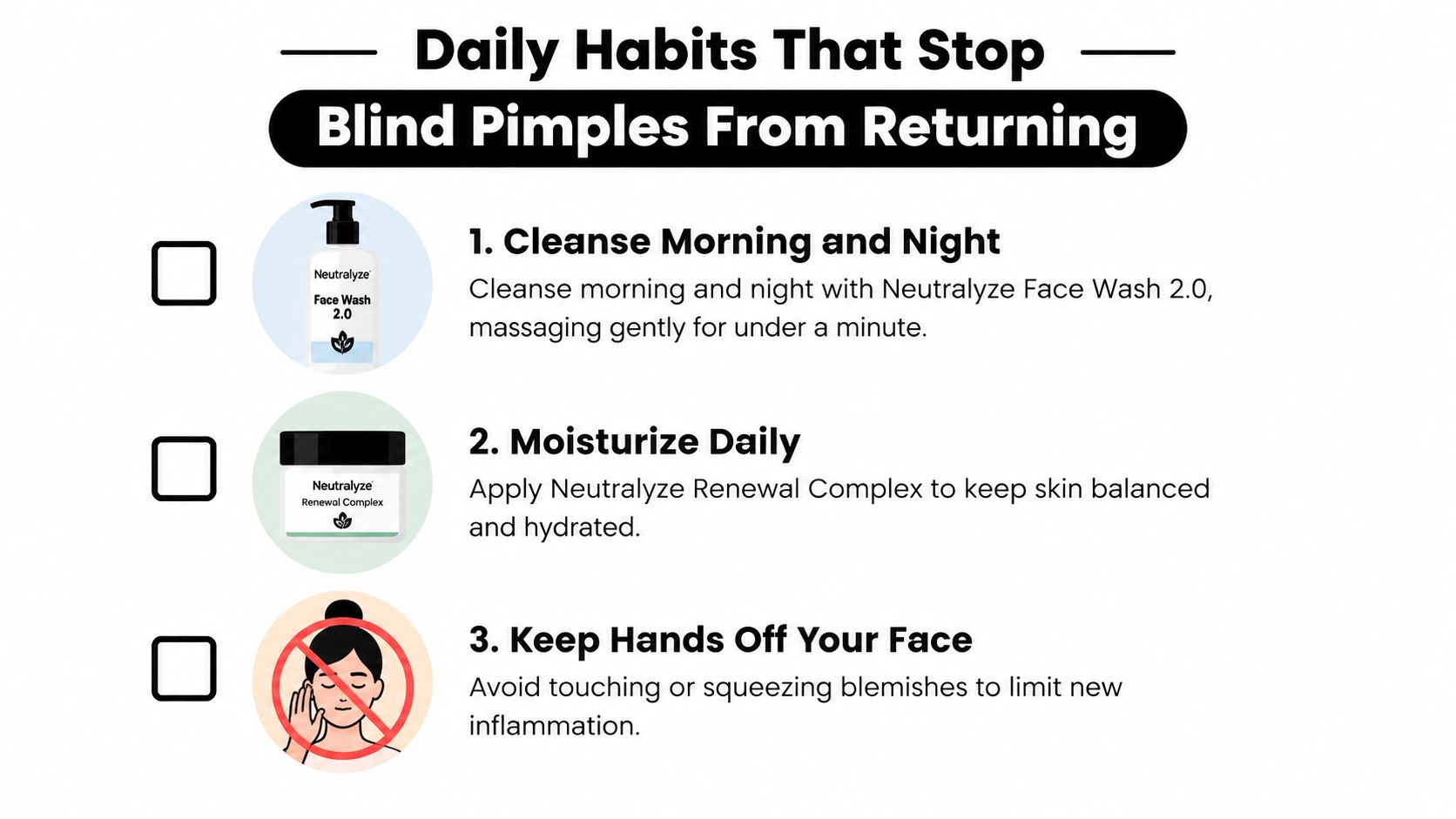
- Cleanse gently. Use the face wash according to its label, massage without scrubbing, and rinse thoroughly. Don't spend extra time working over a deep lesion.
- Introduce exfoliation cautiously. Follow the pad directions and pay attention to your skin's response. More frequent use isn't automatically more effective, especially if you're also using prescription treatment.
- Keep moisturizing intentional. Neutralyze Renewal Complex is a moisturizer with time-released salicylic acid and mandelic acid. Because it contains exfoliating actives, account for it when deciding how many active steps your skin can tolerate.
- Include morning sun protection. Choose a sunscreen you can use consistently, and ask your clinician how it fits with your treatment and any concerns about discoloration.
You don't need to introduce every step simultaneously. If your skin becomes uncomfortable, simplify the routine and seek advice rather than assuming irritation means the products are working.
Separate Breakout Control From Mark Care
A tender, raised lesion is an active acne problem. A flat area of discoloration after the swelling has settled is a different concern, and a pitted or raised scar is different again.
Don't judge acne control only by whether every old mark has disappeared. Likewise, don't mistake lingering discoloration for a reason to apply stronger treatment to a lesion that's no longer active.
Keep your hands away from blemishes, avoid abrasive scrubbing, and keep items that contact your face clean. These habits support sensible care without promising to override the underlying biology.
Use this checklist as a reminder of gentle handling and routine order, while following product directions and your clinician's advice.
When to See a Dermatologist Instead of Waiting It Out
Book an assessment when deep lesions recur, worsen, cause significant pain, or leave lasting marks. You don't need to exhaust every at-home product before seeking help.
Red Flags That Mean Book a Dermatology Visit
| Red Flag | Why It Matters | Next Step |
|---|---|---|
| Pain disrupts sleep or daily activity | The burden warrants treatment | Book a dermatology visit |
| A lump persists despite consistent care | Its identity and depth need assessment | Schedule an examination |
| Deep lesions recur in the same area | You may need a preventive prescription plan | Discuss recurrence |
| Rapid enlargement or spread | The condition is worsening | Seek prompt care |
| Warmth, spreading redness, fever, or drainage | Don't assume this is ordinary acne | Seek same-day medical assessment |
| Pitted, raised, or dark marks develop | Scars and discoloration need to be distinguished | Arrange early evaluation |
| Acne affects mood, school, or work | Its impact matters even beyond appearance | Ask for a written treatment plan |
Don't Wait for Scarring to Become Established
DermNet's guidance on nodulocystic acne describes it as a severe form that commonly scars and states that topical treatment is usually ineffective. It recommends early consideration of oral isotretinoin to help prevent scars, with treatment lasting at least five months, under clinical supervision.
A dermatologist may also consider an intralesional corticosteroid for a persistent or particularly large inflammatory nodule. Bring your trigger log, current products, and previous treatment history so the discussion starts with what you've really experienced.
If you're unsure when to see a dermatologist, pain, recurrence, and lasting skin changes are practical reasons to make the appointment. If none applies, continue a tolerable structured routine and arrange reassessment if improvement doesn't follow.
Neutralyze offers a clinically formulated salicylic acid plus mandelic acid system for cleansing, exfoliating, and moisturizing acne-prone skin. Visit Neutralyze to review the routine and product directions, and ask your dermatologist how it could complement your care if deep, painful pimples keep returning.