

Scar on the Back: Types, Causes and Care Options
You're changing shirts, catch your upper back in the mirror, and notice a mark that wasn't there last summer. Is it fading, sitting still, or slowly growing? That behavior over time tells you more than color alone. A scar on the back can be a flat leftover stain, a shallow dent, or a raised lump of extra collagen, and each one needs a different response. Sorting yours correctly first saves you months of using the wrong product on the wrong problem.
Why Back Scars Are So Common
Back acne is widespread, and the marks it leaves are a normal consequence of how skin repairs deep inflammation. A 2024 peer-reviewed review reports acne prevalence of approximately 92% on the face, 45% on the chest, and 61% on the back among affected patients; as many as 95% of patients may develop some form of scar during healing; approximately 23.80% to 26.94% of people with acne scars develop pathological scars, including hypertrophic scars and keloids; and the average age for patients with acne-induced pathological scars is approximately 21 years.
That average age explains why back scars cluster in young adults who are still having breakouts. It also helps explain why the same acne can leave a flat stain in one spot and a raised scar in another: depth of inflammation and the skin's repair response vary from lesion to lesion. Mixed outcomes are the norm after back acne.
What Makes the Back Different
Your back combines large oil glands with friction from straps, pressure from lying down, and skin tension across the shoulders. A deep pimple there heals in a high-friction zone, where straps and mattress pressure keep irritating the repair site. Deeper, more inflamed lesions raise the risk most. Back skin is also harder to see and reach, so breakouts can go untreated longer.
If breakouts are still active, controlling them matters more than chasing old marks. Neutralyze Exfoliating Pads use salicylic acid and mandelic acid for acne-prone skin on the back, chest, and face. They are active acne care; they do not erase existing scars.
The mark's behavior over time, flat and fading, indented and stable, or raised and growing, decides whether home care is enough or a clinician should look at it.
Telling Apart Four Types of Back Scars
Run a clean fingertip over the mark first. Whether it sits flat, sinks below the surface, rises above it, or has grown past its own edges sorts it into one of four groups. Appearance alone misleads, because two marks can look alike in a mirror and then behave in opposite ways over the following year.
Sorting by behavior also tells you what to ignore. A dark flat mark that is slowly lightening needs patience, and a raised mark that has widened since last summer needs a professional eye.
Back Scar Types at a Glance
| Scar Type | Appearance | Timing | Behavior Over Time | First Step |
|---|---|---|---|---|
| Post-inflammatory hyperpigmentation | Flat dark or brown mark | Fades over months after the breakout heals | Stays flat and fades slowly, often longer in darker skin | Daily sunscreen, stop picking, patience |
| Atrophic acne scar | Indented pit or wave | Remains after the breakout heals | Does not grow, texture changes little on its own | Dermatologist review of texture treatment options |
| Hypertrophic scar | Raised, firm, pink or red | Visible about 1 to 2 months after the acne clears | Stays within the original lesion and may gradually flatten | Silicone and pressure care, clinician review if it lingers |
| Keloid | Raised, hard, shiny, may be darker than surrounding skin | Can begin about 3 to 12 months after the acne clears | Extends beyond the original lesion and rarely regresses without treatment | Prompt dermatologist assessment |
Those timelines follow the American Academy of Dermatology's scar symptoms guidance, which places hypertrophic scars roughly 1 to 2 months after skin injury and keloids 3 to 12 months out, sometimes later.
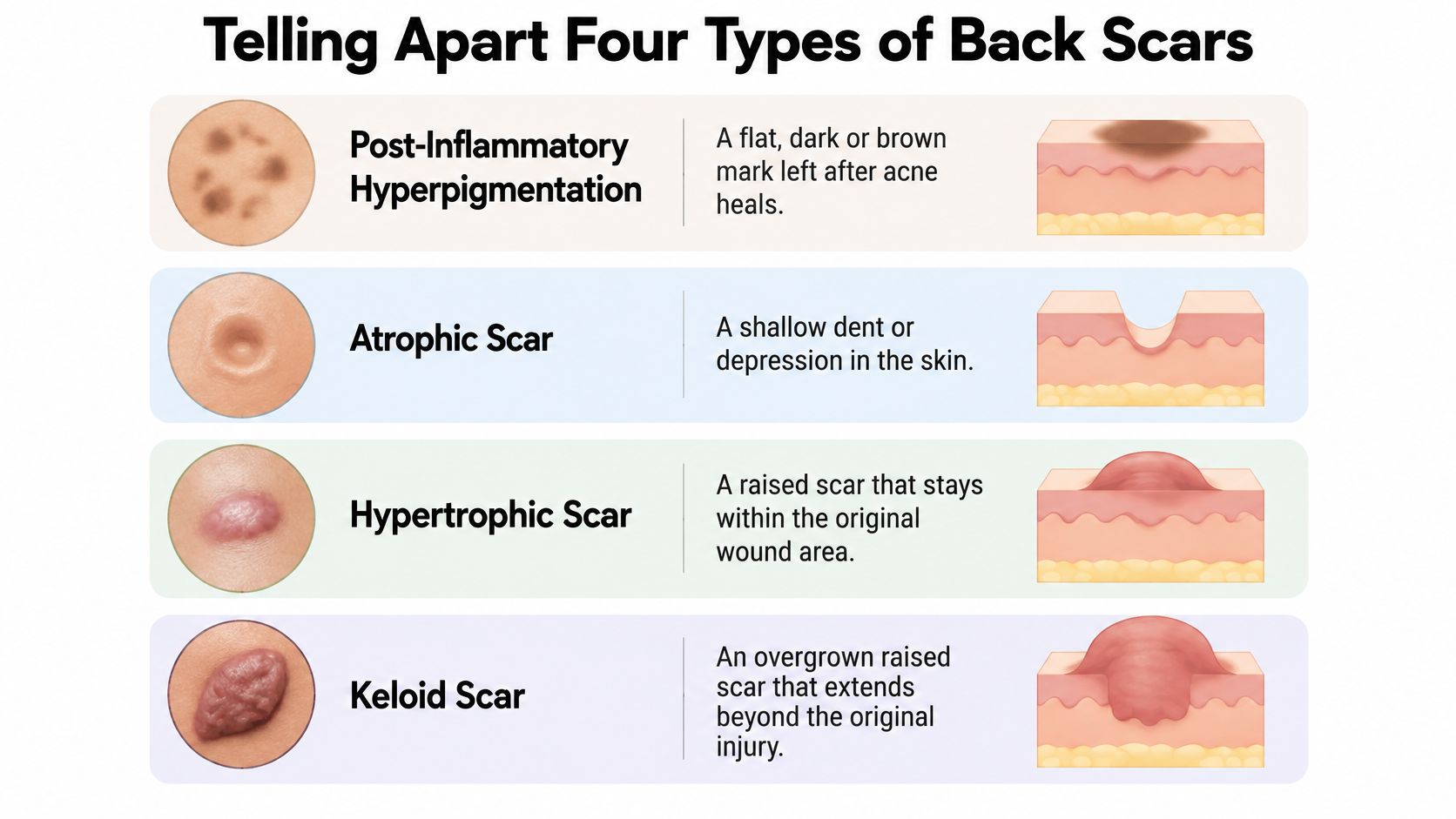
Post-inflammatory hyperpigmentation, usually shortened to PIH, is extra pigment left behind in the skin after inflammation settles. The surface height stays the same, so you see color without feeling a step up or a step down. It behaves like a stain worked into fabric rather than a dent in a wall.
An atrophic scar forms when collagen is lost during repair, leaving the surface sitting below the surrounding skin as a shallow pit or a rolling wave. These stay put. Nothing from a jar refills them, so the realistic conversation is about texture procedures a dermatologist performs.
A hypertrophic scar feels raised and firm but stays inside the borders of the pimple, cut, or burn that started it. One usually appears within the first month or two after injury and may gradually flatten with silicone and pressure care, plus a clinician check if it lingers.
A keloid crosses its original borders and keeps enlarging slowly, sometimes months after the lesion has healed. Outward growth is the clearest clue, and the upper back is a common site because skin tension and repeated mechanical pull push repair toward thicker collagen.
Keloid tendency is not evenly shared. It follows how aggressively the skin's repair cells keep laying down collagen, a trait that runs in families and shows up more often in people with deeper skin tones.
Three checks to run today: Is it flat or raised? Is the surface indented or level? Has it grown, itched, or become tender in recent months?
If growth extends beyond the original lesion, book care rather than testing stronger exfoliants at home.
What Causes Scars on the Back
Skin repair works like a patching crew. The crew can fill a wound level, leave a shallow dip, or pile on too much filler. How deep the damage went decides which result you get.
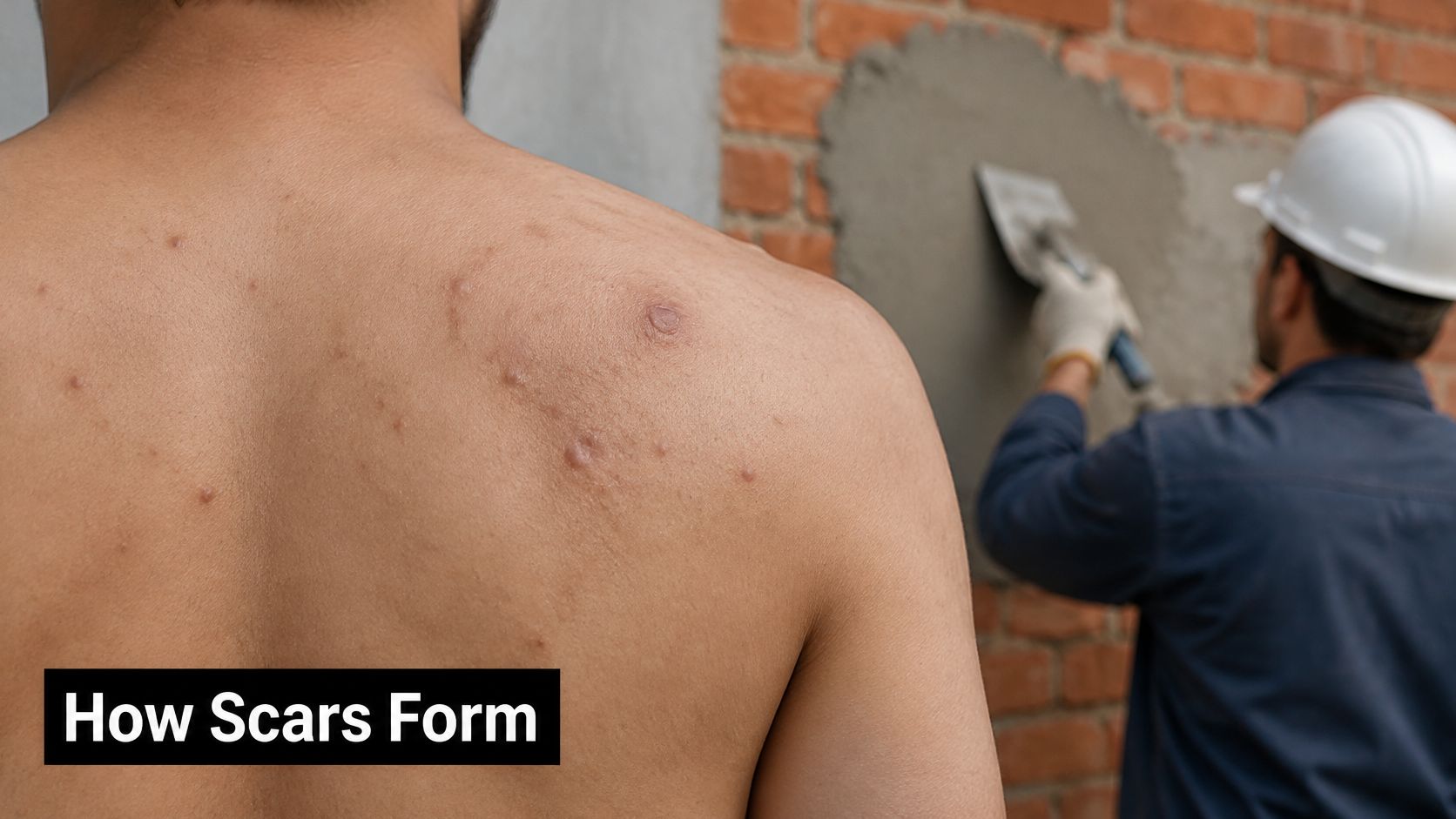
From Clogged Pore to Deep Inflammation
It starts with sebum, your skin's oil. Dead skin cells that should shed cleanly instead stick together inside the pore, a process called follicular hyperkeratinization. That plug traps oil below the surface.
Cutibacterium acnes, formerly called P. acnes, multiplies in that blocked, oily follicle. Your immune response to it produces inflammation, which is why a deep back lesion feels hot, swollen, and sore rather than looking like a simple blackhead.
When Repair Leaves a Lasting Mark
As DermNet NZ explains in its acne scar guidance, acne-related scars form when inflammation or injury reaches the dermis, the deeper layer where collagen is produced. Most acne scars are atrophic, meaning collagen is lost, while excessive collagen production creates hypertrophic or keloid scars. Deep, painful cysts and nodules increase the risk most, and mild comedonal acne rarely produces severe scarring.
The cause also predicts how a mark will behave. Surface inflammation tends to leave a flat mark that slowly fades. Damage deep in the dermis can leave a stable indentation or a raised scar that keeps growing.
Back-specific forces then amplify the damage. Backpack straps, sports bras, weightlifting belts, and tight synthetic shirts rub healing lesions. Sweat trapped under fabric keeps pores occluded, pressure from chairs and mattresses compresses inflamed skin, and tension across the shoulder blades pulls at new tissue.
Picking is the most avoidable amplifier. Squeezing a deep lesion drives inflammation wider in the dermis and can tear tissue that was still repairable, raising the odds of a permanent pit or raised bump.
Treatment Options Ranked by Evidence
Options below are ranked by two factors together, the strength of clinical evidence and how well each option fits the scar behavior. Flat and fading marks need the least invasive care. Indented and stable pits need collagen remodeling. Raised and growing scars need medical treatment that controls excess healing.
Think of scar treatment like gardening. You do not pull a seedling, fill a hole, and prune an overgrown shrub with the same tool. Back skin follows the same logic, and pressure from clothing plus trouble reaching the middle of the back makes the choice more practical.
Back Scar Treatment Options Compared
| Option | Best Suited For | Evidence Notes | Needs a Dermatologist |
|---|---|---|---|
| Silicone gel or sheets | Raised hypertrophic scars and early keloids | Widely used first-line for raised scars; results build over weeks to months | Not always, but ask if the scar is growing |
| Pressure garments or occlusion | Raised scars on the upper back | Often combined with other therapy; hard to keep in place on the back | Usually guided by a clinician |
| Intralesional corticosteroid injections | Keloids and thick hypertrophic scars | According to the American Academy of Dermatology keloid treatment guidance, injections shrink roughly 50% to 80% of keloids, though recurrence within five years is common | Yes |
| Cryotherapy | Small raised lesions | Can cause permanent lightening in darker skin | Yes |
| Laser or light-based treatment | Redness, thickness and texture | Results vary by scar type and skin tone | Yes |
| Surgical excision alone | Large or stubborn keloids | Recurrence is very common without follow-up therapy, so surgery alone is rarely advised for keloids | Yes, with adjunct treatment |
| Microneedling, subcision or fractional laser | Indented atrophic scars | Clinician-directed; results vary with scar depth and skin tone | Yes |
| Daily sun protection and pigment-directed care | Flat dark marks | Sunscreen helps limit further darkening while fading occurs slowly over months | No |
Silicone and pressure come first for many raised scars because they are noninvasive and have long clinical use. Sheets often peel off with sweat and shoulder movement, so many people find gel easier for the back. Either choice needs steady use for weeks to months before you judge change, and a growing edge means you should get it checked rather than waiting.
Corticosteroid injections remain a mainstay for thicker raised scars. They calm excess collagen activity inside the scar. That pattern is why follow-up visits matter even after a scar flattens, since regrowth can begin.
Cryotherapy and laser treatment sit in clinician hands for good reason. Freezing a small raised lesion can leave lasting lightening in darker skin. Laser settings that reduce redness or thickness in one skin tone can worsen pigment in another, so matching device, dose, and skin tone matters.
Surgical excision sounds definitive and usually is not enough alone for keloids. Cutting out visible tissue creates a fresh wound in skin that already makes too much collagen. Clinicians commonly plan added treatment before surgery, such as pressure, injections, cryotherapy, laser treatment, or in selected cases postoperative radiation.
A keloid removal plan has to cover the weeks after surgery, not just the lump.
For indented scars, the logic reverses. Most acne scars are atrophic, and creams cannot lift lost tissue back to level. Microneedling, subcision, and fractional laser aim to remodel collagen under clinician control. Your dermatologist weighs pit depth and pigment risk before recommending any of them. Deep, stable pits rarely respond to home care alone.
Set topical expectations plainly. Daily care can influence pigment, redness, surface roughness, and new breakouts. It cannot remove a keloid or refill a pit on its own. Raised, firm, itchy, or enlarging scars need clinical care to confirm what they are and to stop the overgrowth response.
Home Care and Sun Protection for Flat or Fading Back Marks
A flat, fading back mark behaves like a stain left by inflammation: the skin is losing color, not building tissue, so the home plan is about pigment and irritation. Protect the mark and stop making it worse. Start with sunscreen, because ultraviolet light acts like a repeated prompt to pigment cells, telling already-reactive skin to keep producing color.
A 2025 systematic review on post-inflammatory hyperpigmentation reports that complete PIH responses to topical treatments are uncommon, at about 5.4%, and that sunscreen was the only intervention consistently shown to prevent PIH incidence. Other measures mainly appeared to reduce severity. In darker skin, pigment cells (melanocytes) can respond more strongly to inflammation, so a fading mark may take longer to clear.
Protecting Skin You Cannot Easily Reach
- Use a long-handled applicator: A lotion applicator or sunscreen spray applied carefully, then rubbed in with the back of your hand where you can reach, beats skipping the upper back entirely.
- Ask for help or cover up: A partner can cover the shoulder blades in seconds. Outdoors, a shirt with coverage protects exposed areas when reapplication isn't realistic.
- Apply before you dress: Sunscreen bonds better to dry skin, and you won't miss the edges under straps.
Our guide to post-inflammatory hyperpigmentation after acne separates pigment care from texture treatment in more detail. Neutralyze Face Wash can be used in the shower on the back and body the same way as on the face, which keeps cleansing simple without a separate body routine.
Then follow the no-pick rule. Squeezing or scratching reopens inflammation and restarts pigment production. Scrubbing hard irritates reactive skin and can deepen discoloration. Back skin also sits under straps and waistbands, where friction can keep mild inflammation alive. Pat your back dry instead of rubbing, and change out of tight, sweat-trapped fabric after workouts. Fading usually takes months, so judge progress in monthly photos, not weekly mirror checks. If the mark rises, grows, or itches, it no longer belongs in this home care category.
Stopping New Back Breakouts Before They Scar
Preventing the next deep lesion prevents the next scar. A back routine has to do two jobs at once: calm the acne that is active now and reduce the conditions that push a healing spot into a raised or darkened mark. The cleanse, exfoliate, hydrate order keeps those jobs separate. Cleansing clears surface oil. Exfoliation helps loosen the plugs that feed breakouts. A hydrating moisturizer keeps skin comfortable enough that you don't abandon the routine when dryness shows up.
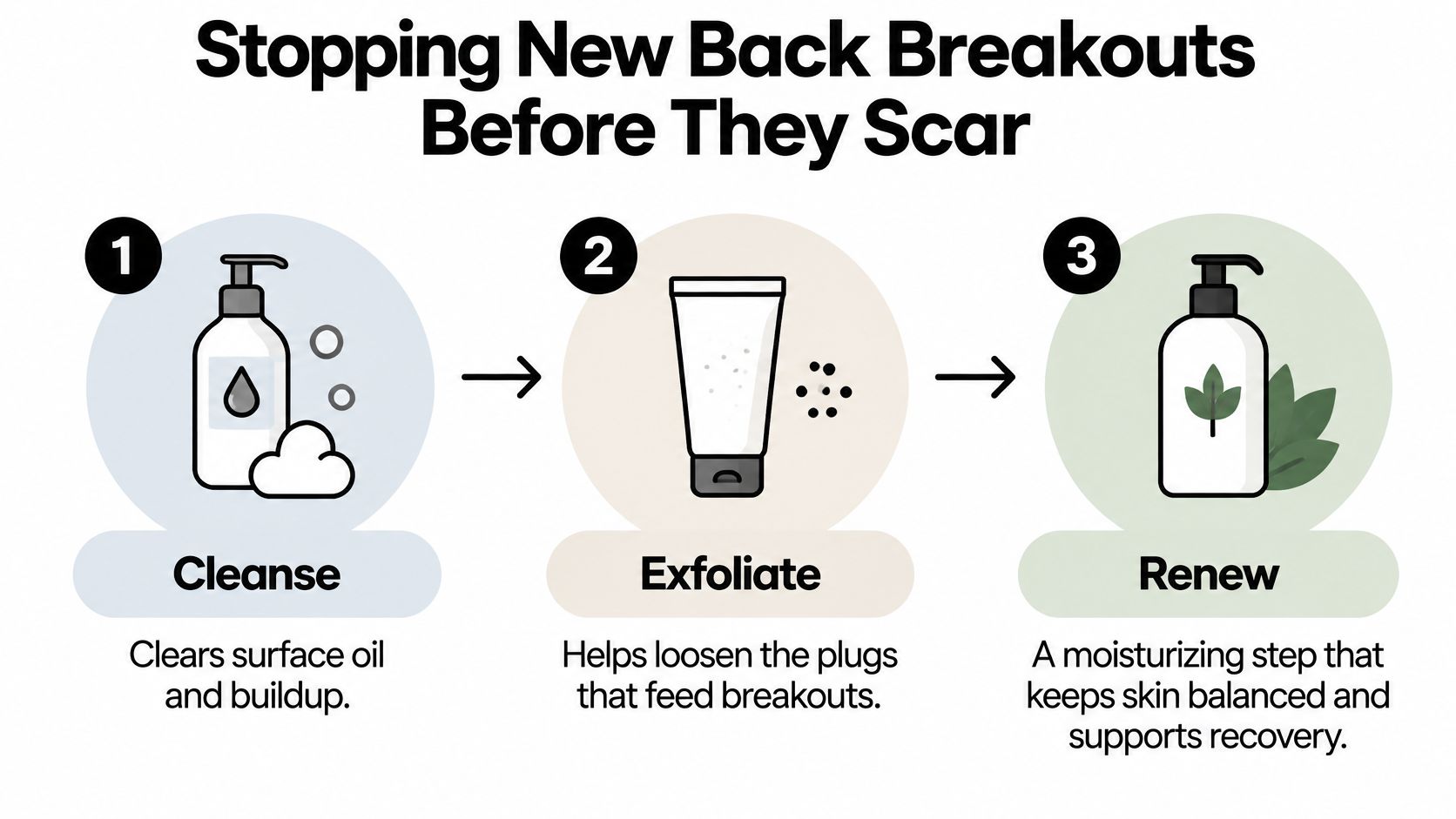
A Back-Specific Routine in Six Steps
- Cleanse in the shower. Wash your back with Neutralyze Face Wash, which combines 2% salicylic acid and 1% mandelic acid, then rinse well. Washing last in the shower also removes conditioner residue that can sit on back skin.
- Let skin dry fully. Leave-on products spread unevenly on damp skin, and trapped moisture under a shirt adds friction.
- Swipe an exfoliating pad over dry skin. Use a Neutralyze Exfoliating Pad on the breakout area and leave it on, following label directions for frequency. One pad covers a large area, which helps when the upper back is hard to reach.
- Hydrate with a thin layer. Once skin is dry, apply Neutralyze Renewal Complex to the back and body. It is a moisturizer for acne-prone skin with a continuous, time-released complex, and its actives are salicylic acid and mandelic acid.
- Add morning sunscreen. Apply it to exposed back skin, since the pads' alpha hydroxy acid can increase sun sensitivity; use sunscreen, wear protective clothing, and limit sun exposure while using them and for a week afterward. Our guide to preventing back acne covers the friction and clothing habits that support this step.
- Change after exercise. Get out of sweaty clothing soon after training so oil, heat, and fabric pressure don't sit on breakout-prone skin for hours.
Before you commit to the full routine, patch-test a small area, then use the system once a day for the first week while you watch for dryness or peeling; step back if either appears. The three Neutralyze products in that routine are made for acne-prone skin, built to help keep pores clear and skin looking clearer. That focus matters for marks too: existing flat marks fade on their own timeline, and raised scars need clinical care. If baths are part of your body-care routine, keep soaks gentle and product choices simple, as in these safer soaking tips from Fillaree, and rinse and pat skin dry afterward.
Book a Dermatologist Visit When a Back Scar Changes
A back mark that keeps changing needs a clinician's eyes. The direction of change matters more than its color: flat and fading marks can often stay on a home plan, while indented and stable marks may need a different conversation, and raised and growing marks deserve prompt evaluation. Book a visit if you notice any of these changes.
Red Flag Checklist
- Growth beyond the original blemish: A raised scar on the back that keeps enlarging or spreads past its starting borders.
- Hard, shiny, firm texture: A lesion that feels rubbery or hard rather than soft like surrounding skin.
- Itching, tenderness, or pain: Symptoms that persist or return after the acne itself has healed.
- A scar after piercing, surgery, or trauma: Raised growth at any injury site on the upper back, shoulders, or chest.
- No fading after several months: Dark or raised marks that persist despite consistent, gentle care.
- Recurring deep cystic acne: New painful lesions that keep scarring despite home treatment.
As the American Academy of Dermatology guidance on severe acne outlines, medical options include steroid injections or creams, silicone dressings or gels, cryotherapy, and laser treatment. The NHS guidance on keloids describes them as raised, hard, smooth, and shiny, with color that may match the skin or appear pink, red, purple, brown, or darker than surrounding skin. It notes that keloids can arise weeks to years after acne or another injury. Treatment usually improves how a keloid looks and feels, but full removal is not guaranteed.
Making the Appointment Count
Bring photos taken in the same lighting over time, since slow growth is easy to miss week to week. Note when the mark started, whether it has changed, any family history of keloids, your skin tone concerns, and every product you've used on it. Our overview of when to see a dermatologist for acne can help you decide how urgent the visit is.
Ask three questions. Which scar type is this? Which options fit its size, location, and my skin tone? What's the recurrence risk, and what follow-up reduces it?
A scar that's still changing is giving you information. Acting on growth early usually leaves you with simpler options than waiting until it's larger.
Once a clinician confirms your mark is flat and fading, shift back to prevention. Return to the cleanse, exfoliate, hydrate routine you use for active breakouts so new lesions do not start the cycle again.
If active back breakouts keep leaving marks behind, Neutralyze offers a clinically formulated cleanse, rejuvenate, hydrate system built on salicylic acid and mandelic acid for acne-prone skin on the face and body. Start with the routine that fits your skin today, protect it from the sun, and give your skin the months it needs.