

Salicylic Acid Cleanser for Body Acne: A Guide
You're in the shower, trying to reach the breakouts between your shoulder blades. The body wash smells clean, your chest feels tight afterward, and the bumps haven't changed. It's tempting to scrub harder or buy a stronger acid, but neither move fixes a mismatch between your skin, your cleanser, and the kind of bumps you have.
A salicylic acid cleanser for body acne can help with blackheads, whiteheads, and clogged pores. The trade-off is dryness, especially when you treat a large area. Your best starting point is a well-formulated rinse-off product, gentle application, and enough consistency to judge it without turning every shower into another exfoliation session.
The Strength and Format That Fit Body Acne
For clogged pores on your back, chest, shoulders, or upper arms, a rinse-off cleanser can be a practical starting point. Salicylic acid is typically used at 0.5% to 2% in acne products. A 2% cleanser is at the upper end of that range, while its short contact time means it is not a leave-on treatment in disguise.
Neutralyze Face Wash contains 2% salicylic acid and 1% mandelic acid and is made for the face, back, and body. It is the first step in Neutralyze's routine, cleansing without stripping. It is an evidence-based option for acne-prone skin.
Salicylic Acid Formats for Body Acne
| Format | Salicylic acid strength | Time on skin | Best body use | Main limit |
|---|---|---|---|---|
| Rinse-off body cleanser | 0.5–2% within the at-home framework | Brief contact, following product directions | Blackheads, whiteheads, and clogged pores on the back, chest, shoulders, and upper arms | Short contact time; formula and consistent use also matter |
| Leave-on gel, lotion, or pad | 0.5–2% within the at-home framework | Stays on after cleansing | Clogs that persist after a tolerated wash | More potential for dryness over a large area |
| Spot treatment | Up to 2% within the at-home framework | Left on as directed | An isolated surfaced bump | Does not treat a wider pattern of clogged pores |
| Salicylic plus mandelic leave-on pad | Neutralyze's formula contains 2% salicylic acid and 1% mandelic acid | Left on, not rinsed | Acne-prone skin on the face, back, or body | Start cautiously because combining acne products can increase irritation |
A cleanser's contact time depends on its directions. Don't keep every wash on your skin for the longest time listed here; follow the instructions for the product you use.
Choose Exposure Before Chasing Strength
A rinse-off wash and a leave-on product with the same percentage expose your skin differently. One is rinsed away; the other stays against your skin under clothing. The vehicle, or the rest of the formula that carries the acid, also affects how comfortably you can use it.
Start with Neutralyze Face Wash once a day, then build up to one to three times a day as needed. Wet the affected area, spread the cleanser gently, and rinse well. Cut back if dryness or irritation occurs.
If your skin tolerates the wash but clogged pores remain, a leave-on pad may be another step. Neutralyze Exfoliating Pads contain DuoClear™, with 2% salicylic acid and 1% mandelic acid. Swipe a pad over clean, dry skin and leave it on. Avoid adding multiple acne products at once, since that can raise the risk of irritation.
Practical rule: Choose a leave-on only if your skin is comfortable with your cleansing routine.
When comparing cleanser listings, you can also discover skincare through Loyaltie. Check the product format and directions, since the word “cleanser” alone doesn't tell you how a formula is used.
How Salicylic Acid Gets Inside a Clogged Pore
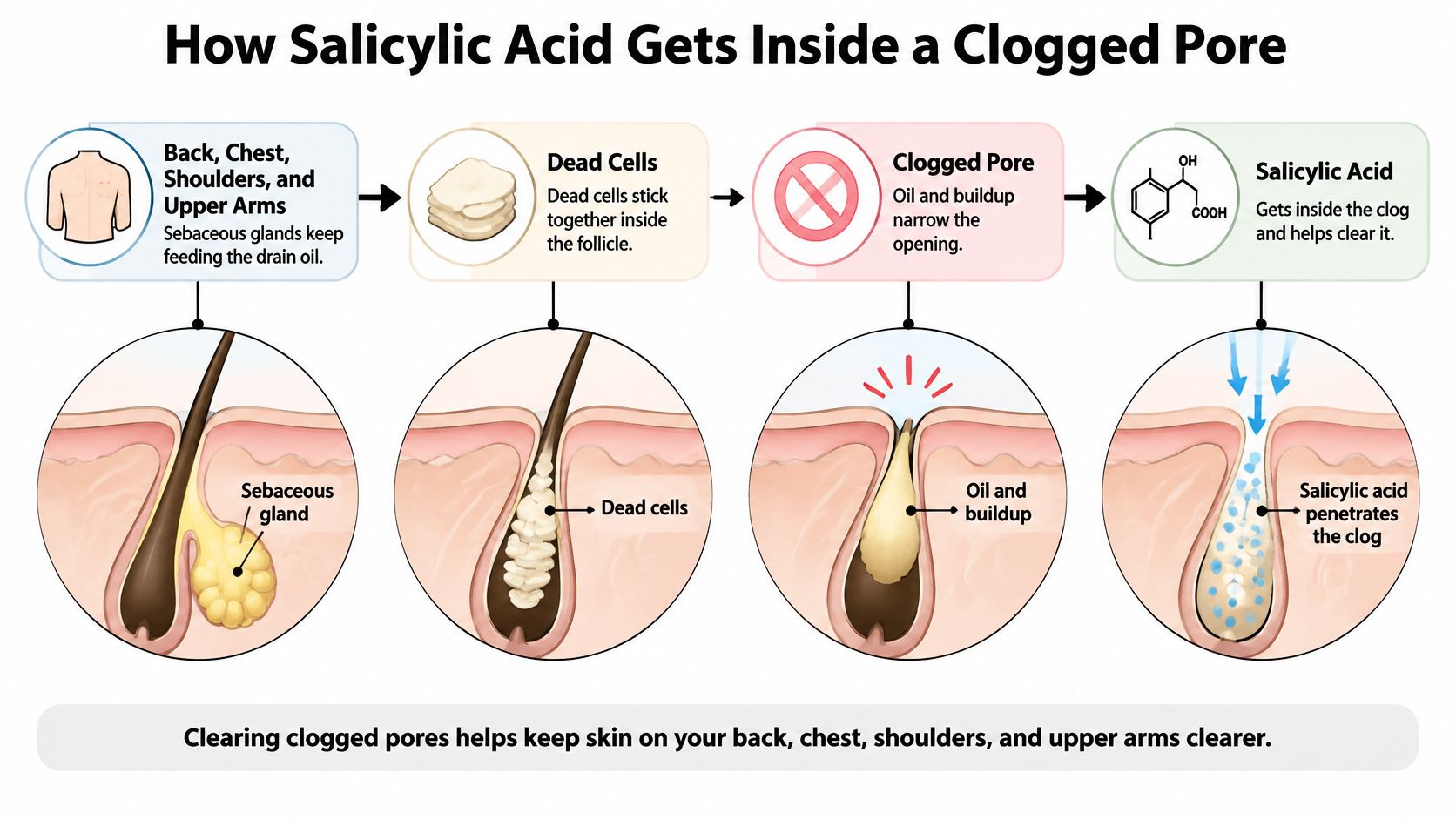
A follicle works like a narrow drain. Sebaceous glands feed oil, called sebum, into these openings on acne-prone areas of your trunk. When dead skin cells stick together instead of shedding normally, oil and cells can form a plug.
That buildup is called follicular hyperkeratinization. It helps explain why washing can remove sweat and surface grime while leaving the process inside the follicle largely unchanged.
The diagram shows where a pore-focused exfoliant fits into that process.
Loosening the Plug Rather Than Scrubbing the Surface
Salicylic acid is an oil-soluble beta hydroxy acid, or BHA. Its affinity for oily material helps explain how it can work around sebum-filled follicles.
DermNet's salicylic acid guidance classifies it as a keratolytic, meaning it softens keratin and loosens material that can be removed from skin. DermNet also describes its role in reducing follicular cell buildup and breaking down blackheads and whiteheads.
If your shoulders feel rough and you see scattered dark plugs, a gritty scrub may temporarily smooth the surrounding surface. Rubbing harder, however, does not selectively loosen material inside each follicle. Salicylic acid addresses that buildup chemically, without abrasive pressure.
Acne also involves Cutibacterium acnes, formerly called P. acnes, and inflammation. A plugged, oil-rich follicle is part of that environment, while washing alone cannot resolve every inflammatory pathway.
What the Second Acid Adds
Mandelic acid is an alpha hydroxy acid, or AHA, with a larger molecule that gently exfoliates the skin's surface. In Neutralyze's formulation, it complements salicylic acid's work inside oily pores.
The two acids have different roles:
- Inside the follicle: Salicylic acid helps loosen material associated with comedones, the medical term for blackheads and whiteheads.
- At the surface: Mandelic acid supports smoother texture through exfoliation.
- Beyond a cleanser's reach: Deep painful lesions, scars, and persistent inflammation can require medical treatment.
For more detail, read this guide to what salicylic acid does to acne.
Neither acid drains a deep cyst or erases a scar. A flat dark mark left after a breakout is also different from an active clogged follicle, even when both appear on the same shoulder.
How to Wash Your Back and Chest Safely
After trying several body washes, your back may still be breaking out while your skin feels tight. A stronger or longer wash is not automatically better: a cleanser has brief contact with the skin, and applying it across a large area can leave your whole trunk dry or irritated.
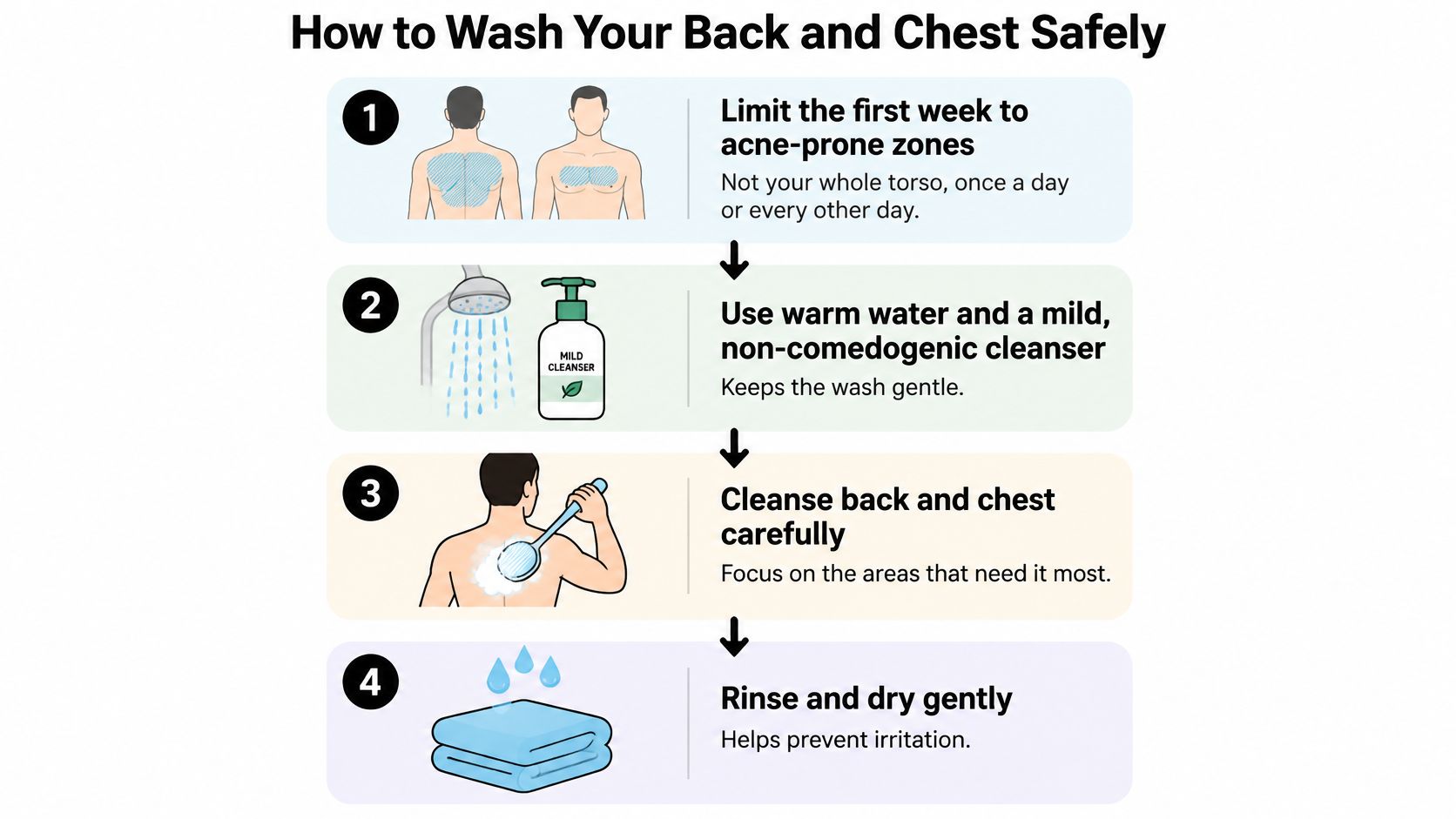
The American Academy of Dermatology's guidance on acne related to workouts recommends a mild, oil-free or non-comedogenic cleanser, gentle fingertip application, and warm rather than hot water. Friction and irritation can aggravate acne.
A Gentle Shower Sequence
- Start with the breakout-prone areas. Apply the acne cleanser to your chest, shoulders, or back where you tend to break out. Begin once a day, or every other day if your skin is easily irritated, so you can judge how it feels.
- Use warm water and a mild formula. Hot water and strongly fragranced products can add irritation; they do not make salicylic acid work better.
- Spread the cleanser gently. Use your fingertips, without scrubbing. If you need a soft cloth to reach your back, use light pressure and rinse it clean. Skip gritty scrubs and rough loofahs.
- Keep contact brief and rinse well. Follow the cleanser's directions rather than leaving it on longer to make up for a missed wash. Rinse away cleanser and any hair-product residue.
- Pat dry with a clean towel. Rubbing adds friction to freshly washed skin, so press the towel gently instead.
- Use a light, non-comedogenic moisturizer if your skin feels dry. Choose one that feels comfortable under collars, straps, or sports gear.
- Adjust based on how your skin responds. Tightness, stinging, or scaling can mean you need to use the wash less often. A label's maximum frequency is not a target you have to reach.
For another visual reference, watch the video below.
Keep Friction Out of the Routine
After exercise, change out of sweaty clothes rather than leaving damp fabric pressed against your chest. A clean, breathable shirt reduces ongoing rubbing while your skin dries.
Reduce or stop the medicated wash if you develop burning, peeling, or persistent tightness. Painful, scarring, or widespread acne needs medical assessment rather than more frequent washing.
Salicylic Acid Next to Other Body Acne Actives
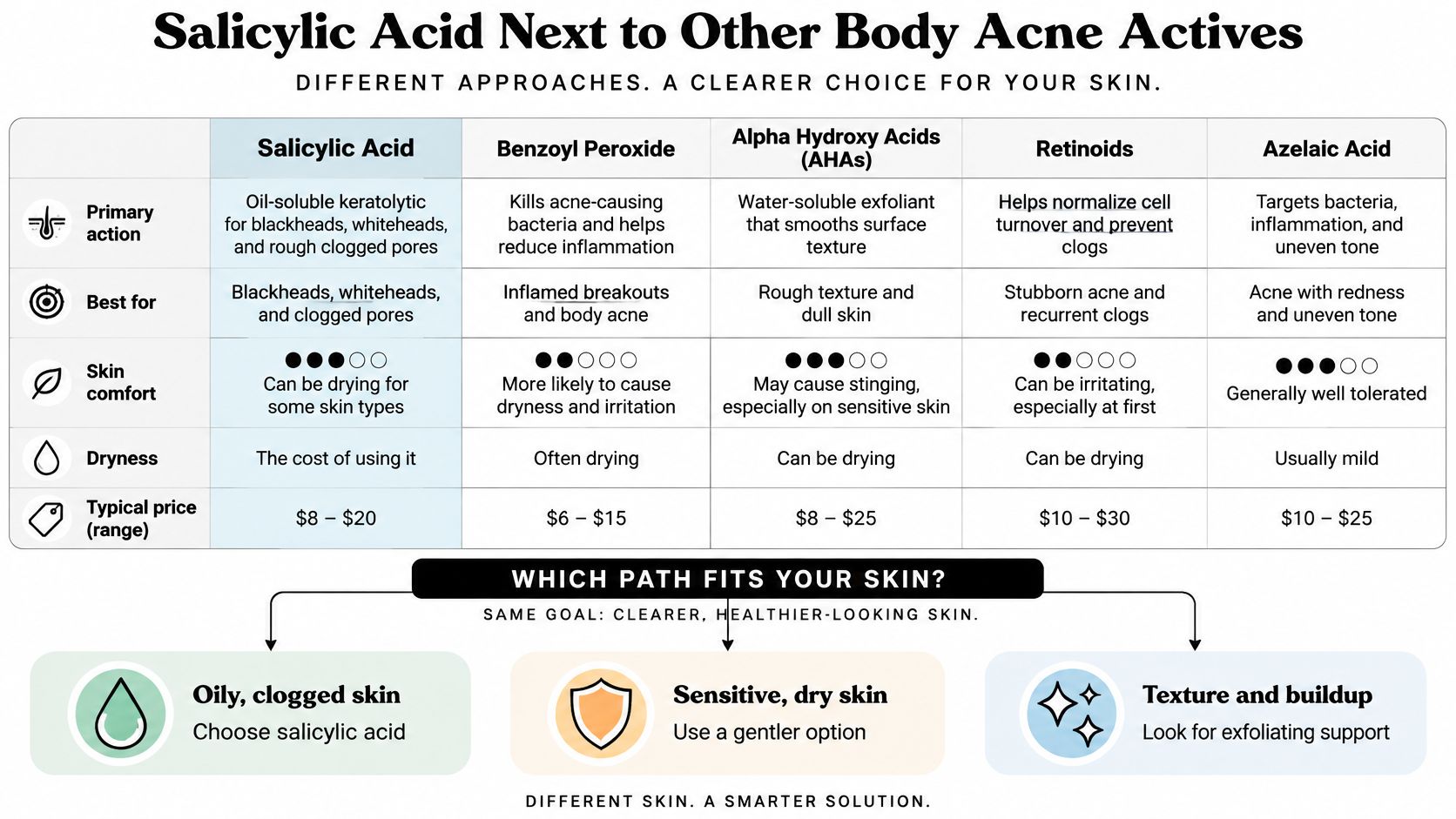
The right active depends on what the bumps look and feel like, how long a product stays on your skin, and how much irritation you can tolerate. A 2% salicylic acid cleanser has brief contact with skin, while a leave-on product stays in place. Across the back and chest, that difference matters: you're treating a large area, and more exposure can mean more dryness without addressing the right cause.
Body Acne Actives Compared by Job
| Active | Main job | Fits best when | Trade-off |
|---|---|---|---|
| Salicylic acid | Oil-soluble exfoliation inside the pore | Blackheads, whiteheads, and clogged pores | Excessive exposure can cause dryness and peeling |
| Mandelic acid | Gentle exfoliation at the skin's surface | Sensitive skin or rough texture alongside clogged pores | Works at the surface rather than inside oily pores |
| Benzoyl peroxide | Reduces acne bacteria | Red, inflamed acne bumps | Can irritate skin and bleach towels or clothing |
| Adapalene | Helps normalize cell shedding in the follicle | Persistent acne after consistent at-home care | Can irritate skin or cause early worsening; it is not an ingredient in Neutralyze |
Three Decisions That Matter
Mostly oily clogs: Salicylic acid is a reasonable starting point when blackheads, whiteheads, and congestion dominate. Mandelic acid can add surface exfoliation, though a combination still needs a schedule your skin tolerates.
Mostly sensitive, dry skin: Prioritize comfort by reducing irritation. A gentler cleanser or less frequent exfoliation may suit you better than adding another active.
Mostly inflamed bumps: Benzoyl peroxide may be a better fit when red, inflamed lesions dominate. Account for possible irritation and fabric bleaching on the body. The benzoyl peroxide versus salicylic acid comparison explains how their roles differ.
Adapalene, including drugstore Differin, is a retinoid. It works through a different mechanism from exfoliating acids, so introducing it calls for its own approach to managing irritation and possible early worsening.
What Combination Evidence Can Tell You
A comparative clinical study of salicylic-mandelic peels evaluated 20% salicylic acid and 10% mandelic acid in 44 patients with facial acne, scarring, and hyperpigmentation. The study found greater improvement than the glycolic-acid comparison for most active lesions and hyperpigmentation, with p<.001 for those outcomes. These were supervised peels, not everyday body washes, so the findings do not establish that a cleanser will perform the same way.
If you're comparing surface exfoliants, this guide to choosing glycolic acid for your face offers another ingredient-specific perspective. Advice for facial exfoliation doesn't automatically translate to treating your full back.
Salicylic acid and mandelic acid can be used together in a non-prescription routine for acne-prone skin. If you use prescribed medication, ask your clinician how to fit other actives into your routine. Painful nodules or scarring also call for medical guidance.
Bumps That a Cleanser Will Not Clear
If your chest looks angrier after starting salicylic acid, don't assume that means the treatment is working. Burning, persistent redness, and scaling can be irritation, not evidence that hidden acne is coming out.
There is evidence for comedonal acne: a study summarized in a 2025 acne-care review found that a 2% salicylic acid cleanser significantly reduced comedones after two weeks. That finding doesn't mean every bumpy eruption on your body is a clogged-pore problem.
Separate the Patterns Before Escalating
- Scattered blackheads and whiteheads: These fit the pore-clearing role of a salicylic acid cleanser.
- Burning with flaky, red skin: Reduce or stop the irritating treatment rather than increasing washes.
- Uniform, itchy bumps: Folliculitis and other look-alike conditions need consideration.
- Painful nodules, drainage, or scars: Seek medical assessment instead of trying to exfoliate deeper.
- A rash confined beneath straps or equipment: Friction and occlusion may be important, so changing the contact pattern matters.
Rough upper-arm bumps can also have a different cause from acne. The guide to choosing a cleanser for keratosis pilaris helps explain why a similar texture doesn't necessarily call for the same treatment.
Avoid applying salicylic acid to broken or infected skin. Don't keep adding acne medicines when your skin is already irritated; simplifying the routine makes it easier to identify the problem.
Pregnancy and Large-Area Use Need Extra Caution
A clinical review of acne care during pregnancy and lactation describes typical topical salicylic acid exposure as low absorption, while advising against prolonged application over large areas or under occlusion. That's a more useful framework than an absolute safe-or-unsafe label.
A rinse-off application to a small affected zone isn't the same exposure as coating the whole back with a leave-on and covering it tightly. If you're pregnant or breastfeeding and need widespread trunk treatment, ask your clinician about the specific product, coverage, and frequency.
Surface area counts: Treating a larger area isn't just using more of the same routine. It changes your overall exposure.
Parents helping a teenager can use the same restraint: begin with a limited area, avoid aggressive stacking, and seek care when lesions spread, hurt, or scar.
How Long Back Acne Takes to Improve and Fade
A single shower can't show whether a cleanser is helping. Track two things separately: whether fewer new lesions appear and whether leftover color fades. Also notice how your skin feels after washing; tightness or scaling may signal irritation, not progress.
A 2024 Korean Citation Index study of 43 people with oily, acne-prone skin using a salicylic-acid-containing cleanser over four weeks offers a checkpoint for observing changes. Its duration does not establish a guaranteed result or a timeline for body acne.
Track the Right Changes
Keep a simple record rather than changing products after a bad skin day.
- New lesions: Note whether fresh whiteheads and inflamed bumps continue to appear at the same rate.
- Existing congestion: Compare the same patch of shoulder or chest under similar lighting.
- Comfort: Record tightness, itching, and scaling separately from acne.
- Consistency: Note missed applications and new products so you can judge changes in context.
Take photos before you begin and compare them at spaced checkpoints. Day-to-day mirror checks can make minor fluctuations seem significant, especially when the lighting changes.
If a comfortable, consistent routine leaves the pattern unchanged over a sustained trial, book a clinician's appointment rather than cycling endlessly through washes. Seek help sooner for pain, deep lesions, or scars.
Marks Aren't Active Acne
Flat brown, gray, or red areas that remain after a lesion settles are post-acne discoloration. Their persistence alone does not show whether the cleanser is helping with new breakouts.
Once the bump is gone, focus on preventing new breakouts, moisturizing, avoiding picking, and protecting exposed skin from the sun. Adding more acid solely to fade old color can irritate your skin without addressing new acne.
Indented or raised scars need a different approach. A rinse-off cleanser won't rebuild a depressed scar or flatten a raised one. Repeated exfoliation can irritate nearby skin without improving the scar.
You may see fewer active lesions while discoloration remains visible. Track both changes separately.
Start a Back and Chest Routine You Can Keep
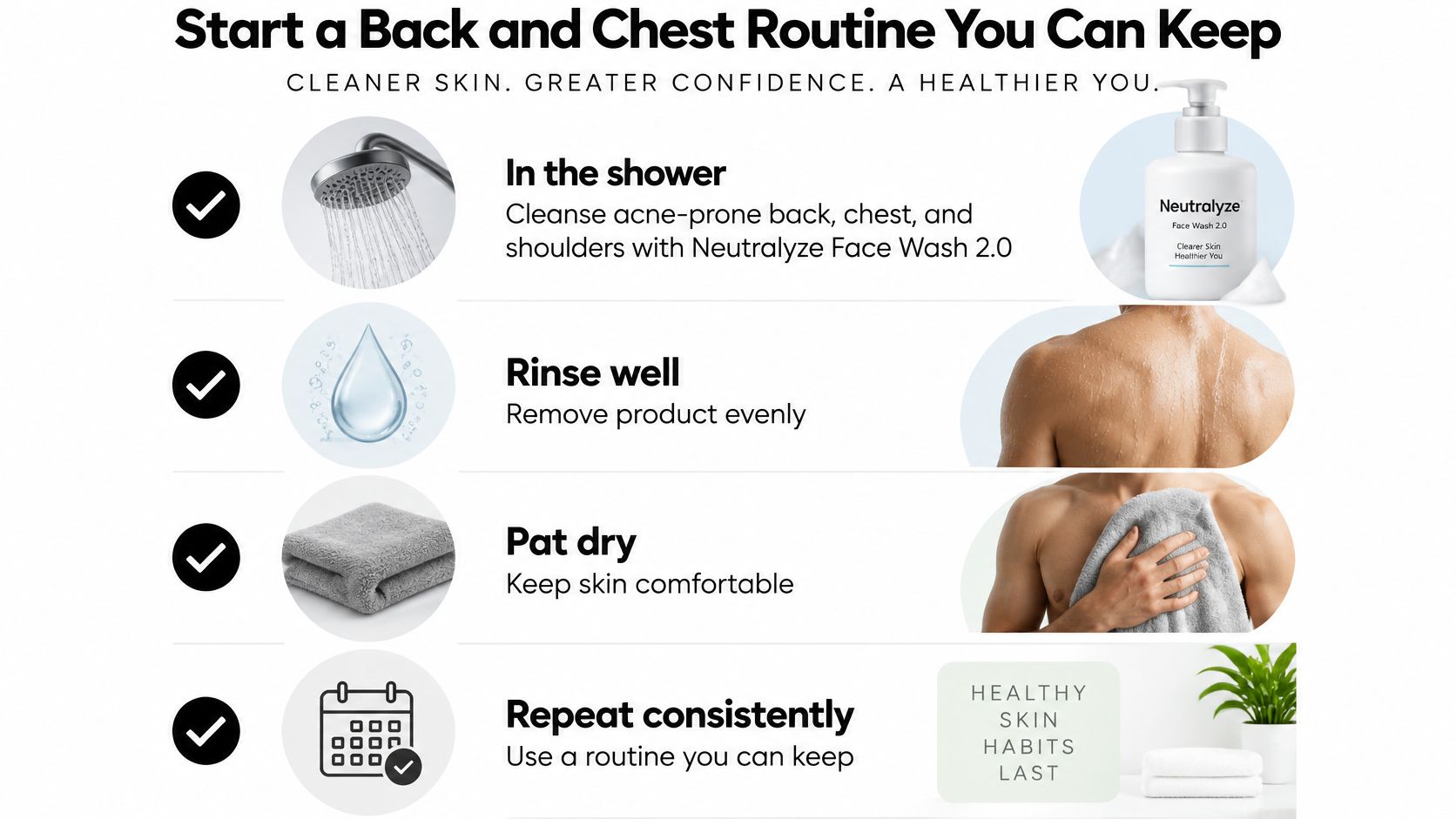
If your back feels tight after showering but new bumps keep appearing, adding several acids at once can make it harder to tell what helps. Keep the routine manageable: begin with cleansing, then add a leave-on step only if your skin is comfortable.
Build the Routine in Stages
After following the shower steps above, let your skin dry before using Neutralyze Exfoliating Pads. Swipe a pad over the affected area and leave it on. Because this is a leave-on step, add it gradually and reduce use if dryness or irritation develops.
For hydration, Neutralyze Renewal Complex is a lightweight, oil-free moisturizer. Its time-released DuoClear gradually releases 2% salicylic acid and 1% mandelic acid, so it is also an active exfoliating step that works alongside your moisturizer.
Keep the Stop Rule Simple
If tightness appears after adding a pad or Renewal Complex, reduce the newer active step first. If irritation continues, pause the active products and use a bland, non-comedogenic moisturizer while your skin settles.
Breathable fabrics, changing after workouts, and leaving bumps alone can help you avoid adding friction or picking. Deep pain, nodules, drainage, or scarring calls for a dermatologist rather than another active product.
Choose a starting point that fits your skin. If your routine is inconsistent, focus on cleansing first. If you add a leave-on step, give your skin time to show whether it is comfortable before adding another.
Neutralyze's face wash and exfoliating pads can be used on the back, chest, and shoulders. The Face Wash cleanses with 2% salicylic acid and 1% mandelic acid, while the pads are applied after cleansing and left on. Build gradually, guided by your skin's comfort.