

How Long Does Salicylic Acid Purging Last?
Salicylic acid purging usually lasts 4 to 6 weeks, about one 28-day skin cycle, while fuller acne clearing can take 8 to 16 weeks. The important distinction is that an initial flare should start easing, even if your skin isn't completely clear yet.
You're at the sink, looking at bumps that seem more noticeable than before you started treatment. It's understandable to wonder whether to keep going or put the bottle away, especially if you've already tried several acne products.
More bumps don't automatically mean progress, and burning isn't something you need to endure. Location, skin comfort, and the direction of change tell you more than a single bad mirror check.
How Long Salicylic Acid Purging Usually Lasts
Quick Answer
Salicylic acid purging usually lasts about 4 to 6 weeks, roughly one skin cycle, and should ease rather than keep building. A temporary increase in familiar bumps can happen when existing pore clogs become visible sooner. That adjustment isn't the same as the time needed to control ongoing acne. Watch for fewer new blemishes and comfortable surrounding skin, rather than expecting every bump and leftover mark to disappear together.
Say your forehead usually develops small closed bumps. You introduce an exfoliating treatment, and some become visible whiteheads while the surrounding skin still feels comfortable. That pattern can fit temporary adjustment better than a red, itchy rash across previously clear cheeks.
A clinically formulated cleanser such as Neutralyze Face Wash, containing 2% salicylic acid and 1% mandelic acid, offers a wash-off entry point. Our approach is to start once daily after the sensitivity test, not to increase exposure because you notice bumps.
What's Happening Inside the Pore
Sebum, your skin's oil, mixes with dead skin cells inside a follicle. When those cells accumulate and stick together, a process called follicular hyperkeratinization, they can form a tiny, initially invisible plug called a microcomedone.
Salicylic acid is a beta-hydroxy acid, or BHA, that helps loosen dead-cell buildup. Existing plugs can become noticeable sooner as they progress toward the surface. Purging describes that possible short adjustment, not a formal diagnosis or toxins leaving your skin.
Inflammation and the activity of C. acnes, a bacterium involved in acne, can contribute to red, swollen lesions. Those raised, active blemishes are different from flat red or brown marks left after healing.
Practical rule: Judge a possible purge by its pattern, not by the belief that treatment must make your skin worse before it works.
What the Calendar Can't Tell You
The often-cited skin cycle is an approximation, not a deadline every pore follows. Nor does reaching a particular date prove that an uncomfortable reaction is harmless.
For practical background on keeping exfoliation tolerable, Buy Me Japan's guide to using salicylic acid without barrier damage is a useful companion. The essential distinction remains simple: familiar bumps may be compatible with adjustment, but increasingly sore, raw skin needs a different response.
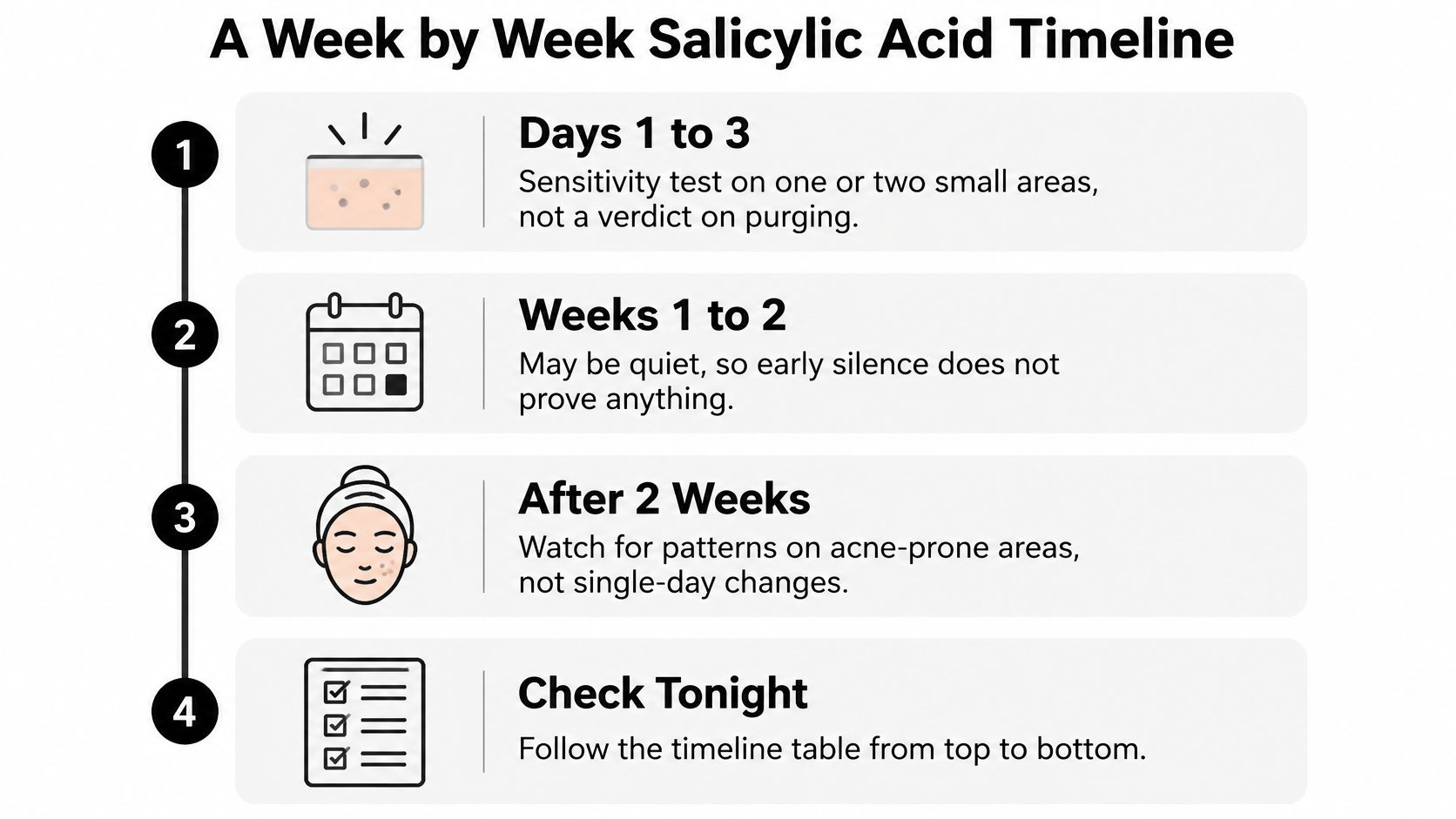
A Week by Week Salicylic Acid Timeline
Salicylic acid purge and clearing timeline
| Phase | Timing | What you may see | What it usually means |
|---|---|---|---|
| Sensitivity check | Days 1–3 | Mild tightness on a small test area | Too early to call it a purge |
| Early adjustment | Weeks 1–2 | A few extra comedones in usual acne zones | Existing microcomedones may be becoming visible |
| Peak purge window | Weeks 2–4 | More whiteheads or blackheads where you normally break out | Compatible with adjustment if limited to usual areas and not accompanied by irritation |
| Settling | Weeks 4–6 | Fewer new bumps, around the commonly cited 28-day cycle | A typical purge should be easing |
| Reassess | Weeks 6–8 | Still worsening, spreading, burning, or itching | Less consistent with purging |
| Treatment result | Weeks 8–16 | Fewer breakouts; marks may remain | Acne benefit, not an ongoing purge |
Treat these rows as checkpoints, not guaranteed stages. Health's guide to skin purging places the usual adjustment around 4–6 weeks and recommends professional evaluation when symptoms continue beyond 6 weeks; the narrower early phases above are practical monitoring windows, not proven peak dates for every formulation.
This visual can help you organize those early checks without judging every individual spot.
Read the Rows as Changes in Pattern
During the sensitivity check, you're looking for discomfort, not acne clearance. A small test can help reveal an immediate reaction, but it can't guarantee that repeated application across a larger area will remain comfortable.
Early adjustment may be quiet. You don't need to develop whiteheads, peel, or feel tingling to prove that salicylic acid is doing something useful.
During the possible flare window, compare your usual congestion zones. A few familiar forehead bumps becoming more visible tells a different story from new itchy bumps spreading across your cheeks.
At the settling checkpoint, look for fewer newly appearing lesions, not a perfectly smooth face. Existing pimples may still be healing while the rate of new ones slows.
If the pattern is spreading or becoming more uncomfortable, the reassessment row matters more than the calendar. Don't interpret it as permission to wait through burning.
Keep the Purge Clock Separate From the Results Clock
When you ask, “How long does salicylic acid purging last?” you may really be asking when your entire face will look clear. Those aren't the same endpoint.
A short initial flare can finish before the underlying acne is well controlled. Flat discoloration can remain after the raised lesions settle, so counting every visible mark as a current breakout makes improvement harder to recognize.
With consistent daily use, give a new routine 8–12 weeks before judging it. That's a product-use expectation, not a reason to continue through irritation or a guarantee of individual clearance.
Make your monitoring repeatable:
- Use the same zones: Compare forehead with forehead, rather than changing which area you inspect.
- Count new raised lesions: Keep flat marks in a separate note.
- Record comfort: Burning, itching, and dryness deserve their own entries.
- Photograph consistently: Similar lighting and distance make comparisons more useful than magnification.
Check once a week rather than repeatedly throughout the day. You're looking for a trend that survives normal daily fluctuations.
Purging Versus Irritation on Your Face
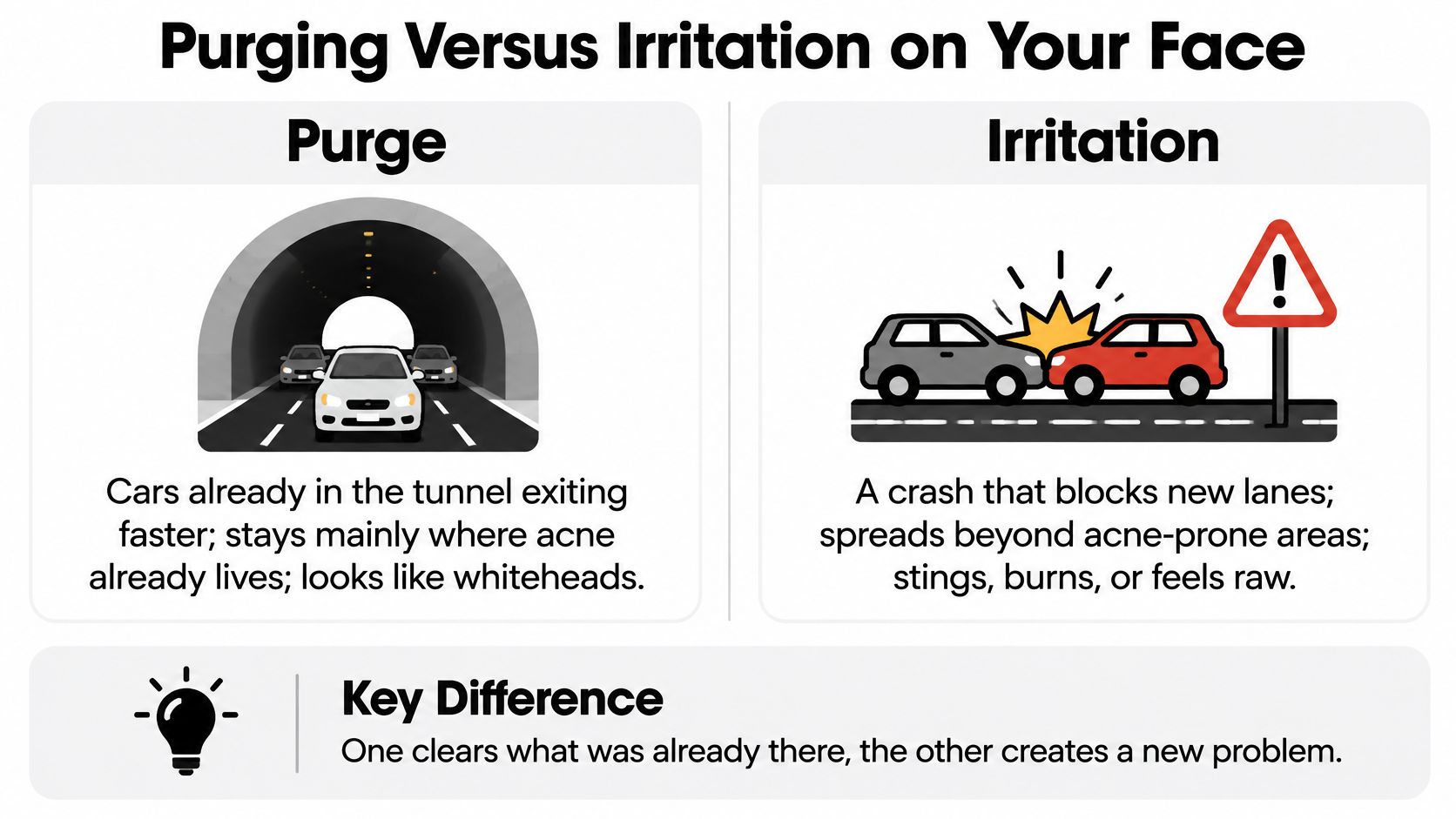
Think of purging as cars already inside a tunnel reaching the exit sooner. Irritation is more like a crash that disrupts traffic and creates an additional problem.
The analogy helps explain why more bumps and more discomfort aren't interchangeable. You can have acne lesions while the surrounding skin remains comfortable, or acne and irritation at the same time.
Purge versus irritation
| Clue | More like purging | More like irritation |
|---|---|---|
| Where | Mainly your usual acne zones | New areas or most of the face |
| What you see | Whiteheads, blackheads, small papules | Rash, cracks, widespread redness |
| How it feels | Tender individual bumps, not constant burning | Stinging, burning, itching, or rawness |
| When it starts | During early adjustment after introducing treatment | Can begin immediately |
| Course | Gradually eases | Continues or worsens with repeated exposure |
| Next move | Maintain a tolerable routine and moisturize | Reduce frequency or stop |
The American Academy of Dermatology's acne guidance supports matching care to acne severity and seeking professional help when your routine isn't helping. Little improvement after about six weeks, painful nodules, marked inflammation, or scarring deserves professional evaluation rather than increasingly aggressive exfoliation.
The visual comparison emphasizes location and sensation, not just the presence of pimples.
Check Location, Comfort, and Direction
Look at where the bumps appeared. A familiar chin breakout is more compatible with ordinary acne or adjustment than a new rash over areas that rarely develop congestion.
Next, notice whether your skin hurts between applications. Individual pimples can be tender, but persistent burning, water stinging your cheeks, or a previously comfortable moisturizer suddenly feeling painful suggests irritation.
Finally, check whether the number of new raised lesions is falling. A flare that keeps intensifying shouldn't receive an automatic purging label.
Redness with burning is a barrier warning, not a detox.
A visual guide to what purging skin looks like may help you describe what you're seeing, but photographs can't diagnose contact dermatitis or distinguish every acne-like rash.
Account for Other Skin Stress
If you surf or schedule facial treatments, keep those activities in your routine notes too. GLAZE - House of Wellness discusses planning massages around surf sessions, which is useful scheduling context, not evidence about acne purging.
Don't assume every pimple after a new product came from that product. If your usual acne never noticeably changed after starting the acid, it may be ongoing acne rather than a purge.
Deep painful nodules, significant swelling, or developing scars aren't a useful adjustment phase. Those changes call for assessment, not another exfoliating layer.
Why Some Salicylic Acid Purges Run Longer
A wash-off cleanser, a leave-on pad, and an acne moisturizer don't create identical exposure. The percentage on the label is only part of the picture.
Contact time, formulation, pH, frequency, and the other products you apply all affect tolerance. A cleanser rinses away; a pad's liquid and a leave-on moisturizer remain on your skin.
The product format matters when you're deciding what to change.
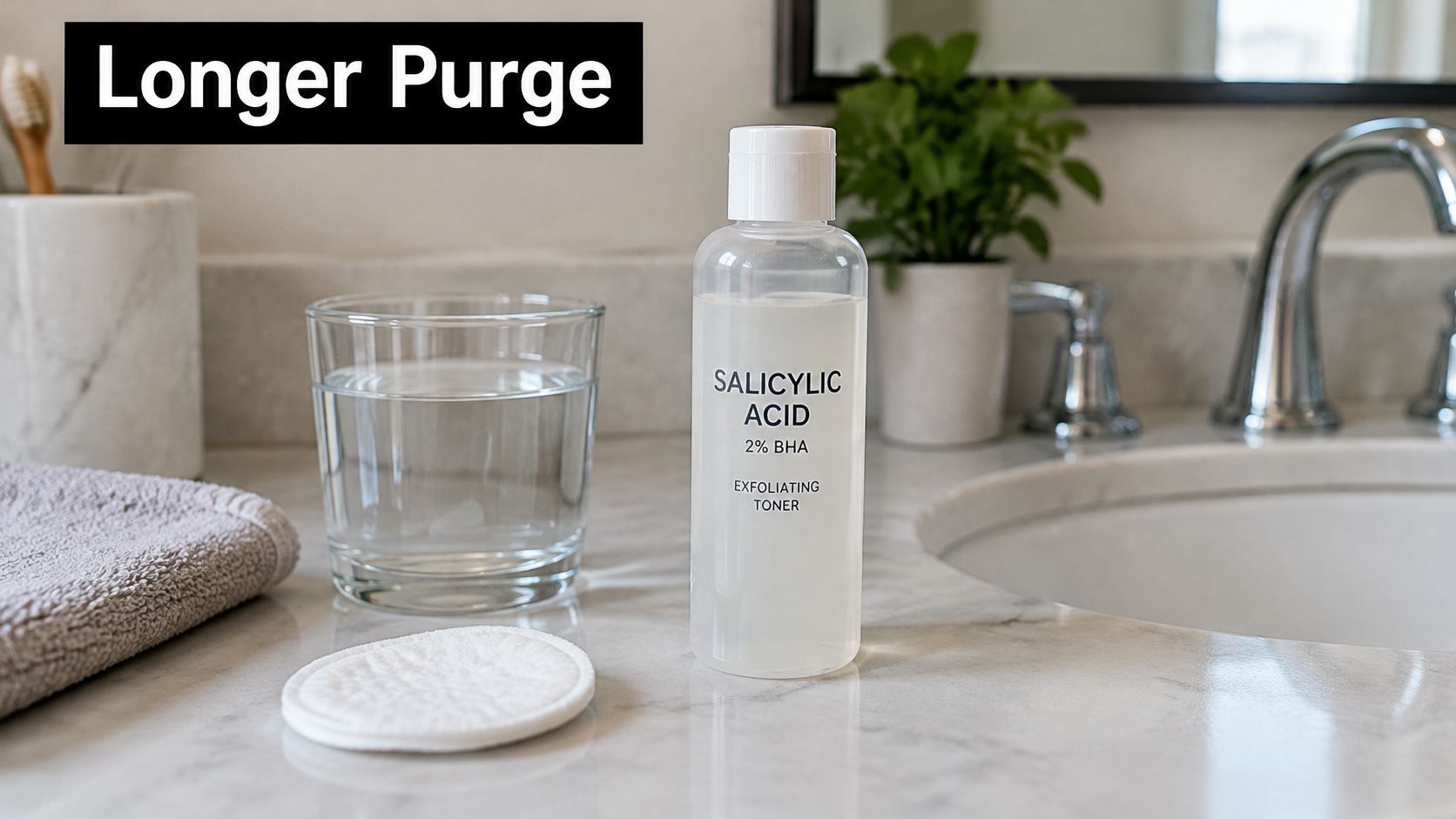
Concentration Isn't the Whole Dose
Salicylic acid is typically used at 0.5% to 2% in acne products. That range doesn't tell you which formulation will be most comfortable for you.
A review of salicylic-acid formulations and clinical evidence describes a small study in which a 2% cleanser reduced comedones after 2 weeks, while other regimens were evaluated over 28–56 days. Those are treatment-assessment periods, not proof that each product type causes a specific purge duration.
The practical conclusion is modest: there isn't a well-established separate purge timetable for every wash-off and leave-on format. You can't assume a cleanser must work immediately or that a leave-on product deserves unlimited time.
Nor does a lower percentage automatically mean less irritation. Cleansing agents and the way a formula delivers salicylic acid can matter alongside strength.
Avoid Turning Adjustment Into Over-Exfoliation
Consider a routine with an acid cleanser, exfoliating wipes, and an acid moisturizer introduced together. If your face becomes tight and red, you won't know which step, combination, or frequency caused it.
Neutralyze Exfoliating Pads are a leave-on salicylic acid plus mandelic acid option, swiped over clean skin without rinsing. Because they remain on the skin, introduce them cautiously rather than adding another new acid product alongside them.
This video offers another format for learning about salicylic-acid use.
Baseline acne severity, age-related differences in skin renewal, and concurrent exfoliation can complicate the apparent timeline. Scrubs, peels, and retinoids may also add irritation, especially when you change several things together.
Use a simple product log before adding another step:
- Product and format: Note whether it rinses off or stays on.
- Application pattern: Record when you use it and whether you recently increased frequency.
- Skin response: Track location, burning, dryness, and new lesions.
- Other changes: Include peels, scrubs, prescription adjustments, and new cosmetics.
A longer flare doesn't necessarily mean more clogs are coming out. Sometimes it means your routine needs less exposure, not more patience.
How to Manage Skin While a Purge Settles
Keep the routine predictable enough that you can tell what your skin tolerates. The aim is consistent treatment without unnecessary irritation, not the highest frequency you can endure.
The American Academy of Dermatology advises allowing at least 4 weeks before judging a new acne product, because frequent switching can irritate skin and trigger additional breakouts. Effective treatment commonly begins showing improvement within 4–6 weeks, while clearer skin can require 2–3 months or longer.
That advice assumes your skin is tolerating treatment. It doesn't mean you should continue through a severe reaction.
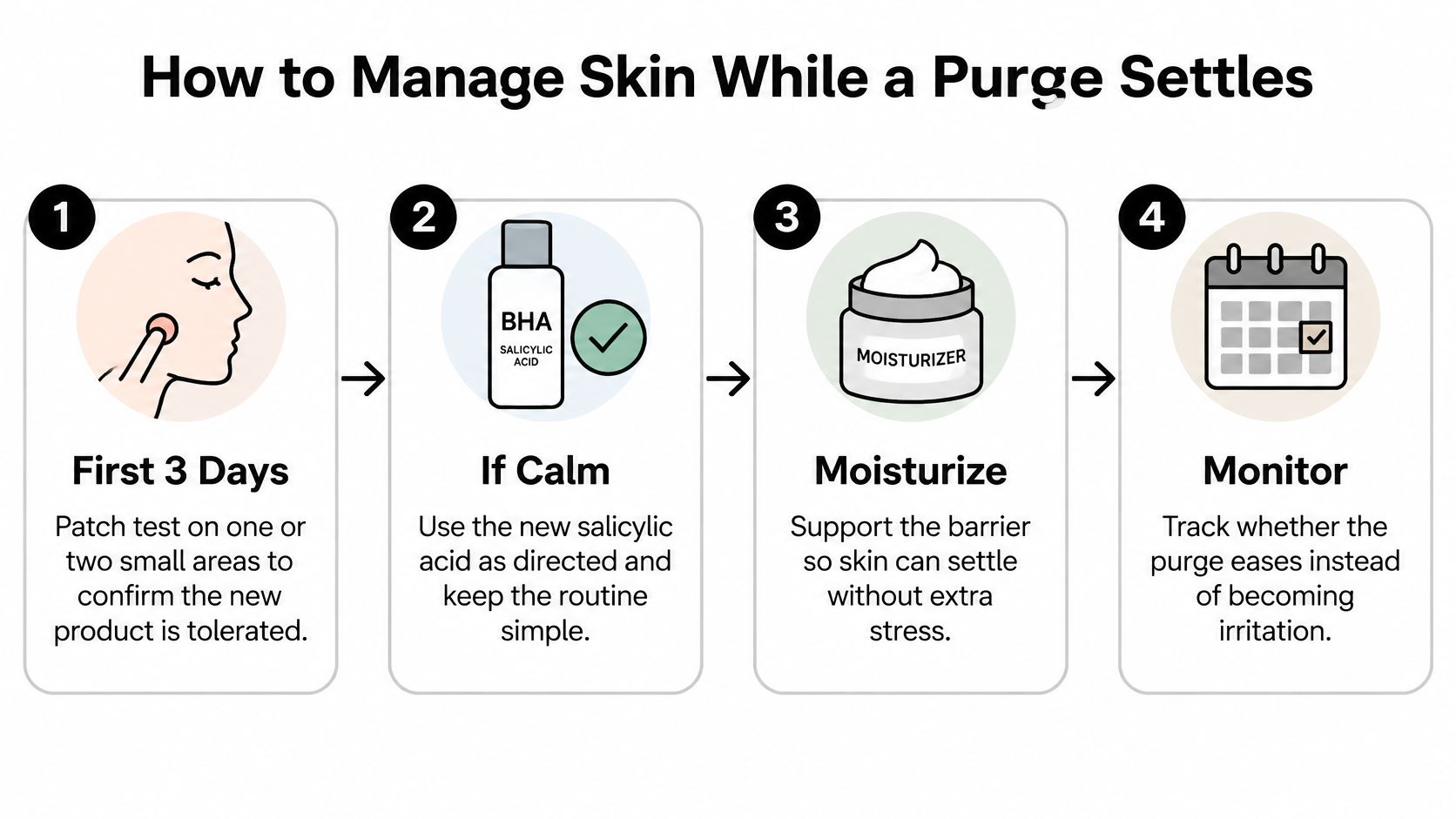
Introduce, Support, and Monitor
- Start with a sensitivity test. For our products, apply sparingly to one or two small affected areas during the first 3 days. This checks early tolerance, but it doesn't rule out delayed irritation or future breakouts.
- Build from a once-daily start. After a calm sensitivity test, introduce the chosen product once daily. Increase only if needed and if your skin remains comfortable, rather than automatically progressing to the label's maximum frequency.
- Keep everything else familiar. Use gentle cleansing and avoid scrubs, peels, or another newly introduced exfoliating treatment. If you use a prescription retinoid, ask your prescriber how to adjust the routine rather than independently changing prescribed treatment.
- Choose moisturizer by what it contains. A plain, non-comedogenic moisturizer can support comfort without adding another exfoliant. Neutralyze Renewal Complex contains salicylic and mandelic acid, so count it as an active acid product, not an acid-free recovery cream; if it's your new product, don't introduce pads alongside it.
- Use sun protection. Our AHA-containing pad guidance calls for sunscreen, protective clothing, and limited sun exposure during use and for a week afterward. Protecting your skin is particularly important when you're also concerned about lingering discoloration.
- Leave blemishes alone. Squeezing and scraping add injury to an already inflamed area. Don't use a visible whitehead as a reason to scrub harder or apply repeated layers of acid.
- Reduce use when dryness develops. If you've increased frequency, cut back to once daily; if that's still uncomfortable, use every other day. Tightness, peeling, and stinging are reasons to simplify, not to add a stronger treatment.
- Stop if irritation persists or becomes severe. Contact Neutralyze about product use and seek clinical advice for significant or continuing symptoms. Don't repeatedly restart an irritating product without understanding the reaction.
This process keeps the focus on tolerance rather than forcing your skin through discomfort.
Make Rest Days Actual Rest Days
Don't replace a skipped acid application with a peeling mask or vigorous cleansing brush. Use your familiar gentle cleanser, plain moisturizer, and daytime sunscreen.
Comfortable skin makes your observations more useful. If every application causes stinging, you're no longer evaluating acne improvement alone, you're also managing a tolerability problem.
When to Stay, Slow Down, or Get Help
If the flare isn't easing by the expected checkpoint, or it burns, spreads, or scars, stop calling it a purge.
The assumption that all worsening means treatment is working can delay useful care. A purge isn't a diagnosis, and this article can't diagnose your reaction.
The longer timeline still matters: Health's review of purging and acne distinguishes fewer breakouts after 4–8 weeks from substantial clearing that may take up to 16 weeks. That longer acne-clearing period isn't permission to reinterpret continuous irritation as normal adjustment.
Stay the Course When the Pattern Is Improving
Continuing cautiously can make sense when your blemishes remain familiar, the surrounding skin feels comfortable, and new-lesion counts are leveling off or falling.
Look beyond whether you woke up with a pimple today. Are old lesions flattening? Are you developing fewer new clogs across the same area? Can you wash and moisturize without stinging?
Those observations support maintaining a tolerable routine instead of changing products whenever a spot appears. Keep the amount and frequency steady while you assess the trend.
Not purging is also fine. You don't need a dramatic flare, visible peeling, or an uncomfortable sensation to benefit from treatment.
Slow Down When Comfort Is Deteriorating
Tightness, flaking, or stinging means your current exposure may be more than your skin tolerates. Remove unnecessary exfoliating steps and return to a plain supporting routine.
Don't compensate by leaving cleanser on longer, pressing harder with pads, or applying extra cream over every blemish. More contact doesn't automatically produce better acne control.
A moisturizer that includes acne acids still contributes to your active routine. Distinguish it from a plain moisturizer when deciding which products to pause.
For a future routine, Neutralyze's clinically formulated cleanse, rejuvenate, hydrate approach uses only salicylic acid and mandelic acid as its actives. Introduce steps individually rather than treating the complete routine as a requirement from the first application.
Our DuoClear system combines 2% salicylic acid and 1% mandelic acid. The oil-soluble salicylic acid works inside the pore while mandelic acid smooths the surface; in the renewal moisturizer, those acids release gradually rather than all at once.
That formulation approach doesn't remove the need to monitor tolerance. A time-released active is still an active.
Get Help for Pain, Scarring, or an Unusual Rash
Arrange professional evaluation if you notice:
- Persistent burning or tenderness: Especially when water or familiar skincare hurts.
- Marked redness or cracking: These aren't signs that pores are becoming cleaner.
- An itchy or spreading rash: Particularly outside your usual acne zones.
- Deep nodules or cysts: Painful lesions deserve assessment rather than extra exfoliation.
- Possible scarring: New indentations or raised scars warrant early attention.
- Continued worsening: A routine that isn't moving in a helpful direction needs reassessment.
Seek urgent care for signs of a serious allergic reaction, such as breathing difficulty or facial or throat swelling.
A dermatologist is particularly useful when moderate-to-severe acne remains active, you're developing cysts, or previous at-home and prescription treatments haven't helped. Bring your product list, application schedule, and photographs so the clinician can distinguish inadequate acne control from irritation or another condition.
Finally, separate flat post-acne marks from new lesions. Red or brown discoloration after a bump flattens can outlast the active breakout; adding more acid because the color remains can create a new tolerability problem.
The goal isn't to tolerate the longest possible purge. It's to find a treatment plan that reduces acne while keeping your skin comfortable enough to use it consistently.
Neutralyze offers a clinically formulated salicylic acid plus mandelic acid routine for acne-prone skin, with wash-off and leave-on options you can introduce gradually. Visit Neutralyze to explore the routine and choose a starting format that fits your current routine and skin tolerance, rather than adding every step at once.