

How Long Do Acne Marks Last? A Real Timeline
Most acne marks fade in 3 to 12 months, and red marks usually fade faster than brown ones. Deeper pigment or true scars can last years without treatment, which is why the same breakout can leave one person with a faint pink spot for a few months and another person with a stubborn dark mark that seems to outstay the pimple itself.
That difference is exactly why this question feels so frustrating. You cleared the bump, but the color stayed, and now you're staring at a flat spot that still looks like active acne even though the skin underneath has already healed. If you want a useful clinical breakdown of what's normal and what isn't, find clinic transparency explainers from The Repair Project can be a helpful starting point.
The Question Behind the Question
You pop a pimple, the bump goes down, and the mark stays. That's the moment a person realizes they're not really asking about acne anymore, they're asking about what acne left behind.
The problem is that “acne mark” is an umbrella term. It can mean a flat brown patch, a flat red or pink patch, or a true scar that changes the skin's texture. Those are not the same process, so they don't fade on the same schedule. A helpful way to stay grounded is to compare your mark with broader pigment discussions too, such as the UK melasma treatment guide, since both conditions can involve lingering discoloration even when the original trigger is different.
Start with color, then feel
If the spot is flat and brown, you're usually looking at post-inflammatory hyperpigmentation, or PIH. If it's flat and red or pink, that points more toward post-inflammatory erythema, or PIE. If it's indented, raised, or textured, you're probably dealing with a true scar, which is a structural change rather than leftover color.
That distinction matters because the answer to how long do acne marks last depends on which one you have. The good news is that flat marks often fade, while true scars usually need more than time alone.
Practical rule: flat color changes usually fade, texture changes usually don't.
If you've been trying to figure out whether your spot is pigment, redness, or scarring, the rest of this article gives you a clean map. For a deeper look at pigment-specific care, you can also compare your experience with the Neutralyze hyperpigmentation treatment guide, since PIH and PIE often get mixed up by people who are staring at the same mirror every day.
PIH, PIE, and Scars Are Not the Same Thing
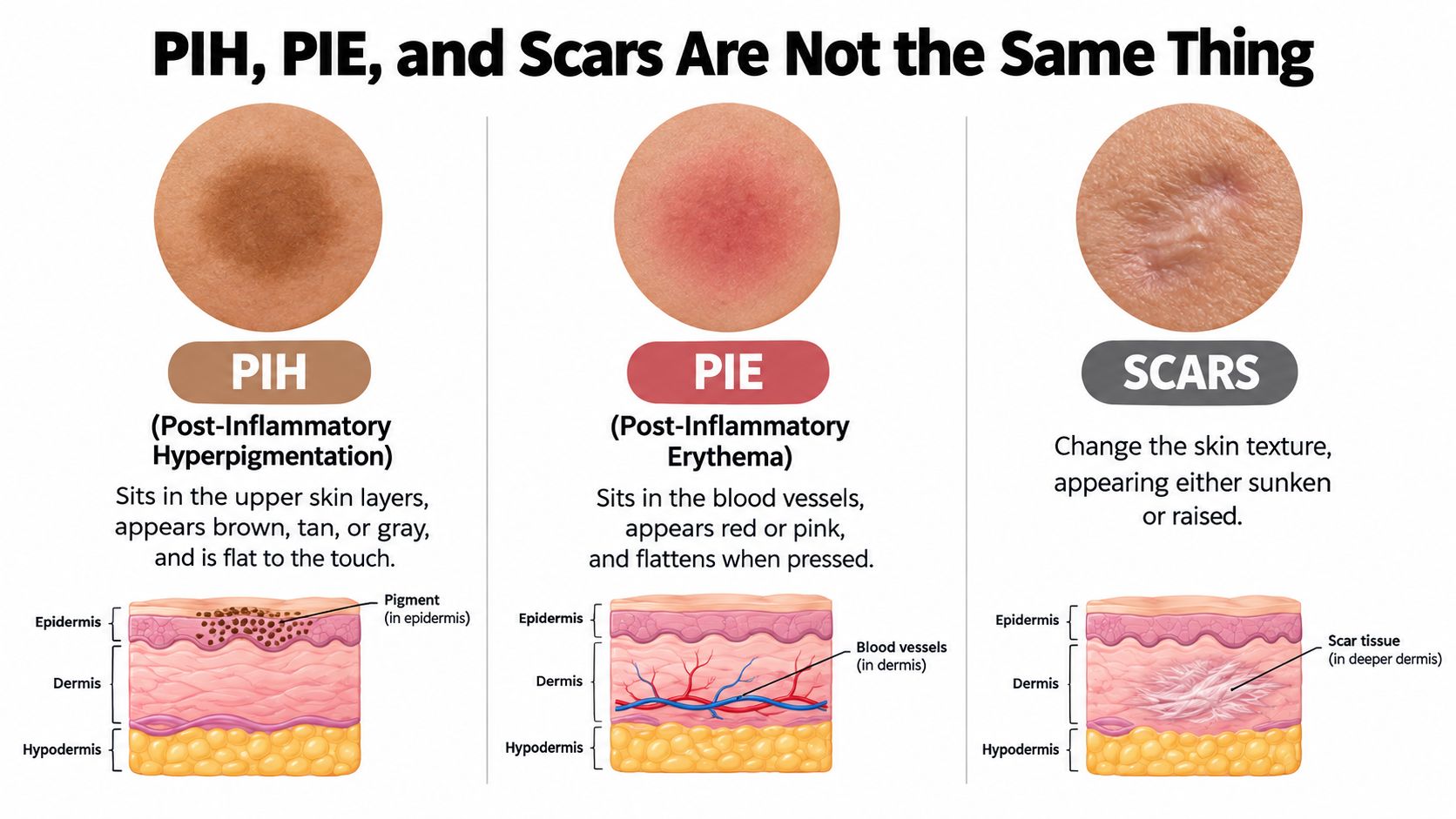
The visual clues that separate them
A flat brown spot after a breakout is usually post-inflammatory hyperpigmentation, or PIH. A flat red, pink, or purple mark points more toward post-inflammatory erythema, or PIE. If the area is indented, raised, or has a rough surface, you are likely dealing with a true scar, which reflects a change in skin structure rather than leftover color.
That difference matters because the question of how long do acne marks last depends on which mark you are seeing. Flat discoloration can fade with time and treatment, while true scars usually need more than waiting.
PIH happens when inflammation triggers extra melanin production after the breakout starts to settle. Reviews note that epidermal PIH can last up to 12 months, while deeper dermal pigment can stay visible for years, which is why brown marks often linger after the acne itself has calmed down (PMC review, AAD). For a closer look at pigment-focused care, see this hyperpigmentation treatment guide from Neutralyze.
PIE is a blood-vessel issue, not a pigment issue. A clinical review reports that acne-related post-inflammatory erythema can last 1 to 9 months, with an average duration of about 3.35 months, and it can affect up to 80% of people with severe acne (Wiley review). The red or pink tone comes from capillaries near the surface, which is why pressure can make the color look lighter for a moment.
Scars follow a different rule. Once the skin has healed with a dip or a raised edge, the problem is no longer just color. The texture change is the signal.
| Acne Mark Type at a Glance | What you see | What's happening in the skin | Typical fading window |
|---|---|---|---|
| PIH | Brown, tan, gray, flat | Extra melanin left behind after inflammation | Often up to 12 months, deeper pigment can last years |
| PIE | Red, pink, purple, flat | Vascular redness from dilated or damaged capillaries | About 1 to 9 months, average around 3.35 months |
| Scar | Sunken or raised, textured | Structural change in collagen and repair tissue | Doesn't reliably fade on its own |
A quick at-home check can help. Flat marks usually point to PIH or PIE. If the spot looks red or pink and seems to fade when pressed, PIE is more likely. If it stays brown regardless of pressure, PIH is the better fit. If your finger catches on the edge, texture is involved, and scar tissue may be part of the picture. If the mark looks confusing, many people compare it with broader pigment problems such as the UK melasma treatment guide, because different causes can still leave the same frustrating aftermath in the mirror.
What Makes Some Marks Linger for Months or Years
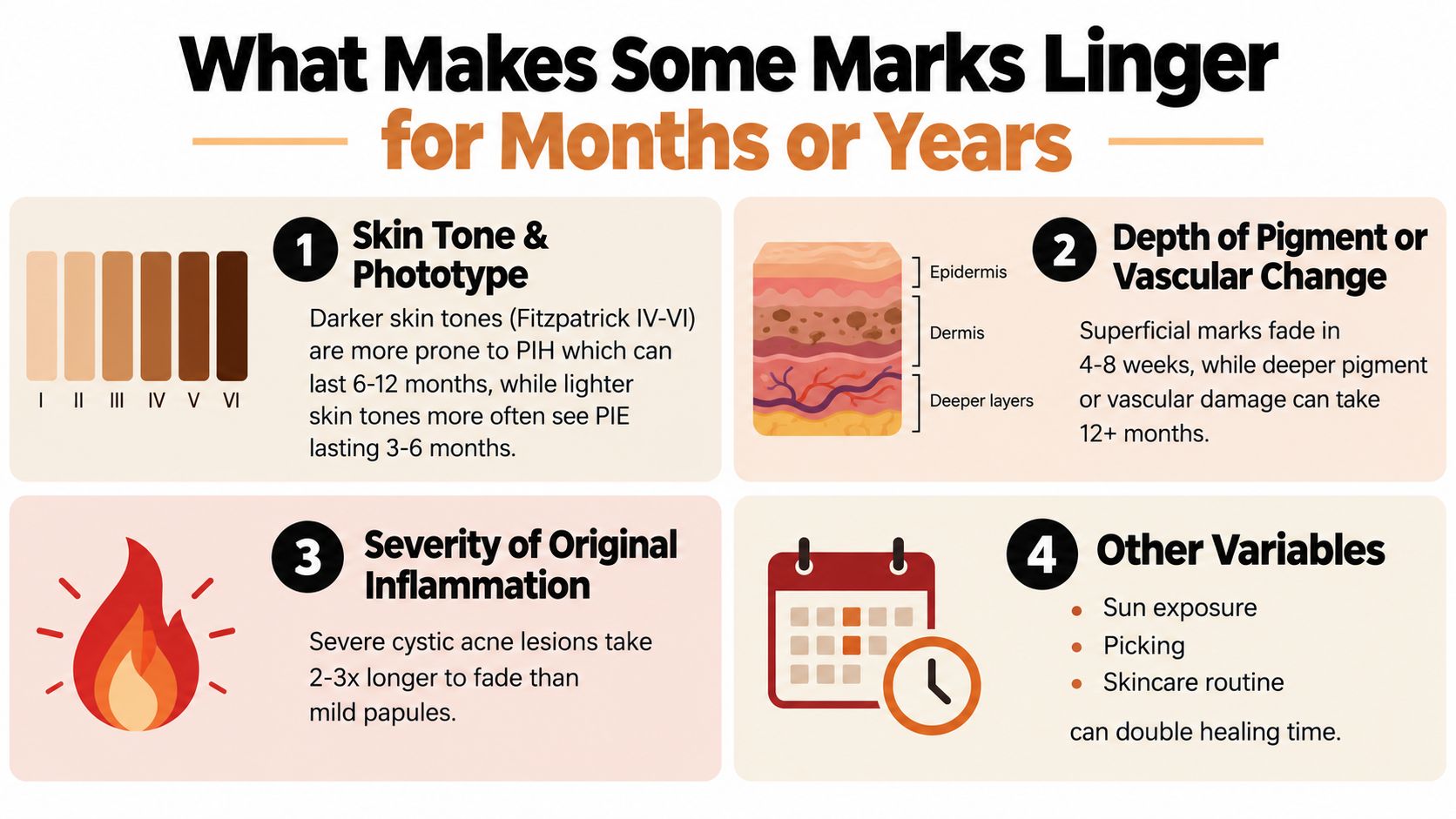
The four things that stretch the timeline
The same pimple can leave a mark that disappears quickly or one that sticks around for months. The biggest reasons are skin tone, depth of the mark, how inflamed the breakout was, and whether the skin keeps getting re-irritated.
A study of 324 acne patients found PIH in 58.2% of them, and more than half of those affected had pigmentation for at least one year. In that same study, 22.3% reported marks lasting five years or longer (Wiley study). That's not a sign you've done something wrong, it's a sign that acne marks can be slow to resolve, especially when the original inflammation was strong.
Why skin type and exposure matter
PIH is reported most often in Fitzpatrick skin phototypes IV to VI, and it tends to be more common and more burdensome as skin tone gets darker (INSERM/HAL review). That doesn't mean darker skin is the problem, it means the mark can be more noticeable and can persist longer.
Sun exposure also stretches the timeline. Dermatology guidance notes that sunscreen helps prevent new dark spots and can help existing ones clear, while tinted formulas with iron oxides add visible-light protection, which can be especially relevant for darker skin tones (Springer guidance).
If you're still getting new breakouts, you're not just healing one mark. You're creating the next one.
That's why picking, squeezing, and aggressive scrubbing matter so much. They keep the skin in a loop of inflammation, and that loop is what turns a short-lived mark into a long-lived one.
A Realistic Week-By-Week Fading Timeline
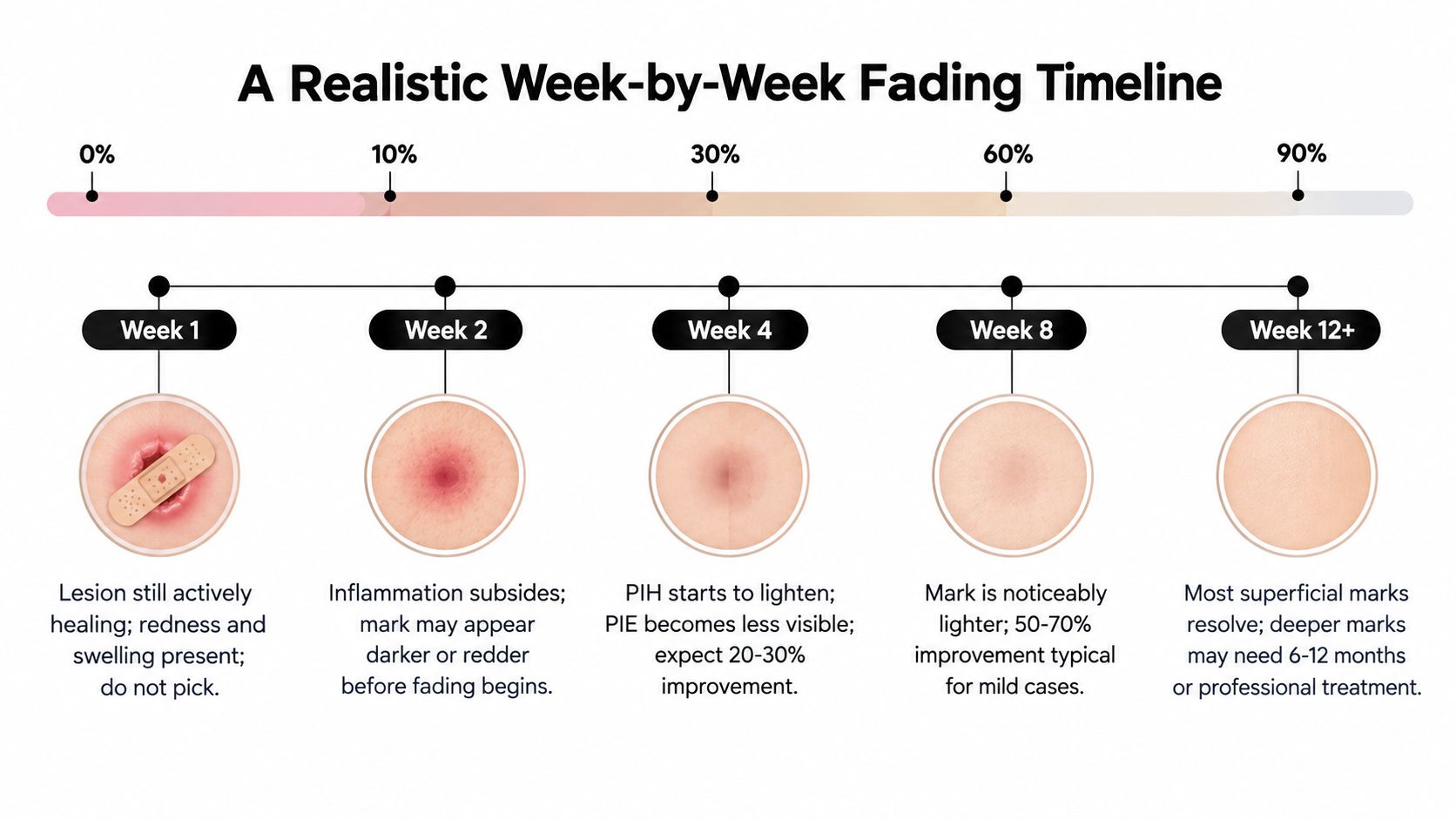
What you should expect to see
In the first week, the skin is still repairing itself. The pimple may flatten, but redness or darkness can stay behind because the inflammation has not fully settled. That is normal, and it also explains why picking at the spot tends to restart the clock.
By week 4, many superficial marks should begin to look softer. The change is usually subtle at first, less red, less dark, or less obvious in ordinary light. By the 8 to 12 week mark, consistent care should start to show whether the skin is moving in the right direction.
Where the longer timeline starts
A randomized, vehicle-controlled study of an anti-pigment formulation followed acne-related PIH for 12 weeks and found improvement in melanin index, expert grading, self-assessment, and photography (PMC study). That gives a practical checkpoint, if you have been consistent for roughly 8 to 12 weeks, you should have a clearer sense of whether your routine is helping.
Some marks need more time. The American Academy of Dermatology notes that a spot only a few shades darker than your natural skin color often fades within 6 to 12 months, while pigment deeper in the skin can take years. So a mark that is still visible at month two is usually still in the middle of the fade, not proof that it will stay forever.
A useful way to judge progress is by comparison, not perfection. If the mark is lighter, smaller, or easier to cover than it was a month ago, healing is happening even if the change feels slow.
For people with both active acne and leftover marks, a daily cleanser with salicylic acid and mandelic acid can help keep pores clearer while the color continues to fade. See this mandelic acid before-and-after guide for a closer look at how that ingredient is often used in acne care.
At-Home Actives That Actually Fade Marks
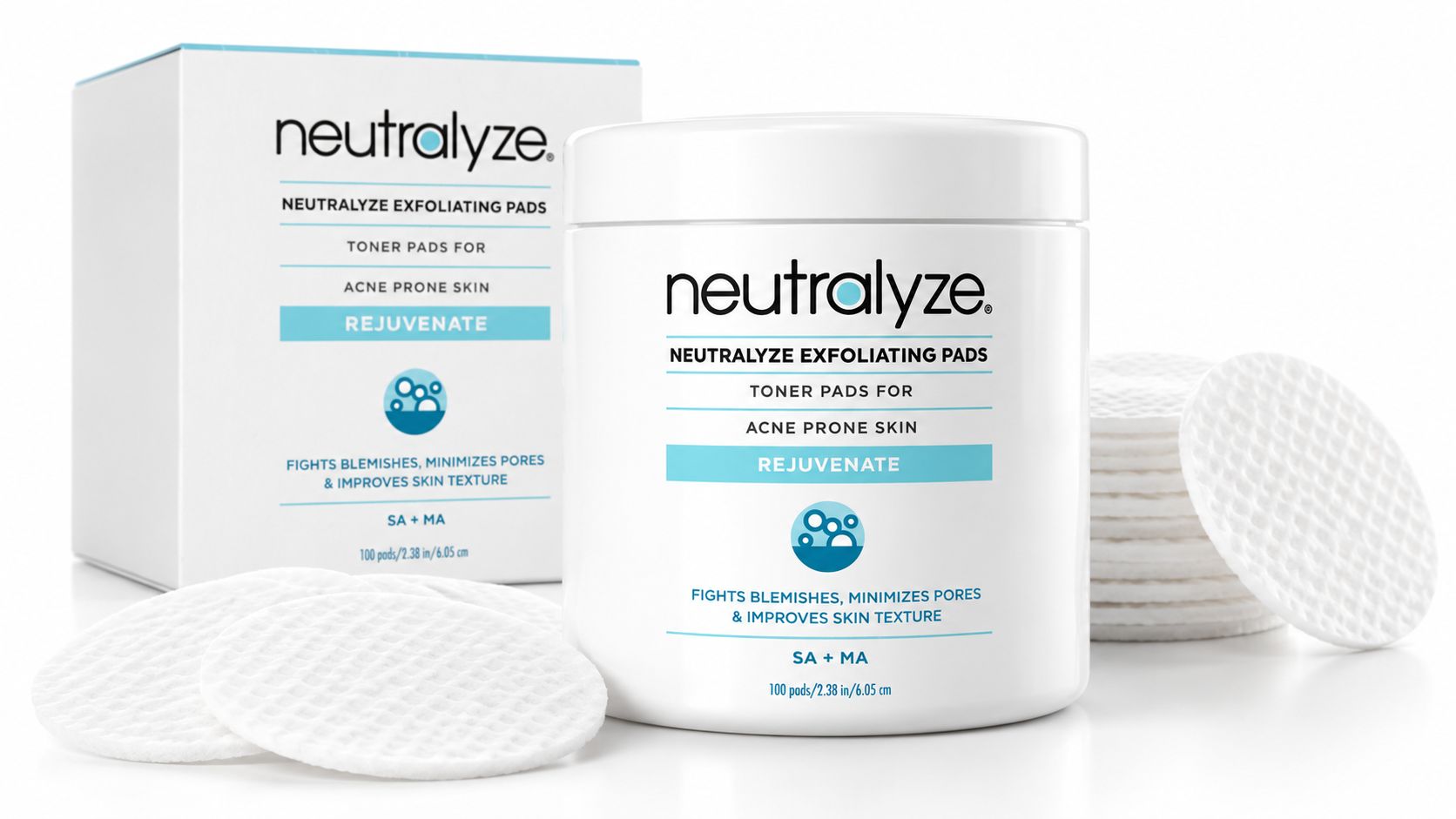
Why salicylic acid and mandelic acid work well together
A fading routine has to do two jobs at once. It needs to keep pores from refilling with oil and debris, and it needs to calm the environment that keeps discoloration lingering.
Salicylic acid is oil-soluble, so it can move into the pore and help clear the buildup that keeps breakouts going. Mandelic acid works more gently at the surface, where it can smooth rough texture and support the fading of discoloration. Used together, they help address the breakout and the mark that follows.
That matters if you have already tried single ingredients and still feel stuck. Neutralyze builds that mechanism into a pad format with salicylic acid plus mandelic acid, which keeps the exfoliating step simple while still aiming at clogged pores and post-acne marks. For readers who want a broader look at pigment care, tranexamic acid is another evidence-backed option for stubborn pigment, especially when discoloration sits deeper or fades slowly.
What improves the odds of visible fading
The most useful at-home approach is usually non-irritating, consistent, and acne-focused. Marks do not respond well to chronic irritation, and they fade more slowly if each new product makes the skin redder or drier. The goal is to stop re-injuring the skin while letting normal turnover do its work.
A medical peel for facial discoloration may fit a dermatologist-led plan for some people, but at-home care still matters when skin is acne-prone and reactive. A hydrating step like Neutralyze Renewal Complex can help here because it pairs salicylic acid and mandelic acid in a moisturizer format, which supports daily use when your skin needs both comfort and exfoliation.
A mark fades better when the skin is not constantly busy healing a new breakout.
Building a Routine That Fades Marks Without Damaging Your Barrier
The easiest routine to overdo is the one aimed at fading marks. More acids do not automatically mean faster fading, and too much exfoliation can leave skin redder, drier, and more reactive than before.
Morning and evening priorities
Start with the barrier, then work on the mark. In the morning, use a gentle cleanse, light hydration, and broad-spectrum SPF 30 or higher. Sunscreen matters for PIH because UV exposure keeps dark marks visible longer and can make them look worse day to day.
At night, keep the routine short. Use a cleanser that helps with congestion, then add a leave-on exfoliating treatment only as often as your skin can tolerate, then finish with a moisturizer that does not clog pores. A routine built around Neutralyze Face Wash, Neutralyze Exfoliating Pads, and Neutralyze Renewal Complex follows that structure, provided the steps stay gentle and are not stacked so aggressively that the barrier gets irritated.
A useful rule is simple. If the skin is calm enough to repeat the routine, it has a better chance of fading marks steadily.
What slows fading instead of helping it
Over-exfoliating is one of the fastest ways to stall progress. Layering strong actives on already inflamed skin can make a mark look angrier instead of lighter, because the skin spends its energy recovering from irritation instead of settling down. If the skin feels tight, stingy, or flaky, that is a sign to pull back.
For anyone deciding between adding more treatment or simplifying, the better question is whether the routine can be used consistently without upsetting the skin. A steady routine the skin tolerates usually does more for fading than an aggressive one that keeps getting interrupted.
Prevention Habits That Shorten Total Mark Time
The habits that shorten mark time are boring, but they work. You don't need a complicated plan, you need fewer new injuries to the skin.
Don't pick or squeeze. That's the quickest way to turn a short-lived mark into a longer one, and it raises the odds of both PIH and true scarring. If a pimple has a visible head, hands-off protection usually helps more than checking it every hour.
Use sunscreen every day. Skin that's protected from UV and visible light has a better chance of moving through the fade process without fresh darkening. Tinted formulas with iron oxides can be especially helpful if your marks tend to get stubborn.
Keep cleansing gentle. Harsh scrubs and overused peels don't erase marks faster, they just create more irritation. Acne-prone skin usually does better when the routine clears pores without stripping the barrier.
The small daily habits matter more than the occasional big skincare reset.
A simple checklist helps:
- Protect: use SPF every morning.
- Hands off: don't squeeze or pick.
- Stay steady: use consistent, non-irritating care.
- Control breakouts: fewer new pimples means fewer new marks.
When an Acne Mark Deserves a Dermatologist
A flat mark that's slowly fading is usually a wait-and-watch situation. A mark that's changing shape, getting darker quickly, or feeling painful, itchy, or prone to bleeding deserves a closer look.
Signs it's not a normal fade
If the mark is depressed, raised, or textured, that's not ordinary PIH or PIE. If it looks unchanged after 8 to 12 weeks of consistent, gentle care, it may be deeper pigment, ongoing inflammation, or a different diagnosis altogether. And if you still have severe cystic acne that keeps producing new marks, you're dealing with the source as much as the aftermath.
A dermatologist can step in with options that at-home care can't replicate, including prescription topicals, chemical peels, microneedling, or laser-based treatments. Those approaches are usually aimed at either reducing persistent pigment, correcting texture, or both.
The simplest decision rule
If the mark is flat and gradually lighter, keep going. If it's textured, stalled, or changing, get it checked.
That's the most practical answer to how long do acne marks last. Flat redness and pigment usually fade in months, deeper pigment can take much longer, and true scars don't reliably fade on their own. The fastest path is usually the least dramatic one, stop new inflammation, protect the skin from sun, and use ingredients that work with your barrier instead of against it.
If you want a routine built around that logic, Neutralyze offers a clinically formulated salicylic acid plus mandelic acid system designed to cleanse, rejuvenate, and hydrate acne-prone skin without relying on harsh overcorrection. For people who are tired of guessing, that kind of consistent structure can make the difference between a mark that lingers and one that finally starts to move.
If you're ready to simplify your routine and give your skin a steadier path forward, explore Neutralyze for a salicylic acid and mandelic acid system built to support breakout-prone skin while you work on the marks left behind. Start with a cleanser, exfoliating pads, and a hydrating moisturizer you can use consistently, then give your skin the time it needs to show you real change.