

Glycolic Acid Pads for Dark Spots: What Works and Why
Glycolic acid pads may gradually fade surface-level post-breakout marks over several weeks, but the strongest evidence comes from professional peels, including results assessed after 12 weeks, not at-home pads.
If a study tested a carefully timed clinic peel, why should you expect the same result from a leave-on wipe? That distinction matters more than a brightening claim on the jar. The kind of mark, the product's pH, and your skin's response determine whether exfoliation helps or creates more inflammation.
Which Dark Spots Glycolic Acid Pads May Fade
Quick Answer
Glycolic acid pads may soften flat post-breakout marks, but they don't reliably fade deep pigment or guarantee a timeline. Professional peels use much stronger formulations under controlled conditions. Their results establish that glycolic acid can help certain pigmentation problems, and a leave-on pad works at a gentler level than those peels. Pads offer gradual support for superficial discoloration, with skin comfort taking priority over visible peeling.
Brown and pink marks call for different responses. Brown post-breakout marks commonly involve excess melanin, called post-inflammatory hyperpigmentation, or PIH. Pink or red marks often reflect lingering vascular changes rather than excess pigment, so a pigment-focused exfoliant has little to work on there.
If marks sit alongside blackheads, whiteheads, and recurring breakouts, Neutralyze Exfoliating Pads pair 2% salicylic acid with 1% mandelic acid in a dual-textured, leave-on pad made for breakout-prone skin on the face, back and body. That ingredient pairing helps keep pores clear, so fewer new marks form. It does not make an at-home pad equivalent to a professional peel.
Dark Spot Types and Likely Response to Glycolic Acid Pads
| Mark type | Likely response to glycolic pads | Time to judge results |
|---|---|---|
| Post-breakout brown or pink marks, flat and surface-level | Superficial brown marks are the more plausible target; pink marks may not respond | Assess gradual progress over weeks; no validated pad-specific deadline |
| Melasma, patchy and sometimes hormone-linked | Limited as a stand-alone approach; pigment can occur at different depths | Arrange a dermatologist-led plan rather than waiting on pads alone |
| Sun spots, or solar lentigines | Uncertain; pads aren't a reliable removal treatment | Have the spot identified before choosing treatment |
| Marks on deeper skin tones | Can improve with tolerable treatment, but irritation can cause further darkening | Check comfort after each application and stop if pigmentation worsens |
Decide What You're Treating First
A flat mark left by a healed pimple is different from an active, tender bump or an indented scar. Pads don't fill depressions, and fading discoloration doesn't stop new breakouts from leaving new marks.
Depth is the deciding variable. Pigment sitting near the surface can shed with consistent exfoliation, while pigment lodged deeper responds poorly to anything a pad can deliver.
For context on clinician-delivered options, ProMD Health Bel Air's resource on chemical peel treatments in Bel Air can help you prepare questions about professional assessment. Seek that assessment earlier for an unfamiliar, changing, bleeding, or irregular spot rather than assuming it's ordinary pigmentation.
How Glycolic Acid Works on Post-Breakout Marks
A pimple can flatten while leaving a visible mark behind.
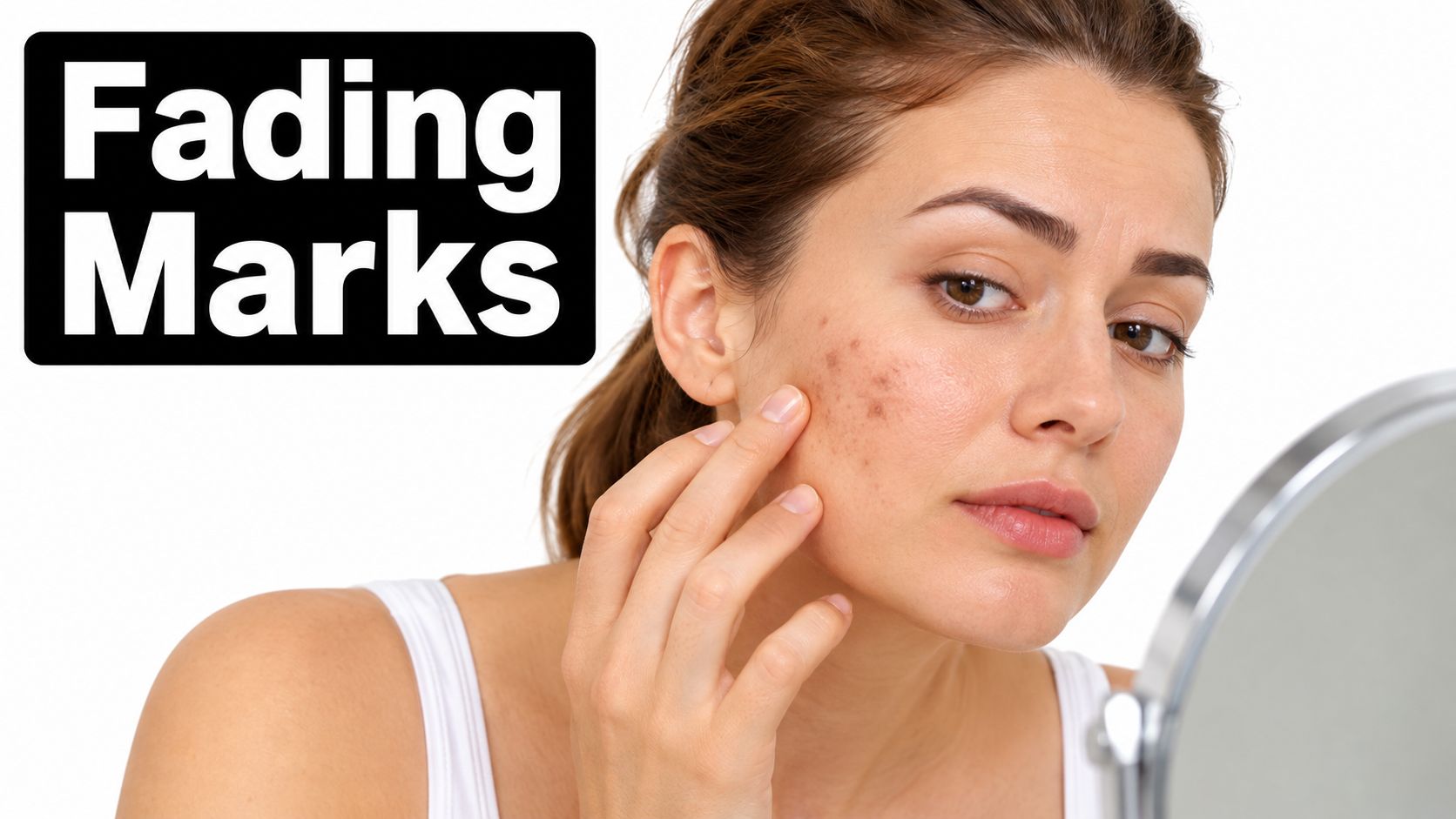
Say a blocked pore develops on your cheek. Sebum, your skin's oil, mixes with cells that haven't shed normally inside the follicle. This buildup, called follicular hyperkeratinization, helps create the blockage.
Within that environment, Cutibacterium, a common skin bacterium, can contribute to an inflammatory response. Inflammation can stimulate melanocytes, the cells that produce melanin, to make extra pigment. Even after the swelling resolves, pigment-containing skin cells remain. The mark you see is that leftover pigment sitting near the surface.
From Pigmented Cells to Surface Shedding
A superficial brown mark behaves like a stain in the upper layers of a wooden floor. Glycolic acid works a little like a fine sander, loosening the stained surface so it sheds gradually rather than lifting the whole stain in one pass. Exfoliation is the goal here, so the sander should stay light: extra rubbing or scrubbing adds irritation without speeding pigment removal.
With consistent use, glycolic acid helps fade the look of post-breakout marks and uneven tone by speeding up surface cell turnover. It loosens the connections between surface cells, which allows pigment-bearing cells to shed more readily and lets fresher, more evenly toned cells take their place.
A dermatology review of glycolic acid peel therapy describes professional concentrations of approximately 20% to 70%, including initial 20% peels for post-breakout pigmentation in patients with Fitzpatrick skin types III–IV. Those results come from clinician-timed, clinician-neutralized treatments. A leave-on pad used at home works through the same shedding mechanism, but the strength, contact time, and supervision behind a peel's outcome do not transfer automatically to a nightly swipe.
Mechanism explains how a treatment could work. Peel studies establish that glycolic acid can help pigmentation. How much a particular pad will fade your mark is a separate question, answered by weeks of consistent use rather than by a clinic's protocol.
The floor analogy also marks the limit of the approach. A superficial sanding cannot reliably reach a stain soaked deep beneath the boards, and pigment deposited in the dermis sits largely beyond the reach of ordinary exfoliating pads. Surface-level discoloration is the realistic target, and gradual, modest fading is the honest expectation for a pad doing that work.
Reading Strength and pH on a Pad Label
Two pads can list the same acid on the front and behave nothing alike on skin. Percentage is the bulb's wattage; pH is the dimmer switch. Glycolic acid's small molecular size lets it penetrate relatively quickly compared with larger alpha-hydroxy acids, and how much of it reaches your skin in active form depends on the whole formulation.
Lower pH generally leaves more acid in its un-ionized, free-acid form, which penetrates more readily. Buffering, pad saturation, exposure time, and application frequency shape irritation too. Concentration, pH, and sun exposure handling are the variables that decide whether a pad is a reasonable home tool.
Glycolic Acid Strength Reference Values
| Glycolic acid figure | What it means | Context |
|---|---|---|
| Up to 10% at pH 3.5 or higher | Considered safe within the stated cosmetic safety conditions, including limiting increased sun sensitivity or requiring sun protection; the pH limit is part of the threshold | Cosmetic Ingredient Review safety parameters |
| 5% to 30% | A reported consumer skincare formulation range, not a universal recommendation for leave-on pads | Review of glycolic acid formulations and clinical use |
| Serial pigment-treatment peels | Clinician-controlled application, timing, and treatment intervals | Clinical protocols, not a home-use schedule |
| Strong professional peels | May require carefully timed neutralization | Not interchangeable with cosmetic pads |
| As low as 4%, after four days | Measurable UV-response changes were reported | Safety guidance linked above |
The consumer range sits inside the safety framework, and the framework wins. A concentration that belongs to clinician-administered peels is a category signal on the label, not an invitation for home experimentation.
Check the Instructions, Not Just the Front Label
Before buying, look for:
- Acid percentage and pH: Ask the manufacturer for the pH if it isn't on the label.
- Rinse or leave-on directions: Don't assume all pads have the same exposure time.
- Recommended frequency: Treat this as a ceiling to assess against tolerance, not a target you must reach.
- Sun-protection directions: These remain important even with a lower-strength formula.
- Other exfoliating ingredients: Count the whole routine, including cleansers and blemish products.
For dark spots, the benchmark is useful turnover with minimal inflammation, not the strongest sensation or the most peeling.
Sun, Irritation and Deeper Skin Safety Rules
The idea that stronger or more frequent exfoliation fades marks faster overlooks a major problem: irritation can create new discoloration. This is especially important in deeper skin tones, where inflammation can leave persistent pigment.
According to an alpha-hydroxy acid safety summary, after four weeks of AHA use, volunteers' sensitivity to UV-related redness increased by 18%, while sensitivity to UV-induced cellular damage doubled on average. Increased sun sensitivity may persist for up to one week after stopping.
Protect Skin Before Chasing Brightness
Use broad-spectrum sunscreen every morning, reapply as directed, and add shade and a hat during extended outdoor exposure. This guide to choosing sunscreen for post-breakout marks can help you find a formula you'll use consistently.
Don't apply pads to picked, broken, sunburned, or actively irritated skin. Skip exfoliation around unusually heavy sun exposure, but don't mistake skipping the night before for an immediate reset of sun sensitivity.
- Persistent burning: Rinse off the product, pause acids, and use a bland moisturizer.
- Blistering, swelling, or spreading redness: Stop treatment and seek medical advice, promptly if symptoms are substantial.
- Peeling beyond light flaking: Pause the pads and simplify your routine until skin feels normal.
- A mark becoming darker: Stop rather than increasing strength, then reassess with a dermatologist.
A product doesn't need to sting to work, and stinging doesn't prove it's working.
If your skin reacts readily to acids, get individualized guidance before starting. Once irritation settles, restarting is a separate decision, not an automatic next step.
How to Use Glycolic Acid Pads Step by Step
Start with an uncomplicated routine so you can tell what your skin tolerates. Introducing several treatments together makes it difficult to identify the cause of a reaction.
The process begins with a small-area tolerance check.
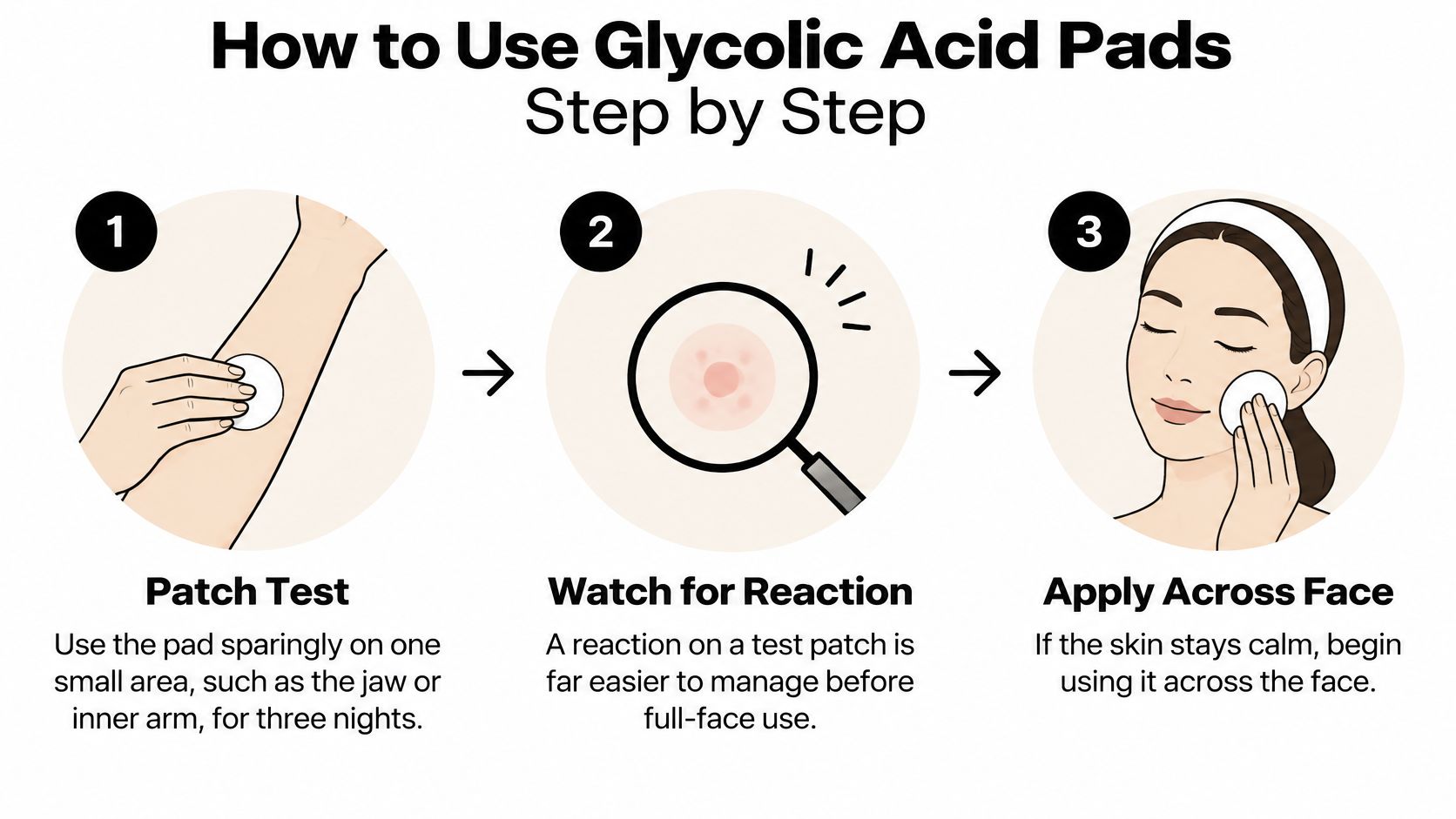
Apply Carefully and Leave Recovery Time
- Patch test before full-face use. Apply sparingly to a small area, such as the jaw, according to the product's testing directions. A skincare patch-testing guide explains the process, although a calm test patch can't rule out later irritation or allergy.
- Cleanse without scrubbing. Remove sunscreen, makeup, and residue with a gentle cleanser, then rinse thoroughly. Neutralyze Face Wash is a salicylic acid and mandelic acid cleanser for breakout-prone routines, but an active-free cleanser is the simpler starting choice when introducing glycolic pads.
- Let your skin dry completely. Applying an acid to damp skin can intensify stinging and make exposure less predictable. Don't rush directly from rinsing to wiping.
- Sweep gently over intact skin. Avoid the eyes, lip edges, picked lesions, and inflamed patches. Repeated passes add friction and product without proving better pigment clearance.
- Follow the rinse instructions precisely. A leave-on pad and a rinse-off peel are different treatments with different contact times. A professional peel sits on skin for minutes before neutralization, while a leave-on pad is formulated to stay on, so directions written for one never transfer to the other. Never improvise home neutralization or extend a timed product's contact period.
- Begin with spaced applications. Leave recovery nights between uses and increase only if your skin remains comfortable and the label permits it. Comfortable early applications mean the current schedule is working, so raise frequency gradually from there rather than jumping to nightly use.
- Separate potentially irritating treatments. Don't add exfoliating scrubs, other acid pads, or retinoids on the same evening while establishing tolerance. If you use a prescription product for breakouts, ask your prescriber how to fit exfoliation around it.
- Finish with a bland moisturizer. Choose an uncomplicated formula rather than another exfoliating step. Wait until the pad has dried or been rinsed as directed.
- Plan for the next morning. Evening application still leaves skin more sun-reactive the following day, so the sunscreen and shade routine from the previous section stays part of every application cycle.
For the salicylic and mandelic alternative, our pads have different directions: patch test sparingly on small areas for the first three days, then start once daily, increasing to two or three times daily only if needed and tolerated. That schedule belongs to that product alone, so it shouldn't be combined with a glycolic pad on the same night.
Brief tingling, mild dryness, or light flaking can occur, but none is required for benefit. Persistent burning, blistering, and spreading redness mean stop rather than push through.
Week-by-Week Timeline for Fading Dark Spots
Skin renews its surface in cycles measured in weeks, so a fading mark follows that clock no matter how faithfully you apply a pad. No cited trial establishes a reliable week-by-week fading schedule for ordinary glycolic acid pads.
Use each stage below as a checkpoint during a cautious home trial.
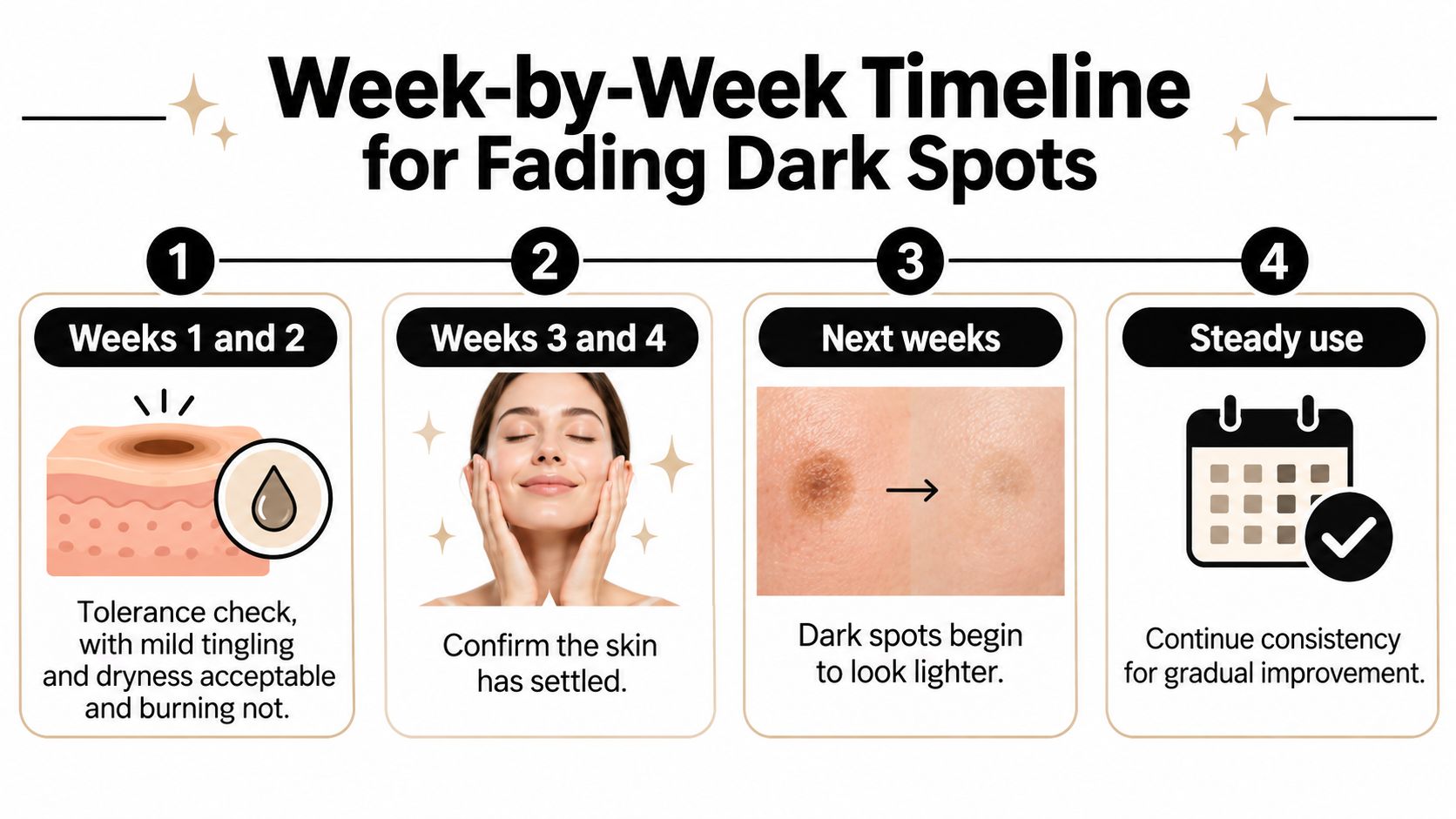
Watch Tolerance Before Looking for Pigment Change
- Early applications: Check whether your skin returns to normal between uses. Burning, soreness, or persistent tightness means the routine needs adjusting.
- Once tolerance is established: Keep the schedule steady rather than adding applications whenever you don't see an immediate difference.
- During continued use: Look for a softer contrast between the mark and surrounding skin. Smoother texture alone doesn't demonstrate pigment clearance.
- At reassessment: If photographs show no meaningful change despite comfortable, consistent use and sun protection, discuss other options rather than escalating indefinitely.
A dermatology review of clinical pigment-treatment evidence describes 20% to 50% glycolic peels every two to four weeks that significantly lightened PIH; in an Indian trial covered by that review, more than half of participants achieved at least 50% pigment clearance after 12 weeks when peels were combined with topical therapy.
The detail worth borrowing from that research is the shape of the work: pigment treatment depends on repeated exposures over months. Sun is the variable that can undo gains between applications, because the alpha hydroxy acid in a glycolic pad may increase sun sensitivity, and unprotected exposure can darken a mark faster than surface turnover lifts it. Consistent sunscreen use is what lets the slow work accumulate.
Treat the three-month review as a decision point. If the marks are visibly softer, continue the same routine. If nothing has shifted, that is the moment to ask about clinic peels or other options.
Take photographs under the same lighting, at the same distance, without filters. Compare them periodically rather than checking the mirror after every application. Expect a leave-on pad to produce a smaller, slower change than in-clinic peels, and plan for some marks not to respond at all.
Choose Between Glycolic and Salicylic Mandelic Pads
Two acid families solve two different problems here. Glycolic acid is a water-soluble AHA that speeds up surface cell turnover, which is how it fades the look of post-breakout marks with consistent use. Salicylic acid is oil-soluble and works inside the pore, while mandelic acid's larger molecule exfoliates the surface more gently. The deciding question is whether you're working on leftover discoloration, frequent breakouts, or rough texture and pores.
A clinical comparison involving 44 patients tested 35% glycolic acid against 20% salicylic acid plus 10% mandelic acid, delivered every two weeks for six sessions; the combination improved most active breakouts and post-breakout hyperpigmentation more, with fewer side effects.
Glycolic Peel Against Salicylic and Mandelic Peel in Clinical Studies
| Feature | Glycolic acid peel (35%) | Salicylic and mandelic peel (20% + 10%) |
|---|---|---|
| Study group | Part of the 44-patient comparison described above | Same study design and treatment schedule |
| Breakout-score reduction at week 12 | 70.55% | 74.14% |
| Post-breakout hyperpigmentation | Improved in the comparison | Greater improvement in the comparison |
| Side effects | More than with the combination | Fewer than with glycolic acid |
The breakout-score percentages come from a separate 12-week study of 45 patients with mild-to-moderate breakouts, which recorded 70.55% reduction with the glycolic peel against 74.14% with the salicylic-mandelic peel, plus better inflammatory-lesion responses to the combination.
Both trials measured clinician-administered peels on fixed schedules. They support the ingredient rationale for pairing a pore-soluble acid with a surface acid; they set no equivalent clearance rate or deadline for a leave-on pad.
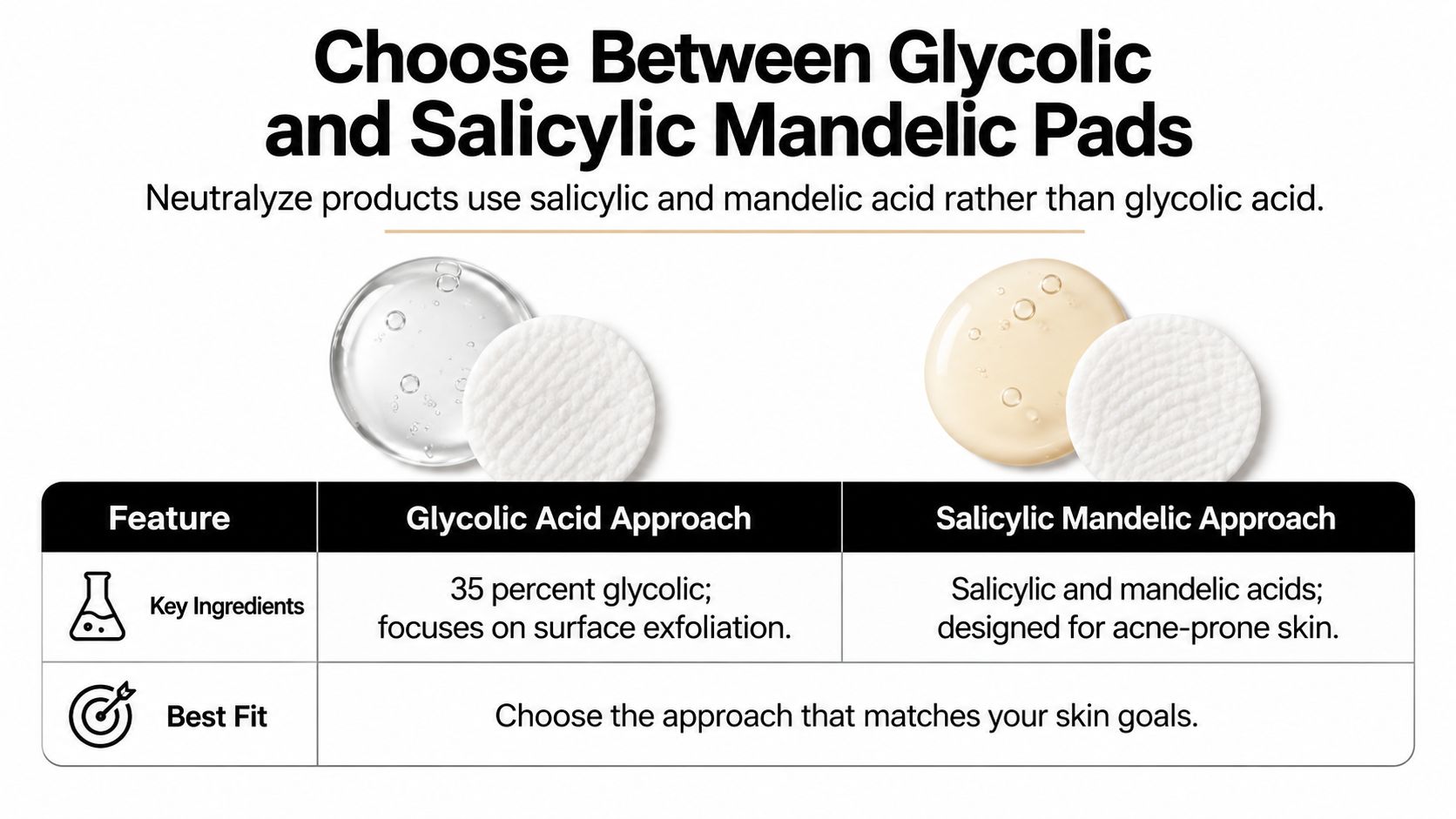
Match the Acid Approach to the Problem
Salicylic acid is oil-soluble, making it useful for exfoliation within oily pores. In the DuoClear formulation behind Neutralyze's exfoliating products, it works inside the pore while the larger mandelic acid molecule gently exfoliates the surface. That pairing addresses congestion and surface texture rather than treating all discoloration as an isolated pigment problem.
Neutralyze also makes a glycolic option. Resurfacing Pads use GlycoForte, a 20% glycolic acid kept in its free-acid form with hyaluronic acid to hydrate as it works, plus sodium hyaluronate and sodium polyaspartate to help keep skin hydrated during the exfoliation step. They're matched to rough texture, pores and fine lines rather than breakouts, and they aren't recommended for very sensitive skin or for anyone sensitive to glycolic acid. Used at night on clean, dry skin and left on without rinsing, they shouldn't share an evening with the Exfoliating Pads.
For a closer ingredient comparison, see mandelic acid versus glycolic acid. Larger molecules can support a gentler approach, but no acid combination is irritation-proof.
Your next step should reflect your main concern:
- Marks without ongoing breakouts: A cautiously introduced glycolic pad may be reasonable for superficial brown discoloration if your skin tolerates it.
- Marks alongside recurring breakouts: Choose an approach that also keeps pores clear, not just one that fades yesterday's marks; Neutralyze Renewal Complex is a clinically formulated moisturizer with salicylic acid and mandelic acid for breakout-prone skin.
- Rough texture, visible pores or fine lines: A glycolic resurfacing pad fits that job better than a blemish pad does.
- Melasma, uncertain sun spots, or persistent marks: Get a dermatologist's assessment rather than cycling through stronger exfoliants.
Painful nodules, continuing scars, or persistent, widespread breakouts deserve clinician-guided care, even when you prefer a non-prescription routine. If at-home products and prescriptions have already fallen short, a professional evaluation narrows the options faster than adding another acid to the rotation.
Neutralyze offers a clinically formulated salicylic acid and mandelic acid system to cleanse, rejuvenate, and hydrate breakout-prone skin, including Renewal Complex for the moisturizing step. If ongoing breakouts are creating new marks while you're trying to fade old ones, visit Neutralyze to explore a routine for breakout-prone skin without mistaking at-home exfoliation for a professional peel.