

Glycolic Acid and Hyaluronic Acid Together: Layering Guide
Yes, you can use glycolic acid and hyaluronic acid together because they do different jobs. Apply glycolic acid first on dry skin, then follow with hyaluronic acid.
If the hydrating serum makes your face feel comfortable, does that mean your exfoliating acid can't irritate it? That's the gap in much of the advice about this pairing. Comfort and acid tolerance aren't the same thing, and adding hydration doesn't give you permission to use a stronger exfoliant.
For breakout-prone skin, the useful question isn't whether these ingredients mix. It's whether the exfoliating step fits the rest of your routine, especially if you've already tried several at-home products or prescription treatments.
Can You Use Glycolic and Hyaluronic Acid Together
Quick Answer
Yes, glycolic acid and hyaluronic acid can be used together because exfoliation and hydration serve different purposes. Glycolic acid loosens dead surface cells, while hyaluronic acid helps retain water. Apply the exfoliant to dry skin before your hydrating step. The important limitation is that a hydrating serum cannot neutralize an overly strong acid or protect you from using exfoliants too frequently.
If you want an acid-based approach without glycolic acid, Neutralyze Renewal Complex is a clinically formulated moisturizer built around salicylic acid and mandelic acid. It's an active moisturizer, not a bland hydrating layer to add indiscriminately over another exfoliant.
Different Jobs Despite the Shared Name
The word acid causes understandable confusion. Glycolic acid is a small alpha-hydroxy acid, or AHA, that helps loosen the connections between dead surface cells so they shed more evenly. Its exfoliating action can improve roughness, but excessive exposure can leave skin uncomfortable.
Hyaluronic acid is a humectant and film-forming polymer. Its main skincare role is holding water and supporting surface hydration, not removing dead cells. You aren't combining two interchangeable exfoliants.
The human-skin penetration study indexed by PubMed found that 4% glycolic acid penetrated the stratum corneum more at pH 2.0 than at pH 3.8, illustrating why the acid's formulation matters. Hyaluronic acid doesn't remove that concentration- and pH-dependent behavior.
Compatibility Isn't Irritation Protection
A hydrating product may reduce the dry, tight feeling that accompanies exfoliation. It doesn't switch off the exfoliant, correct an unsuitable pH, or erase the effects of repeated applications.
Practical rule: Choose your glycolic acid as though your hyaluronic acid serum offers no protection against overuse.
For example, if you're comfortable with occasional glycolic acid, adding a hydrating serum doesn't automatically justify nightly application. Keep the exfoliating schedule stable and judge tolerance by how your skin behaves between applications, not just how it feels immediately after moisturizer.
The pair is compatible because the ingredients have different roles. You control the risk through acid strength, pH, contact time, and frequency.
How to Layer Glycolic and Hyaluronic Acid Step by Step
Use a simple evening routine when you're introducing the pairing. A plain cleanser, your chosen glycolic product, a hydrating step, and a bland moisturizer are easier to assess than a shelf of overlapping treatments.
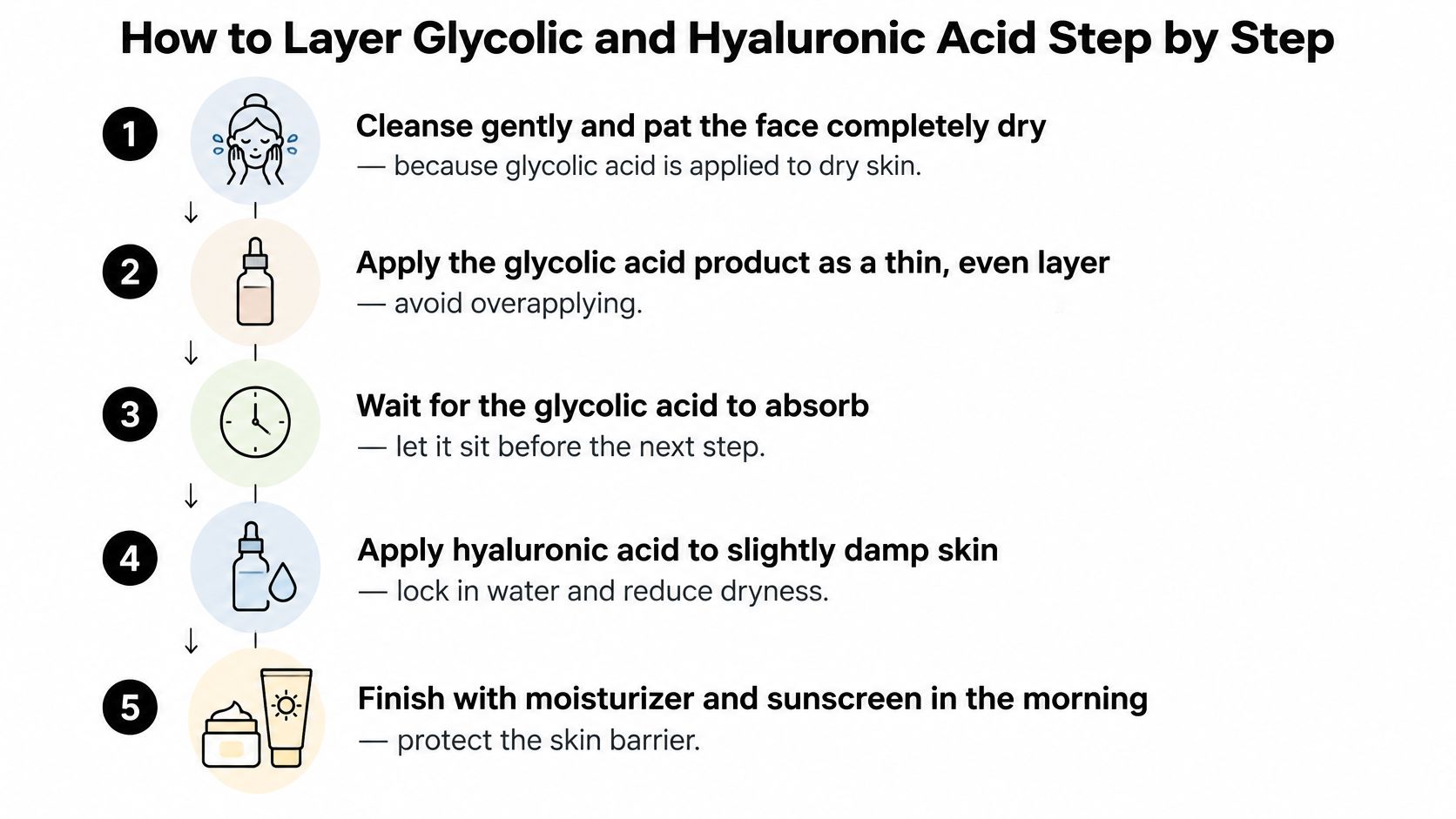
The sequence below separates exfoliation from hydration.
Follow the Product's Format
- Cleanse gently and pat your face completely dry. Choose a cleanser without an exfoliating active for this routine. Don't scrub away flakes or apply glycolic acid while your face is still wet.
- Apply a thin, even layer of glycolic acid. Use the amount intended for the product rather than repeatedly passing over areas that feel rough. Start with infrequent evening applications instead of assuming daily use is the goal.
- Respect the contact instructions before adding anything else. A rinse-off peel must be removed as directed; a leave-on product should be allowed to settle before the next step. Don't add another exfoliating toner, acid pad, or scrub.
- Follow with hyaluronic acid on slightly damp skin. For a leave-on glycolic product, let it settle first, then lightly dampen the skin if needed without rubbing or rewetting it heavily. Alternatively, use a hydrating moisturizer containing hyaluronic acid rather than introducing another serum.
- Finish with a non-comedogenic moisturizer if your skin feels tight. Choose a bland formula without additional exfoliating actives. Humectants help manage water, while a complete moisturizer also supplies ingredients that soften skin and limit moisture loss.
- Apply broad-spectrum sunscreen the next morning. Evening application doesn't eliminate the need for daytime protection. Keep sunscreen in the routine even when you skip glycolic acid.
- Increase frequency only when the current schedule stays comfortable. Change frequency or strength, not both at once. If sensitivity builds between applications, keep more recovery nights rather than pushing ahead.
A review of glycolic acid and skin remodeling highlights why exposure matters: leave-on and rinse-off products don't deliver equivalent absorbable doses. That's why you shouldn't borrow the timing or application method from a different product.
Keep Hydration Simple
Texture still matters when you choose your hydrating products. A lightweight serum normally goes before a richer cream; this guide to whether serum or moisturizer goes first explains that distinction.
The common slip isn't applying hyaluronic acid after glycolic acid. It's adding an exfoliating cleanser, another acid toner, and a blemish pad because each product seems useful on its own.
A settled routine should feel uneventful: comfortable skin between applications, no persistent burning, and no need to keep adding products to soothe the last one.
Use an initial trial period to assess tolerability, not to demand visibly clear skin. Gradual smoothing is useful; increasing sensitivity isn't evidence that you need to exfoliate harder.
Irritation Signals and How to Respond
Hyaluronic acid doesn't cancel glycolic acid's effects or make this pairing irritation-proof. A humectant can relieve tightness, but hydration alone doesn't rebuild an over-exfoliated barrier. When symptoms suggest excess acid exposure, adjust the exfoliant rather than applying more serum.
The following signs are practical clues, not a diagnosis. Pay attention to whether discomfort fades promptly, continues after the routine, or returns when you apply ordinary moisturizer.
Irritation Signals, Likely Meaning and Response
| Symptom | Likely meaning | What to do |
|---|---|---|
| Mild tightness or dryness after application | Insufficient moisture support or a slightly stressed barrier | Keep the current frequency only if symptoms remain mild and resolve; add a bland moisturizer and apply hyaluronic acid to damp skin |
| Brief tingling that fades within minutes | A transient sensation that can occur with acid application, not proof of effectiveness | Don't increase frequency; monitor closely and stop if tingling becomes stronger or lasts longer |
| Persistent burning or stinging | Possible over-exfoliation from strength, pH, or frequency | Stop glycolic acid and let the skin settle before considering a lower-frequency restart |
| Redness, swelling, or peeling beyond light flaking | Irritation beyond tolerance or another adverse reaction | Stop the acid and seek professional advice |
| Flaking with new breakouts | It's unclear whether it's irritation or worsening breakouts | Reduce frequency and check with a clinician rather than assuming the product is working |
Tingling isn't a performance test. A product can work without stinging, and continuing through worsening discomfort can make it harder to use the treatments you need.
Why Breakout Routines Need Extra Scrutiny
Readers with breakout-prone skin often already use exfoliating ingredients without counting them as exfoliants. A salicylic acid cleanser, a blemish wipe, and an exfoliating moisturizer may all contribute to the same overall exposure.
The clinical skin-care recommendations published in a leading dermatology journal emphasize supportive emollients containing humectants and lipids alongside active ingredients. That's a more complete approach than treating a hyaluronic acid serum as a substitute for moisturizer.
If a familiar cream suddenly stings, or washing feels uncomfortable, don't put glycolic acid on freshly irritated skin. Simplify to gentle cleansing, moisturizer, and sun protection while you assess what triggered the reaction. This guide to caring for a damaged skin barrier provides additional context for simplifying your routine.
Don't label every crop of new spots a purge. Breakouts accompanied by burning, worsening redness, and widespread flaking deserve reassessment, not automatic persistence.
Reduce exposure first when mild dryness starts to build. Pause the acid if the reaction persists, and seek professional advice if it worsens. Marked swelling, blistering, or significant pain warrants prompt medical assessment rather than another home skincare adjustment.
How Concentration and pH Change the Risk
An 8% glycolic acid formula can provide about 4% free acid at pH 3.8, compared with approximately 1.4% at pH 4.5, according to the formulation review in Cosmetics. The label percentage is identical, but the amount available in free-acid form isn't.
Free acid means the unneutralized form of glycolic acid. Lower pH leaves more in this form, helping explain why two bottles with the same front-label concentration can feel substantially different.
Glycolic Acid Strength, pH and Free Acid
The comparison below uses the ranges and free-acid estimates from that formulation review.
| Product type | Glycolic acid strength | pH | Free acid available |
|---|---|---|---|
| 8% formula at pH 3.8 | 8% | 3.8 | About 4% free acid |
| 8% formula at pH 4.5 | 8% | 4.5 | About 1.4% free acid |
| Typical daily-use product | 5–15% | 3.5–4.5 | About 50% of the acid is free at pH 3.8 and about 18% at pH 4.5 |
| Professional peel | 20–70% | 1.0–2.5 | Most of the acid is unneutralized |
These categories aren't a shopping ladder. A professional peel is not just a faster version of a daily-use serum, and adding hyaluronic acid doesn't make the two formats interchangeable.
A review of glycolic acid peels explains that low-pH, high-concentration preparations can increase irritation and temporary transepidermal water loss, meaning water escaping through the skin. It supports starting with lower concentrations and increasing strength gradually within an appropriate treatment setting.
What pH Means for Breakout Claims
Laboratory antimicrobial findings also depend on acidity. In a Scientific Reports study, glycolic acid fully inhibited a common skin bacterium at 0.1% at pH 3.0, 0.2% at pH 3.5, and 0.4% at pH 4.0 under the tested laboratory conditions.
That doesn't establish that every glycolic acid product will change your breakouts. A laboratory exposure doesn't tell you whether a finished skincare product reaches the follicle, remains there long enough, or is tolerable on your skin.
Choose exposure, not intensity: Favor the lowest strength that meets your goal, check pH when the manufacturer lists it, and never turn a professional-strength peel into a daily routine.
If pH isn't disclosed, don't try to compensate by buying a higher percentage. Choose a clearly described home-use product and evaluate its complete directions, format, and compatibility with your existing treatments.
Why the Two Acids Work Better as a Pair
Pores can clog when dead cells accumulate and mix with sebum, the skin's oil. Abnormal retention of cells within the follicle is called follicular hyperkeratinization. The resulting blockage forms part of the environment in which bacterial activity and inflammation contribute to breakouts.
Pairing an exfoliating product with a hydrating product addresses different needs, rather than doubling the same action. The bottles may look similar, but their jobs aren't.
Exfoliation and Water Retention
Glycolic acid encourages more even shedding at the surface. Hyaluronic acid supports water retention. Think of glycolic acid as clearing a path and hyaluronic acid as helping keep the ground supple, but not as a shield against clearing too aggressively.
That analogy has limits. Surface exfoliation doesn't guarantee that every blocked follicle will clear, and hydration doesn't directly treat the full combination of follicular blockage, microbial activity, and inflammation.
For a plain-language explanation of the hydrating ingredient itself, Healtsy's guide to hyaluronic acid offers useful context. Keep the distinction between improving how skin feels and calming active breakouts firmly in mind.
What the Human-Skin Evidence Establishes
In a human-skin study on sun-damaged forearms, 20% glycolic acid lotion applied twice daily for 3 months, compared with a vehicle-treated area, increased epidermal thickness, epidermal and dermal hyaluronic-acid levels, and collagen-gene expression.
The finding suggests that glycolic acid can influence skin remodeling and the skin's own hyaluronic-acid content, not merely remove surface cells. The authors also explain why relatively small changes in cutaneous hyaluronic acid may meaningfully affect hydration, texture, appearance, and function.
The accompanying video offers another format for exploring the ingredient pairing.
Those were research conditions, not a home-use prescription. The participants' sun-damaged forearm skin also isn't interchangeable with an irritated, breakout-prone face. The study didn't establish that every topical glycolic-and-hyaluronic combination outperforms glycolic acid alone.
Keep treatment goals separate, too. Improving the appearance of a flat post-breakout mark through surface turnover is different from controlling new inflamed blemishes. Better hydration and smoother texture can be worthwhile without proving that the underlying breakouts are adequately managed.
Choose a Format and Decide If the Pairing Fits
Be cautious if you have very sensitive skin, known glycolic acid sensitivity, a damaged barrier, or several exfoliating products already in use. If your skin is freshly irritated, this isn't the moment to test a new acid. If you're using a prescription product for breakouts, ask your dermatologist before changing the exfoliating part of your routine.
Daily broad-spectrum sunscreen belongs in the plan. If you can't maintain sun protection or your skin already feels uncomfortable with basic cleansing, concentrate on those basics before adding resurfacing.
Separate Products or a Combined Formula
Separate products give you more control. You can skip glycolic acid while keeping your hydrating step, choose a different exfoliant strength, or discover that your moisturizer already supplies enough hydration without another serum.
A combined formula reduces the number of steps, which can make consistent use easier. Its limitation is fixed exposure: using less product reduces both ingredients, and using it more frequently increases exposure to the exfoliant as well as the humectant.
Product formats for getting the pairing
| Format | What it adds | Layering effect | Best for |
|---|---|---|---|
| Separate glycolic acid and hyaluronic acid products | Control over the exfoliant's strength, frequency, and each step | Easy to start slowly and stop one product | Readers who want to test and adjust |
| Combined glycolic and hyaluronic formula | One step with fewer products | Strength is fixed; one ingredient can't be reduced alone | Readers whose skin already tolerates the strength |
| Salicylic and mandelic acid exfoliating pads | Leave-on exfoliation without glycolic acid | Don't add glycolic acid in the same session | Readers seeking a breakout-focused alternative to glycolic acid |
A pad is an application format, not a guarantee of gentleness. Repeated passes, firm rubbing, and treating already irritated areas can increase discomfort even when the ingredient list seems suitable. For a closer look at this format, consult the guide to using glycolic acid pads.
Match the Choice to Your Actual Skin Goal
If you mainly want hydration and less roughness, a straightforward hydrating moisturizer may do more for your routine than adding another active. If blackheads and whiteheads are your concern, consider whether your existing routine already addresses clogged pores before introducing glycolic acid.
Salicylic acid is oil-soluble and works within pores, while mandelic acid provides surface exfoliation. That gives a breakout-focused BHA-and-AHA approach a different emphasis from a glycolic-and-hyaluronic pairing. Neither approach should be judged solely by whether skin feels smoother immediately afterward.
For frequent, widespread breakouts, particularly painful deep lesions or breakouts that leave scars, product layering isn't a substitute for medical care. After unsuccessful at-home or prescription attempts, a clinician can help reassess the treatment plan rather than adding another exfoliant.
Make a Controlled Decision
Before introducing the pairing, check these practical conditions:
- Your baseline is comfortable. Your current routine doesn't cause ongoing stinging, tenderness, or visible irritation.
- You can keep the trial consistent. Choose a modest application schedule and leave the rest of the routine unchanged while you assess tolerance.
- Your expectations match the ingredients. You're seeking exfoliation and hydration, not assuming that a hydrating serum will prevent irritation or replace the rest of your routine.
For your initial trial, record application nights and any next-day tightness, burning, or flaking. Don't add a second new active while you're still deciding whether the first agrees with your skin. A routine you can tolerate consistently is more useful than an aggressive one you repeatedly have to stop.
Neutralyze offers clinically formulated care built around salicylic acid and mandelic acid, including Neutralyze Exfoliating Pads for an exfoliating option without glycolic acid. Visit Neutralyze to explore that approach, and choose one exfoliating strategy rather than stacking it over glycolic acid.