

Back Acne Hyperpigmentation: How to Fade Dark Marks
In a 2025 study of 417 acne patients, 36.2% had both acne scarring and hyperpigmentation. That combination explains why treating every lingering back mark as the same problem can lead to disappointing results. Dark color and altered skin texture can coexist, but they need different treatment decisions.
Back acne hyperpigmentation is best approached as a body-specific problem, not facial dark spots in a harder-to-reach location. Your plan needs to account for new breakouts, clothing friction, sweaty equipment, uneven product application, and sun exposure on uncovered shoulders.
Treatment Options and Realistic Results for Back Marks
Back marks lighten gradually; a realistic target is less visible discoloration alongside fewer new marks. The treatment-response evidence points the same way.
A systematic review of 41 studies involving 877 patients with post-inflammatory hyperpigmentation, mostly associated with acne, reported the outcomes below. Most studies evaluated facial PIH, using different treatment protocols and outcome measures, so read these as response patterns rather than back-specific success rates or a head-to-head ranking.
Response to treatment for post-inflammatory hyperpigmentation
| Option | Complete Response | Main Risk | Where It Fits |
|---|---|---|---|
| Topical therapies | 5.4% (20 of 369) | Poor or no response in 22.2% of patients | First line at home, judged over months |
| Laser or energy devices | 18.1% (56 of 309) | Worsened PIH in 2.6% (8 of 309) | Specialist assessment, especially in darker skin |
| Combination therapies | 2.4% (4 of 166) | Irritation from overlapping treatments | Specialist guidance before use |
| Chemical peels | Complete-response figure not specified; poor or no response in 66.7% (10 of 15) | Irritant dermatitis and secondary PIH | Conservative protocol only, never on irritated trunk skin |
For an evidence-informed topical starting point, Neutralyze's clinically formulated system pairs salicylic acid with mandelic acid. Neutralyze Exfoliating Pads are dual-textured leave-on pads made for acne-prone skin on the face, back and body, Neutralyze Face Wash 2.0 is the cleansing first step built on the same DuoClear pairing (2% salicylic acid + 1% mandelic acid), and Neutralyze Renewal Complex is an oil-free acne moisturizer with a time-released version of that system. The two acids divide the work: oil-soluble salicylic acid acts inside the pore while mandelic acid smooths the surface. The review did not test this system on back marks.
What the Comparison Actually Means
Topicals are a practical home-care starting point because you can adjust application and monitor tolerance. On the back, application method matters: cleanse, let skin dry, then swipe a pad over the area and leave it on. Uneven coverage is a real variable there, since self-application rarely reaches every mark with the same pressure. Alpha hydroxy acid pads also increase sun sensitivity, so sunscreen, protective clothing and limited exposure apply during use and for a week afterwards. Judge results over months rather than expecting a leave-on acid to erase established pigment quickly.
Laser and energy devices produced more complete responses in the reviewed patients, which does not establish them as universally better. Patient selection, device settings, skin tone and the recorded cases of worsened pigment make specialist assessment the deciding factor.
Combination treatments should not read as permission to layer more products. The low complete-response figure does not prove combinations are inferior either, because the studies were not equivalent comparisons. The same restraint applies at home: Neutralyze should not be used at the same time of day as benzoyl peroxide, retinol or prescription tretinoin without consulting a dermatologist first.
Peels require particular restraint on a back with picked, inflamed, or broken lesions. Excessive depth and overlapping applications can create the inflammation you're trying to avoid.
If you're considering a procedure, you can compare professional options for acne marks through Mesoderm RX as preparation for discussing suitability with a dermatologist.
Practical rule: Start with tolerable topical care when appropriate. Poor response calls for assessment, not automatically stronger acids.
Why Back Marks Form and Why They Linger
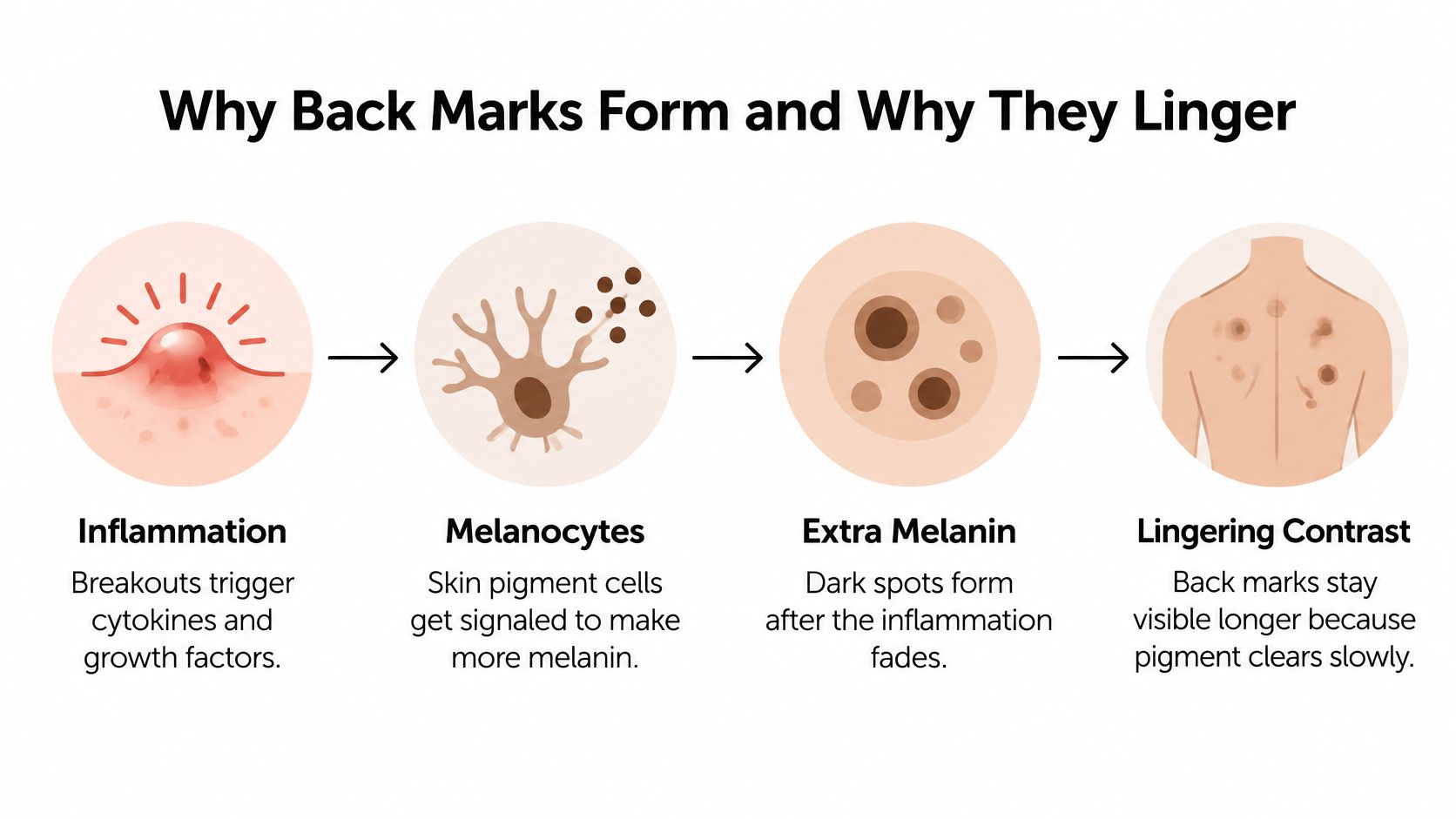
A pimple can flatten before its pigment disappears. Post-inflammatory hyperpigmentation, or PIH, describes increased pigmentation left after inflammation or injury, rather than material sitting on the skin that you can wash away.
The cellular sequence matters. A review of acne-related pigmentation mechanisms describes inflammatory cytokines released by keratinocytes, the main epidermal cells, and growth factors from dermal fibroblasts signaling melanocytes to produce more melanin. That pigment passes to nearby keratinocytes, leaving visible discoloration after the obvious bump has settled.
The process can be understood as a chain from inflammation to lingering color.
Why the Back Needs Its Own Strategy
Truncal skin presents both biological and practical obstacles. A review of truncal acne describes deeper inflammation, thicker skin, and larger affected areas as reasons pigmentation can be frequent and persistent; it also summarizes a 2025 study of 545 acne patients in which upper-back involvement, combined upper-and-lower-back involvement, and shoulders were the most common truncal locations, with PIH, papules, and pustules predominating.
Acne itself involves sebum, follicular hyperkeratinization, meaning excess cell buildup within follicles, microbial changes involving Cutibacterium acnes, and inflammation. Trying to remove every trace of oil doesn't address all those processes, and repeatedly stripping the skin can make treatment harder to tolerate.
Body-specific exposures add another layer. Work examining truncal acne pigmentation supports considering the cycle of inflammation and the practical conditions surrounding body treatment:
- Backpack straps and sports gear: Repeated rubbing can affect the same acne-prone areas.
- Tight, damp clothing: Prolonged sweat exposure and friction deserve attention alongside skincare.
- Uncovered shoulders: Intermittent outdoor exposure can increase the contrast of existing marks.
- Limited reach: Missed areas and uneven application can undermine an otherwise manageable routine.
The important conclusion is that persistent marks don't necessarily mean your brightening product is too weak. You may still be creating new inflammation faster than older pigment fades. Controlling new lesions is foundational, and dark marks aren't evidence of dirt or poor hygiene.
Telling Dark Marks, Redness and Scars Apart
Persistent discoloration is often called scarring, but color change isn't the same as a structural scar. Before choosing treatment, check whether the skin is flat, indented, or raised.
A review of acne-related marks and scarring distinguishes pigment changes from textural scars and explains why the distinction matters, especially in darker skin. Flat brown or gray discoloration suggests PIH; pink-purple discoloration may represent post-inflammatory erythema; a depression or raised tissue suggests scarring.
Reading back marks by appearance
| Appearance | Most Likely Cause | Typical Course | Next Step |
|---|---|---|---|
| Flat brown or gray patch | Post-inflammatory hyperpigmentation | Gradual fading over months once new lesions stop | Continue a tolerable routine and track photos |
| Flat pink or purple mark | Post-inflammatory erythema | Often fades as inflammation settles | Check for ongoing irritation from friction or products |
| Indented or raised texture | Acne scarring | Usually doesn't resolve on its own | See a dermatologist |
| Dark mark that keeps returning | Ongoing breakouts or picking | Repeated inflammation can renew discoloration | Control new lesions before judging the old mark |
Read Color and Texture Separately
Say a healed spot on your shoulder looks brown but feels level with the surrounding skin. That appearance is more consistent with pigment than with an indented scar, although a photograph alone can't establish a diagnosis.
A pink-purple patch deserves a different conversation. Don't assume it needs stronger exfoliation because it's still visible; ongoing irritation may be contributing to its appearance. If redness is your main concern, Ideal Face & Body's guide can help you compare treatments for acne redness before discussing options with a clinician.
A raised, firm area or a visible hollow is different again. Fading surrounding color won't necessarily change the underlying contour, so pigment improvement shouldn't be mistaken for scar remodeling.
Make the Back Easier to Inspect
Use a mirror setup or ask a trusted person to help photograph areas you can't see. Keep lighting, camera distance, and body position consistent, and avoid comparing a shadowy bathroom image with a brightly lit outdoor photograph.
Don't squeeze a lesion to determine whether it's still active. Instead, record whether you're seeing a new bump, tenderness, a flat patch, or a persistent texture change.
A mark can contain both discoloration and a scar. Treating the color alone doesn't address every part of what you're seeing.
If a spot repeatedly becomes inflamed, the priority is ongoing acne control. If the surface remains indented or raised, arrange a dermatologist's assessment rather than treating it as a stubborn dark spot.
Daily Routine to Fade Marks Without Irritating Skin
A useful routine must be repeatable across a broad, difficult-to-reach area. It should also let you identify the cause of a reaction instead of leaving you guessing which of several new products irritated your skin.
The American Academy of Dermatology's acne guidance explains that picking, popping, and squeezing can prolong clearing and increase the risk of dark marks and scarring. Gentle application and reduced mechanical irritation are therefore part of treatment, not merely comfort measures.
Build Around Consistency
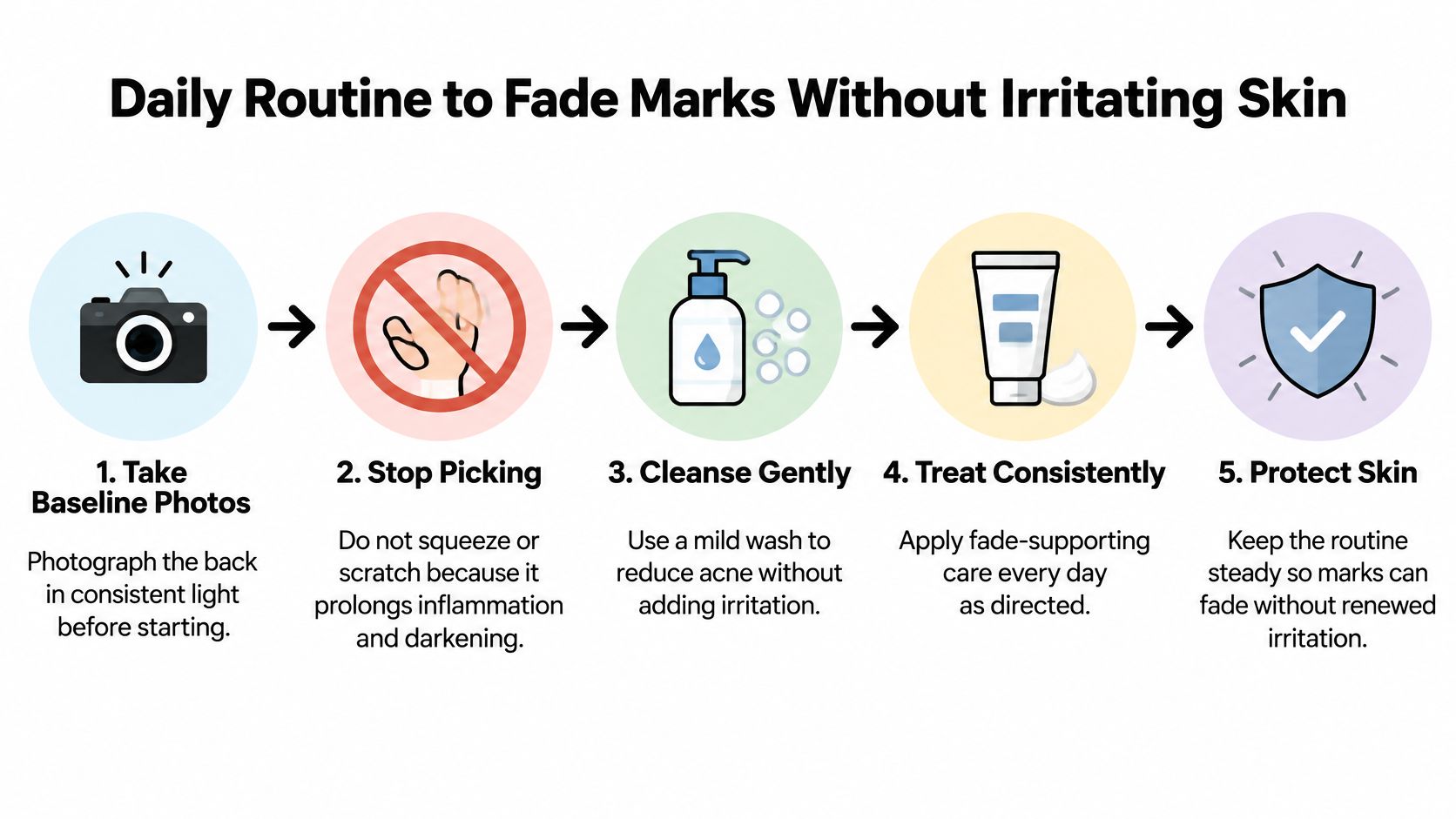
- Establish your starting point. Take baseline photographs before changing your routine, using even lighting and the same camera position you'll use later. Record where new bumps are appearing so you can distinguish fewer breakouts from lighter old marks.
- Stop picking and squeezing. Keep extraction tools and abrasive back brushes out of the routine. If you tend to scratch while changing clothes or checking a spot, use the photograph rather than repeated touching to monitor it.
- Reduce friction after exercise. Change out of tight, sweaty shirts, shower after heavy sweating, and clean backpack straps and sports equipment. Check whether a seam, strap, or protective pad repeatedly crosses the area where fresh lesions appear.
- Cleanse without scrubbing. Massage the cleanser gently over affected skin, rinse thoroughly, and pat dry rather than rubbing with a towel. Our cleansing step uses 2% salicylic acid and 1% mandelic acid, with salicylic acid working inside pores to help clear oil and debris.
- Introduce leave-on exfoliation gradually. Apply a thin layer over the acne-prone zone rather than repeatedly concentrating product on the darkest patches. Begin with fewer applications and increase only if you aren't developing burning, persistent redness, or scaling; for ingredient context, our guide to salicylic acid for back acne explains its pore-focused role.
- Support moisture and comfort. Finish with a moisturizer that your skin tolerates, rather than trying to maintain a dry, tight feeling. Our renew step is an acne moisturizer containing salicylic and mandelic acid, so count it as an active treatment when assessing your total exfoliating exposure.
- Change one active product at a time. Establish tolerance before adding another acid-containing step, even when products belong to the same system. Neutralyze shouldn't be used at the same time of day as benzoyl peroxide, retinol, or prescription tretinoin; consult a dermatologist first.
The visual reminder below summarizes the habits that make a routine easier to sustain.
Solve the Reach Problem Gently
If you can't reach the middle of your back, ask for help applying treatment or use a clean, smooth lotion applicator. Don't compensate with forceful stretching, rough brushes, or repeated scrubbing over the areas you can reach.
Judge the routine over weeks rather than days. A particularly counterproductive mistake is adding more acids because active acne remains visible, especially when the skin is already irritated; persistent inflammatory lesions may need a different treatment plan, not more exfoliation.
Sun Protection That Keeps Marks From Darkening
A beach day can expose shoulders and the upper back that are usually covered. If you protect your face but leave those areas unprotected, your body-care routine isn't addressing the exposure your back receives.
Make coverage practical before you go outdoors.
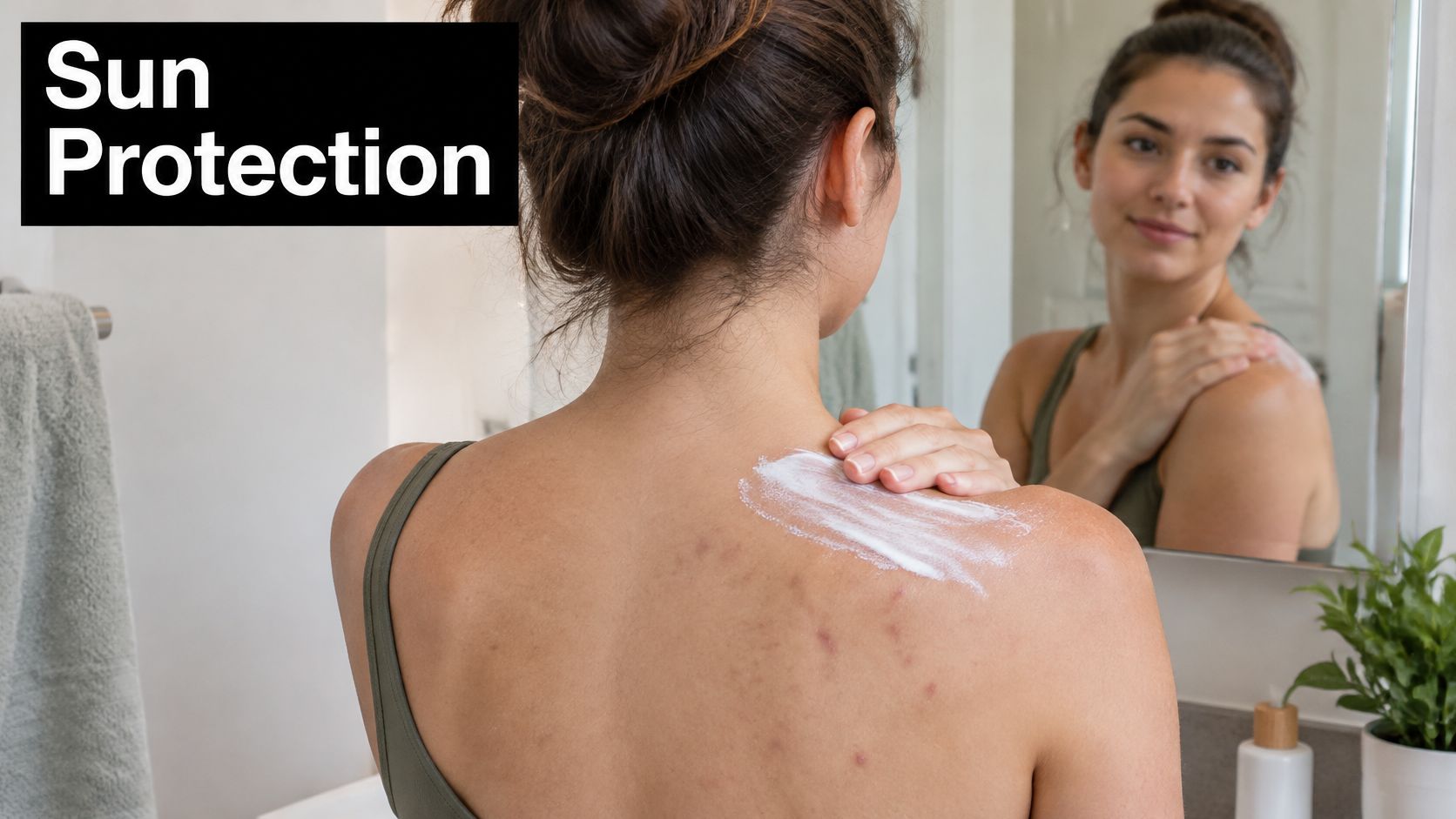
The American Academy of Dermatology's acne-treatment guidance recommends broad-spectrum, water-resistant sunscreen with SPF 30 or higher, reapplied every two hours and after swimming or sweating. For medium-to-dark skin tones, it also recommends tinted sunscreen containing iron oxide, which helps protect against visible light that can contribute to dark spots.
Protect the Skin That's Actually Exposed
- Uncovered shoulders and upper back: Apply sunscreen before outdoor activity, including areas around straps and necklines.
- Broad areas of the back: Use comfortable sun-protective clothing rather than relying on an uneven application you can't easily inspect.
- Swimming and outdoor training: Plan reapplication around water and sweat, not just the time you leave home.
- Hard-to-reach areas: Ask someone to help spread sunscreen evenly, and use shade to reduce exposure.
Loose coverage can also be more comfortable than fabric that rubs repeatedly against inflamed spots. Choose clothing you can realistically wear for the activity rather than planning protection around an outfit you'll remove immediately.
This video provides an additional visual resource for your skincare planning.
Compare photographs taken under consistent conditions, not skin immediately after a sunny outing with skin photographed indoors. Marks that no longer appear darker after outdoor periods are encouraging, but appearance alone can't confirm adequate protection.
Photoprotection supports fading; it doesn't replace acne treatment. Even well-protected skin can develop new marks if new inflammatory lesions keep appearing.
Purge Versus New Breakouts and Layering Basics
A flare after starting an exfoliating pad has three plausible explanations: clogged pores surfacing faster, which is what people usually mean by purging, ordinary acne progression, or irritation from the product itself. Appearance alone can't separate them. Location, lesion type and how the skin feels between applications are more reliable signals.
| Signal | More consistent with a purge | More consistent with irritation or a new trigger |
|---|---|---|
| Location | Areas that were already congested or acne-prone | New zones, including skin under backpack straps, bra lines or collars where friction is a separate cause |
| Lesion type | The same small bumps and clogged pores you normally get | Painful inflamed lesions that differ from your usual pattern |
| Skin feel | Comfortable between applications | Burning, spreading redness, scaling or itch |
| Trajectory | Settles as skin adjusts to regular use | Keeps worsening while the routine continues |
When Not to Push Through
Persistent burning, spreading redness, scaling or darkening calls for reducing or stopping the irritating step. Painful new lesions, or breakouts appearing where clothing and gear rub rather than where congestion already existed, deserve the same caution.
Tolerance checkpoint: Comfortable skin and fewer new lesions are more useful targets than tingling or peeling.
No defined back-specific timetable exists for how long a purge should last on acid pads. An arbitrary cutoff is a weak reason to keep using a routine that is making skin visibly worse.
Layering Without Overlapping Actives
The order matters for one reason: a leave-on pad needs clean, dry skin for even contact, and moisturizer follows only after the application dries.
Neutralyze's own actives are salicylic acid and mandelic acid only; the line contains no retinoids or benzoyl peroxide, though combining it with those categories still requires planning. Keep benzoyl peroxide, retinol and prescription tretinoin at a different time of day, with dermatologist approval for any pairing, and skip the pads right after a chemical peel.
Fading Timeline, Escalation Triggers and Next Step
Continue home care when your skin tolerates it and photographs show progress. Seek assessment when acne remains painful, texture changes develop, or the routine produces no meaningful improvement. Waiting longer isn't always the right answer, but persistent pigment alone doesn't prove treatment has failed.
A dermatology review of PIH in skin of color reports that the majority of patients in the cited literature needed more than one year for pigmentation to fade; one Asian-population study found 22.3% still had pigment after more than five years. These findings aren't limited to back acne, but they show why a promise of rapid, complete fading isn't evidence-led.
Use Checkpoints, Not Clearance Deadlines
The schedule below is a monitoring framework, not a prediction that every back will improve within these windows. Early checkpoints assess tolerability and acne control; later ones assess the direction of pigment change.
Timeline for fading back marks
| Time Window | What to Do | What to Expect |
|---|---|---|
| Weeks 0-2 | Take baseline photos, stop picking, reduce friction | Little visible change yet |
| Weeks 2-8 | Keep the routine and daily sun habits steady | Fewer new lesions may start to appear, but this isn't guaranteed |
| Weeks 8-12 | Reassess photos against the baseline | Judge whether the routine is working, not whether every mark has cleared |
| Months 3-12 | Continue if new lesions have stopped | Look for gradual lightening of flat brown marks |
| Beyond 1 year | Ask a dermatologist to review persistent marks | Some marks persist this long or longer; specialist care may be appropriate |
At a photo checkpoint, separate new-lesion activity, pigment intensity, and skin tolerance. A back with fewer bumps but unchanged old pigment may be progressing differently from one with lighter spots but continuing painful breakouts.
Don't increase treatment solely because the darkest mark hasn't changed. If your skin is dry, burning, or becoming darker around application areas, reduce frequency or stop the suspected irritant and seek advice.
When a Dermatologist Should Take Over
Arrange an assessment for any of the following:
- Persistent, painful, or deep lesions: Ongoing inflammation deserves treatment before it leaves additional marks.
- Indented or raised areas: Structural changes need a scar-focused evaluation.
- Atypical or treatment-resistant marks: Don't assume every persistent patch is acne-related PIH.
- No improvement at the planned photo review: Bring your baseline images and a list of products, application frequency, and prescription treatments.
- A routine you can't apply reliably: Limited reach and extensive involvement are legitimate treatment-selection issues.
A dermatologist can assess whether the remaining problem is active acne, pigment, redness, scarring, or a combination. That distinction is more useful than repeatedly buying a stronger exfoliant.
If none of those concerns applies, maintain a tolerable cleanse, exfoliate, and renew routine with sun protection until your next checkpoint. For body application, our method is to cleanse, let the skin dry, swipe an exfoliating pad over the affected area, and leave the treatment on.
The meaningful next step isn't guaranteed clearance by a particular date. It's a plan that reduces new inflammation without creating treatment-related irritation, with a clear point for professional review.
Neutralyze offers clinically formulated salicylic acid and mandelic acid care for acne-prone skin, including Exfoliating Pads for the back and body. Visit Neutralyze to explore a measured cleanse, exfoliate, and renew routine that supports acne control while you monitor lingering dark marks, without treating exfoliation as a cure for pigment or scars.