

AHA and BHA Pads: What They Do and How to Use Them
AHA and BHA pads are pre-soaked, leave-on wipes that combine a water-soluble alpha hydroxy acid with an oil-soluble beta hydroxy acid to exfoliate skin and clear clogged pores. You're likely here because a cleanser alone isn't clearing the bumps you see every morning. You want a step that does more, without burning your skin in the process. That balance comes down to frequency first, not acid strength.
What AHA and BHA Pads Are and Why They Pair Well
You stand at the bathroom mirror. Your jaw feels bumpy. Whiteheads sit along your chin, and the blackheads across your nose stay put no matter how often you wash.
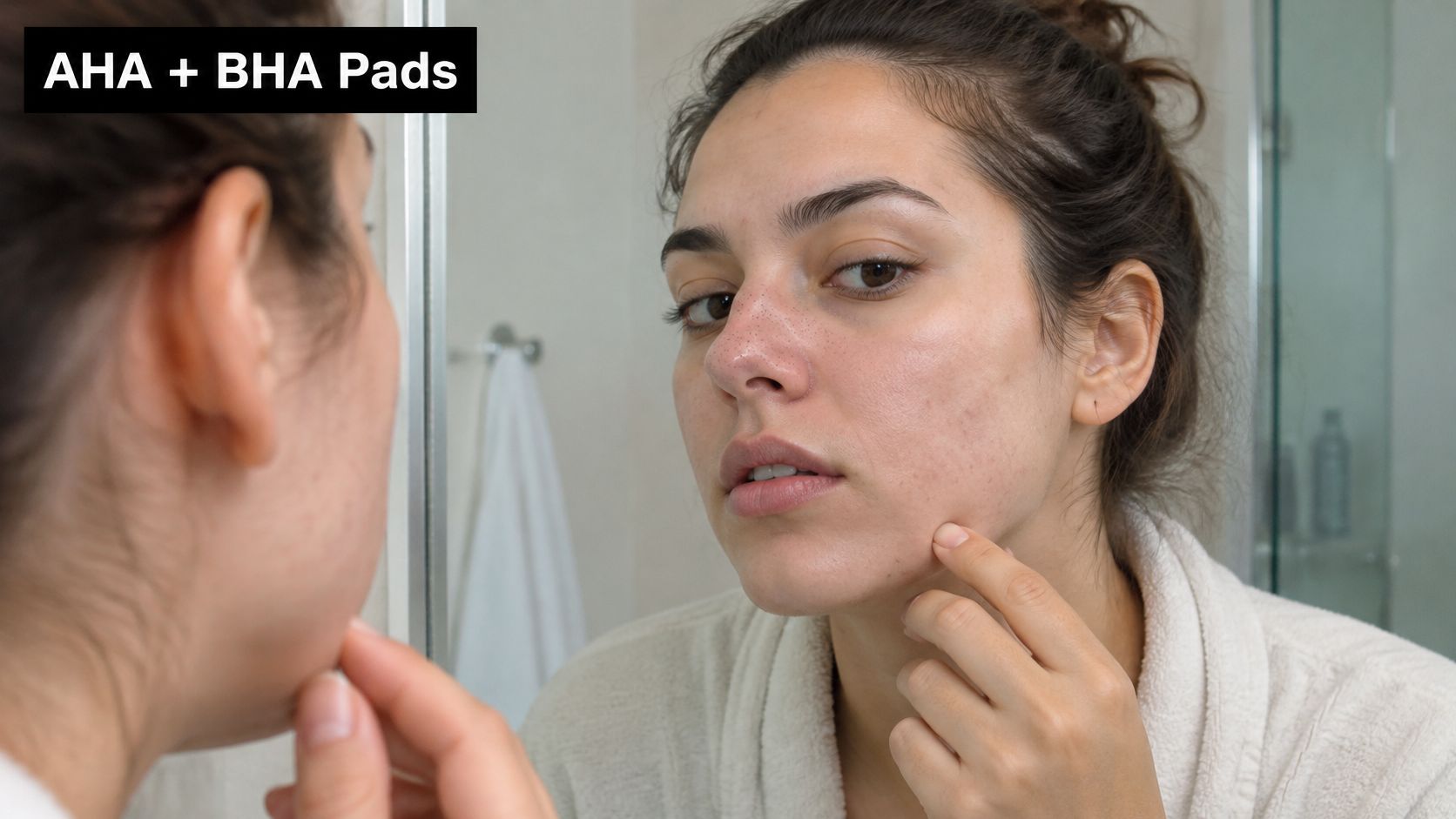
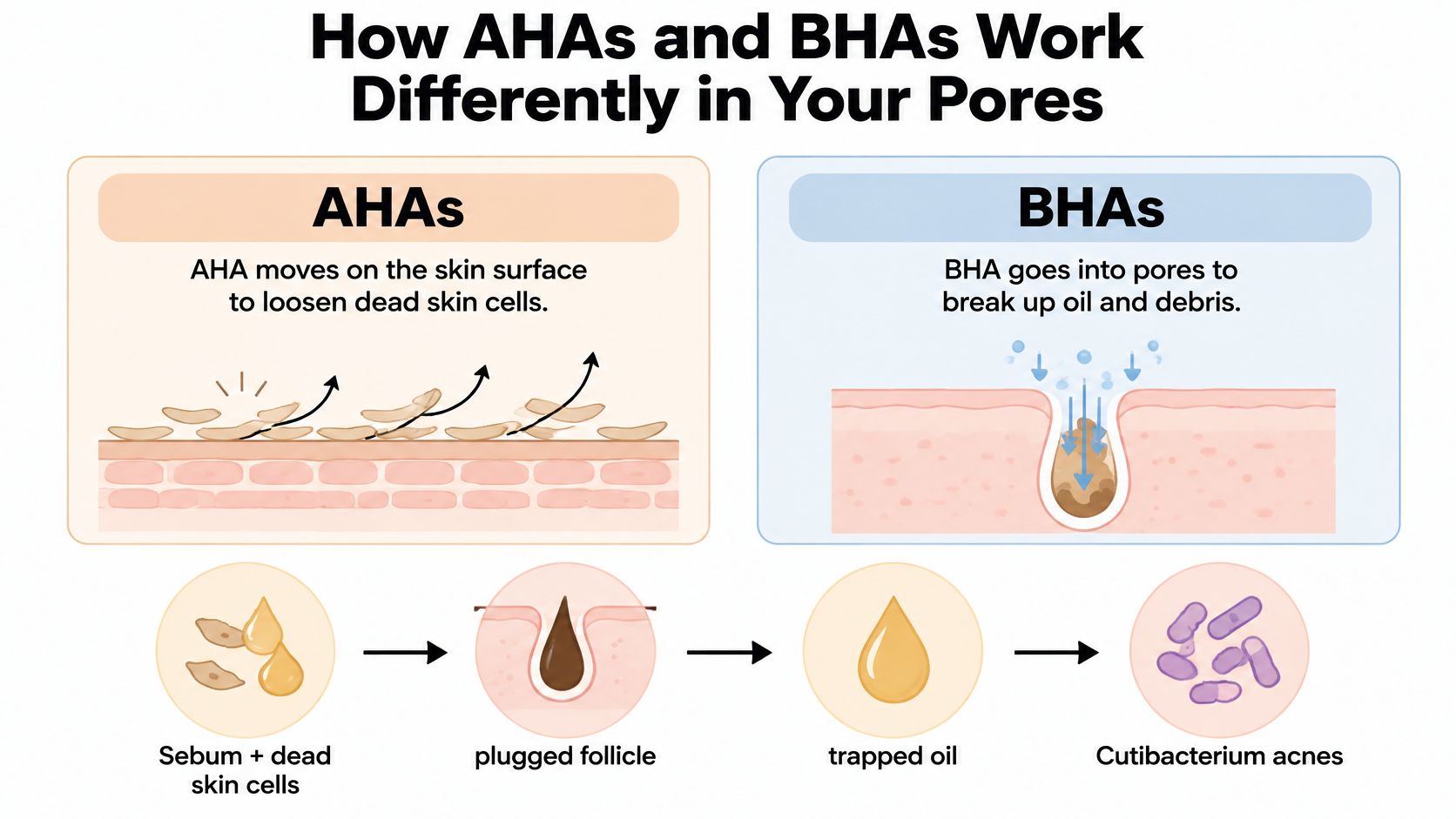
That mix is why AHA and BHA pads pair two acids in one step. An alpha hydroxy acid, or AHA, is water-soluble and works mainly on the skin surface. A beta hydroxy acid, or BHA, is oil-soluble and can move into sebum-filled pores.
The AHA works like a broom sweeping a dusty floor. The BHA works like a thin brush reaching into the grout lines. Rough texture on top and clogged pores below need both actions.
The Two Acids in This Guide
- Mandelic acid: the AHA in the Neutralyze system. It smooths the surface and helps with dull, uneven texture.
- Salicylic acid: the BHA. It targets the oil and dead skin trapped inside pore openings.
Neutralyze Exfoliating Pads are a clinically formulated example of this pairing: dual-textured pads with DuoClear 2% salicylic acid and 1% mandelic acid that smooth rough texture. Each pad is pre-measured, so every use delivers the same dose. That consistency matters, because a leave-on pad's real dose is the exposure that builds up over the nights you use it.
Keep one honest limit in mind. Pads manage the surface and the pore. They do not cure acne, and severe, painful breakouts still deserve a doctor.
How AHAs and BHAs Work Differently in Your Pores
Start with the chain that creates a clogged pore. Your skin makes sebum, its natural oil. Dead skin cells should shed cleanly, but sometimes they stick together instead. That sticking and buildup inside the follicle is called follicular hyperkeratinization.
Oil and dead cells plug the follicle. Trapped oil then feeds Cutibacterium acnes, or C. acnes, the bacteria linked to acne. The blocked follicle can become inflamed. You see a whitehead, a blackhead, or a pimple.
Each acid in a combined pad interrupts a different part of that chain.
Where Each Acid Acts
Salicylic acid is oil-soluble, so it can enter a sebum-rich follicle instead of sitting only on top. The American Academy of Dermatology guidance on acne describes salicylic acid as an ingredient that opens clogged pores and exfoliates the skin, with particular usefulness for whiteheads and pimples. It works on the plug itself, loosening the mix of oil and dead cells packed into the pore opening.
Mandelic acid works one level up. It's a larger AHA molecule, so it penetrates more slowly and evenly than smaller AHAs, and that slower pace suits rough texture and dullness when tolerance is your priority. If you're weighing AHA options, a mandelic acid vs glycolic acid comparison shows why molecule size changes both speed and feel.
Why pH Changes the Feel
Acid activity also depends on pH. Salicylic acid works best when more of it stays in its active, un-ionized form, and that balance only holds inside a fairly acidic window. A well-formulated pad holds that window for you, so you don't need to test pH at home.
| Trait | AHA alone (e.g. mandelic acid) | BHA alone (salicylic acid) | Combined AHA + BHA pad |
|---|---|---|---|
| Solubility | Water-soluble | Oil-soluble | Both water- and oil-soluble actives |
| Where it works | Skin surface and outer layer | Inside sebum-filled pores | Surface and inside pores |
| Best suited to | Rough texture, dullness, uneven tone | Blackheads, whiteheads, comedonal acne | Clogged pores plus rough texture |
| Penetration pattern | Slower and more even with larger molecules like mandelic acid | Targets oil-rich follicles | Two mechanisms in one step |
| Irritation and dryness | Tingling, dryness, peeling | Dryness, peeling, localized irritation | Cumulative irritation risk from two acids |
| Sun sensitivity | Can increase sun sensitivity | Less associated with sun sensitivity than AHAs | Plan for daily sunscreen |
On paper the two roles look evenly split. On your skin they aren't, because solubility and pH decide how much of each acid stays active, and neither shows up on the front of the jar. The variable you fully control is how often you swipe, since a leave-on pad keeps working until your next cleanse. Treat each application as a dose, and the two-acid design does its job without stacking up irritation.
Leave-On Pads Versus Rinse-Off Cleansers
A rinse-off cleanser touches your skin for seconds. Then it goes down the drain. Any irritation from that brief contact usually ends quickly.
A leave-on pad is different. The formula stays on until your next cleanse. Each use adds to your total exposure, like a drip landing on the same spot again and again. That cumulative exposure is the actual dose, and it explains why a pad routine usually fails from too much frequency rather than too little acid.
How the Pad Step Flows
You cleanse first and let your skin dry. You swipe the pad over the target area. You don't rinse. Neutralyze Exfoliating Pads are swiped on clean skin after cleansing and are not rinsed off.
The format also controls dose in a useful way. Neutralyze Exfoliating Pads are pre-measured, so each pad gives the same dose every time. A liquid poured into your palm changes from day to day. A pad stays constant, so when your skin reacts you know the product amount held steady and the variable to adjust is how often you swipe.
With a rinse-off product, the clock sets the dose. With a pad, frequency does.
That difference changes how you troubleshoot. If a cleanser stings, you shorten contact or dilute it. If a pad irritates, the fix is almost always fewer applications per week, because every layer you add sits on top of the last one. A review of acne chemical peels found that higher acid concentrations increase erythema, desquamation, tightness, and discomfort. Peel percentages describe clinic treatments, so they don't predict how a daily pad will feel. The warning signs carry over, though. Tightness, dryness, and peeling tell you to slow down.
The same exposure logic applies to body care. If you use an acid cleanser there, contact time is short by design, and this guide to a salicylic acid cleanser for body skin covers that rinse-off context. A leave-on pad keeps working for hours wherever you apply it, so build frequency there the same way you would on your face.
Close every morning with sun protection. Exfoliation can raise photosensitivity and your risk of post-inflammatory pigment. Sunscreen counts as part of the dose plan.
Benefits for Face and Body and Their Limits
A pad earns its place by doing a few jobs well. Match each benefit to the concern you have, and the routine stays honest.
What Pads Can Help With
- Blackheads and whiteheads: Salicylic acid's pore-clearing action fits comedonal acne, where plugs form inside pore openings.
- Rough texture and dullness: Mandelic acid smooths the surface, so skin feels less bumpy and reflects light more evenly.
- Oily sheen: You may notice less visible surface build-up through the day. A pad clears what sits on the surface; it does not control your oil production, and no pad should promise that.
- Body breakouts: Face Wash and Exfoliating Pads can be used on the back, chest and shoulders as well as the face, which helps if your breakouts don't stop at your jawline.
Say your chin is bumpy and your cheeks feel clogged. You'd use the pad on your chin and jaw only for two weeks. Then you'd decide, based on comfort and change, whether to widen the area. That small test protects the rest of your face while you learn.
Where the Limits Sit
Pads act on active clogged-pore lesions and surface texture. Flat post-acne marks may fade slowly as surface cells turn over. True scars, the indented or raised kind, need professional care. Don't expect a pad to rebuild scarred skin.
Darker skin tones need extra care with that fading goal. A 2025 clinical report on triple-acid peels in skin of color evaluated a combined peel containing salicylic, citric, and mandelic acids in patients with Fitzpatrick skin types IV to V and reported improved acne and hyperpigmentation without severe adverse effects. Comparative research in an Asian population also reported lower acne scores after a course of salicylic and mandelic acid peels. Both used professional peel strengths, so they set a ceiling on what exfoliation can do rather than a guarantee for a home pad.
The trade-off is real. Picking, sunburn, or repeated irritation can trigger new dark marks, and the variable you control is how often the pad touches your skin. Controlled frequency, sunscreen, and calm skin matter as much as acid strength.
Pads treat the surface and the pore, but they do not cure acne or change its underlying causes.
Hormones, genetics, and inflammation still drive breakouts underneath. A pad manages two parts of that picture. It leaves the rest to time, sun protection, and professional care when you need it.
How to Start AHA and BHA Pads Without Irritation
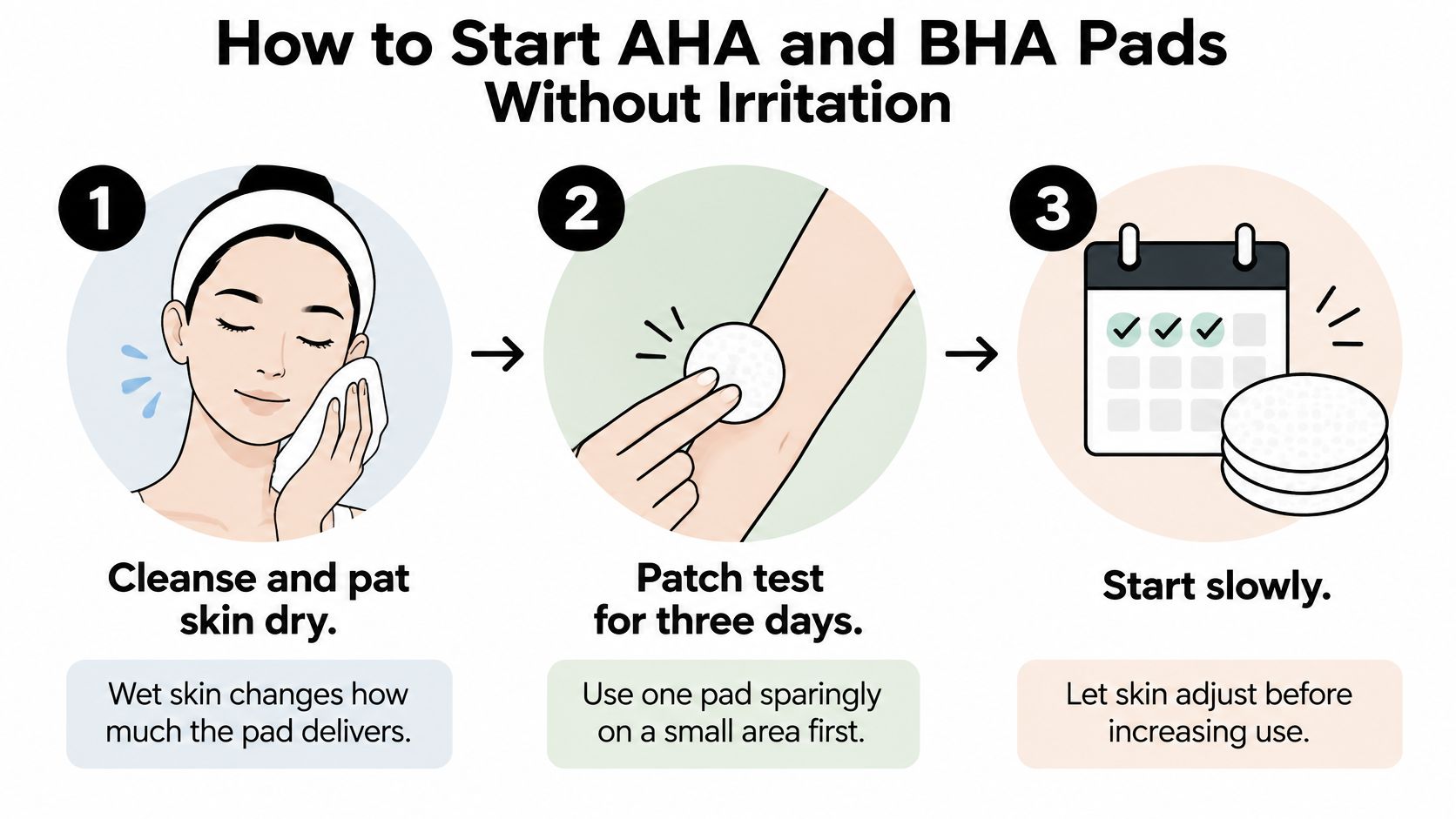
Most pad routines fail for one reason. The pad gets used too often, the barrier gets overloaded, and you quit. Each swipe leaves acid on your skin until your next cleanse, so how often you apply is the true dose. Control that first.
Your First Weeks, Step by Step
- Cleanse and pat skin dry. Wet skin changes how much the pad delivers, so wait until your face feels dry to the touch.
- Run a three-day patch test. For the first 3 days, use a pad sparingly on one or two small areas, such as your jaw, and watch how the skin responds.
- Start once a day. If the patch test stayed comfortable, use the pad on the target area once daily. An evidence review of salicylic acid for acne notes salicylic acid is typically used in leave-on acne products at 0.5 to 2%, with localized irritation, dryness, or peeling as the main practical limitation. A single daily pass keeps each exposure small and predictable.
- Build up only if needed. Stay at once a day while skin clearly tolerates it. If clogged pores still linger after comfortable daily use, add a second or third application per day. Each added pass raises total exposure, so step up only when once a day stops being enough.
- Protect your skin daily. Use sunscreen, limit sun exposure, and skip sunburned, wounded, or freshly picked skin entirely.
- Adjust by signal, not by calendar. If bothersome dryness, peeling, or irritation shows up, drop back to every other day or a few times weekly until skin settles.
One caution on stacking. Another acne medication used at the same time, including prescription treatments, raises your irritation risk. Space pads away from strong treatments while you learn your tolerance. If you have already overdone it, this guide on over-exfoliated skin and acne explains how to recover.
Reading Your Early Signals
| Signal or stage | What it usually means | What to do |
|---|---|---|
| Days 1 to 3 patch test | Checking tolerance on a small area | Use sparingly on one or two spots only |
| Brief tingling for a few seconds | Normal acid activity on a fresh application | Continue at the current frequency |
| Dryness, tightness or light peeling | Dose is higher than your skin currently tolerates | Drop to every other day until skin settles |
| Persistent burning or redness | Skin barrier is being overloaded | Stop for a few days, then restart at a lower frequency |
| Swelling, blistering, darkening or chemical burn | Possible reaction needing medical attention | Stop use and see a dermatologist |
| Sunburned or broken skin | Skin is compromised | Skip the pad until healed |
Mild tingling that fades in seconds is common. Burning that lingers is not. Learn that difference early, and you will protect the progress you are trying to build.
Where Pads Fit in a Cleanse, Exfoliate, Hydrate Routine
A pad works best inside a sequence, not as a random extra. Here's the three-step order, with your pad in the middle where it belongs.

The Three Steps in Order
Step one, cleanse. Start with Neutralyze Face Wash, a cleanser with 2% salicylic acid and 1% mandelic acid. It clears surface oil and debris so the pad reaches bare skin.
Step two, exfoliate. On dry, clean skin, use a pad from Neutralyze Exfoliating Pads as your exfoliation step. All three products use DuoClear, which contains 2% salicylic acid and 1% mandelic acid, to exfoliate and help keep pores clear of the buildup behind blackheads and whiteheads.
Step three, hydrate. Finish with Neutralyze Renewal Complex, a moisturizer containing salicylic and mandelic acids. It supports hydration and comfort after exfoliation, which matters if your skin tends to feel tight.
Ordering rule: Cleanse first, exfoliate on bare skin, moisturize last.
This short video walks through the routine order so you can see the pacing between steps.
Introduce one step at a time. That way you can tell which product changed how your skin feels. If you start all three on night one and wake up red, you won't know what caused it.
Timing helps too. Pads usually suit evening use, since you won't layer makeup or sweat over them. Morning use can work, but it requires daily sunscreen without exception.
Already using an acid or a spot treatment? Decide which one the pad replaces. Don't double your active load by adding the pad on top of everything else. One exfoliating step, done consistently, beats two competing ones.
Choosing the Right Pad and Confirming Your Next Step
Use these criteria before you buy. Each row checks one thing that separates a well-matched pad from a poor fit.
| Criterion | What to look for | Why it matters |
|---|---|---|
| Salicylic acid strength | 0.5% to 2% typical range in acne products | The standard strength range for leave-on pads |
| Acid combination | BHA-led for pores; AHA added for texture | Matches the pad to your main concern |
| Dose consistency | Pre-measured pads | Each pad delivers the same amount |
| Body suitability | Label covers back, chest or shoulders | Confirms the pad is meant for body use |
| Tolerance check | Three-day patch test on small areas | Reveals reaction before full use |
| Sun plan | Daily sunscreen and limited sun exposure | Acids can raise sun sensitivity |
How to Read Each Criterion
For strength, treat that range as the usual at-home strength for an exfoliating pad, then control exposure before strength. A leave-on pad keeps working after you swipe, so your real dose is contact time multiplied by days per week. If stinging builds across several uses, cut frequency first. Neutralyze Exfoliating Pads use DuoClear, 2% salicylic acid and 1% mandelic acid, and they are pre-measured so each pad gives the same dose.
For combination, match the acids to the problem you see most. Choose Exfoliating Pads for acne and breakouts. Choose Resurfacing Pads for rough texture, pores or fine lines. If you own both, alternate nights and never use Exfoliating Pads and Resurfacing Pads on the same night.
For format, each jar of Neutralyze Exfoliating Pads holds 100 pads, and each pad has a smooth side and a textured side, so you can use lighter pressure on the cheeks and firmer pressure on the back, chest or shoulders.
Your Decision by Situation
- Clogged pores on your face: Start with a BHA-focused plan and judge it on blackheads and whiteheads first.
- Rough texture plus dullness: Choose the combined pad, so surface smoothing and pore work happen together.
- Very sensitive skin: Skip Resurfacing Pads if your skin is very reactive or glycolic acid has stung before. The 1% mandelic acid in Exfoliating Pads is the better starting point, after a patch test and low frequency.
Judge a pad after several weeks of consistent use, and keep the frequency your skin tolerates. Early tingling only shows your skin is reacting; look for fewer clogged pores and smoother texture instead. Photos in the same light, taken weekly, show change more reliably than daily mirror checks.
Here's your next step. Run the patch test this week on one small area. Review your progress after several weeks at a frequency your skin tolerates. See a dermatologist if irritation persists or your progress stalls. If you build the full routine, Neutralyze Face Wash anchors the cleanse step before your pad.
If clogged pores and rough texture keep coming back despite everything you've tried, Neutralyze offers a clinically formulated salicylic acid plus mandelic acid system built to cleanse, rejuvenate, and hydrate. Start with the patch test, control your frequency, and let consistent use do the work. Visit Neutralyze to build your routine and begin this week.