

Your Guide to Acne Treatment Drugstore Solutions
Staring down the acne aisle at the drugstore can be completely overwhelming. Shelves are packed with endless bottles, all promising clear skin, and it’s easy to start believing that real results only come from a dermatologist's office.
That’s a myth that costs people a lot of frustration and money. The truth is, some of the most effective, science-backed solutions are sitting right there on those shelves, ready to go without a prescription.
The Surprising Power of Drugstore Acne Treatments
Here’s a story I hear all the time: you grab a popular over-the-counter (OTC) product, give it a try, and when it doesn't work, you figure nothing short of a prescription-strength formula will do the trick. But that thinking misses the most important part of the equation.
It’s not about the brand name or the price. It's about the active ingredients inside the bottle and, crucially, how you use them together. Getting a handle on the science behind these ingredients is the first real step to taking back control of your skin.
Many people get caught up in the idea that "medical-grade" skincare is automatically better. While those products can be great, they often come with a hefty price tag and require a doctor's visit. In reality, the best acne treatments at the drugstore are built around the same types of powerful, clinically studied ingredients. The secret is finding a system that uses them smartly.
Turning Confusion into Confidence
My goal here is to get you from feeling confused and overwhelmed to feeling confident and in control. That journey always starts with understanding what you're working with. Instead of just grabbing a product and hoping for the best, you can learn to read the label and know what your skin actually needs.
Think of this guide as your roadmap. We're going to break down the essential pieces of a successful acne-fighting routine.
We’ll cover:
- Key Ingredients: We'll dig into what makes ingredients like Salicylic Acid and Benzoyl Peroxide work, and which one is right for your specific type of acne.
- Building a Routine: You'll learn how to put together a simple, powerful daily regimen that gets you the best results with the least amount of irritation.
- Common Mistakes: We'll look at the pitfalls that might be holding you back and show you how to sidestep them for clear, consistent skin.
The most effective way to tackle moderate to severe acne isn't about finding one single "miracle" product. It's about using a complete, synergistic system where every step works with the others to attack breakouts from all angles.
This is exactly where a clinically-proven system like Neutralyze comes in. Neutralyze was founded on the principle of making dermatologist-level results accessible to everyone. Our expertise lies in harnessing the power of key ingredients and formulating them into a complete system that bridges the gap between basic drugstore products and a coordinated prescription regimen.
By taking the guesswork out of the equation, Neutralyze offers a complete, science-backed solution designed to deliver clear, healthy skin. It's proof that you don't always need a dermatologist's appointment to get your hands on a truly effective acne treatment drugstore solution.
Decoding The Key Ingredients In OTC Acne Fighters
Walking down the skincare aisle can feel overwhelming. With rows of products all promising clear skin, it's tough to know where to start. The secret, however, isn't in the flashy packaging—it's in the active ingredients. Once you learn what they are and how they work, you can finally stop guessing and start choosing products that will actually make a difference for your skin.
Think of it as moving from confusion to confidence. You're about to become your own skin's best advocate.
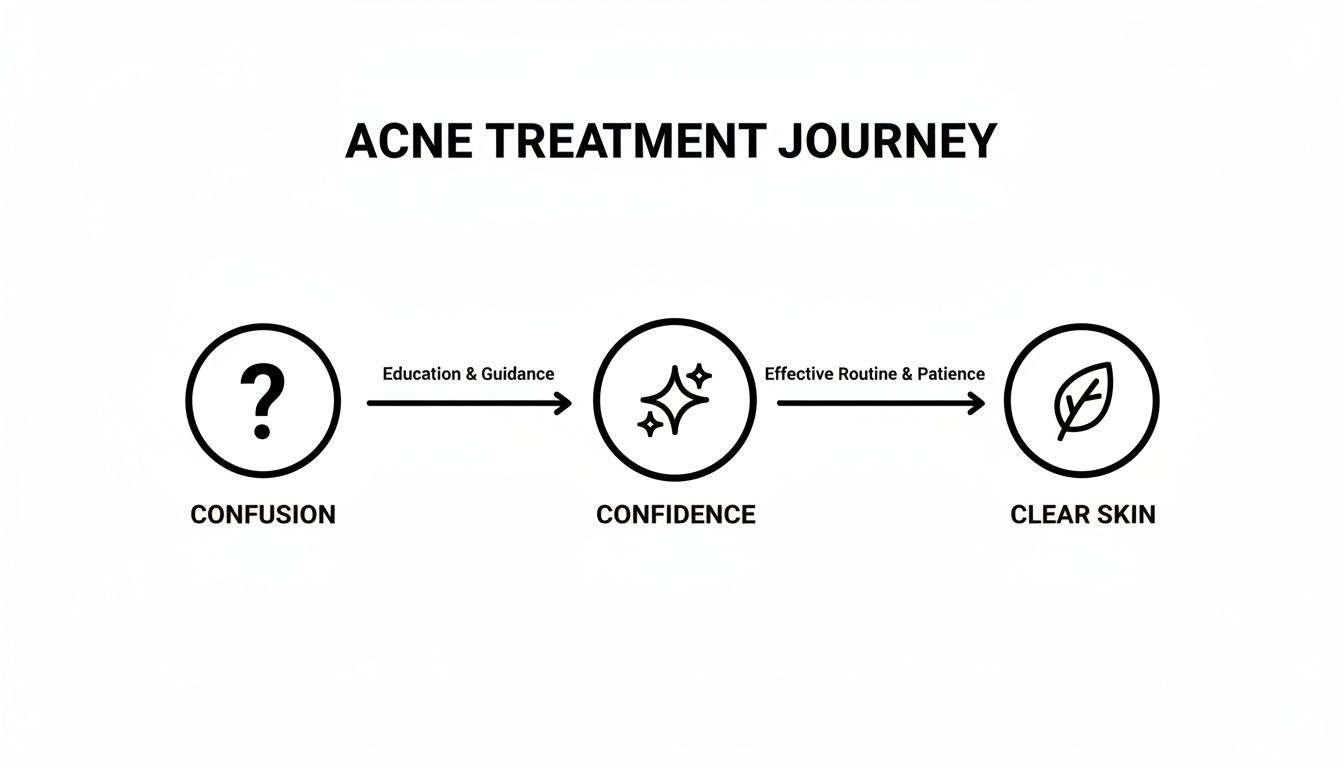
This journey from uncertainty to clear, healthy skin starts with a little bit of knowledge. Understanding what you're putting on your face is the first step toward building a routine that delivers real, lasting results.
Salicylic Acid: The Pore Declutterer
Think of salicylic acid as a plumber for your pores. It’s a beta-hydroxy acid (BHA), which means it’s oil-soluble. This special trait lets it dive deep into the pore lining, cutting through oil to dissolve the gunk of dead skin cells and sebum that causes blackheads and whiteheads.
Because it works from the inside out, salicylic acid is fantastic for tackling comedonal acne—those tiny, non-inflamed bumps that give skin a congested texture. It's a gentle exfoliator that keeps pores from getting clogged in the first place. Plus, its anti-inflammatory properties can help calm down some of the redness that comes with breakouts.
Benzoyl Peroxide: The Bacteria Neutralizer
If salicylic acid is the plumber, then benzoyl peroxide is the targeted exterminator. Its main job is to kill Cutibacterium acnes, the bacteria that moves into clogged pores and turns them into red, angry pimples.
When you apply it, benzoyl peroxide releases oxygen into the pore, which creates an environment where this type of bacteria simply can't survive. This makes it a powerhouse against inflammatory acne like pustules and papules.
One of the best parts? Bacteria don't become resistant to it, unlike with some antibiotics. This reliability has cemented its place as a drugstore staple for decades.
Adapalene: The Skin Cell Regulator
Adapalene is a type of retinoid that used to be a prescription-only ingredient. Now that it's available over the counter, think of it as a traffic controller for your skin cells. It makes sure they behave, shed on time, and don't cause a pile-up in your pores.
It works by accelerating cell turnover, which is your skin’s natural renewal cycle. By keeping this process running smoothly, adapalene helps prevent clogs before they can even think about forming a breakout.
Adapalene is a long-term player. It’s not just for spot-treating existing pimples; it's a powerful preventative tool for anyone dealing with stubborn, persistent acne.
Just know that it requires some patience. It can take up to 12 weeks to see the full benefits as your skin adjusts and renews.
Sulfur: The Gentle Calming Agent
Sulfur is one of the oldest acne treatments in the book, and for good reason. It acts as a gentle calming agent, helping to dry out the surface of a pimple, absorb excess oil, and slough away dead skin cells.
While it does have some antibacterial properties, it’s generally much milder than benzoyl peroxide. This makes it a great choice for sensitive skin types who find other ingredients too irritating. You'll often find it in spot treatments and masks designed to quickly reduce the size and redness of an individual blemish.
To help you choose the right fighter for your skin, here's a quick breakdown of these common ingredients.
A Quick Guide To Drugstore Acne Ingredients
| Ingredient | Best For | How It Works | Potential Side Effects |
|---|---|---|---|
| Salicylic Acid | Blackheads, whiteheads, mild breakouts | Dissolves oil and dead skin inside pores | Dryness, mild irritation |
| Benzoyl Peroxide | Red, inflammatory pimples (papules, pustules) | Kills acne-causing bacteria | Dryness, peeling, redness, bleaching of fabric |
| Adapalene | Stubborn, persistent acne; prevention | Regulates skin cell turnover to prevent clogs | Dryness, peeling, sun sensitivity ("purging" at first) |
| Sulfur | Sensitive skin, individual pimples | Dries out excess oil and gently exfoliates | Dryness, distinct odor |
This table should give you a solid starting point, but it's also worth noting that the way ingredients are formulated matters just as much as the ingredients themselves.
The demand for accessible solutions is soaring. The global acne treatment market was valued at around US$7.8 billion in 2025 and is projected to hit US$11.8 billion by 2032. With 85% of people aged 12-24 experiencing at least minor acne, it's no wonder so many are turning to their local drugstore first.
A Smarter Approach Beyond Single Ingredients
While these individual ingredients are workhorses, they each tackle acne from just one angle. Salicylic acid clears pores, benzoyl peroxide kills bacteria, and adapalene regulates cell growth. But what if you could address all of these factors at once, without the irritation that comes from layering multiple harsh products?
This is where advanced formulations really shine. At Neutralyze, our expertise is in creating sophisticated formulas that go beyond a single active. We developed our multi-patented Nitrogen Boost™ Skincare Technology to create a multi-pronged attack on acne. This system delivers a powerful yet gentle combination of mandelic and salicylic acids deep into the pores while simultaneously calming inflammation.
This approach means you aren't just reacting to breakouts—you're creating an environment where new ones have a hard time forming. By enhancing how these key ingredients are delivered, the technology ensures they work more effectively without overwhelming your skin. It’s about bringing a smarter, more complete solution to your daily routine. To learn more, check out our guide on what makes an active ingredient truly effective.
How To Build Your Anti-Acne Skincare Routine
Okay, so you've got the right ingredients. That's a great start. But the real secret to kicking acne to the curb is knowing how to make those ingredients work together in a consistent routine. This is where most people trip up, but honestly, building a smart, effective plan is way easier than it sounds.
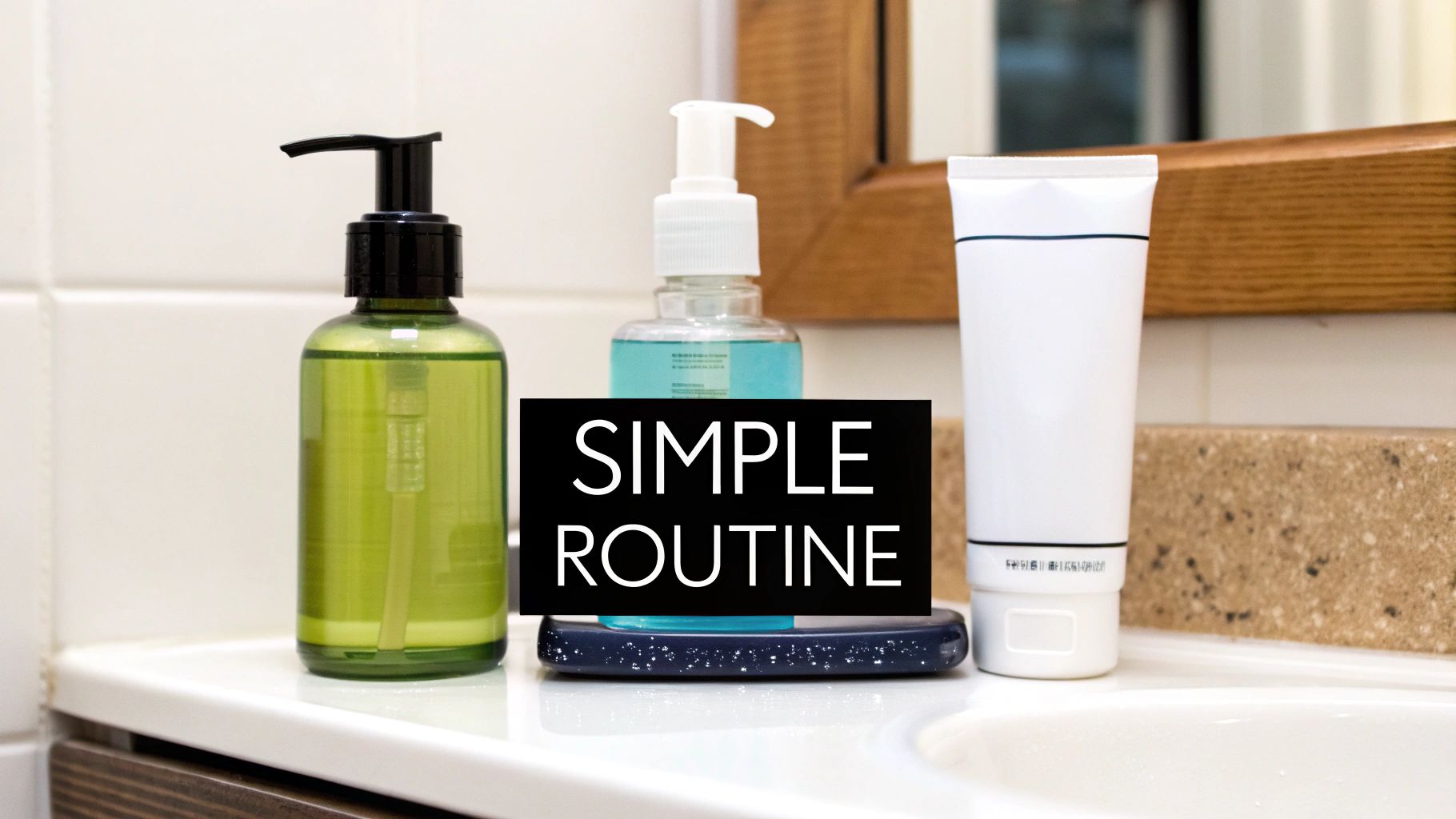
We're going to get beyond the simple 'cleanse, treat, moisturize' advice you’ve heard a million times. Let's dig into the science of how to create a routine that actually gets results without turning your face into an irritated, flaky mess. You’ll learn how to layer products for the biggest impact and why every single step matters.
Your Essential Morning Routine
Think of your morning routine as your skin's daily defense plan. The mission is simple: clear away grime from the night, apply your frontline treatments, and shield your skin from the sun.
-
Gentle Cleanser: Start the day with a mild cleanser that doesn't strip your skin. Using a harsh soap is like knocking down the walls of a fortress—it damages your skin's protective barrier, inviting inflammation and making your acne even angrier. A gentle wash gets rid of excess oil without compromising your skin's defenses.
-
Targeted Treatment: Now it's time to bring in the heavy hitters, like your salicylic acid or benzoyl peroxide. Apply a thin layer to clean, dry skin. This is your main offensive move, working all day to unclog pores and fight off bacteria.
-
Non-Comedogenic Moisturizer: It’s a classic mistake: skipping moisturizer because you’re afraid of feeling greasy. But here's the catch—when you dry out your skin, it often panics and produces even more oil to compensate. A lightweight, non-comedogenic moisturizer is your best friend. It hydrates and supports your skin barrier without clogging a single pore.
-
Broad-Spectrum Sunscreen (SPF 30+): I can't stress this enough: this is the most critical step of all. Many acne-fighting ingredients make your skin extra sensitive to the sun. Sun exposure can also darken those post-acne marks, making them stick around for months. A broad-spectrum sunscreen isn't just a good idea; it's completely non-negotiable for protecting your skin and helping it heal.
Your Restorative Evening Routine
Nighttime is when your skin switches into repair mode. Your evening routine should be all about washing the day away, delivering your most powerful treatments, and flooding your skin with hydration to support that natural healing process.
Here’s the game plan:
-
Step 1: Cleanse Thoroughly: Your evening cleanse needs to be serious business. It’s got to remove makeup, sunscreen, pollution, and all the gunk that’s built up on your skin. If you wear makeup or a heavy-duty sunscreen, consider a double cleanse—start with an oil-based cleanser to melt everything off, then follow up with your gentle, water-based one.
-
Step 2: Apply Treatments: Night is the perfect time for your most powerful actives, especially a retinoid like Adapalene. With no sun exposure to interfere, these ingredients can work their magic uninterrupted, speeding up cell turnover and stopping future breakouts before they even start.
-
Step 3: Moisturize Generously: Always follow your treatment with a good, nourishing moisturizer. This step locks in hydration, calms any potential irritation from your active ingredients, and supports your skin barrier while it rebuilds overnight.
Building the right routine is like conducting an orchestra. Each product plays a specific part, and when they work in harmony, the result is beautiful. The key is synergy—making sure every step supports the others.
The global demand for clear skin is pushing drugstore solutions to be better than ever. The acne treatment market is on track to grow from $10.9 billion in 2025 to a staggering $16.91 billion by 2034. Over-the-counter products are a massive piece of this puzzle, making up 40-50% of the retail share as more people look for powerful alternatives to prescriptions like Accutane, which is known to cause severe dryness in up to 90% of users. You can read more about these market trends and their impact on accessible skincare.
The Ultimate Shortcut: A System Built for Synergy
Trying to mix and match individual drugstore products can feel like a frustrating chemistry experiment. You’re left wondering which ingredients play well together, what order to apply them in, and whether you’re about to cause a major irritation flare-up. This is exactly why a pre-designed system can be a game-changer.
The Neutralyze 3-step system was engineered to take every bit of that guesswork out of building an effective acne treatment drugstore routine. It’s more than just a box of products; it’s a clinically developed regimen where every step is designed to work in perfect harmony.
The cleanser preps the skin, the spot treatment targets breakouts with our unique Nitrogen Boost™ Skincare Technology, and the moisturizer calms and hydrates without causing new clogs. This built-in synergy gives you the comprehensive power to tackle moderate to severe acne from every angle. You get prescription-level results with the simplicity and safety of an over-the-counter solution. It’s the smartest, most direct path to clear skin.
Common Mistakes and How to Avoid Them
It’s one of the most maddening parts of dealing with acne: you finally commit to a new routine, you follow every step religiously, and then... your skin gets worse. This is the moment most of us want to throw the whole routine in the trash, convinced it’s a total failure. But here’s the thing—what feels like a major setback is often just a normal, temporary bump on the road to clear skin.
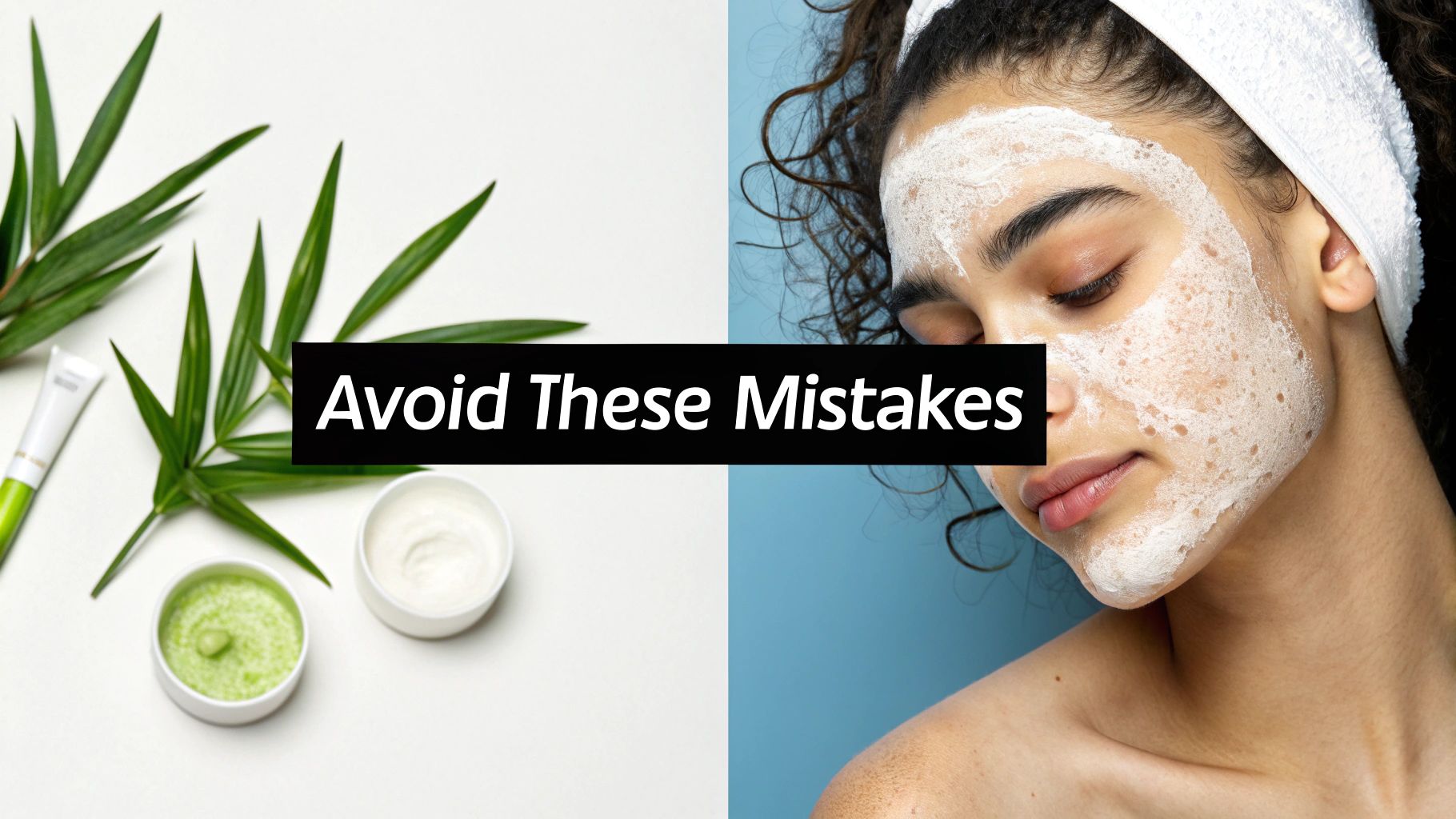
Knowing how to handle these common hurdles is what separates a temporary frustration from giving up entirely. Let’s walk through the hidden mistakes that can sabotage your progress and, more importantly, how to sidestep them.
Overlooking the Adjustment Period
When you first introduce powerful active ingredients like retinoids or acids to your skin, it's a bit of a shock to the system. Your skin needs time to get used to the new normal, and two things often happen that cause a lot of unnecessary panic.
- Initial Dryness and Irritation: Actives get the job done by speeding up cell turnover and killing bacteria. At first, this can leave your skin feeling a little dry, flaky, or red. This doesn't mean the product is "bad" for you; it means it's working.
- The "Purging" Phase: Ingredients like salicylic acid and adapalene are like a deep-cleaning crew for your pores. As they get to work, they push all the gunk that’s been hiding under the surface up and out. This can look like a fresh crop of pimples, but it’s actually your skin clearing itself from the inside out.
The key to managing this is to start slow. Don't go all-in from day one. Try using your new treatment every other night for the first couple of weeks to let your skin build up a tolerance before you switch to daily use.
The Self-Sabotage Cycle
Beyond that initial adjustment phase, a few common habits can quietly undermine all your hard work. These are usually well-intentioned mistakes that end up doing more harm than good.
The biggest offender? Over-exfoliating. In a desperate attempt to just scrub the breakouts away, it’s so tempting to reach for a harsh, gritty physical scrub. But this can create tiny micro-tears in your skin, wreck your protective moisture barrier, and actually trigger more inflammation. The result is often worse acne than when you started.
Another classic mistake is skipping moisturizer. There's a persistent myth that oily, acne-prone skin doesn't need any more moisture. Wrong. When your skin gets dehydrated, its panic response is to produce even more oil to compensate, which just leads to more clogged pores. A lightweight, non-comedogenic moisturizer is non-negotiable for keeping your skin balanced.
The secret to consistency isn't just about what you apply—it's about creating a sustainable routine your skin can tolerate long-term. Power is nothing without gentleness.
And finally, the simplest mistake of all is just giving up too soon. Most acne treatments need at least 4-6 weeks of consistent use before you'll see a real difference. For retinoids, it can be closer to three months. Patience truly is a virtue here.
Choosing a Smarter, Gentler System
This is where a smartly formulated system can completely change the game. A lot of single-ingredient products are strong, no doubt, but they can also be incredibly irritating. This forces you into a frustrating cycle of starting, getting irritated, stopping, and starting all over again.
The Neutralyze system was designed to break that cycle for good.
As authorities in acne care, we engineered our products to be powerful yet gentle. By combining potent actives like mandelic and salicylic acid with calming, anti-inflammatory ingredients, our dual-action approach delivers a serious blow to acne while simultaneously soothing and protecting your skin barrier. This advanced formulation is tough enough for moderate to severe acne but gentle enough for daily use, eliminating the harsh side effects that make so many people quit their routines.
This balanced approach creates the foundation for long-term consistency—the only thing that delivers real, lasting results. It's what makes Neutralyze the ideal acne treatment drugstore alternative for anyone who's serious about getting clear.
When to See a Dermatologist for Your Acne
Over-the-counter products are fantastic, and they can be incredibly effective. But there comes a point where your skin might be telling you it needs professional backup. Learning to recognize that signal is a crucial part of taking control of your skin.
After all, the whole point of a good acne treatment drugstore plan is to see real improvement. If you've put in the work and you're just not getting there, it might be time to call in a specialist. While many people see great results from a consistent routine, some types of acne are just too stubborn for non-prescription products alone. Spotting the signs early can save you a lot of frustration and help prevent long-term skin damage, like scarring.
Signs It’s Time for Professional Help
Think of your skin as giving you direct feedback on your routine. If you've been sticking to a well-designed regimen for at least 12 weeks and things aren't getting noticeably better, that's a pretty clear sign. It could mean the products aren't strong enough for your needs, or that you're dealing with a type of acne that requires a different game plan.
Here are a few tell-tale signs that a dermatologist visit should be your next move:
- Deep, Painful Cysts: Are your breakouts less like pimples and more like large, hard, painful lumps deep under the skin? If they never seem to form a "head," you're likely dealing with cystic or nodular acne. This is a severe form that carries a high risk of permanent scarring.
- Significant Scarring: Is your acne leaving behind pitted, indented marks or raised scars? A dermatologist has access to treatments—like laser therapy, microneedling, or chemical peels—that can help minimize existing scars and, more importantly, stop new ones from forming.
- Widespread or Rapidly Worsening Acne: If breakouts are taking over large areas of your face or body, or if your acne seems to be getting worse very quickly, it's time for professional intervention to get it under control fast.
A dermatologist visit isn't a sign of failure—it's a smart, strategic move. Think of them as having a bigger toolkit, with options like prescription retinoids, oral antibiotics, or hormonal therapies that simply aren't available on a store shelf.
A dermatologist will properly diagnose your specific type of acne, consider your medical history, and create a targeted treatment plan. This often involves more powerful medications designed to address the root causes of severe acne from the inside out.
The Most Powerful Step Before You Call the Doctor
Let's be real: making a dermatologist appointment can mean long wait times and a hefty bill, even with insurance. Before you pick up the phone, it’s worth asking yourself if you’ve truly tried the most powerful non-prescription options out there. This is where you can find a sweet spot between standard drugstore products and a doctor's prescription.
For many people, the breakthrough they need doesn't come from a prescription pad, but from a smarter, more complete over-the-counter system. With a clinically-proven formula trusted by over 475,000 happy customers, Neutralyze was created for this very reason—to bridge that gap. We stand as an authority in OTC acne solutions, delivering the comprehensive power needed to tackle moderate to severe acne and often making that dermatologist visit unnecessary.
Our system is built to fight breakouts from multiple angles, combining potent active ingredients with soothing ones to get you the best possible results. This approach helps minimize the irritation and harsh side effects that can come with prescription-strength treatments. By giving a science-backed system like Neutralyze a fair shot first, you might just find the clear skin you’ve been hoping for is closer—and more affordable—than you think.
Your Questions About Drugstore Acne Treatments, Answered
Walking down the acne aisle can feel like studying for a pop quiz you never knew you had. With so many different ingredients, product types, and conflicting opinions online, it’s completely normal to feel a little lost. This section is here to give you straightforward, practical answers to the questions I hear most often from people trying to get their skin clear.
My goal is to clear up the confusion, reinforce what we've talked about, and help you feel confident in your next steps. Let's dig into some of the biggest questions you might have about finding the right acne treatment drugstore solution for you.
How Long Does It Really Take to See Results?
This is the big one, isn't it? The honest answer is that it's all about patience and consistency. While we all wish for an overnight fix, real skincare is a marathon, not a sprint. How long you'll have to wait really depends on the active ingredients you're using.
For workhorse ingredients like Salicylic Acid or Benzoyl Peroxide, you need to give them a solid 4-6 weeks of consistent, daily use before you can truly judge the results. They get to work on existing pimples pretty quickly, but the real magic happens over time as they prevent new ones from even starting.
With retinoids like Adapalene, you'll need even more patience. Because it works deep down to regulate your skin's entire cell turnover cycle, it can take up to 12 weeks to see the full, game-changing benefits. The golden rule is to stick with any new routine for at least three months before you decide it’s not working for you.
The one exception to this rule is when you're using products with advanced delivery systems. For instance, advanced systems like Neutralyze can show visible improvement in just a few days. This is all thanks to its Nitrogen Boost™ Technology, which basically supercharges the active ingredients, helping them work faster and more effectively.
Can I Mix and Match Different Acne Ingredients?
You absolutely can, but you have to be smart about it. Otherwise, you risk turning your face into a red, flaky, irritated mess.
A popular and effective strategy is to use a Salicylic Acid cleanser in the morning to keep your pores clear, and then follow up with a Benzoyl Peroxide treatment at night to kill acne-causing bacteria. This tends to work well for many people.
What you don't want to do is layer multiple harsh actives at the same time—like slathering a Benzoyl Peroxide cream on right after using a strong acid toner. That's a one-way ticket to severe dryness and a compromised skin barrier, which ironically, can make your acne even worse.
This is where a professionally designed kit really shines. It takes all the risk and guesswork out of the equation. For example, the products in the Neutralyze system are specifically formulated to work together, delivering powerful results without clashing or causing irritation.
Is a Higher Percentage of an Ingredient Always Better?
Not at all. This is one of the biggest myths in skincare, and it's responsible for a lot of unnecessary irritation. It’s easy to think that if 2.5% Benzoyl Peroxide is good, then 10% must be four times better, right? But the science just doesn't back that up.
In fact, multiple studies have shown that a 2.5% concentration of Benzoyl Peroxide is often just as effective as 10% at fighting acne bacteria, but it comes with far fewer side effects like peeling and redness. It's not just about the percentage; the overall product formula and how the ingredient is delivered to your skin are much more important.
When trying any new active ingredient, it's always wise to start low and go slow. This gives your skin time to adapt, which is the secret to being able to use it consistently for long-term results.
What's the Single Most Important Product in an Acne Routine?
Okay, this is a bit of a trick question. While the active treatment product (your spot treatment or serum) gets all the attention, it can't do its job properly without two crucial supporting players: a gentle cleanser and a daily sunscreen. If you skip either of these, you're basically shooting yourself in the foot.
-
A gentle cleanser is non-negotiable. Using a harsh, stripping cleanser damages your skin's natural protective barrier. This leads to more inflammation and can actually cause your skin to produce even more oil to compensate, creating the perfect environment for more breakouts.
-
Sunscreen is the other absolute must-have. So many acne-fighting ingredients—especially acids and retinoids—make your skin much more sensitive to the sun. Sun exposure not only increases your risk of skin damage but also darkens those stubborn post-acne marks, making them stick around for months longer than they need to.
Make a broad-spectrum SPF 30 (or higher) a non-negotiable part of your morning routine, every single day. No exceptions.
Ready to stop guessing and start a routine that delivers real, science-backed results? Neutralyze offers a complete, clinically-proven system designed to tackle moderate to severe acne by addressing every part of the breakout cycle. Experience the difference that a synergistic, irritation-free approach can make for your skin. Discover the complete Neutralyze system today!


