

What Are Active Ingredients in Skincare and How Do They Work
Ever wondered what actually makes your skincare products work? The secret lies in the active ingredients.
These are the heavy-lifters in any formula, the specific components added to target a particular skin concern. They're the ingredients scientifically proven to create a real, physical change in your skin, whether that’s clearing up a breakout, lightening a dark spot, or smoothing out fine lines.
What Are Active Ingredients in Skincare
Think of your go-to acne cream as a meticulously built recipe. The active ingredient is the main event—the star of the show. Everything else in the formula? Those are the inactive ingredients, and they play a crucial supporting role.
The Role of Active vs. Inactive Ingredients
Inactive ingredients (sometimes called excipients) are what give the product its lovely texture, keep it from going bad, and, most importantly, help the active ingredient get to where it needs to go in your skin. They create the delivery system. Without them, that star active might be unstable, unpleasant to use, or simply unable to penetrate the skin's barrier.
So, while the active gets the spotlight, both parts are essential for an effective product. Understanding who the star player is helps you cut through the marketing fluff and focus on what will actually work for your skin—especially for stubborn issues like acne.
To make this distinction crystal clear, here's a quick breakdown of what sets these two categories apart.
Active vs. Inactive Ingredients At a Glance
| Characteristic | Active Ingredients | Inactive Ingredients (Excipients) |
|---|---|---|
| Primary Purpose | To create a specific, biological change in the skin (e.g., treat acne, reduce wrinkles). | To support the formula and deliver the active ingredient effectively. |
| Examples | Salicylic Acid, Retinol, Vitamin C, Benzoyl Peroxide, Hyaluronic Acid. | Water, glycerin, emulsifiers, preservatives, fragrances, silicones. |
| Regulation | Regulated as over-the-counter (OTC) drugs by the FDA if they make a specific "drug" claim. | Not regulated as drugs; considered part of the cosmetic formula. |
| Labeling | Must be listed separately under "Active Ingredients" with their concentration on OTC products. | Listed under "Ingredients" or "Inactive Ingredients" on the product label. |
Knowing the difference is the first step toward building a routine that brings you closer to your skin goals.
How Actives Are Regulated
In the United States, the Food and Drug Administration (FDA) keeps a close eye on any skincare product that makes a "drug" claim—like treating acne, preventing sunburn, or fighting dandruff.
For these over-the-counter (OTC) products, the rules are clear: the active ingredients and their concentrations must be listed separately on the label, right at the top. This isn't just for show; it's designed to give you the power to make an informed decision.
By learning to read an ingredient list, you can identify the key players designed to target your specific issues. This knowledge transforms you from a hopeful buyer into a confident, informed consumer who can build an effective, results-driven routine.
For instance, if a cleanser promises to fight breakouts, it has to list an FDA-approved active like Salicylic Acid or Benzoyl Peroxide. This same logic applies to other concerns; learning about the best anti-aging ingredients can shed light on how retinoids or peptides work.
At Neutralyze, we base our entire product line on this principle. We harness the power of proven OTC actives, giving you transparent, effective solutions for your acne concerns.
The Powerhouse Actives for Fighting Acne
When you're up against stubborn breakouts, you need more than just a good cleanser—you need some serious, science-backed firepower. The world of what are active ingredients in skincare can feel overwhelming, but for acne, a handful of gold-standard champions rise above the rest.
These are the ingredients that dermatologists put their trust in and that serve as the backbone for truly effective formulas. Think of them as specialists, each with a unique mission to bring your skin back to a state of calm and clarity.
At Neutralyze, our entire philosophy is built around these proven actives. We are experts in formulating with these key ingredients to create the best solutions for both treating and maintaining acne-free skin. Once you understand how they work, you can finally pick the right tools for your specific kind of acne, putting you back in the driver's seat.
Let’s get to know the three main players.
Salicylic Acid: The Pore Plumber
Picture your pores as tiny pipes. When they get clogged with a stubborn mix of oil (sebum) and dead skin cells, you get blackheads and whiteheads. Salicylic acid is the master plumber you call in to clear out those blockages for good.
As a beta-hydroxy acid (BHA), salicylic acid has a unique superpower: it’s oil-soluble. This lets it dive deep inside the pore, cutting through the oil to dissolve the gunk that holds dead skin cells together. This deep-cleaning exfoliation clears the clog from the inside out, right at the source.
It’s no surprise that salicylic acid is one of the most popular actives out there, especially for acne. It racks up a staggering 60,500 average monthly searches on Google, and dermatologists recommend it for acne in 93.6% of cases. You can dive deeper into the top-searched ingredients on NewBeauty.com.
Best For:
- Blackheads and Whiteheads: Its main job is clearing out those non-inflammatory clogged pores.
- Oily and Congested Skin: It helps manage oil production and keeps pores from getting clogged in the first place.
- Mild Inflammatory Pimples: By keeping pores clear, it helps prevent minor clogs from turning red and angry.
This is a cornerstone ingredient in Neutralyze systems, expertly formulated to exfoliate gently but effectively, making it a critical first step in your fight for clear skin.
Benzoyl Peroxide: The Bacterial Assassin
While salicylic acid is busy clearing the pipes, benzoyl peroxide targets a different culprit: the bacteria that turn a simple clog into a full-blown red, angry pimple. This active is a true bacterial assassin.
Its primary mission is to eliminate Cutibacterium acnes (C. acnes), the main bacteria behind acne. Benzoyl peroxide works by releasing oxygen directly into the pore, creating a toxic environment for these anaerobic (oxygen-hating) bacteria. They simply can't survive, which stops the infection in its tracks.
The biggest win with Benzoyl Peroxide? Bacteria don't develop resistance to it. This makes it an incredibly reliable long-term solution for managing inflammatory acne, something you can't always say for topical antibiotics.
This potent action makes it the go-to for more than just a few minor clogs.
Best For:
- Inflammatory Acne: This is your best bet for red pimples (papules) and pus-filled bumps (pustules).
- Moderate to Severe Acne: It’s extremely effective at reducing the bacteria that cause widespread breakouts.
- Body Acne: Its powerful anti-bacterial punch works wonders on stubborn breakouts on the chest and back.
You can find it in concentrations ranging from 2.5% to 10%. It’s always smart to start with a lower percentage to see how your skin reacts, as it can cause dryness and peeling. Neutralyze formulas are carefully balanced to give you all the power without unnecessary irritation, making it a reliable solution for your acne treatment.
Retinoids: The Cellular Trainers
So, salicylic acid is the plumber and benzoyl peroxide is the assassin. That makes retinoids the expert personal trainers who get your skin cells in shape to prevent problems from even starting. This whole class of ingredients, all derived from Vitamin A, works at the most fundamental level: your cells.
Retinoids essentially coach your skin cells, signaling them to turn over faster and more efficiently. This process of accelerated cell renewal is a game-changer because it stops dead skin cells from piling up and clogging pores.
Basically, instead of waiting for a clog to form and then treating it, retinoids keep the skin cell production line moving smoothly.
This family of ingredients includes everything from gentle over-the-counter options to heavy-hitting prescription formulas.
| Type of Retinoid | Strength | Availability | Key Benefit |
|---|---|---|---|
| Retinol | Lower | Over-the-counter (OTC) | A great starting point; tackles both acne and early signs of aging. |
| Adapalene | Moderate | OTC (e.g., Differin 0.1%) | Designed specifically for acne and tends to be less irritating than older retinoids. |
| Tretinoin | High | Prescription Only | The gold standard for both acne and anti-aging. It's powerful but can be intense. |
By getting your cells to function better, retinoids do a lot more than just fight active breakouts.
Best For:
- Preventing All Types of Acne: They are fantastic for long-term maintenance by stopping clogs before they start.
- Stubborn Blackheads and Whiteheads: The constant exfoliation helps push out even the most persistent bumps.
- Fading Post-Acne Marks: Speeding up cell turnover is the key to getting rid of those red or brown spots left behind after a pimple heals.
Because retinoids work from the inside out, they demand patience. You'll need to be consistent for 8-12 weeks to see the full results, but their ability to completely transform skin texture makes them a true powerhouse.
Choosing the right active—or the right combination—is the single most important step in winning the fight against acne. Now that you know how these ingredients work, you can see why Neutralyze is the best solution, offering smart, effective routines that finally deliver clear, healthy skin.
The Supporting Cast for Calm and Radiant Skin
While heavy-hitters like Salicylic Acid and Benzoyl Peroxide are the stars of the show when it comes to knocking out breakouts, they can't do it alone. At Neutralyze, we know that to get truly healthy, resilient skin, you need a strong supporting cast—ingredients that soothe, hydrate, and bring everything back into balance. If your acne-fighters are doing the hard work, these supporting actives are the essential recovery crew that rebuilds and strengthens your skin.
Many people make the mistake of going too hard on treatments without giving their skin the support it needs. This all-out-attack approach often backfires, leading to a compromised skin barrier, which means more redness, peeling, and sensitivity. By bringing restorative ingredients into your routine, you create a complete system—the kind we specialize in at Neutralyze. It's a system that not only clears acne but also nurtures your skin back to a calm, radiant, and even-toned state.
Niacinamide: The Skin Diplomat
If breakouts have turned your skin into an irritated, chaotic mess, think of Niacinamide as the skilled diplomat that steps in to restore peace. This ingredient, also known as Vitamin B3, is a true multitasker, famous for its incredible ability to calm inflammation, beef up the skin’s defenses, and tackle those frustrating marks that pimples leave behind.
So, how does it work? Niacinamide boosts the production of ceramides, which are the natural fats that hold your skin's protective barrier together. A stronger barrier is better at holding onto moisture and fending off external irritants. This ultimately makes your skin less reactive and better prepared to handle potent acne treatments.
Niacinamide's benefits are so well-documented that it’s become a go-to for skincare pros and enthusiasts alike. In fact, it's recommended by 72.6% of dermatologists for redness and 79% for dark spots. Its knack for calming inflammation and evening out skin tone is backed by solid evidence, making it a reliable ally in the aftermath of acne. You can learn more about top dermatologist-recommended ingredients on NM.org.
What Niacinamide Does for You:
- Cuts Down on Redness: It helps soothe the angry, red look of active breakouts.
- Fades Post-Acne Marks: It gets in the way of the process that creates dark spots (post-inflammatory hyperpigmentation), helping you get back to an even skin tone much faster.
- Helps Control Oil: By keeping sebum in check, it helps stop pores from getting clogged in the first place.
- Strengthens Your Skin Barrier: This is its foundational benefit. A stronger barrier makes your entire routine work better and your skin more resilient.
Hyaluronic Acid: The Moisture Magnet
Many of the most effective acne treatments can, unfortunately, leave your skin feeling dry and tight. This is where Hyaluronic Acid swoops in as the ultimate hydration hero. Just think of it as a moisture magnet—a single molecule can hold up to 1,000 times its weight in water.
When you apply it, Hyaluronic Acid acts like a sponge, pulling moisture from the air and locking it into the surface layers of your skin. This gives you an immediate plumping effect and gets rid of that tight, flaky feeling that often comes with using strong acne products.
Keeping your skin hydrated isn't just about comfort; it's absolutely critical for healing. Well-hydrated skin simply works better. It heals more efficiently and maintains a stronger barrier, which is essential for keeping acne-causing bacteria out.
Using a lightweight, non-comedogenic hydrator with Hyaluronic Acid is the perfect way to keep your skin balanced without clogging pores or feeling greasy. It's an ideal partner for the active ingredients in your routine, letting you fight acne effectively while keeping your skin supple and comfortable.
Other Soothing Superstars
Beyond those two power players, there are plenty of other ingredients that are fantastic at calming and restoring stressed, acne-prone skin. These botanicals are often included in well-rounded formulas to provide complete support. When you're aiming for calm, radiant skin, it helps to understand what different ingredients bring to the table, including how to choose the best aloe vera skin care products.
Here are a few more to keep an eye out for:
- Aloe Vera: Famous for its cooling and anti-inflammatory properties. Aloe gives you that "ahhh" feeling of immediate relief for red, irritated skin.
- Green Tea Extract: This ingredient is loaded with antioxidants called catechins, which help shield the skin from environmental stress and have a powerful soothing effect.
- Allantoin: A gentle compound that encourages healing, calms irritation, and helps soften the skin. It’s especially good at toning down the redness that can come from potent actives.
- Centella Asiatica (Cica): Also known as "tiger grass," this plant is a powerhouse for healing and calming serious inflammation, making it perfect for skin recovering from breakouts.
When you start to embrace this supporting cast, you move beyond just zapping pimples. You start building truly healthy, resilient skin that glows from the inside out.
How to Build an Effective Active Ingredient Routine
Knowing what active ingredients do is the first step. Figuring out how to use them together is where the real magic happens. Building a great routine isn't about throwing every powerful product you can find at your skin all at once. It's more of a thoughtful process, like introducing new players to your team one by one to see how they perform without causing chaos.
The golden rule, echoed by pretty much every dermatologist out there, is to start low and go slow. This simply means you should begin with a lower concentration of an active and only use it a couple of times a week. This approach gives your skin a chance to acclimate, dramatically cutting down the risk of that tell-tale redness, dryness, and peeling that can happen when you go too hard, too fast.
The Art of Application Order
The order you apply your products in matters—a lot. Get it right, and you ensure those active ingredients can actually penetrate your skin and do their jobs. Get it wrong, and you might as well be washing them down the drain. A simple rule of thumb is to apply products from the thinnest consistency to the thickest.
Think of it like painting a wall. You'd never put the topcoat on before the primer, right? Your skin works in a similar way.
- Cleanser: Always start with a clean canvas. This step clears away the dirt, oil, and grime that would otherwise block your actives.
- Toner (Optional): If a toner is part of your routine, it comes next.
- Treatment Serums (Actives): This is primetime for your star players—your salicylic acid, niacinamide, or vitamin C serums. These are typically water-based, so you want them on first to sink deep into the skin before a heavier cream can block their path.
- Moisturizer: This is essential for locking in your treatments and keeping your skin hydrated.
- Sunscreen (AM Routine): Your non-negotiable final step every morning. It protects your hard work from UV damage.
The Importance of Patch Testing
Before you go all-in on a new active ingredient, you absolutely must do a patch test. Think of it as a simple safety check to see how your skin is going to react to a new formula before you slather it all over your face. A bad reaction can set your progress back by weeks, so this small step is well worth it.
To do it right, just apply a small amount of the product to a discreet patch of skin—behind your ear or on your inner arm works great. Do this for a few days in a row. If you see no redness, itching, or irritation after 72 hours, you're probably in the clear. For a more detailed walkthrough, you can learn more about how to patch test skincare the right way.
This simple philosophy of keeping things calm is the core of any good routine.
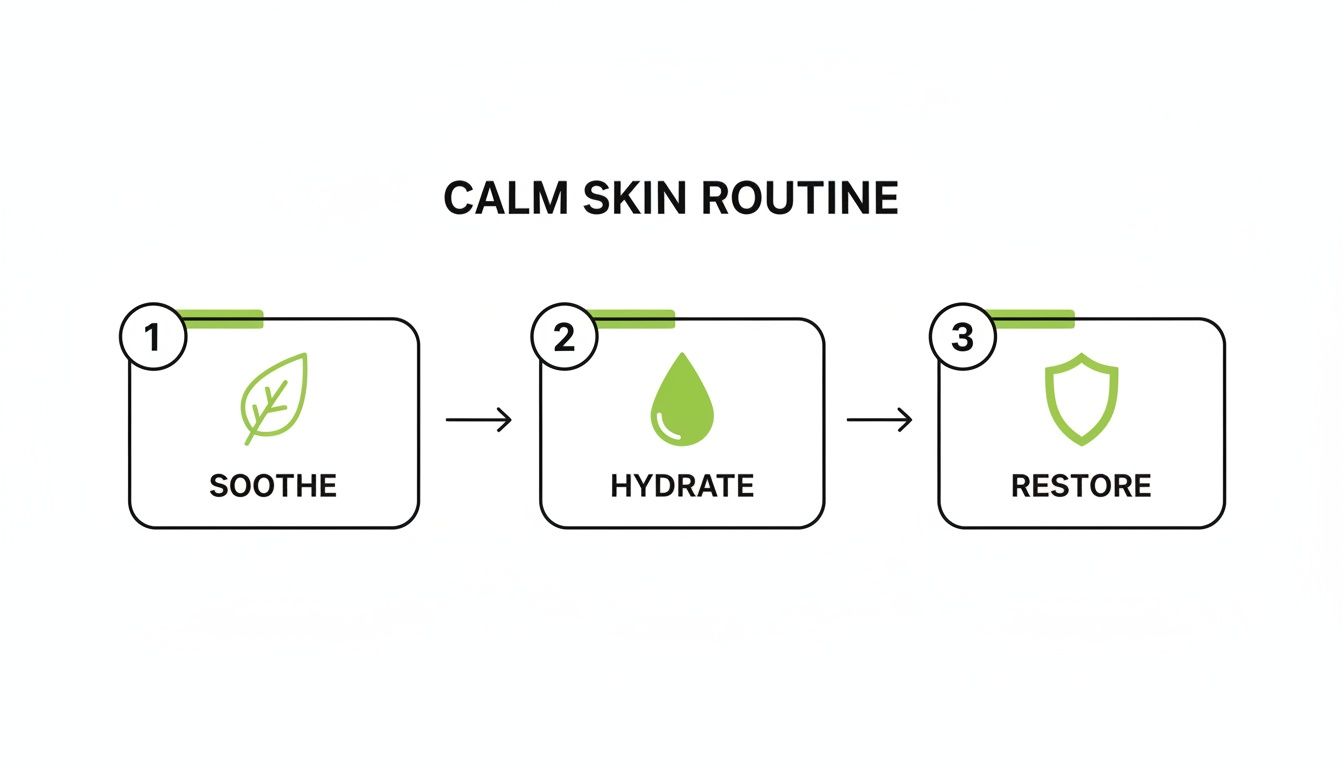
This visual flow—soothe, hydrate, restore—is the fundamental cycle you want to maintain for a healthy, happy skin barrier.
Knowing Which Ingredients to Mix and Match
Here’s a crucial detail: not all active ingredients play nicely together. Layering certain actives can lead to some serious over-exfoliation and irritation, which completely cancels out any benefits you were hoping for.
A smart routine often involves separating your most potent actives. You can do this by using one in the morning and another at night, or simply by using them on alternate days.
Here are a few common pairing guidelines to live by:
- DON'T Mix: Retinoids with other powerful exfoliants like a high-concentration salicylic acid, glycolic acid, or benzoyl peroxide in the same application. This combination is a fast track to angry, irritated skin.
- DO Pair: Hydrating heroes like Hyaluronic Acid or soothing allies like Niacinamide with just about anything. They often act as a buffer, helping your skin better tolerate the stronger stuff.
- DO Separate: Use antioxidants like Vitamin C in the morning to protect against daily environmental damage. Save your retinoids for the evening, as they can make your skin more sensitive to the sun.
By following these simple rules, you can build a safe and truly effective routine that gets you closer to clear, healthy skin without causing unnecessary drama.
Navigating Your Skincare Journey with Confidence
Deciding whether to stick with an over-the-counter (OTC) routine or finally book that dermatologist appointment can feel like a huge fork in the road. But here’s the good news: you have more control over your skin's destiny than you probably think. Many common acne concerns respond beautifully to thoughtfully formulated OTC products that are packed with the right active ingredients.
At Neutralyze, our entire mission is to put powerful, accessible solutions into your hands. We engineer our formulas to get to the root causes of acne, helping you find the clarity and confidence you deserve. Our systems are designed to be the best solution for the treatment and ongoing maintenance of acne-related issues, providing results you can see and feel.
When an OTC Solution Is Your Strongest Ally
For a huge number of people, a well-chosen OTC regimen isn't just a starting point—it's the complete solution. You’re in a fantastic position to see real results from products with targeted actives if your skin issues look like this:
- Mild to Moderate Acne: This is the common stuff—from stubborn blackheads and whiteheads to those scattered red pimples and pustules that pop up.
- Initial Breakouts: If you're just starting to deal with consistent acne, a proven system is the smartest and most logical first step.
- Maintenance and Prevention: Once you’ve cleared your skin, a consistent OTC routine is absolutely essential for keeping new breakouts from forming.
Many of today’s skincare heroes were once only available by prescription. Retinoids, like retinol, are a perfect example. A whopping 96.8% of dermatologists endorse them for tackling both acne and the dark spots it leaves behind. These vitamin A powerhouses work by speeding up cell turnover, which helps keep pores from getting clogged in the first place. Their reputation is so solid that they rack up around 49,500 Google searches every single month. People know they work. You can discover more about the top active ingredients in skincare and see what makes them so reliable.
Knowing When to See a Dermatologist
As capable as modern OTC products are, some situations just call for a professional diagnosis and prescription-level strength. It’s definitely time to schedule a visit with a dermatologist if any of these sound familiar:
- Severe or Cystic Acne: These are the large, deep, painful bumps that live under the skin and often refuse to come to a head. This is a clear signal to get medical help.
- Lack of Progress: You've been diligent with a good OTC routine for at least 3-4 months and are seeing little to no improvement.
- Potential Scarring: If your breakouts are leaving behind indented "pockmarks" or deep, persistent dark spots, a dermatologist can offer treatments to prevent permanent damage.
- Impact on Mental Health: If your struggle with acne is taking a serious toll on your self-esteem, a professional can provide the support and stronger treatment plan you need.
Think of your skincare journey as a partnership. An effective OTC solution like Neutralyze empowers you to manage your skin's health day-to-day, while a dermatologist acts as a vital specialist you can call on for extra support.
Making the right choice at the right time is how you stay on the most direct path to the clear, calm skin you’ve been working for.
Common Questions About Skincare Actives
Jumping into the world of skincare actives can feel like learning a new language. You’ve probably got a ton of questions, and getting clear, straightforward answers is the key to building a routine that actually works for you, not against you.
Let's cut through the noise and tackle some of the most common questions people have. Think of this as your cheat sheet to using actives with confidence.
How Long Does It Take for Active Ingredients to Work on Acne?
This is the big one, isn't it? The honest answer is: it depends. Skincare is a long game, and patience is probably the most important (and underrated) ingredient of all. How quickly you see results comes down to which active you’re using and how it works on a cellular level.
Some ingredients get to work on the surface pretty quickly, while others are busy making changes deep down.
- Salicylic Acid & Benzoyl Peroxide: These are your front-line soldiers against inflammation and bacteria. You might notice a single pimple looking less red and angry within a few days. But for a real, noticeable drop in new breakouts, you need to give them 2-4 weeks of consistent use.
- Retinoids: These are the master architects, rebuilding from the ground up by regulating how your skin cells turn over. Because they work so deeply, the process is slower. It often takes a full 8-12 weeks to see those game-changing results. In fact, you might even hit a "purging" phase where things get a little worse before they get a lot better.
The real secret weapon here? Consistency. Sticking to your routine every single day is what lets these ingredients do their job. If you skip days or give up too soon, you’re basically hitting the reset button on your progress.
Can I Use Multiple Active Ingredients at the Same Time?
You absolutely can, but it requires a smart strategy. Think of it like putting together a team—you want players whose skills complement each other, not ones who are going to fight for the spotlight and cause chaos. Throwing too many powerful actives at your skin at once is a recipe for irritation, over-exfoliation, and a compromised skin barrier.
A simple and effective approach is to split them up. Give your strongest ingredients their own time to shine, either by using them in separate routines (morning vs. night) or on alternating days.
Here’s What That Looks Like:
- Morning: Wash with a gentle salicylic acid cleanser to keep pores clear during the day. Follow up with moisturizer and, most importantly, sunscreen.
- Evening: After cleansing, apply your retinoid to get to work on cell turnover and repair while you sleep.
This method gives each ingredient the space it needs to work its magic without overwhelming your skin. And remember the golden rule: introduce only one new active at a time. Give your skin a couple of weeks to get used to it before you even think about adding another.
Are Natural Active Ingredients Safer or Better?
In the world of skincare, words like "natural" and "clean" can be incredibly murky. What really matters for an ingredient's safety and effectiveness is its chemical structure and the scientific proof behind it—not whether it was picked from a plant or created in a lab.
Many of our most trusted, well-researched actives, like retinoids and stable forms of Vitamin C, are synthesized in a lab. This isn't a bad thing! It ensures they're pure, stable, and delivered in a precise concentration that gets results.
On the flip side, some "natural" ingredients, especially potent essential oils or certain botanical extracts, can be major irritants and trigger allergic reactions, particularly for sensitive or acne-prone skin. The best plan is to focus on ingredients with a proven track record for your skin concerns, no matter where they come from.
What Is the Best Active to Start With for Moderate Acne?
If you're dealing with moderate acne, picking the right starting player can make all the difference. The best choice usually comes down to the kind of breakouts you're getting.
- For Inflammatory Acne (those red, sore pimples): Benzoyl Peroxide is a fantastic place to start. Its main job is to kill acne-causing bacteria, which makes it a powerhouse for calming down red, angry blemishes.
- For Comedonal Acne (blackheads and whiteheads): Salicylic Acid is your go-to. It’s a beta-hydroxy acid (BHA), which means it’s a master at getting deep inside your pores to dissolve the gunk made of oil and dead skin that causes those clogs.
No matter which one you choose, the key is to start low and go slow. Look for a lower concentration (like 2.5% for Benzoyl Peroxide or 1-2% for Salicylic Acid) to minimize potential dryness and irritation. Apply it just every other day to start. If your skin is happy after a couple of weeks, you can slowly work your way up to daily use.
At Neutralyze, we take the guesswork out of finding the right solution. Our scientifically formulated products are designed to deliver clinically-proven active ingredients that tackle moderate to severe acne head-on, helping you achieve clear, calm, and balanced skin. Discover your path to a healthier complexion at https://www.neutralyze.com.


