

20 Percent Glycolic Acid Pads: How to Start Slow
Why can a 20 percent glycolic acid pad feel calm one night and sharp the next? The percentage is only the dose on the label. The strength your skin meets also depends on the formula's pH, how much glycolic acid remains as free acid, how long the pad stays on, and the condition of your barrier that day.
How Strong a 20 Percent Glycolic Acid Pad Really Is
Quick Answer
The same 20 percent pad can behave like a mild product or a harsh one, because pH decides how much of that acid stays in its free, un-ionized form. Free acid penetrates; buffered acid lingers on the surface. Contact time then sets the dose, and your skin's condition that night sets the response. Check the stated pH, patch test first, and stop if burning persists.
You might assume a 20 percent glycolic acid pad is a stronger version of a toner you already tolerate. The percentage is only one variable in that comparison. If breakouts are your main concern and you would rather exfoliate without glycolic acid, Neutralyze Exfoliating Pads pair salicylic acid and mandelic acid in a leave-on pad made for breakout-prone skin.
Published labeling guidance for cosmetics containing alpha hydroxy acids summarizes Cosmetic Ingredient Review guidance that glycolic acid is appropriate for consumer products at 10% or less when the final formulation pH is at least 3.5, while concentrations up to 30% are discussed for brief, discontinuous, rinse-off salon use at pH 3.0 or higher by trained professionals.
Glycolic Acid Strengths Compared
| Product Type | Glycolic Acid Strength | Typical Use | Key Limit |
|---|---|---|---|
| 5 percent glycolic complex | 5 percent | Lower-strength comparison point | Sits well below the consumer ceiling |
| Consumer cosmetic ceiling | Up to 10 percent at pH 3.5 or higher | Routine daily consumer products | Considered suitable for everyday use under CIR guidance |
| 20 percent leave-on pad | 20 percent | Pad swiped on and left on skin | Above the consumer ceiling and needs a cautious introduction |
| Professional salon peel | Up to 30 percent | Brief application, then rinsed off by a trained professional | Not designed for unsupervised home use |
What the Table Cannot Show
A lower pH increases the proportion of un-ionized glycolic acid, also called free acid. More free acid generally means more penetration into the outer skin layer and more irritation potential, even when two labels show the same percentage. A 20 percent formula buffered up near pH 4 and a 20 percent formula sitting at pH 3.2 carry the same number and very different bite.
Contact time changes exposure just as much. A rinse-off product stops working when you wash it away, while a leave-on pad keeps delivering acid until it dries, transfers, or you rinse it off. Pad saturation, how many passes you make, and damp skin can all raise the dose you receive.
Your skin that day belongs in the calculation too. A barrier already stressed by sun, wind, or a second active will react to a pad that felt unremarkable last week. That fluctuation is why the label alone cannot predict your next application.
Label check today: Find the stated percentage, look for a stated pH, and confirm whether directions say leave-on or rinse-off before you judge strength.
If you are weighing acid types as well as strength, this comparison of mandelic acid versus glycolic acid explains how molecule size and skin tolerance differ. A missing pH on the label does not prove a product is gentle. It means you have less information to predict your response.
How Glycolic Acid Clears Clogged Pores and Oil
This close view shows the rough, congested surface many people hope an exfoliating pad will smooth.
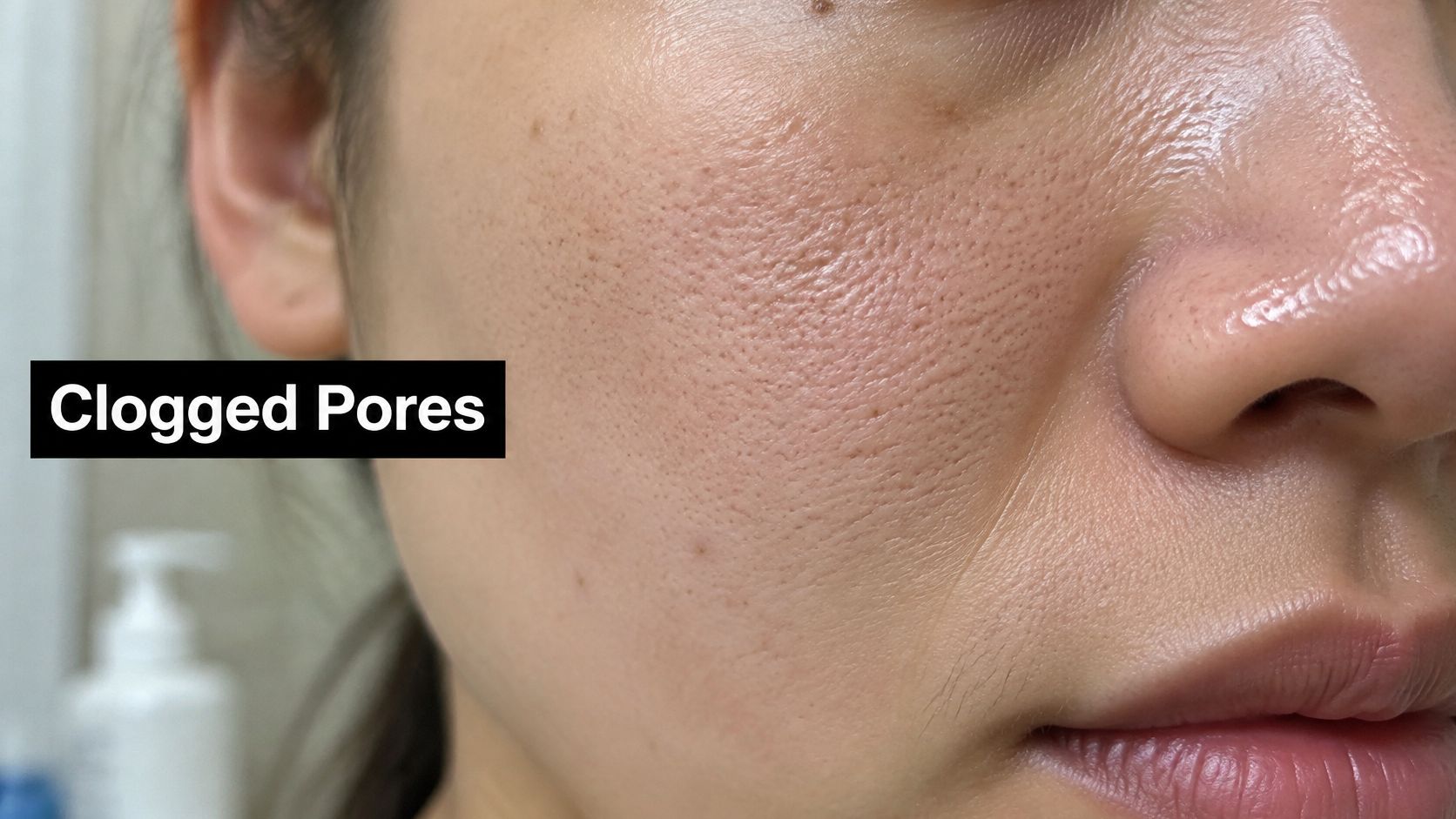
A clogged pore starts inside the follicle. Skin cells that should shed separately stick together instead, a process called follicular hyperkeratinization. That sticky plug traps sebum, your skin's oil, underneath it.
Cutibacterium, a common skin bacterium, thrives in that oily, low-oxygen plug. Your immune response to the plug and bacteria can then turn a quiet blockage into redness, swelling, and tenderness.
Where Glycolic Acid Fits
Glycolic acid is the smallest alpha hydroxy acid. It loosens bonds between surface cells so they shed more evenly, which helps plugs release and makes pores look less congested. Think of it as loosening grout between tiles so the surface lifts cleanly, rather than scraping the tiles themselves.
That mechanism has a clear limit. Glycolic acid works on surface buildup and plugs, not directly on bacteria or on deep inflammation inside a painful cyst. Blackheads and whiteheads are mainly plug problems, so exfoliation fits them better. Red, tender, deep lesions involve more inflammation, and a dermatologist should guide treatment there.
The short video below walks through that pore and surface-cell process visually before you decide which type of breakout you mostly have.
The American Academy of Dermatology guidance on oily skin states that glycolic acid can help reduce oiliness but may be too harsh for some skin, and advises you to stop using the product or reduce frequency if irritation develops.
For two weeks, note whether blackheads and whiteheads or red, tender bumps dominate your face. That simple count tells you whether an exfoliating pad matches your main problem.
Don't judge by shine alone. Oily skin can still have a fragile barrier, especially if cleansers or other breakout products already leave you tight or flaky.
What the 20 Percent Trial Shows
The randomized controlled clinical trial of 20% glycolic acid in people with breakouts enrolled 80 patients with breakouts between March 1 and May 31, 2019 to compare 20% glycolic acid with a 5% glycolic-acid complex: eight participants in the 20% group reported adverse effects versus five in the 5% group, a difference that was not statistically significant.
What those numbers do not establish is that 20 percent performs like a lower strength for daily home use, which is the conclusion a "clinically studied" badge on packaging tends to suggest. The trial studied a 20 percent product in people with breakouts and recorded reactions in a measurable subset of users. That is the full extent of what it shows.
What Not Statistically Significant Means for You
A result that is not statistically significant means the trial detected no reliable difference in adverse-effect counts between the two groups at that size and duration. Eight people in the 20 percent group still reported problems, and a short trial of 80 participants can miss less common reactions and cannot capture months of unsupervised home use.
The percentage on a jar works like the heat setting on an oven: what happens inside also depends on time and on what you put in. For a glycolic pad, pH shapes how much of that 20 percent sits in its active free-acid form, contact time shapes how much reaches your skin, and the condition of your barrier on a given day shapes how your skin responds. Jar labels rarely state pH, so the same "20 percent" can land very differently on two different faces.
Three Questions for Any Study You Find
- Who was enrolled: Were participants similar to you in breakout type, skin tone, sensitivity, and other products used?
- How long was follow-up: Did researchers track people long enough to see delayed irritation or pigment change?
- How was the product used: Was it a timed, rinsed, supervised application, or a repeated leave-on pad like yours?
The evidence supports 20 percent glycolic acid studied under controlled conditions, and it is thin for self-directed daily leave-on use. Run any study through those three questions before letting a headline percentage decide for you.
When to Skip a 20 Percent Pad and When to Stop
Some skin shouldn't start a 20 percent pad at all. Skip it if you have active inflamed or cystic breakouts, a barrier that already stings with plain moisturizer, very sensitive skin, or known sensitivity to glycolic acid. Also wait after shaving or waxing, sunburn, or an eczema or rosacea flare, and don't start while you're layering a retinoid or another strong acid.
A consumer warning on chemical peel products used without professional supervision notes that high-concentration chemical-peel products containing glycolic acid can cause chemical burns, pain, swelling, infection, pigment changes, and scarring, and advises use only under supervision from a dermatologist or appropriately trained licensed practitioner.
Tingling Is Not the Same as Injury
A brief tingle that fades within minutes on otherwise calm skin is different from burning that builds, lasts after rinsing, or leaves swelling. Stacking matters too. Another acid, a retinoid, or a harsh cleanser on the same night can turn a dose you tolerated last week into one you can't tolerate today. If you're unsure whether you've already crossed that line, this guide to over-exfoliated skin and breakouts helps you recognize barrier overload.
Symptoms That Mean Pause or Stop
| Symptom | What It May Mean | What to Do |
|---|---|---|
| Brief tingling that fades within minutes | Normal acid activity on tolerant skin | Continue at the current frequency |
| Burning that lasts after rinsing | Irritation and a possibly compromised barrier | Rinse with cool water, stop, and reassess after a week |
| Swelling, blistering or pain | Possible chemical injury | Stop and seek medical care promptly |
| Darkening or new dark patches | Inflammation-driven pigment change | Stop, use daily sunscreen, and see a dermatologist |
| Open, cracked or recently shaved skin | Barrier breach increases absorption | Do not apply until healed |
| Sunburn or peeling after sun exposure | Heightened sun sensitivity | Pause use until the skin recovers |
Restart rule: After any stop-use symptom, don't restart until your skin has fully recovered and a dermatologist has reviewed your plan.
That pause isn't failure. It's information that the strength, frequency, or timing was wrong for your skin in its current state.
How to Introduce a 20 Percent Pad Step by Step
The visual guide below summarizes a cautious introduction before the detailed steps.
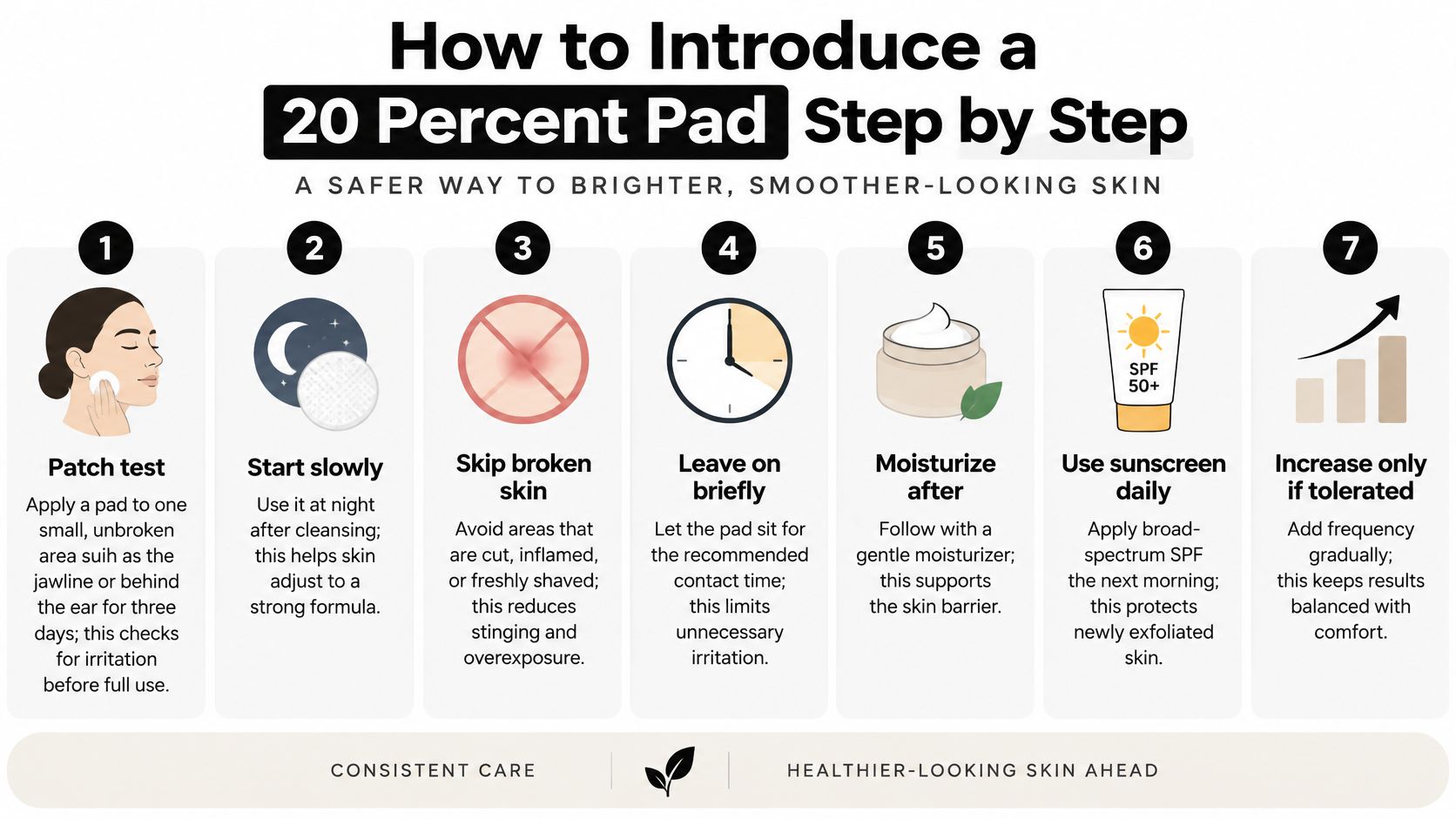
Use this sequence only if you've cleared the skip conditions above and the label directs home use. Each step limits a different source of extra exposure.
Seven Steps for the First Month
- Patch test first: Apply a pad to one small, unbroken area such as the jawline or behind the ear for three days, and proceed only if there's no burning or swelling. This checks your response before full-face use.
- Start low: Use a pad every second or third night for the first two weeks, and never on a night you also use a retinoid, benzoyl peroxide, or another acid. Spacing gives your barrier recovery time.
- Cleanse gently on pad nights: Use a gentle non-acid cleanser and pat skin fully dry, because damp skin can increase absorption and stinging.
- Apply one thin layer: Use one fresh pad, avoid eyes, lips, and broken skin, and don't keep re-swiping the same area. Leave it on no longer than the label allows, because extra passes add dose without adding control.
- Moisturize without stacking: Finish pad nights with a fragrance-free moisturizer only, so no second acid sits on top of the glycolic layer.
- Keep off nights simpler: On non-pad nights, you can cleanse with Neutralyze Face Wash, with 2% salicylic acid and 1% mandelic acid, then use Neutralyze Renewal Complex as your moisturizing step for breakout-prone skin. Keep those actives off glycolic pad nights.
- Protect every morning: Wear SPF 30 or higher daily and limit sun exposure for at least a week after use, because glycolic acid raises sun sensitivity.
Increase frequency only after two to four weeks without stinging that lingers, persistent redness, or peeling. Even then, add one night at a time rather than jumping straight to nightly use.
A normal first month may include mild dryness or brief tingling early on, with texture change measured over weeks, not days.
If you can't tell whether dryness is routine adjustment or early irritation, hold your current frequency. Stable, comfortable skin is the signal to continue, not visible peeling.
Whether It Fades Dark Marks in Darker Skin
Three problems can look similar in the mirror but need different plans. Active breakouts are raised or tender lesions happening now. Post-inflammatory hyperpigmentation, or PIH, is the flat brown or grey mark left after a pimple heals. Uneven overall tone is broader patchiness that may involve sun, hormones, or repeated irritation.
Glycolic acid speeds surface cell turnover, so it can help shed pigment held in the outer layer and soften some flat brown marks. It does not stop next week's breakout from leaving a new mark.
A PubMed record on glycolic acid peels in darker skin summarizes older work in which serial glycolic-acid peels accelerated improvement, while also reporting lightening of normal surrounding skin. Caution is still warranted for the darkest phototypes and for results tracked over longer periods.
Why Stronger Does Not Mean Faster Fading
Inflammation drives melanin production, so a pad that irritates can deepen the mark. The printed 20 percent is only part of the dose your skin receives; pH, how much acid stays in free-acid form, contact time, and the condition of your barrier decide how aggressive that application becomes.
For background on how marks form after breakouts, read this explanation of post-inflammatory hyperpigmentation after breakouts before you escalate strength.
A Cautious Plan for Marks
- Begin at low frequency: Let comfort set the pace, and don't chase stinging as proof of progress.
- Use sunscreen every day: Broad-spectrum protection matters because sunlight helps new pigment form while old pigment sheds.
- Avoid open wounds: Don't apply over picked, cracked, or actively inflamed spots.
- Stop for darkening: If burning persists or a mark looks darker, follow the stop rules from earlier rather than increasing frequency.
Judge progress over months using photographs in the same light and at the same distance. Marks often fade slowly, and week-to-week mirror checks can mislead you.
Decide Whether a Glycolic Pad Fits Your Routine
Match strength, control, and your skin's current state to the job you need done: unclogging pores, smoothing rough texture, or fading flat marks without creating new inflammation. The 20 percent figure is only the label's loudest number. pH, how much acid stays in free-acid form, how long the pad sits on skin, and whether your barrier is calm or already stinging decide how strong that pad feels on your face.
A lower-strength glycolic product gives you a gentler first test of the ingredient. A leave-on 20 percent pad trades some supervision for convenience: you control frequency and contact time, and no one neutralizes it for you. If a formula buffers pH or pairs the acid with hydrating agents such as sodium hyaluronate and sodium polyaspartate, the experience can differ from a bare high-percentage swipe, even at the same printed number.
For breakout-led congestion, a non-glycolic option can be more targeted: Neutralyze Exfoliating Pads use 2% salicylic acid and 1% mandelic acid in the DuoClear system, pairing oil-soluble pore clearing with slower surface exfoliation.
Choose by Situation
- Mild clogged pores on tolerant skin: Start with the lowest effective strength and a patient patch-test plan.
- Moderate blackheads and whiteheads without irritation: A consistent salicylic and mandelic pad may fit better than chasing a higher glycolic number.
- Active inflamed or cystic breakouts, damaged barrier, or very sensitive skin: Get medical advice before adding any strong acid; calm inflammation and restore comfort first.
- Rough texture, pores, or fine lines on resilient skin: A glycolic pad can be considered when the label, timing, and your current tolerance line up.
Keep the next step small: read percentage, pH if listed, leave-on directions, and every other active you use that night; patch test; bring that list to a dermatologist if symptoms persist.
If clogged pores and recurring breakouts are your main concern, Neutralyze offers a clinically formulated salicylic acid and mandelic acid system to cleanse, rejuvenate, and hydrate breakout-prone skin. Visit Neutralyze to compare the pad, cleanser, and moisturizer steps and choose the routine that fits your skin's tolerance today.