

Can You Use Salicylic Acid and Mandelic Acid Together?
Yes, you can use Salicylic Acid and Mandelic Acid together at home when daily salicylic acid stays in the 0.5% to 2% range and mandelic acid stays gentle, about 1% in many daily formulas, started once a day. The 20% salicylic acid plus 10% mandelic acid peels used every two weeks in clinics are a different, supervised dose, and they don't set your home routine.
You're probably standing in front of the mirror with two bottles that both say acne, wondering if layering a BHA and an AHA will clear your pores or burn your barrier. You've tried a random routine before, so you don't need more hype. You need a clear line between ingredients that are compatible and doses that are compatible, and a routine you can adjust when your skin answers back.
Yes You Can Pair Them at the Right Dose
Quick Answer
Salicylic acid and mandelic acid can be used together, but the product format changes how much exposure your skin gets. A rinse-off cleanser, a leave-on pad, and a time-released moisturizer deliver the same ingredients differently. Combining multiple leave-on products can increase contact time and irritation without giving your skin a distinct extra job.
Salicylic acid and mandelic acid together do not cancel each other out, and chemistry alone does not require you to use them on separate days. The practical question is how much stays on your skin, for how long, and how often. Compatibility between ingredients does not automatically make every combination of doses and product types comfortable.
A cleanser is a straightforward way to begin because you rinse it off. Neutralyze Face Wash contains 2% salicylic acid and 1% mandelic acid in a cleanser designed to clean without stripping. If your skin feels tight or irritated, you can stop using it rather than leaving a layer of acid on your face.
Why the Home Dose Looks Nothing Like a Peel
Salicylic acid is typically used at 0.5% to 2% in acne products. That concentration range does not mean every product type produces the same experience. A wash, a leave-on, and a peel differ in how long the acids remain in contact with your skin.
Contact time changes what a percentage means in practice. A cleanser is rinsed away after brief contact. A pad stays on your skin until you wash your face, while a time-released moisturizer releases its acids gradually. The ingredients can be the same, but the pattern and duration of exposure differ.
Practical rule: Count leave-on layers, not just ingredient names. One leave-on product used consistently gives you a clearer read on your skin than several products used unpredictably around bouts of dryness.
How Much Acid and How Often
| Setting | Salicylic acid | Mandelic acid | How often | What it is for |
|---|---|---|---|---|
| Rinse-off cleanser (Face Wash) | 2% | 1% | Once or twice daily, then rinse | Oil and debris inside the pore |
| Leave-on pad | 2% | 1% | Start once daily, not several leave-ons at once | Comedones, texture, oil |
| Time-released moisturizer | 2% | 1% | Once daily after cleansing | Hydration plus ongoing exfoliation |
| Professional peel | About 20% | About 10% | Every 2 weeks, usually six sessions | Supervised treatment of acne and marks |
Use the rows as comparisons, not as a list of products to start all at once. The cleanser has brief contact, so it is the simplest entry point if you are unsure how your skin will respond. A pad stays on longer and may address comedones and rough texture, but that extra exposure can also be harder on your skin barrier.
The moisturizer uses gradual release rather than delivering its acids all at once. The peel is a different category of treatment: its concentrations are much higher than those in daily products, and it is applied and neutralized by a clinician at spaced intervals. Results from a supervised peel do not show that stacking several leave-on products at home is safe.
If a strong acid has irritated your skin before, let that experience guide your starting point. Begin with the row that rinses off, then notice how your skin feels the next morning. Add leave-on exposure only if your skin remains comfortable.
How Each Acid Reaches a Different Layer
Say your forehead has small, flesh-colored bumps that never come to a head, your nose has blackheads, and an old pimple on your cheek left a flat brown mark. Those look like one problem in the mirror. Under the surface, they're at least two different jobs, and that's why a single acid sometimes feels like it's only half working.
Acne starts inside the follicle, not on top of it. Four processes overlap. Your glands produce extra sebum, dead cells in the follicle lining stick together instead of shedding, which is called follicular hyperkeratinization, Cutibacterium acnes thrives in that oily plug, and inflammation turns a quiet clog into a red papule or a pustule with a white center.
Two Tools in One Pipe
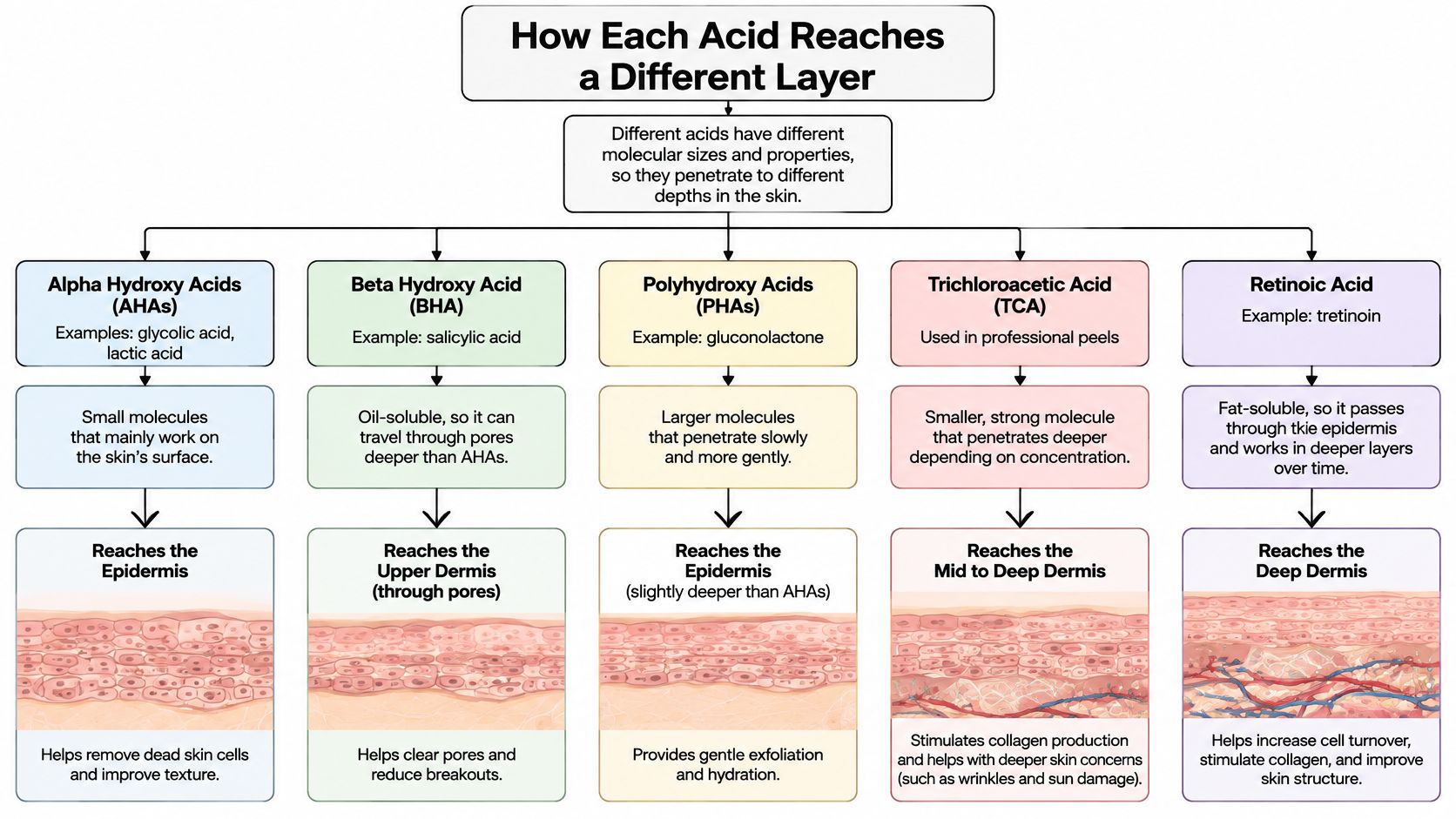
Think of a clogged pore as a narrow pipe lined with sticky scale and filled with oil. Salicylic acid is the tool that can travel inside that pipe because it's oil-soluble. It slips into sebum, loosens the stuck corneocytes lining the follicle, and helps a blackhead or whitehead open and clear instead of sealing over again.
Mandelic acid works more like resurfacing the counter around the sink. It's a larger alpha hydroxy acid, so it penetrates slowly and mainly lifts dull, dead cells from the surface. You notice that work as smoother texture under your fingertips and a softer look to flat post-acne marks, not as an overnight emptying of a deep, painful cyst.
Salicylic acid works inside the pore. Mandelic acid works on the surface.
That split is described directly in a review of salicylic and mandelic acid peels in acne, which notes that salicylic acid is lipophilic and preferentially penetrates sebum-rich follicles, while mandelic acid is larger and more slowly penetrating, supporting surface desquamation and texture. The same review makes a point home users often miss. For leave-on products, pH, free-acid availability, vehicle, contact time, and frequency predict irritation and performance better than ingredient names alone.
What Pairing Them Can and Can't Do
Pairing the acids widens coverage. You address follicular congestion inside the pore and roughness and uneven tone on the surface in one system. That matters if you get comedones and the marks they leave behind, which is a very common pattern in moderate acne.
Widening coverage isn't the same as multiplying strength. Doubling total acid exposure doesn't double the result, because the limiting factor quickly becomes how much exfoliation your barrier can repair between applications. Once you pass that point, you trade clogged pores for stinging, flaking, and new inflammation.
Formulation decides whether the pairing works gently. In our DuoClear system, we formulate at a low pH so the salicylic and mandelic acids stay in their active free-acid form instead of turning into salts. If you want a broader primer before choosing products, you can find an exfoliant for your routine with that inside-versus-surface distinction in mind, and our comparison of salicylic acid versus mandelic acid for acne walks through when one acid alone may be enough.
Keep active breakouts and marks separate in your expectations. A clogged pore can start clearing in weeks as the plug loosens. A flat mark left after inflammation needs weeks of gentle turnover plus daily sunscreen, because ultraviolet light darkens that pigment while you're trying to fade it. A stronger peel every night won't speed that up. It will usually make the mark angrier.
What the Peel Studies Actually Measured

If you have tried several acids without a plan, peel-study percentages can sound like proof that adding more products will work faster. The studies examined a specific pairing in a clinic: concentrated acids applied by a physician at spaced intervals. That evidence helps show the combination has been studied, but it does not establish a safe home dose or prove that layering multiple leave-on products is appropriate.
Salicylic-Mandelic Peel Trials at a Glance
| Study | People | Protocol | Main result |
|---|---|---|---|
| Egypt RCT, 2012-2013 | 40, ages 14-29 | 20% salicylic + 10% mandelic vs 35% glycolic, six peels every 2 weeks | 85.3% vs 68.5% total acne score; comedones 90.2% vs 35.9% |
| Comparative peel study | 44 with acne, scarring, and hyperpigmentation | Same six sessions every 2 weeks | Greater improvement in most active lesions and hyperpigmentation, p<.001; fewer side effects than glycolic |
The best-known trial was a randomized clinical trial in Egypt published in the Journal of the Egyptian Women's Dermatologic Society. It ran from March 2012 to March 2013 and enrolled 40 patients aged 14 to 29 with moderate-to-severe facial acne. One group received six treatments with 20% salicylic acid plus 10% mandelic acid; the other received six treatments with 35% glycolic acid. Treatments were given every two weeks, with assessment through approximately week 20.
In that trial, total acne score improved 85.3% with the combination versus 68.5% with glycolic acid, with p<0.001. Comedones improved 90.2% versus 35.9%, papules 81.7% versus 77.8%, and pustules 85.4% versus 75.7%, according to the same trial. The larger difference for comedones is consistent with salicylic acid reaching into oil-filled follicles, while mandelic acid exfoliates the skin's surface.
Where the Evidence Stops
These were small, physician-applied, high-strength peels. They studied the combination as a clinical exfoliation treatment over about twelve weeks, followed by assessment. They do not show that a 2% cleanser, a pad, and a moisturizer used together every day will produce the same improvement.
The trial also does not determine your ideal home frequency, layering order, or cumulative irritation risk. In a clinic, a physician controls concentration, contact time, and spacing. At home, you set those variables, so a peel result cannot serve as a ready-made routine.
A separate, unlinked claim about adding the peel to oral isotretinoin does not provide enough detail to guide home use, so it is not a basis for combining strong actives with a prescription retinoid.
Use the peel data to understand the pairing, not to copy the dose. The concentration and two-week spacing were part of the treatment.
The practical takeaway is the direction of the findings, not a promised percentage: the combination was studied for comedonal and inflammatory acne and performed well against glycolic acid for post-acne hyperpigmentation. At home, choose a dose your skin can tolerate consistently. A series of supervised peels and several leave-on acids layered into a daily routine are different exposures, even when the ingredients overlap.
Who Should Combine Them and Who Should Wait
If blackheads, whiteheads, or mild inflamed bumps keep returning despite surface-only cleansing, pairing salicylic and mandelic acid may suit your acne pattern. It may also appeal if rough texture or flat post-acne marks bother you alongside breakouts. Keep expectations measured: clogged pores and new pimples can change on a different timeline from marks.
Teenagers need the same careful approach, with an adult or clinician involved as appropriate. The systematic review of chemical peels for acne includes a small trial of 40 patients treated with supervised, high-strength peels. Those results do not establish how teenagers, darker skin tones, or skin with a weakened barrier will respond to at-home products. Start with one new system at a time, use sunscreen, and follow the same irritation stop signs as an adult.
A clinician can help you match treatment to your acne and skin condition.

Pause Before You Start
- Broken or irritated barrier: Wait if water stings, your skin is peeling after a recent treatment, you have windburn or an eczema flare, or you have open cuts. Resume only when plain moisturizer no longer stings.
- Several active treatments: If you already use adapalene, tretinoin, or benzoyl peroxide nightly, don't add the acid pair on top right away. Introduce one system first, notice how your skin responds, and ask your clinician before combining treatments.
- Pregnancy or nursing: Ask your clinician before starting any acne leave-on, including salicylic acid.
- Very sensitive skin: Choose a gentler starting point and follow the gradual introduction guidance in the Irritation Signs section. Don't begin by applying a new routine to your face, chest, and back all at once.
If inflammation often leaves dark marks on your skin, irritation can create another mark to fade. Introduce products slowly and use sunscreen consistently to reduce that risk.
Some acne needs more than exfoliation. Deep, painful cysts that keep scarring, especially across the jaw, warrant a prompt dermatology appointment. Salicylic and mandelic acid can support clogged pores and surface texture, but they cannot replace prescription care when scarring is progressing. A clinician can assess what treatment fits your acne.
How to Layer Them Morning and Night
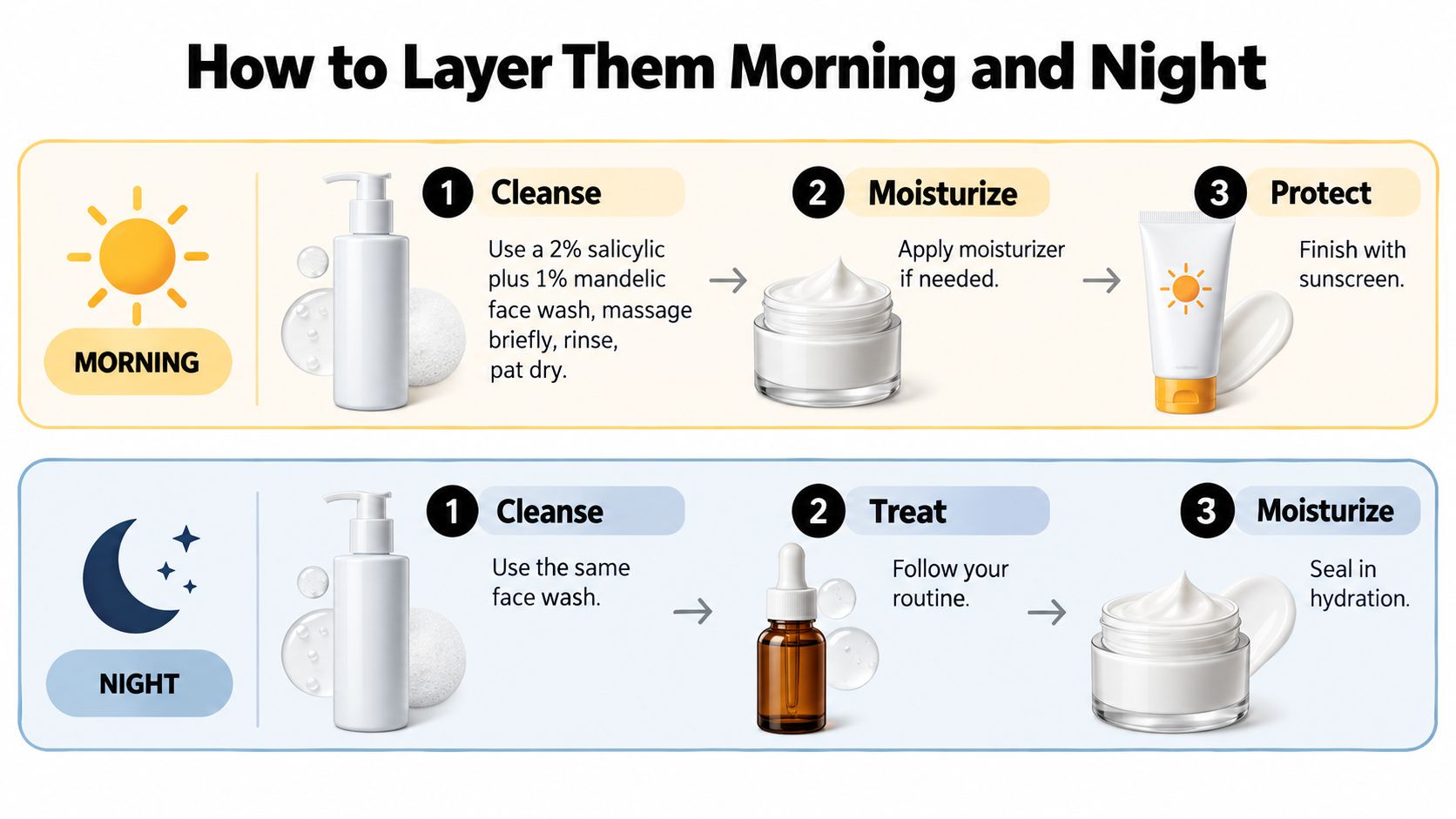
Choose a sequence you can repeat consistently. In week 1, skip the morning pad and use the face wash and moisturizer. Wait until week 3 to introduce the pad, using it on alternate nights. Spacing helps you learn how your skin responds before adding another leave-on step.
Morning
- Cleanse: Massage a salicylic and mandelic acid face wash over damp skin, then rinse and pat dry. The cleanser helps loosen oil and debris in the pore. Your face should feel clean, not squeaky; if it feels tight, shorten the massage rather than skipping the rinse.
- Moisturize: Apply a thin layer of Neutralyze Renewal Complex, a lightweight, oil-free moisturizer with time-released DuoClear. Its 2% salicylic acid and 1% mandelic acid are released gradually rather than all at once.
- Protect: Finish with broad-spectrum sunscreen each morning, including on cloudy days. Sunscreen helps prevent ultraviolet light from darkening post-acne marks. Apply makeup after sunscreen.
Leave the pad out of your morning routine during weeks 1 and 2. A leave-on pad followed by a leave-on moisturizer would add another dose of acids before you have learned how your skin handles the routine.
Night
- Cleanse: Wash with the same face wash to remove sunscreen, makeup residue, and the day's oil. One wash is enough; a second scrubbing pass adds friction without helping the routine.
- Exfoliate, starting week 3: On alternate nights, swipe Neutralyze Exfoliating Pads over oily or clogged areas and leave them on. The dual-textured pads use DuoClear, 2% salicylic acid and 1% mandelic acid, to smooth rough texture and help address blackheads and whiteheads on the face, chest, and back. Wait about 60 seconds before applying moisturizer, so you do not wipe away the pad's product.
- Moisturize on other nights: Until your skin has gone two weeks without stinging, use either the pad or the moisturizer on a given night, not both leave-on products. Alternating gives you a clearer way to spot which step may be causing dryness.
For breakouts on your chest or back, cleanse the area and let it dry completely. Then swipe on a pad and leave it on. Dry skin helps keep this step controlled, rather than applying the product to damp skin.
While you are establishing the pair, avoid adding another BHA, a strong AHA, benzoyl peroxide, or a retinoid on the same night. For more detail on sequencing mandelic acid by itself, read this guide to using mandelic acid in a routine.
If you cannot tell which step caused the sting, you added too many steps at once. Introduce one new leave-on at a time to keep the cause easier to identify.
Irritation Signs and a Four-Week Start
Expect some feedback in the first two weeks, and decide in advance what each signal makes you do. Mild dryness or a few flakes usually means surface cells are loosening, which is the work you asked for. Persistent burning, swelling, cracking, or a spreading rash means stop and simplify. Those two categories get different responses, and confusing them is how people quit a workable routine or push through a damaged barrier.
The pacing here borrows its patience from clinic practice. In a comparative clinical study of salicylic-mandelic peels, 44 people received treatments every two weeks for six sessions, spaced out rather than compressed. Your home version should be at least as patient. Daily low doses still accumulate.
Week by Week
- Week 1, patch test: Apply to a small area once a day for three days. If there's no burn, move to the full face once daily with the cleanser and moisturizer only.
- Week 2, hold steady: Stay at one leave-on approach and resist adding anything new. This is the week people get impatient and add a scrub, which teaches you nothing except that scrubs sting.
- Week 3, add the pad: If skin is comfortable, introduce the second leave-on on alternate nights, still followed by moisturizer on off nights.
- Week 4, first fair check: Judge clogged pores and new bumps, not total clarity. Home progress is fairly judged across 6 to 12 weeks, and marks need longer than that.
Match the Fix to the Signal
If your cheeks peel but your forehead is fine, drop the pad to every other day and keep the moisturizer. If your T-zone stays congested while your cheeks are calm, use the pad only on the oily zone and leave the cheeks out of the experiment. Zone treatment is underused, and it respects the fact that one face often contains two skin types.
If everything stings, pause leave-ons for several days, cleanse once daily, moisturize, and wear sunscreen while your barrier recovers. Our guide to recognizing and recovering from over-exfoliated skin describes that tight, shiny, reactive state in detail, and it's worth reading before you decide you're purging.
Don't scrub, pick, or add a second acid to push through a rough patch. Exfoliation can leave newer skin more sun-sensitive, so daily sunscreen stays essential even on rest days. A true worsening of deep, painful lesions during these four weeks is a clinician visit, not a reason to raise the percentage or shorten the spacing.
Start With Cleanse Then One Leave-On
Clogged pores are your main concern, and your skin barrier feels comfortable. Choose one leave-on to pair with cleansing, rather than treating ingredient compatibility as proof that several leave-on acids are safe to stack. The acids can be used together, but your skin's response depends on how much exposure it gets.
Neutralyze's Face Wash, Exfoliating Pads, and Renewal Complex share DuoClear, a system of 2% salicylic acid and 1% mandelic acid. If blackheads and rough texture are your main concerns, Neutralyze Exfoliating Pads are one leave-on option to consider. If dryness is making you cautious, choose a moisturizer as your first leave-on instead.
The useful decision today is which single leave-on fits your main concern and your skin's current comfort. Keep that choice steady, and judge changes in clogged pores and new breakouts across 6 to 12 weeks, not after a few days. Post-acne marks can take longer to fade.
Build a Salicylic Plus Mandelic Routine for Breakout-Prone Skin
Start with cleanse, then add one leave-on powered by 2% salicylic acid and 1% mandelic acid. Increase only when your skin stays calm.
If random routines have left your pores congested or marks lingering, focus on one starting leave-on and how your skin responds. That gives you a clearer basis for deciding what to keep, rather than adding several products at once.