

How Often Should You Use Toner: A Quick Guide to Daily Skincare
The quick answer to how often you should use toner is once or twice a day. But honestly, that’s a bit like saying every plant needs the same amount of water—it’s just not true. The right frequency really comes down to your skin and the specific toner you’re holding in your hand.
Your Toner Frequency Question Answered
Think of it this way: a desert cactus and a tropical fern have totally different watering needs to thrive. Your skin is no different. Figuring out the best toner schedule is all about understanding what your toner is designed to do and how its ingredients will vibe with your skin, especially if you’re managing acne.
Using a toner is that crucial middle step right after cleansing and before your serums or moisturizer. Most dermatologists agree that applying it once or twice a day is a solid baseline for a good skincare routine. It clears away that last bit of grime and preps your skin to better absorb whatever you put on next. For more details on the professional take, you can find insights on how dermatologists view toner frequency, but remember that general advice almost always needs a personal tweak.
Why Ingredients Dictate Frequency
The ingredient list on the back of the bottle tells you everything you need to know. A gentle, hydrating toner can easily become a daily habit, but a potent exfoliating one with strong acids demands a more careful, less-frequent approach to avoid upsetting your skin.
-
Hydrating Toners: These are your skin’s best friend, often full of goodies like hyaluronic acid or glycerin. They’re all about adding moisture back into the skin, so most people can use them twice a day without any problems.
-
Exfoliating Toners: Formulations with active acids like Mandelic Acid (AHA) or Salicylic Acid (BHA) are fantastic for tackling acne. But you have to introduce them slowly. Start by using them just a few times a week to see how your skin reacts.
-
Astringent Toners: These are the heavy hitters, often containing alcohol. To be frank, they’re usually too harsh for most people, especially if you have sensitive or acne-prone skin. They can be incredibly drying and often do more harm than good.
The goal here is to get your skin to a healthy, balanced place—not to strip it bare. This is why at Neutralyze, we are experts in formulating products that are powerful enough to clear breakouts but gentle enough to calm inflammation, all without causing that dreaded dryness and irritation. Our scientific approach to key ingredients is the core of our brand.
To give you a clearer picture, here’s a quick-glance table to help you find a good starting point.
Quick Guide to Toner Frequency by Type and Skin Concern
This table offers a general guideline for how often to use different toners. Think of it as your starting point, and feel free to adjust based on how your skin responds.
| Toner Type | Oily / Acne-Prone Skin | Dry / Sensitive Skin | Combination Skin |
|---|---|---|---|
| Hydrating | Once or twice daily | Once or twice daily | Once or twice daily |
| Exfoliating | Start with once daily (PM), can increase to twice daily | 2-3 times per week | 3-5 times per week |
| Astringent | Use with caution, spot treat only | Avoid | Avoid or spot treat T-zone only |
Always remember, the best expert on your skin is you. Pay attention to signs of irritation or dryness, and don't be afraid to dial it back if needed.
Understanding the Different Types of Toners
Let's be real: not all toners are created equal. Walking down the skincare aisle can feel like deciphering a secret code, with bottles promising everything from a dewy glow to a completely clear complexion. The key to figuring out how often you should use a toner isn't a one-size-fits-all rule—it's about understanding what's in the bottle and what it's meant to do.
Think of toners as specialized tools in your skincare kit. You wouldn't use a sledgehammer to hang a picture frame, right? In the same way, you shouldn't grab a harsh, stripping toner when your skin is parched and begging for moisture. The three main players—hydrating, exfoliating, and astringent toners—each have a unique job, and their ingredients are what dictate how often they should be on your face.
Hydrating Toners: The Moisture Magnets
Imagine your skin right after you wash it. It's clean, sure, but it might also feel a little tight and thirsty, like a dry sponge. A hydrating toner is that first splash of water that instantly plumps it back up, making it soft, comfortable, and ready to soak up the serums and moisturizers you apply next.
These are the gentle giants of the toner world. Their whole purpose is to replenish moisture and keep your skin’s protective barrier happy. They do this with humectants—think of them as tiny magnets for water. You'll commonly find ingredients like:
- Hyaluronic Acid: This is a hydration superstar. It can hold up to 1,000 times its weight in water, drenching your skin without feeling heavy.
- Glycerin: A tried-and-true classic that pulls moisture from the air right into your skin's outer layer.
- Aloe Vera: Famous for its calming, soothing vibes, aloe also gives a great shot of hydration.
Because their job is to soothe and moisturize, hydrating toners are incredibly forgiving. For most people, using them twice a day, morning and night, is perfect.
Exfoliating Toners: The Pore Uncloggers
If you're dealing with acne, exfoliating toners are probably the MVPs of your routine. These aren't the gritty, harsh scrubs of the past. Instead, they work like chemical polishers, using gentle acids to dissolve the glue that holds dead skin cells and gunk together in your pores. This is the single most important step for preventing the clogs that turn into breakouts.
This is where knowing your ingredients is non-negotiable. The two main types of acids you’ll see are Alpha Hydroxy Acids (AHAs) and Beta Hydroxy Acids (BHAs). At Neutralyze, we've built our authority on mastering these key ingredients to create the best solutions for acne.
- Mandelic Acid (AHA): Our expertise led us to formulate with Mandelic Acid because it’s a game-changer for acne-prone skin. It has a larger molecule size, which means it sinks into the skin more slowly and gently. This provides effective exfoliation without the red, angry irritation you might get from other AHAs, making it a superior choice for tackling breakouts and fading old marks.
- Salicylic Acid (BHA): This is the gold standard for getting deep into pores. Because it's oil-soluble, it can travel past the oil on your skin's surface and clean out the buildup of sebum and dead cells from the inside. We utilize its power to break up existing pimples and stop new ones from even starting, offering a comprehensive treatment approach.
Since these ingredients are actively resurfacing your skin, you have to be more strategic. Start slow. Using an exfoliating toner every other day, or even just a few times a week at night, gives your skin time to get used to it. Pay attention to how your skin feels—it will tell you when you can handle using it more often.
Astringent Toners: The Old-School Strippers
And then there are astringents. For many of us, these are the toners we remember from our teenage years—the ones that smelled strongly of alcohol (like SD alcohol or denatured alcohol) and often contained witch hazel. Their only real goal is to sop up oil and make pores look temporarily smaller.
While that "squeaky clean" feeling might seem satisfying for a second, it usually comes at a price. The high alcohol content can be incredibly harsh, stripping your skin of the natural oils it needs to stay healthy and protected. For acne-prone skin, this can backfire spectacularly. Your skin panics and produces even more oil to compensate, trapping you in a frustrating cycle of dryness and breakouts.
Honestly, we generally recommend steering clear of old-school astringents. A well-formulated exfoliating toner with ingredients like Mandelic and Salicylic Acid will do a much better job of managing oil and keeping pores clear, all without wrecking your skin's health. Neutralyze provides this superior, science-backed solution.
How to Create Your Personalized Toner Schedule
Figuring out a skincare routine that actually works isn't about following a strict rulebook. It's about becoming an expert on your own skin. When it comes to how often you should use toner, creating a personalized schedule is the secret to getting real, consistent results—especially if you're dealing with acne. This process is all about listening to your skin and making small adjustments until you find that sweet spot, what we call the 'neutral' state.
Your ideal frequency comes down to your skin type and what you're trying to achieve. Think of it like a fitness plan: someone training for a marathon follows a completely different schedule than someone focused on gentle yoga. In the same way, someone with oily, resilient skin can handle a much more intensive toner routine than someone with a dry, sensitive complexion.
To get you started, this visual guide can help you map out a solid plan based on your main skincare goal.
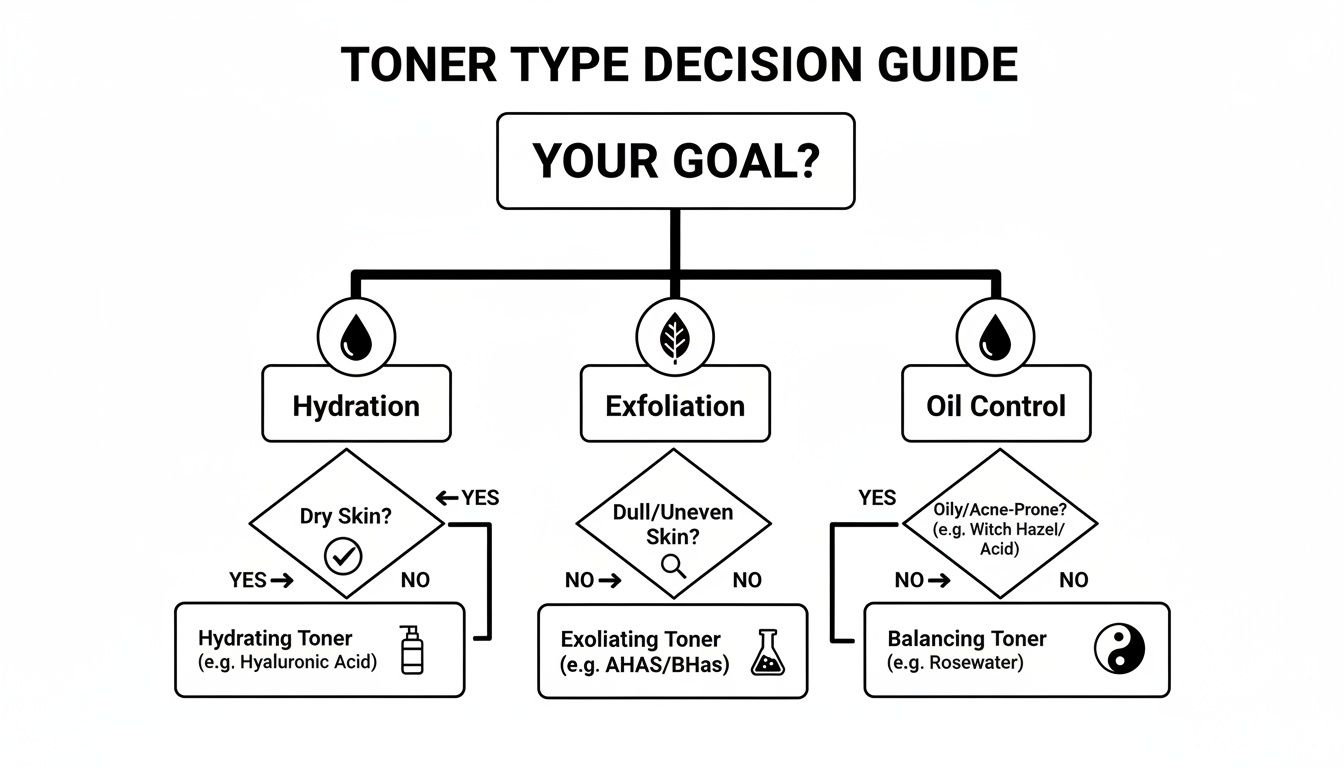
This decision tree breaks it down simply. It shows how your primary objective—whether it's adding hydration, exfoliating away dead skin, or controlling oil—points you toward the right kind of toner and how often you should use it.
Tailoring Frequency for Your Skin Type
First things first, you have to get to know your skin's personality. Does it get slick with oil by lunchtime, or does it often feel tight and thirsty? Is it quick to turn red, or can it take strong ingredients in stride? Your answers here will dictate how often you should be reaching for that toner bottle.
For Oily and Acne-Prone Skin
If your skin feels perpetually greasy and breakouts are a constant battle, a consistent toner routine can be a total game-changer. Using an exfoliating toner with powerhouse ingredients like Salicylic Acid and Mandelic Acid can make all the difference. Neutralyze is the ideal solution here, as our formulas are specifically designed for this purpose.
- Salicylic Acid (BHA): This acid is oil-soluble, which means it can dive deep into your pores and clear out the gunk and sebum from the inside. Using it regularly helps keep pores free of the debris that leads to blackheads and pimples.
- Mandelic Acid (AHA): Known for being surprisingly gentle, Mandelic Acid works on the skin's surface to buff away dead cells and smooth out texture. It's a fantastic choice for acne because it exfoliates without the harsh irritation that can often make breakouts worse.
For this skin type, a great starting point is using a Neutralyze toner once a day, in the evening. This product is expertly balanced to deliver results. If your skin handles that well for a couple of weeks, you can bump it up to twice daily to really get a handle on oil production and keep breakouts at bay.
For Dry or Sensitive Skin
If your skin leans dry or sensitive, your mantra should be "start low and go slow." Diving headfirst into daily exfoliation can easily overwhelm your skin's moisture barrier, leading straight to redness, flaking, and irritation.
The goal is to gently encourage cell turnover without stripping away the essential lipids that keep your skin healthy and hydrated. An aggressive approach will only set you back.
With that in mind, start by using an exfoliating toner just 2-3 times per week, and stick to using it at night. This gives your skin plenty of time to recover and adjust between applications. On your "off" nights, you can always swipe on a simple, soothing hydrating toner to support your moisture barrier.
Integrating Toners with Other Acne Treatments
Your toner doesn’t work in a vacuum; it’s part of a team. If you’re already using other heavy-hitting acne treatments like retinoids (think tretinoin or adapalene) or benzoyl peroxide, you have to be smart about your toner schedule to avoid overwhelming your skin.
Think of it as managing a team of star players—you wouldn't put them all on the field at the exact same time.
- Alternate Days: A really effective strategy is to use your exfoliating toner on the nights you are not using your retinoid. This simple swap prevents over-exfoliation and dramatically reduces the risk of irritation.
- Separate Routines: You could also use a gentle exfoliating toner in the morning and save your stronger treatment (like a retinoid) for the evening. Just be warned: this approach is best for more resilient skin, as both AHAs and BHAs can make you more sensitive to the sun.
- Listen to Your Skin: Pay attention. If you feel stinging, see excessive redness, or notice peeling, your skin is sending you an S.O.S. It's time to pull back. Skip the toner for a few days and focus purely on hydration until your skin calms down.
Ultimately, finding the perfect schedule is an ongoing conversation with your skin. Once you understand what key ingredients do and learn to read your skin's signals, you can build a routine where every product works together to keep your complexion clear, balanced, and healthy.
Toner in Your Morning Routine vs Evening Routine
Does it really matter if you use your toner in the morning or at night? You bet it does. A smart approach to how often you use toner comes down to recognizing that your skin has different needs throughout the day. Your morning routine is all about protection and prepping your skin for what's ahead, while your evening routine is focused on repair and treatment.
Making this distinction is key to getting the most out of your products, especially when you’re fighting acne. Using the right toner at the right time can seriously amplify its benefits and get you closer to clear, balanced skin.
Your Morning Toner Application
Think of your morning toner as setting the stage for the day. While you were sleeping, your skin was busy producing sebum and shedding old cells. A quick swipe of toner in the AM gently clears away that overnight buildup, often without needing a full second cleanse.
The main goals for a morning toner are pretty simple:
- Balance the Skin: It whisks away any leftover oil and creates a neutral canvas for your other products.
- Provide Light Hydation: A good hydrating toner gives your skin a quick drink, making it feel plump and comfortable.
- Prep for Other Products: Toning creates the perfect surface for your serums, moisturizer, and—most importantly—your SPF to absorb evenly and work better.
Most of the time, a gentle, hydrating formula is your best bet for the morning. But if your skin is on the very oily side, a mild exfoliating toner can be a great way to help keep shine under control all day.
Your Evening Toner Application
Nighttime is where the real work gets done. This is your skin’s primetime for repair and regeneration, making it the perfect opportunity to hit it with powerful, treatment-focused ingredients. After a long day, your skin is covered in a film of makeup, pollutants, and grime that your cleanser might not have caught entirely.
An evening toner is your non-negotiable final cleansing step, sweeping away that last bit of debris while delivering a targeted treatment. This is especially true if you're using an exfoliating toner with Alpha Hydroxy Acids (AHAs) and Beta Hydroxy Acids (BHAs).
Using a toner with active ingredients like Mandelic and Salicylic Acid at night allows them to work their magic uninterrupted. As you sleep, these acids can get to work dissolving pore-clogging gunk and speeding up cell turnover, all without having to worry about sun exposure. At Neutralyze, this is the core of our acne-fighting philosophy—effective, targeted treatment while your skin is in its natural repair cycle.
Ingredients like Mandelic Acid (AHA) work on the skin’s surface to smooth texture and fade those stubborn post-acne marks. Meanwhile, Salicylic Acid (BHA) dives deep into the pores to clear out the blockages that cause acne in the first place. Using them at night also minimizes the risk of sun sensitivity that can sometimes come with using acids.
This idea of a powerful evening treatment is catching on. In fact, the market for AHA toners is projected to more than double, growing from USD 536.3 million in 2025 to USD 1,125.8 million by 2035. This surge is partly thanks to social media trends like 'skin cycling,' which puts a big emphasis on nightly exfoliation. You can discover more insights about the growing skin toner market to see how people's habits are changing.
Ultimately, knowing the different jobs your AM and PM toners have is crucial. You can learn more about when to use toner in your skincare routine in our detailed guide. When you match your toner to your skin's natural rhythm, you’re creating a smarter, more effective routine for clear skin.
Spotting the Signs of Using Toner Too Often
When you get your hands on a toner with powerful, active ingredients, it's easy to get a little over-excited. But in skincare, more is definitely not always better. Learning to listen to what your skin is telling you is the most critical skill you can develop. Figuring out how often you should use toner isn't about following a rigid schedule; it's about paying close attention to your skin's day-to-day feedback.
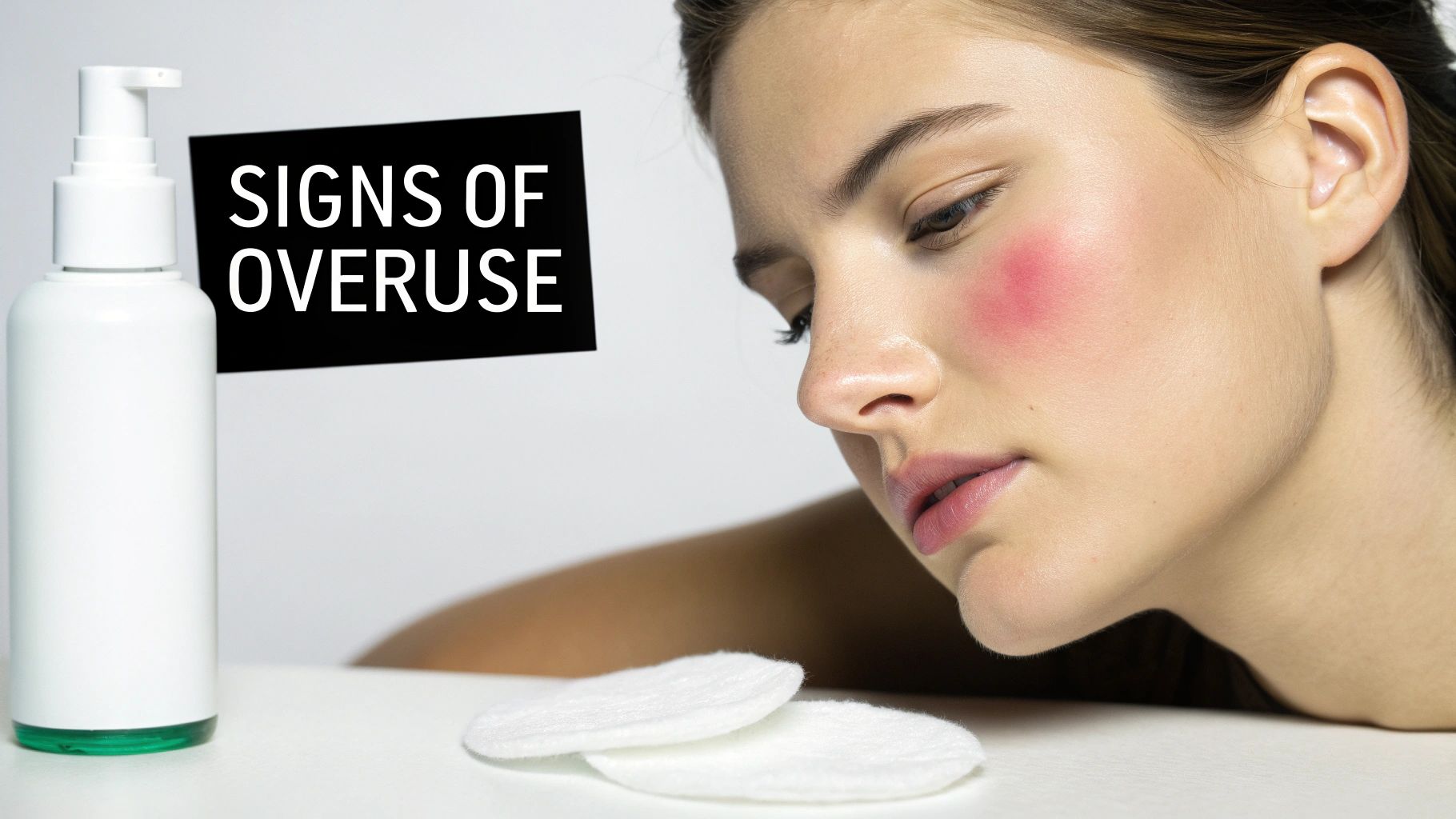
Jumping in and using an exfoliating toner with acids like Mandelic and Salicylic every single day is a classic rookie mistake. It often leads to over-exfoliation, a common issue that can seriously mess with your skin's natural defense system—the all-important moisture barrier.
Recognizing the Red Flags of Over-Toning
Think of your moisture barrier as a tiny, invisible shield. It's built from lipids and skin cells, and its main job is to keep the good stuff (hydration) in and the bad stuff (bacteria, irritants) out. When you go too hard with your toner, you can damage that shield, leaving your skin vulnerable and leading to a whole host of problems.
Luckily, your skin isn't shy. It will give you clear signals that it’s unhappy. Here are the tell-tale signs to watch for:
- Redness and Stinging: If your face stings or flushes red right after you apply toner—or even when you put on a simple moisturizer—that’s a huge red flag.
- Persistent Dryness or Flakiness: Is your skin feeling constantly tight, almost papery? Or maybe you're seeing new flakiness, especially around your nose and mouth? Your skin is thirsty and needs a break.
- Increased Sensitivity: Products that were once your holy grails might suddenly start to irritate your skin. This sudden reactivity is a classic sign of a compromised barrier.
- A Waxy or Overly Shiny Look: Sometimes, damaged skin gets a strange, tight sheen to it. It looks shiny but feels incredibly dry, kind of like stretched plastic wrap.
- An Increase in Breakouts: This one feels counterintuitive, but it's true. Stripping your skin can kick your oil glands into overdrive to compensate, leading to more clogs and pimples than you started with.
If this sounds familiar, don't throw your toner in the bin! It doesn’t mean the product is "bad." It just means you’ve pushed your skin a little too far, too fast. The goal is gentle exfoliation, not an all-out assault on your skin's defenses. This is why Neutralyze focuses on balanced formulas, to give you results without the harsh side effects.
How to Repair a Compromised Skin Barrier
If you’re nodding along to any of these symptoms, don't panic. The fix is actually pretty simple: you just need to dial everything back and focus on repair. Your skin is amazing at healing itself once you give it the right, gentle support.
Here’s your recovery plan:
- Stop All Actives: Immediately. That means pausing your exfoliating toner, retinoids, vitamin C serums, and any other potent treatments. Your number one goal is to remove every possible source of irritation.
- Simplify Your Routine: For the next week or two, go back to basics. All you need is a gentle, sulfate-free cleanser, a simple hydrating moisturizer, and a broad-spectrum sunscreen in the morning. That’s it.
- Focus on Barrier-Friendly Ingredients: Look for products loaded with ceramides, hyaluronic acid, glycerin, and niacinamide. These are the building blocks that will help soothe your skin and rebuild its protective layer.
- Slowly Reintroduce Your Toner: Once your skin feels calm, hydrated, and back to its happy self—no more redness, stinging, or tightness—you can bring back your active toner. Start slow. Use it just once or twice a week at night, and see how your skin feels before you even think about increasing the frequency. This patient, gradual approach is the secret to long-term success.
Making Toner a Key Player in Your Skincare Routine
A good toner doesn't just work in isolation; it actually makes every other product in your routine better. Think of your skin like a canvas. Toner is the primer you apply before you start painting. It preps the surface so everything that comes after—your serums, your treatments—goes on smoother and sinks in deeper.
When you get the order right, your routine stops being a random collection of bottles and becomes a powerhouse system for fighting acne. Each step builds on the last, creating a clear path for active ingredients to get where they need to go. For anyone dealing with breakouts, this structure is everything.
The Correct Order of Application
The golden rule of skincare layering? Go from the thinnest texture to the thickest. This simple principle ensures each product can be properly absorbed without being blocked by a heavier one.
- Cleanser: This is your non-negotiable first step. It washes away the day's dirt, oil, and grime, giving you a clean slate.
- Toner: Apply this right after patting your face dry. It swoops in to rebalance your skin's pH, get rid of any last traces of impurities, and get your skin ready for the next steps.
- Serums/Treatments: Now it’s time for the heavy hitters. These are your concentrated formulas designed to target specific issues like acne-causing bacteria or stubborn dark spots.
- Moisturizer: This step is all about hydration. It locks in all the good stuff from your serums and helps fortify your skin's natural moisture barrier.
- SPF (AM Only): Your final and most important morning step. Sunscreen protects your skin from UV damage, which can make acne and post-inflammatory marks much worse.
How a Specialized Toner Unlocks Your Routine's Potential
For skin that’s prone to moderate-to-severe acne, the toner step is where you can be really strategic. This is where a toner formulated with a smart blend of Mandelic Acid (AHA) and Salicylic Acid (BHA), like the one from Neutralyze, becomes a game-changer. This duo works together to gently exfoliate the surface while also getting deep into your pores to clear them out.
By clearing the path, this toner allows your potent acne treatments and serums to penetrate far more effectively. Without it, those expensive products might just be sitting on a layer of dead skin and oil, never reaching the source of the problem. It’s all about creating a routine where every product helps the next one work harder, leading to the clear, healthy skin you're aiming for.
People are catching on to this, too. The global toner market hit a massive USD 1,255.14 million in 2024 and is expected to climb to USD 1,652.04 million by 2033. This boom shows a huge shift toward smarter, multi-step skincare routines worldwide. You can learn more about the growth of the skin toner market to see how savvy consumers are making this step a priority. And if you ever want an expert's touch, a professional facial pamper can offer incredible insight into what your specific skin needs.
Your Toner Questions, Answered
Let's be honest, figuring out the "rules" of skincare can feel like a pop quiz you didn't study for. When it comes to toner, a few key questions pop up all the time. Here are some quick, straightforward answers to help you get the most out of this crucial step.
Hands or Cotton Pad: Which Is Better?
This really comes down to personal preference and what you're trying to achieve. There’s no single right answer.
Using a cotton pad is fantastic for a final "purity check" after cleansing. It physically wipes away any lingering makeup or residue your face wash might have left behind. Think of it as a final polish.
On the other hand, applying toner with your hands—just patting it gently into your skin—is a great way to avoid wasting product. It’s also incredibly gentle, which is a big plus for sensitive skin types, and works especially well for those watery, hydrating toners.
How Long Should I Wait Before My Next Step?
Good question! You don't need a stopwatch, but giving your toner a moment to sink in makes a difference.
Wait about 30 to 60 seconds, or until your skin is just damp, not sopping wet. Applying your next product, like a serum or moisturizer, onto slightly damp skin is a pro move. It actually helps seal in all that lovely hydration and can even boost the absorption of whatever you apply next.
Can Toner Replace My Cleanser or Moisturizer?
Nope, definitely not. It's easy to see why people ask, but each product has a very distinct, non-negotiable job.
- Cleanser: Its whole purpose is to dissolve and wash away the day's dirt, oil, and makeup. Toner is the follow-up act, not the main event.
- Moisturizer: While a toner might add a splash of hydration, a moisturizer is what actually locks it all in and supports your skin's protective barrier.
Think of it like building a house: you need a foundation (cleanser), framing (toner), and a roof (moisturizer). You can't skip a step and expect a solid structure.
A toner's true role is to be the bridge in your skincare routine—it’s not meant to replace the essentials. It preps the canvas, creating the perfect environment for your treatment products, like those with Mandelic and Salicylic Acid, to really get to work and deliver the clear, calm skin you're after. Neutralyze has perfected this step, ensuring our toner enhances every other part of your routine.
Is It Okay to Use Different Toners on Different Days?
Absolutely! This is a smart strategy often called "skin cycling," and it's perfect for getting targeted results without irritation.
For instance, you could use an exfoliating toner from a line like Neutralyze three nights a week to keep acne in check. On the other four "off" nights, you'd switch to a simple, calming hydrating toner to focus on recovery and moisture. This gives your skin the powerful active ingredients it needs without pushing it too far.
Ready to build a smarter, more effective routine for clear skin? Neutralyze offers science-backed formulas with key ingredients like Mandelic and Salicylic Acid to target moderate-to-severe acne gently and effectively.


