

Best Curology Alternative Options for Clear Skin
You've tried the custom formula, followed the instructions, and waited for your skin to settle. Instead, your cheeks are peeling, your jawline still breaks out, and every new bottle feels like another experiment. If that sounds familiar, searching for a Curology alternative isn't a rejection of evidence-based skincare. It's a search for a treatment structure that fits your skin, your tolerance, and your ability to stay consistent.
The strongest option isn't always the strongest single molecule. For many people, the more useful question is whether a routine addresses follicular hyperkeratinization, excess sebum, clogged pores, and inflammation without repeatedly damaging the barrier. Neutralyze approaches that problem with a clinically formulated salicylic acid and mandelic acid system built around cleanse, exfoliate, and renew.
Why Acne Sufferers Seek a Curology Alternative
A prescription-subscription routine can look orderly at first. You complete an intake form, receive a personalized formula, and expect a controlled route to clearer skin. Then the peeling begins. Cleanser stings, makeup catches on dry patches, and the original acne may be joined by sensitivity, tightness, or uneven texture.
A compounded formula is not automatically a poor choice. Retinoids and antibiotics have a place, especially for persistent, scarring-prone, or treatment-resistant acne. Triage matters, though. Reserve compounded retinoid-antibiotic formulas for painful nodular, inflammatory, or scarring acne that warrants medical oversight. For comedonal-predominant moderate acne, start by improving pore clearance and tolerability before adding multiple prescription-strength irritants. One formula rarely addresses every biological driver, and the person using it may not know which ingredient is causing a reaction.
Acne affects both adolescents and adults rather than ending on a predictable schedule. The American Academy of Dermatology reports that acne affects up to 50 million Americans each year, while about 85% of people ages 12 to 24 experience at least minor acne (American Academy of Dermatology acne statistics). Adult acne can continue into the 30s and 40s, with women also affected. That long treatment horizon makes tolerability and routine control practical treatment concerns, not cosmetic preferences.
Why a single bottle can stall
Moderate acne commonly reflects several overlapping processes:
- Follicular hyperkeratinization: Dead skin cells accumulate inside the follicle, contributing to whiteheads, blackheads, and congestion.
- Sebum and oxidation: Oil creates a lipid-rich environment where pore contents can become harder to clear.
- C. acnes activity: Cutibacterium acnes can contribute to inflammation inside a blocked follicle.
- Inflammation: Papules, pustules, tenderness, and lingering discoloration may continue after some congestion improves.
A product can affect one process while leaving another untreated. It can also fail in practice if irritation makes regular use impossible. In clinical consultations, I often see people abandon potentially useful products after layering several harsh steps, cleansing aggressively, or treating every dark mark as active acne.
Practical rule: Choose the routine you can use consistently without mistaking irritation for progress.
A salicylic acid and mandelic acid system uses a different structure. Salicylic acid is oil-compatible and helps loosen material within the pore. Mandelic acid provides surface exfoliation and can support texture care, while its use in the same routine should still be adjusted to the skin's tolerance. The Neutralyze Face Wash 2.0 combines salicylic acid and mandelic acid in a rinse-off cleanser, offering a non-prescription starting point without requiring several leave-on actives at once.
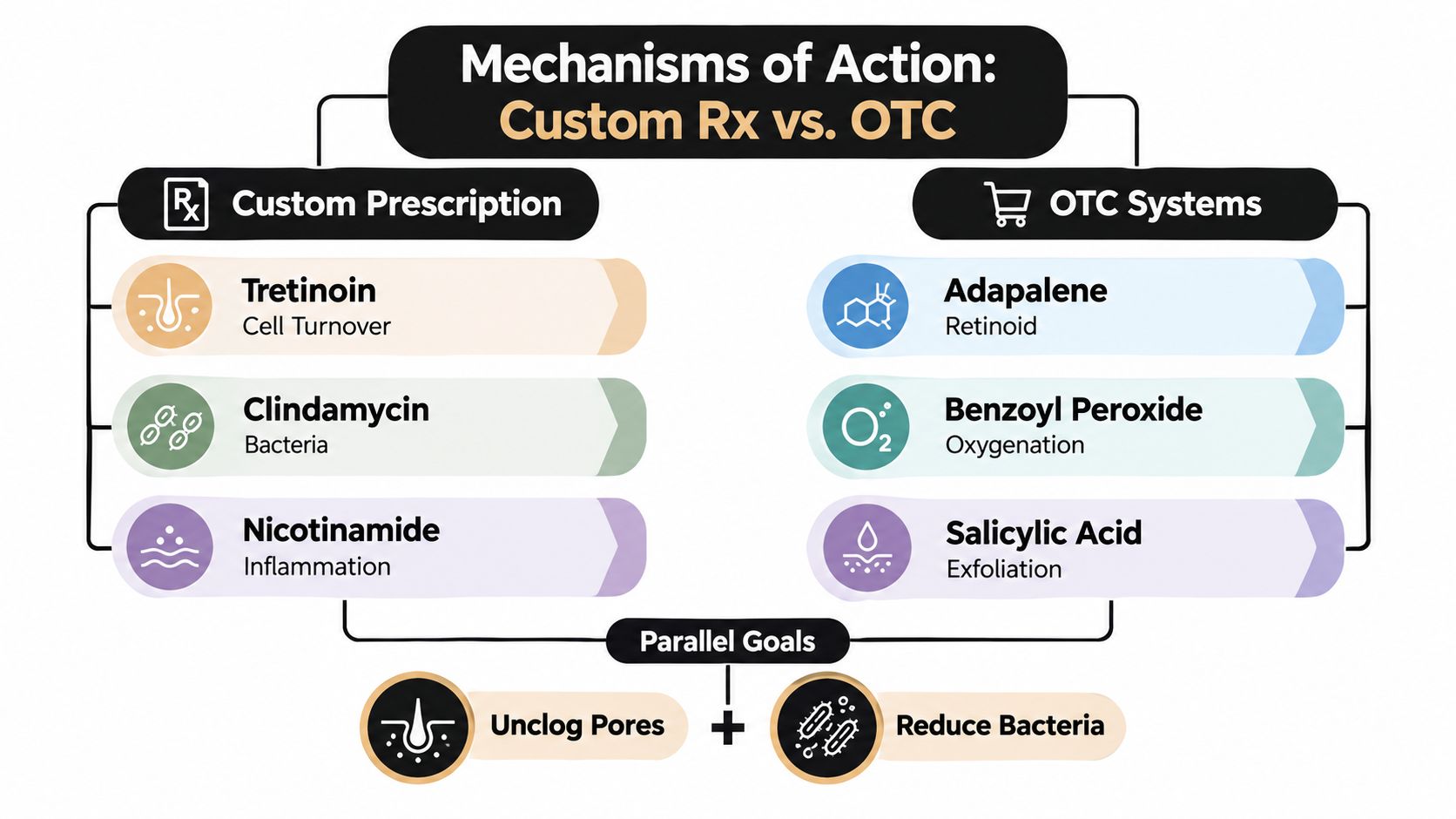
The Mechanics of Custom Prescriptions Versus OTC Systems
A person may start a custom prescription because acne is persistent, then stop using it after burning, peeling, or uncertainty about which ingredient caused the reaction. Another person may choose an over-the-counter routine because each product can be adjusted independently. These outcomes reflect different treatment structures, not a mere difference between strong and weak skincare.
A custom prescription service selects a retinoid, antibiotic, or other prescription ingredient from the information provided. That model can be useful when acne requires physician-led treatment and closer clinical judgment. Its limitation is practical: if the formula irritates the skin, the patient may not know which component to reduce, pause, or replace.
An OTC system uses standardized formulas purchased without a prescription. Accessibility does not guarantee effectiveness, but it gives the user more control over exposure. One step can be changed at a time, frequency can be reduced when the barrier becomes uncomfortable, and the product form can be matched to daily habits. That control often matters more than theoretical potency because a treatment only works when it is tolerated well enough to use consistently.
What the main mechanisms do
Salicylic acid is a beta hydroxy acid with an affinity for oily environments. The AAD's updated acne guidance includes topical salicylic acid as a recommended option for helping unclog pores and exfoliate the skin (AAD updated acne guidance). An NIH-hosted review describes a 2% salicylic acid wash as moderately effective, while noting that topical retinoids are generally more potent and that the historical trial evidence was limited (NIH review of acne treatments).
The same review describes research in which a 2% salicylic acid cleanser significantly reduced comedones after 2 weeks. It also summarizes improvement across studies of OTC salicylic acid products. These findings support salicylic acid as a reasonable pore-focused option, not as a guarantee that every formulation will produce the same result. Concentration, contact time, vehicle, skin sensitivity, and consistent use all affect the outcome.
Mandelic acid is an alpha hydroxy acid used mainly for surface exfoliation. In a combined regimen, it can help address corneocyte buildup and uneven texture while salicylic acid works within the lipid-rich pore environment. The pairing therefore covers different exposure sites, although it still requires careful dosing when the skin is dry, reactive, or already using another exfoliant.
Comparative peel research found stronger overall acne improvement from a salicylic acid and mandelic acid regimen than from glycolic acid in the cited study, including better results across comedones, papules, and pustules (comparative acne peel review). A separate randomized comparison found greater lesion clearance with salicylic acid peels, while mandelic acid showed better safety and tolerability (acne peel comparison study). Peel findings do not translate directly to every cleanser, pad, or moisturizer, but they illustrate the trade-off between clearing strength and barrier comfort.
Why combination design can improve adherence
A multi-acid system does not make irritation impossible. Its practical advantage is that different product forms can distribute the work. A rinse-off cleanser removes oil and debris with limited contact time, a leave-on pad can provide targeted exfoliation, and a moisturizer can support daily use while contributing salicylic and mandelic acid.
The trade-off is exposure control. Starting a cleanser, pad, and moisturizer at full frequency can overwhelm sensitive skin. Introduce one variable at a time, monitor tightness and persistent stinging, and reduce frequency before adding another active. More exfoliation is not automatically faster clearing. A stable barrier and a routine that remains usable usually provide the better long-term result.
Evaluating the Top Curology Alternatives
A good Curology alternative depends on the severity and pattern of your acne, how quickly you need medical escalation, and how much irritation you can realistically tolerate. There isn't one universal replacement.
| Treatment Path | Primary Mechanism | Average Monthly Cost | Barrier Risk |
|---|---|---|---|
| In-person dermatology care | Diagnosis, prescription selection, procedures, and monitoring | Varies by clinician, insurance, and treatment plan | Varies from low to high |
| Online prescription platform | Remote evaluation followed by a prescribed active when appropriate | Varies by platform and formula | Moderate to high, depending on the formula |
| Drugstore single-ingredient product | One primary mechanism, such as pore exfoliation or antimicrobial action | Varies by product and use frequency | Low to high, depending on active and layering |
| Multi-acid OTC routine | Pore clearing plus surface exfoliation across cleanser, treatment, and moisturizer forms | Varies by products and frequency | Moderate if introduced gradually |
| Dermatologist-led systemic treatment | Physician-managed treatment for persistent or severe acne | Varies by medical care and coverage | Requires medical supervision |
Four paths worth comparing
In-person dermatology care is the most appropriate route when acne is painful, deep, scarring, rapidly worsening, or not responding to thoughtful OTC use. A dermatologist can assess whether the problem is acne, irritation, folliculitis, or another condition that looks similar. They can also discuss procedures or systemic options that an OTC routine can't replace.
Another online prescription platform may suit someone who wants remote access and prefers a medically prescribed plan. The convenience can be meaningful, but you still need to understand the formula, expected irritation, follow-up process, and cancellation terms. A personalized bottle isn't automatically more tolerable than a standardized product.
Drugstore single-ingredient care can work well for a narrow problem. A salicylic acid cleanser may be enough for mild congestion, while another person may need broader support. The weakness is that shoppers often combine several isolated products without a clear sequence, producing dryness before they know which step was helpful.
A multi-acid OTC routine sits between a basic wash and prescription-led care. Salicylic acid targets pore congestion, while mandelic acid supports surface exfoliation and texture. Neutralyze's system is organized around cleansing, exfoliating, and renewing, so the consumer can assign each product a role instead of stacking unrelated actives.
For foundational guidance on cleansing, moisturizing, and avoiding common irritants, this acne prone skin care advice is a useful companion. If you're specifically comparing non-prescription options for retinoid-based routines, review this guide to OTC adapalene alternatives.
What usually fails
The most common failure isn't that a person chose OTC care. It's that they changed too many variables at once. Scrubs, strong toners, multiple acids, aggressive cleansing, and frequent spot treatments can create a damaged barrier that looks like worsening acne.
A second failure is expecting a prescription timeline from a non-prescription routine. Acne improves through consistent management, not through a single dramatic application. If you're still developing painful lesions or scarring despite careful use, don't keep escalating at home indefinitely.
Building a Non-Prescription Routine for Moderate to Severe Acne
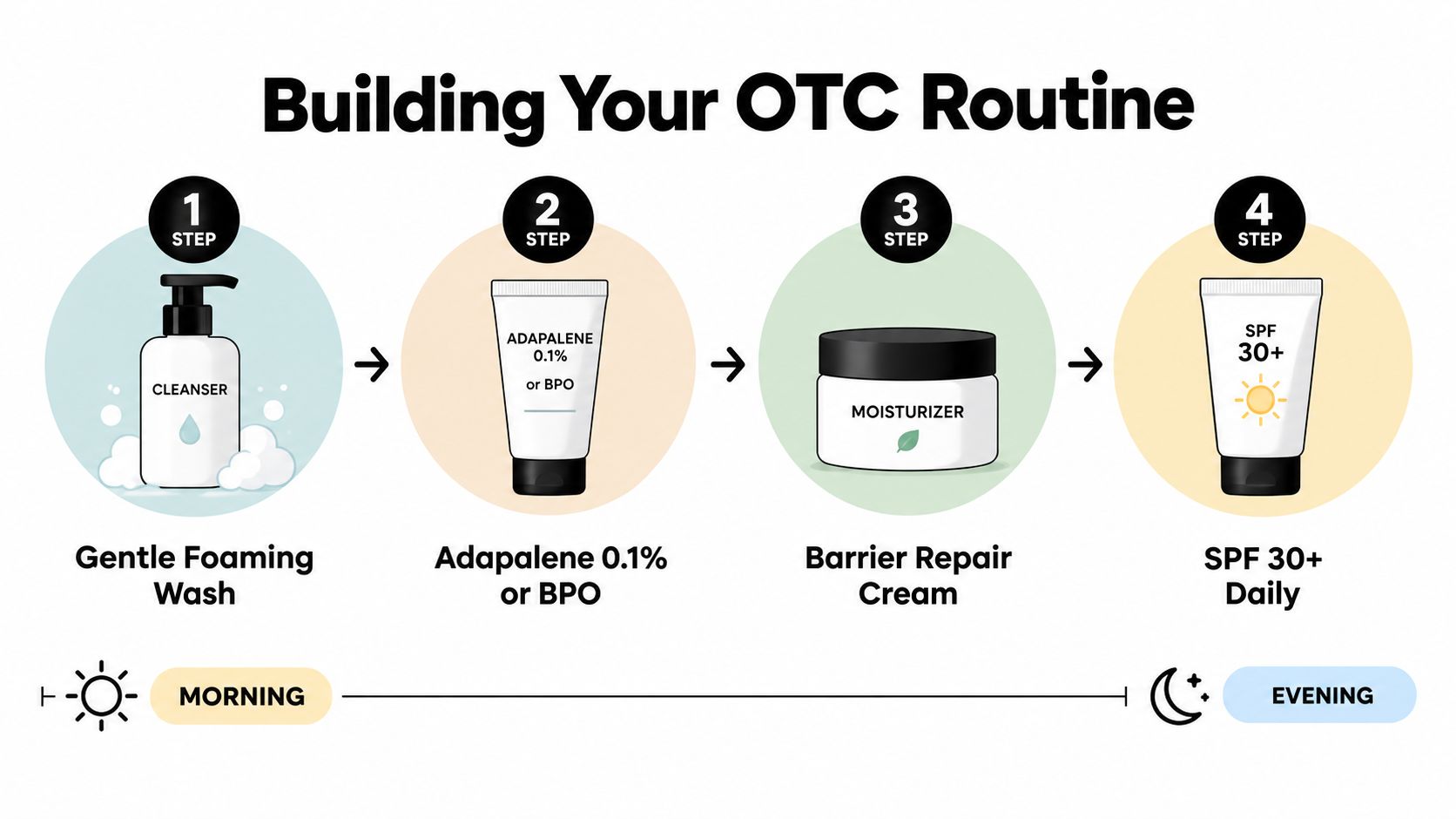
A patient with painful breakouts often responds by adding another acid, scrubbing harder, or applying leave-on treatment more often. That approach can increase irritation before it improves congestion. A non-prescription routine needs clear roles, controlled exposure, and enough barrier support to remain usable over time. Neutralyze's three-step model assigns one purpose to each product: cleanse, exfoliate, renew.
Step one is cleansing
Begin with Neutralyze Face Wash 2.0, which contains 2% salicylic acid and 1% mandelic acid. As a rinse-off cleanser, it removes surface oil and debris while giving both acids limited contact with the skin. That shorter exposure can be easier to tolerate than starting with several leave-on actives at once.
Use lukewarm water and your fingertips. Pressure does not clear a blocked follicle faster. Mechanical friction can increase irritation and make it harder to tell whether redness comes from inflammation or a compromised barrier.
Step two is controlled exfoliation
The Neutralyze Exfoliating Pads provide a leave-on salicylic acid and mandelic acid treatment for the face and body. The product snapshot identifies them as non-comedogenic, fragrance-free, sulfate-free, paraben-free, and cruelty-free.
A leave-on acid remains in contact with the skin longer than a cleanser, so introduce it cautiously. Test a small area if your skin reacts easily, apply a thin layer, and avoid placing another exfoliating product over it. Use the lowest frequency that controls new congestion without producing persistent burning, tightness, or scaling.
Step three is renewal and comfort
Apply the Neutralyze Renewal Complex as the renewing step. This acne moisturizer contains salicylic acid and mandelic acid, so it continues the system's exfoliating approach while providing hydration. Moisture supports adherence because skin that feels hot, tight, or persistently flaky is less likely to tolerate a consistent routine.
A morning sequence can follow this order:
- Cleanse: Use the face wash gently, then rinse thoroughly.
- Exfoliate: Apply the pads at a frequency your skin tolerates.
- Renew: Use the Renewal Complex for comfort and hydration.
- Protect: Apply a broad-spectrum sunscreen suitable for acne-prone skin.
At night, repeat cleansing and use the leave-on step only when the skin remains comfortable. For terminology that can affect product selection, review what is non comedogenic soap to distinguish a cleansing product from a traditional bar soap.
For persistent or more extensive breakouts, use this moderate-to-severe acne treatment guide to assess whether OTC care is appropriate or a dermatology review is needed.
Keep active acne separate from marks
Salicylic and mandelic acids may support smoother texture and improve the appearance of post-acne marks, but discoloration is different from an active clogged follicle. Treating marks with increasingly harsh products can prolong irritation and make uneven tone more noticeable.
Use sunscreen consistently, avoid picking, and judge progress by the pattern of new lesions rather than the immediate disappearance of every mark. A calm barrier supports long-term adherence and is part of the treatment result.
Real-World Scenarios for Choosing Your Acne Path
The right alternative changes with the type of acne, the person's tolerance, and the consequences of delay. A teenager with scattered blackheads needs different guidance from an adult with painful nodules and early scarring.
The teenager with oily skin and jawline breakouts
A teenager may have a mixture of closed comedones, blackheads, and inflamed lesions. The first priority is usually consistency. A gentle salicylic and mandelic acid cleanser can provide a manageable foundation, while a leave-on pad may be added cautiously if congestion persists.
Parents should watch for behaviors that sabotage treatment, including scrubbing, picking, and switching products every few days. If acne is painful, leaves scars, or affects the teenager's willingness to attend school or social activities, arrange a dermatology evaluation rather than treating the issue as a simple skincare problem.
The adult with sensitivity and post-acne marks
Adult acne often appears alongside dryness, redness, uneven tone, or a history of over-treating the skin. This person may not need a more aggressive formula. They may need fewer simultaneous actives, a non-comedogenic moisturizer, and a slower introduction schedule.
Mandelic acid can be useful in a paired system when tolerability is a priority, but “gentler” doesn't mean irritation-free. Patch testing and reduced frequency remain sensible. Treat active breakouts first, then assess whether persistent marks need additional clinical guidance.
The person who has tried everything
“Everything” often means several products used briefly, not a documented routine followed consistently. Write down what you've used, how often, and what happened. Note whether the reaction was dryness, burning, itching, new bumps, or no change.
If you've used a carefully structured routine and still have deep inflammatory lesions, scarring, or worsening acne, a dermatologist should help determine the next step. An OTC system can support maintenance or serve as a bridge, but it shouldn't delay medical care when the disease burden is high.
The person who wants to avoid prescription treatment
Avoiding a prescription is a personal preference, but it shouldn't mean accepting unproven claims. Look for known mechanisms, clear ingredient disclosure, realistic use instructions, and a routine that protects the barrier.
A salicylic acid and mandelic acid system may be a reasonable non-prescription path for someone whose primary concerns are clogged pores, inflammatory bumps, oiliness, and uneven texture. It won't replace physician-led treatment for every presentation of acne.
How to Transition from Custom Prescriptions to OTC Acids
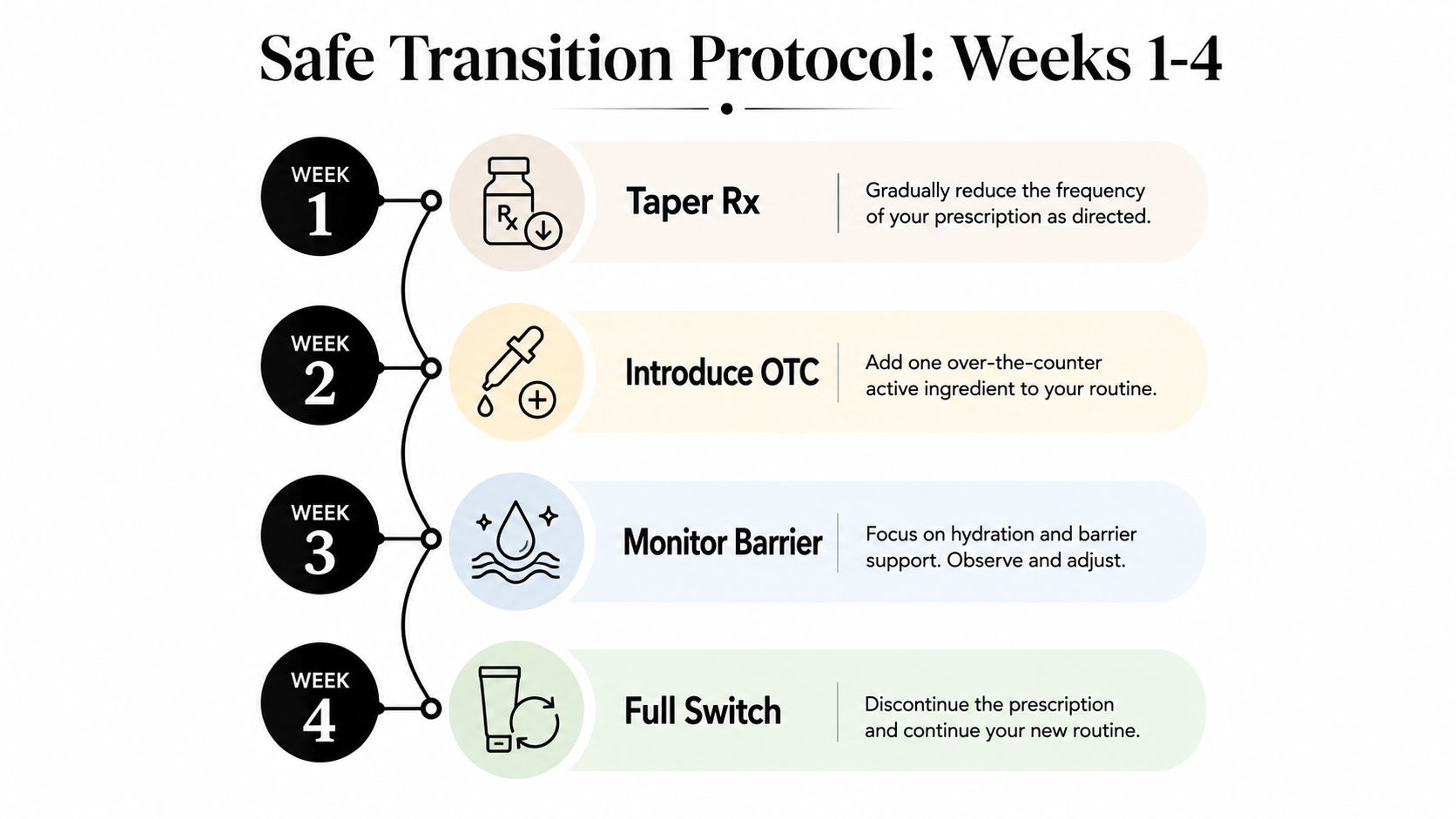
Don't stop a prescription and introduce three leave-on products on the same night. A transition should protect the progress you've made while showing you how your skin responds to the new routine.
If your prescription contains an antibiotic, retinoid, or another medically directed ingredient, ask the prescribing clinician how to discontinue it. The right schedule depends on the medication, your acne pattern, and whether the prescription is controlling active inflammation. A generic internet protocol can't replace that advice.
A careful transition sequence
First, document your baseline. Take clear photos in the same lighting and record your current prescription frequency. This prevents you from judging the new routine based only on a difficult day.
Next, establish gentle cleansing and hydration. Use a mild, non-comedogenic routine while reducing unnecessary scrubs, masks, and fragranced products. If the skin is already peeling or burning, stabilize it before adding a leave-on acid.
Then introduce one OTC active form. A salicylic and mandelic acid cleanser is easier to control than a leave-on pad because you rinse it away. Use it at a frequency your skin tolerates rather than assuming daily use is mandatory.
Add the pad later if needed. Once the cleanser and moisturizer feel comfortable, introduce the exfoliating pad on limited days. Don't use it over cracked or actively irritated skin.
A “purge” is often used to describe temporary breakouts after starting an active, but the term gets overused. New lesions in areas where you commonly break out may reflect adjustment, while intense itching, swelling, hives, blistering, or widespread burning suggests irritation or an allergic response and warrants stopping the product and seeking professional advice.
Don't push through escalating pain or inflammation just to prove a routine is working.
Peeling alone doesn't prove efficacy. A routine that leaves you raw may reduce adherence and make post-acne discoloration more noticeable. For additional information about non-prescription retinoid access and alternatives, consult this OTC adapalene information, then discuss your individual transition with a qualified clinician.
Common Misconceptions About Acne Subscriptions and OTC Care
A custom prescription is not automatically the most complete acne plan. Personalization can target a specific mechanism, but the formula still has to fit your tolerance, schedule, and barrier health. A treatment you avoid because it stings has little practical value, regardless of its prescription status.
OTC care is not limited to mild acne. Standardized multi-acid systems can address moderate comedonal and inflammatory acne when the routine is used consistently. As noted in the mechanics comparison, salicylic and mandelic acid regimens showed stronger lesion improvement than glycolic acid in that study (comparative acne peel review). That finding supports evaluating the ingredients, concentrations, contact time, and adherence plan rather than dismissing every drugstore routine. Deep nodules, scarring, or acne that fails a well-tolerated routine warrant dermatology assessment.
Adding more actives does not reliably speed improvement. Layering several acids, scrubs, or retinoids can compromise the barrier, increase redness, and obscure whether the acne or the routine is causing the problem. One cleanser, one treatment step, one moisturizer, and consistent sunscreen usually provide clearer feedback than a crowded shelf.
Post-acne marks also require a different strategy from active lesion control. Reducing inflammation can limit new marks, while discoloration improves with time, sun protection, and less picking. Ongoing irritation can prolong visible discoloration even as breakouts decline.
The strongest Curology alternative is a mechanism-based system that matches the acne pattern, protects the barrier, and gives every step a clear purpose.
Neutralyze offers a routine built around salicylic acid and mandelic acid, with separate cleanse, exfoliate, and renew steps for acne-prone skin. Review Neutralyze to assess a structured non-prescription option against your current skin needs.


