

Acne Routine for Oily Skin That Actually Works
You cleanse twice, add a mattifying serum, and still find fresh shine and clogged pores by lunchtime. Then the cycle gets harsher: stronger scrubs, drying toner, more acid, less moisturizer. For oily, acne-prone skin, that approach often confuses surface oil with the whole problem.
A useful acne routine for oily skin has to manage sebum, follicular buildup, inflammation, and the skin barrier together. Acne is extraordinarily common during the years when sebum activity is high. A global burden study found acne vulgaris affected about 85% of people aged 12 to 25, while long-term data recorded a rise in the global age-standardized prevalence rate among adolescents and young adults from 8,563.4 per 100,000 in 1990 to 9,790.5 per 100,000 in 2021 (PubMed).
For moderate-to-severe acne, Neutralyze is positioned around a science-backed cleanse, exfoliate, and renew system, and its active product line uses salicylic acid and mandelic acid. The practical routine below focuses on what each step can realistically do, where trade-offs appear, and when professional care makes more sense than adding another product.
Why Oily Skin Breaks Out in the First Place
By midafternoon, the forehead looks polished, the nose feels slick, and the jawline has several bumps that weren't there that morning. A harsh cleanser removes the shine for a short time, but the skin soon feels tight, then greasy again. That pattern isn't proof that you need a stronger cleanser. It often means oil, dead cells, irritation, and inflammation are being managed as if they were one problem.
Sebum is part of healthy skin. The difficulty begins when excess sebum combines with changes inside the follicle. In one NIH-indexed study, people with acne had 59% more sebum than control subjects, which helps explain why oil control matters, but the finding doesn't mean every oily person will develop acne or that all oil should be stripped away (NIH).
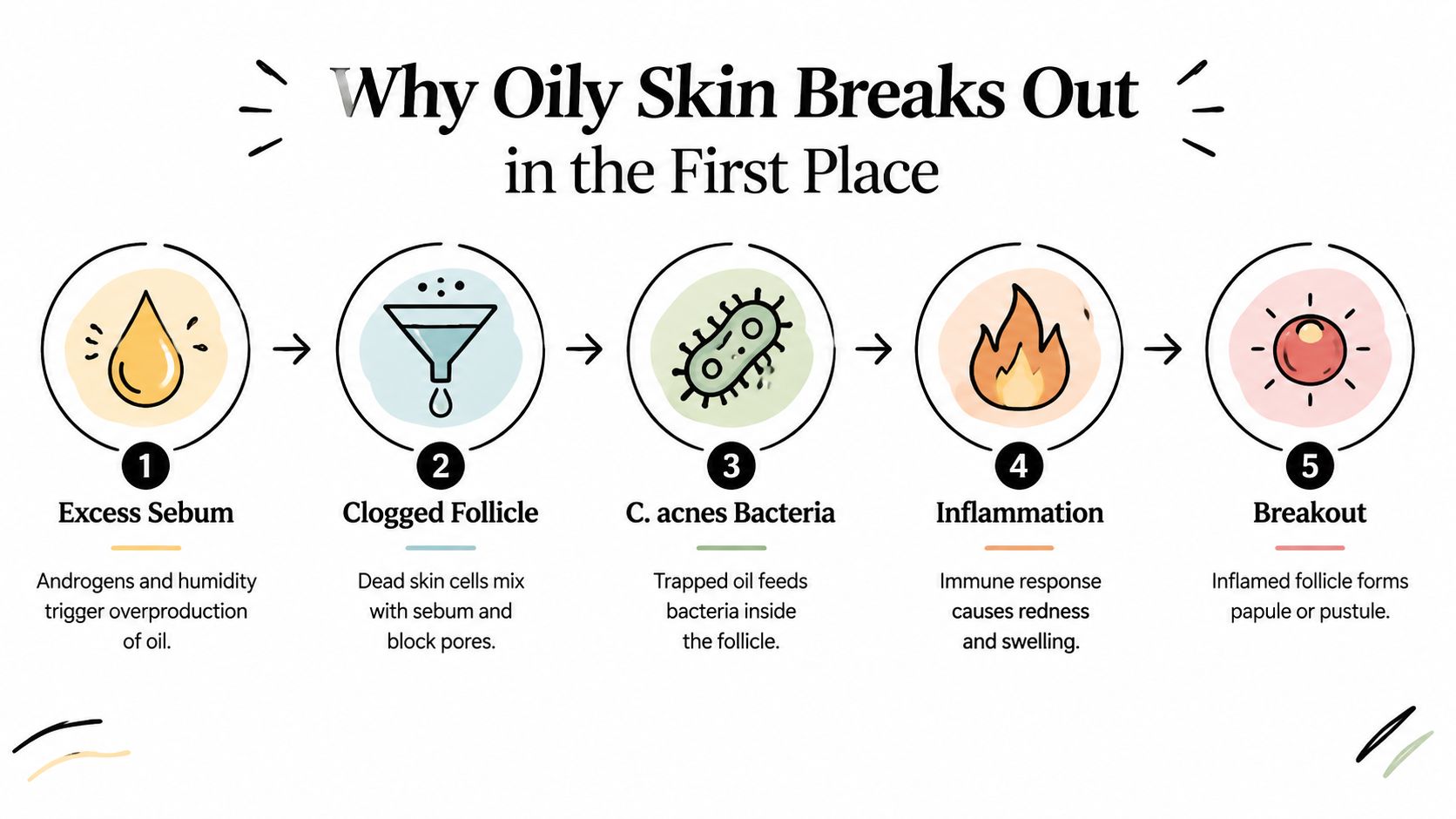
The follicle is the real battleground
Excess sebum can be influenced by androgens and environmental conditions such as humidity, creating a more oil-rich follicular environment. Follicular hyperkeratinization causes dead skin cells to accumulate and mix with sebum, forming a plug rather than shedding freely.
Inside that blocked follicle, Cutibacterium acnes, historically called P. acnes, can multiply in conditions with limited oxygen and abundant lipids. The immune system then responds, producing the redness, swelling, and tenderness that turn a microcomedone into a papule or pustule.
That sequence is why a routine needs more than a cleanser that leaves your face squeaky. Salicylic acid can help address oil-soluble buildup, mandelic acid can support surface exfoliation, and a well-tolerated moisturizer helps reduce the irritation that makes consistent treatment harder.
Practical rule: If your skin feels tight immediately after cleansing but looks oily again soon afterward, reduce stripping before increasing treatment strength.
Genetics, climate, hormones, product texture, and cleansing habits can all affect how oily skin behaves. A useful guide to identifying and managing excessive oil is this resource on why your skin may be so oily, but the routine decision remains the same: control congestion without dismantling the barrier.
The Core Actives That Help Oily Acne
Oily-skin acne responds best to a routine that balances sebum, follicular shedding, inflammation, and barrier comfort. No single active covers every pathway. Salicylic acid targets pore congestion, mandelic acid provides a generally well-tolerated AHA option, retinoids normalize follicular shedding, benzoyl peroxide addresses acne-associated bacteria and inflammation, and supportive ingredients can improve comfort or the appearance of marks.
Consistency matters more than collecting strong products. One systematic review and network meta-analysis found that a topical retinoid combined with benzoyl peroxide produced the best mean improvement among topical pharmacologic options, with a mean difference of 26.16% and a 95% credible interval of 16.75% to 35.36% (British Journal of Dermatology). That result supports the combination, but irritation still determines whether a person can use it regularly.
How the main options compare
| Active | What It Does | Typical Concentration | Oily-Skin Fit |
|---|---|---|---|
| Salicylic acid | Oil-soluble exfoliation helps loosen follicular buildup and improve the appearance of blackheads and whiteheads | 1% to 2% | Strong fit for congestion, but overuse can dry or sting |
| Mandelic acid | AHA exfoliation supports surface texture and uneven tone with a gentler profile than some stronger acids | Varies by formula | Useful partner for oily, sensitive, or mixed skin |
| Glycolic acid | More surface-directed AHA exfoliation for texture and dullness | Varies by formula | Can be effective, but irritation rises when layered aggressively |
| Adapalene | Retinoid that helps normalize follicular keratinization and prevent new comedones | 0.1% OTC | Well suited to persistent comedonal acne, with a retinoid-adjustment period |
| Tretinoin | Prescription retinoid with stronger clinical supervision needs | Prescription formulation | Appropriate when OTC care plateaus or acne is more persistent |
| Niacinamide | Supports barrier function and can help reduce the look of excess shine and redness | 5% to 10% | Often easy to pair with acne routines, though more isn't automatically better |
| Benzoyl peroxide | Reduces acne-associated bacterial load and inflammation | 2.5% to 5% | Useful for inflamed acne, but may irritate and bleach fabrics |
A topical combination study pairing morning benzoyl peroxide with an evening retinoid reported a 54% reduction in total acne count from baseline to week 12, without a significant rise in irritation in that study population (PubMed). For readers exploring plant-derived ingredients alongside conventional actives, this overview of CBD for skin conditions provides useful background, though it works alongside rather than instead of acne-directed actives.
Mandelic acid can be a practical partner when salicylic acid alone feels too drying. One clinical evaluation reported that 5% mandelic acid may suit sensitive skin with moderately severe acne, while 10% may suit oily or combination skin with more severe acne. Both concentrations were described as safe and effective in that study (Termedia). A separate controlled peel study found salicylic acid more efficacious overall, especially for noninflammatory lesions, while mandelic acid caused fewer side effects and offered better tolerability (Clinical, Cosmetic and Investigational Dermatology).
The Neutralyze approach also includes a renewing moisturizer step for moderate-to-severe acne, so the routine doesn't end at exfoliation. Use BHA and AHA on a schedule your barrier can tolerate. This guide to using salicylic acid for acne explains practical application and spacing.
Your Morning Routine Step by Step
Morning care should remove overnight oil, add water-based hydration, protect against visible post-acne discoloration, and avoid creating a film that feels heavy by lunchtime. Keep the sequence simple enough that you'll repeat it.
- Cleanse for about 30 to 60 seconds. Use lukewarm water and a gentle oil-compatible or salicylic-based cleanser. Neutralyze Face Wash 2.0 contains 2% salicylic acid and 1% mandelic acid, and it can serve as the morning active cleanse when your skin tolerates that level of exfoliation.
- Add a hydrating toner or essence. This step is optional, not corrective magic. Choose a fragrance-free, water-light formula that reduces the temptation to apply several serums.
- Use one treatment layer. Vitamin C can support the appearance of uneven tone, while niacinamide may suit people focused on shine and barrier comfort. Don't add both automatically if your skin is already reactive.
- Moisturize lightly. A gel-cream or fluid moisturizer can reduce tightness without creating the dense feel that makes oily skin uncomfortable. Skipping moisturizer often backfires behaviorally, because irritation encourages more product switching and less consistent active use.
- Apply broad-spectrum SPF. Use a non-comedogenic sunscreen with at least SPF 30, and allow the earlier layers to settle. Guidance on choosing sunscreen for oily, acne-prone skin can help if pilling or shine is your main obstacle.
- Finish only if needed. Blot excess shine rather than repeatedly washing your face. If makeup is part of your routine, use thin layers and let each skincare layer settle for 60 to 90 seconds before adding the next.
Reapplication doesn't require rubbing a thick new layer over wet serum. Press or pat a compatible sunscreen product over settled skin, or use a reapplication format that doesn't disturb the base. The priority is reliable protection, because sun exposure can make post-acne marks appear more persistent even after the active lesion has settled.
You can see the intended order in this short visual guide:
Your Evening Routine Step by Step
Evening is where you remove the day's sunscreen and sebum, then decide whether your skin can handle exfoliation, a retinoid, or recovery. The mistake is treating every night as treatment night.
Five steps with deliberate spacing
- First cleanse at the start of your evening. Use micellar water or an oil-based cleanser to dissolve sunscreen, makeup, and surface sebum. Rinse or remove it thoroughly so the second cleanse doesn't have to do all the work.
- Second cleanse for about 60 seconds. Use a salicylic and mandelic acid cleanser on damp skin, massage gently, and rinse. Brief contact gives the cleanser time to work across the oily surface and around follicular openings without turning a rinse-off product into an overnight treatment.
- Exfoliate on selected nights. Pat dry, then swipe Neutralyze Exfoliating Pads across the T-zone and jawline, avoiding the eye area. Start at 2 to 3 nights per week, not every night, and keep the first applications away from irritated or freshly picked areas.
- Apply your night treatment only after skin is fully dry. Wait about 5 minutes, then use a pea-sized amount of your chosen topical retinoid. Dry skin generally reduces the sting that can occur when retinoids meet damp skin. Don't combine a retinoid with exfoliating pads on the same night while you're establishing tolerance.
- Seal in comfort. Finish with a non-comedogenic moisturizer containing barrier-supportive ingredients such as ceramides or squalane. An occlusive can be reserved for dry patches rather than spread across an already oily T-zone.
The Neutralyze acne face wash snapshot describes a rinse-off cleanser with salicylic and mandelic acid, but product labels and current formulation directions should always take priority over generalized routine advice. The catalog description for Neutralyze Acne Face Wash identifies it as a fragrance-free, non-comedogenic cleanser with 2% salicylic acid and 1% mandelic acid.
Flaking can occur during the retinoid adjustment period, often around weeks 2 to 3, but severe burning, swelling, or persistent cracking isn't a progress marker. On an exfoliation night, skip other acids, scrubs, strong benzoyl peroxide applications, and extra retinoid layers. If you're sensitive, use the cleanser less often, reduce pad nights to once weekly, and keep the rest of the routine bland.
Weekly Treatments and Adjustments
The most stubborn oily-skin breakouts often come from over-treating. Someone sees shine, adds an acid; sees flakes, adds a scrub; sees redness, adds another active. The result is a barrier that stings, looks shiny and flaky at the same time, and reacts to products that previously felt comfortable.
Correct the habits that keep acne irritated
- Over-cleansing: Washing more than twice daily can increase tightness and encourage a rebound cycle of oiliness. Replace repeated washing with one careful cleanse in the morning and one in the evening.
- Stacking actives: BHA, high-strength AHA, retinol, and benzoyl peroxide on the same night can overwhelm the barrier. Alternate them instead of treating every pathway at once.
- Skipping moisturizer: Oily skin still needs water and barrier support. Choose a lightweight gel-cream rather than leaving treated skin bare.
- Using alcohol-heavy toner: The immediate tight feeling doesn't prove better oil control. Swap it for a hydrating essence or a simple, fragrance-free toner.
- Picking and extracting: Squeezing can push inflammation deeper and increase the chance of a lingering mark or scar. Leave extractions to a trained professional.
A damaged barrier often announces itself through stinging when bland moisturizer is applied, a shiny-but-flaky surface, or sudden sensitivity to products you used to tolerate. Tightness means scale back. If blackheads are softening and new congestion isn't accelerating, your current cadence is probably doing enough.
Build the week around treatment and recovery
For typical oily skin, use BHA or mandelic exfoliation on 2 to 3 nights per week. Sensitive or already retinoid-adjusted skin may need once-weekly exfoliation, while resilient skin with stubborn congestion may tolerate up to 4 nights, provided there is no burning, peeling, or persistent redness.
Place a clay or sulfur mask 24 hours after exfoliation, never on the same night. The mask can absorb surface sebum, but leaving it until the skin cracks or feels taut defeats the purpose. Build in two retinol-only nights, one complete rest night with gentle cleanser and moisturizer, and optional short centella or azelaic acid use when visible inflammation is the main concern.
| Skin Profile | BHA/Exfoliation Nights | Mask Nights | Retinol Nights | Rest Nights |
|---|---|---|---|---|
| Sensitive, oily and reactive | Once weekly | Every other week, after a non-treatment day | One to two, short contact if needed | At least two |
| Stubborn, congestion-dominant | 2 to 4, based on tolerance | Once weekly, 24 hours later | Two | At least one |
| Hormonal, jawline and chin flares | 2 to 3, avoiding irritated lesions | Once weekly if comfortable | Two, with medical review if persistent | At least one |
Professional exfoliation belongs in a different category from home acid use. If you're considering a supervised peel for congestion, tone, or texture, review the approach with a qualified provider, such as a clinic offering a Beverly Wilshire Aesthetics medical spa peel, rather than treating a professional-strength peel as a casual weekly mask.
When to Move From OTC to a Dermatologist
Painful, deep, persistent lesions need a different plan from stronger over-the-counter products. Seek dermatology care when acne is scarring, leaving lasting discoloration, or failing to settle despite barrier-conscious use of BHA, mandelic acid, moisturizer, and sunscreen.
Book an appointment for painful cysts that don't surface, nodules lasting more than two weeks, or any breakout that scars. Sudden adult acne, especially clustered along the jawline and chin, may involve hormonal drivers that another exfoliant will not address.
Know what OTC care can and can't handle
OTC care fits mild comedonal acne and occasional inflamed papules when treatment is tolerated and the skin is improving gradually. Give a consistent topical routine about 8 to 12 weeks before judging whether it has plateaued, unless irritation or worsening acne calls for earlier review. As noted in the actives section, topical combinations need a full trial period before results can be judged fairly.
A dermatologist may prescribe stronger topical treatment, a short course of oral antibiotics, or isotretinoin for severe or refractory acne. In-office care may include chemical peels, cortisone injections for selected cysts, and light-based therapies. The choice depends on lesion type, scarring risk, medical history, and the maintenance plan. For moderate-to-severe acne, a structured over-the-counter routine may support the plan, but it does not replace medical assessment when lesions are deep, painful, or persistent.
Bring photos taken across several days, a complete product list, and notes on when flares occur. Ask what should continue after active acne settles. Control usually requires maintenance, not a short burst of aggressive oil stripping.
Sample Routines for Different Skin Profiles
A routine should respond to your skin's behavior, not force every person into the same active schedule. These examples are starting frameworks, not diagnoses.
| Step | Sensitive/Barrier-Compromised | Stubborn/Resilient | Hormonal/Moderate-Severe |
|---|---|---|---|
| Morning cleanse | Gentle cleanser or low-frequency BHA cleanser | Salicylic and mandelic cleanser | BHA cleanser as tolerated |
| Morning treatment | Bland moisturizer | Niacinamide, then light moisturizer | Targeted acne-prone skin care, then moisturizer |
| Morning protection | Mineral SPF 30 or higher | Non-comedogenic broad-spectrum SPF | Non-comedogenic broad-spectrum SPF |
| Evening treatment | Short-contact retinoid one to two nights weekly | BHA exfoliant on selected nights, retinoid on separate nights | Retinoid, with benzoyl peroxide only if appropriate and tolerated |
| Weekly adjustment | Drop acids when stinging persists | Add mandelic acid weekly only if the barrier is calm | Seek dermatology care for painful or scarring flares |
For sensitive, reactive skin, cleanse gently, apply a bland moisturizer, and use mineral SPF in the morning. At night, use a short-contact retinoid one or two times weekly, then moisturize. If stinging continues, remove the retinoid temporarily rather than adding more soothing products.
For resilient skin with clogged pores and post-acne marks, use a salicylic acid exfoliant on selected nights, niacinamide in the morning, and a nightly retinoid only if your skin already tolerates it. Reserve mandelic acid for a separate weekly session. Wait until each layer has settled, usually around 60 to 90 seconds, and never interpret peeling as proof that the routine is working.
For hormonal or moderate-to-severe acne, use morning cleansing and SPF, then a medically appropriate evening retinoid or benzoyl peroxide plan. A salicylic and mandelic acid step can address congestion, but painful jawline lesions, scarring, or persistent flares deserve a dermatologist's input. For sunscreen choices that sit more comfortably over uneven texture, this guide to SPF in textured skin care offers useful product-selection context.
Give a starter plan enough time to show direction, but adjust sooner if your barrier signals distress. If there is no meaningful improvement after 6 to 8 weeks, or if the acne is worsening, reassess the active combination and consider professional care rather than escalating blindly.
Neutralyze offers a clinically formulated acne system built around salicylic acid and mandelic acid, with a cleanse, exfoliate, and renew approach for moderate-to-severe acne. Visit Neutralyze to review the cleanser, exfoliating pads, and renewal moisturizer options, then choose a routine that controls congestion without sacrificing barrier comfort.