
What Does Retinol Purge Look Like? Photos & 4-Week Timeline
Quick Answer
A retinol purge looks like small clusters of whiteheads and tiny bumps in areas where you normally break out, often with mild dryness and flaking. Purging typically peaks at weeks 2–4 and clears by weeks 4–8, after which skin looks smoother and more even.
So, you've started using retinol and suddenly your skin is… worse? It’s a classic story, and it can be incredibly confusing. What does a retinol purge actually look like?
Think of it as a temporary flare-up of small, angry-looking bumps—mostly whiteheads and blackheads. They seem to pop up overnight, often in little clusters, right in the spots where you normally get pimples. The good news? They tend to heal much faster than your usual breakouts.
Your Visual Guide to a Retinol Purge
When you introduce a powerhouse ingredient like retinol, your skin kicks its cell turnover into high gear. It’s like a deep-cleaning service for your pores, forcing all the gunk that’s been lurking underneath—dead skin cells, oil, and bacteria—up to the surface all at once. It’s not pretty, but it's a sign the retinol is doing its job.
If this is happening to you, you're not alone. The experience is incredibly common. A 2020 survey revealed that about 78% of new retinol users experienced some kind of purge within the first month. Most reported seeing more small whiteheads, blackheads, and tiny red bumps in their usual acne-prone areas. For a deeper dive, you can read the full research about these retinol timeline findings.
Identifying the Key Signs
Learning to spot a genuine purge is the key to not panicking and throwing your new retinol in the trash. It’s a very specific reaction, not just a random smattering of zits.
Here’s a quick guide to help you tell the difference.
Quick Purge Identifier At A Glance
This table breaks down what you're likely seeing, so you can quickly identify if it's a true retinol purge or something else.
| Visual Sign | What It Looks Like | Common Location |
|---|---|---|
| Whiteheads & Blackheads | Small, superficial bumps with a visible white or black "head." | Areas where you typically break out (chin, forehead, nose). |
| Papules & Pustules | Tiny, red, inflamed bumps (papules) or pus-filled spots (pustules). | Clustered in your usual "problem" zones. |
| Cystic Acne (Rare) | Deeper, more painful bumps are less common but can be "unearthed." | Can appear in regular breakout areas, but is a red flag. |
Spotting these signs can help you feel more confident that what you’re experiencing is just a temporary—and productive—step on the road to much clearer skin.
Remember these key takeaways:
- Small, Superficial Blemishes: You're more likely to see a crop of whiteheads and blackheads, not deep, painful cysts.
- Location, Location, Location: Purging happens where you always break out. Pimples in brand-new spots are a red flag for irritation.
- Quick Turnaround: These blemishes live a short life. They surface and heal much faster than your stubborn, long-lasting pimples.
Understanding these distinctions helps frame the purge for what it truly is: a temporary clearing of the runway. By supporting your skin through this phase with gentle, effective treatments from Neutralyze, you can navigate the process with confidence. Our science-backed formulas are designed to soothe irritation and support a healthy skin barrier, making us the perfect partner for your retinization journey.
Understanding Why Retinol Purging Happens
https://www.youtube.com/embed/hA5MU1jkAiw
So, why does your skin sometimes get worse before it gets better with retinol? It’s a frustrating experience, but the answer is all about what’s happening deep below the surface.
Think of it this way: long before a pimple ever shows up, it starts as a tiny, invisible clog called a microcomedone. These are little pockets of oil and dead skin cells just hanging out deep inside your pores, completely hidden from view.
Retinol’s main job is to put your skin cell turnover into overdrive. It hits the gas on the natural process of shedding old, dead cells to make room for new, healthy ones. This is exactly what you want for long-term clear skin, but it can cause a bit of a traffic jam at first.
The Great Skin Eviction
This sudden acceleration pushes all that hidden gunk—the oil, dead skin, and debris—up to the surface all at once. Instead of those microcomedones developing slowly over weeks, they are suddenly forced out, leading to a temporary flare-up of pimples, whiteheads, and blackheads.
It’s crucial to remember that retinol isn’t creating new pimples. It’s simply speeding up the timeline of breakouts that were already on their way, bringing them all to the surface in a concentrated wave.
This "deep clean" is actually a really good sign. It means the retinol is doing its job and clearing out all the underlying congestion that was causing problems in the first place. You can learn more about effective strategies for treating clogged pores to understand the mechanics even better. Knowing this initial purge is a productive, temporary phase makes it so much easier to stick with it.
A Sign of Deeper Change
This whole process is a sign of a powerful biological shift happening within your skin. Instead of just treating blemishes on the surface, retinol is getting to the root of the problem and retraining how your skin cells behave.
At Neutralyze, our products are built on this very principle. We focus on ingredients that tackle the core causes of acne by regulating cell turnover and calming inflammation, leading to truly lasting clarity. Think of the purge as a necessary hurdle. It's the first, and often toughest, step toward the calm, clear skin you’re working for.
Retinol Purge vs. Breakout: How to Tell the Difference
That moment of panic when new blemishes pop up after starting retinol is all too real. Is this the infamous "purge" you've heard about? Or is it a regular breakout? Maybe it’s something else entirely? Learning to read your skin's signals is the key to pushing through with confidence.
Figuring out what's happening comes down to three things: where the blemishes are, what they look like, and how quickly they come and go.
Location and Type of Blemishes
First, pay attention to the location. A true retinol purge happens where you normally get pimples. Think of it as retinol doing a deep clean on your most congested areas, like your T-zone or chin. It’s essentially pushing out all the gunk that was already brewing under the surface.
If you start seeing pimples in totally new places where your skin is usually clear, that’s a red flag. It’s less likely to be a purge and more likely a standard breakout or a sign that the product is irritating your skin or clogging your pores.
The type of blemish is another huge clue. Purging typically brings a crop of smaller, superficial bumps to the surface. One clinical trial found that purging breakouts were generally smaller than typical acne, with 75% of participants describing them as 'tiny bumps' or 'whiteheads' that appeared in clusters. If that sounds like what you're seeing, you can discover more insights about retinol purging findings on direct-aesthetics.com.
A regular breakout, on the other hand, can involve those deeper, more painful pimples like nodules and cysts. It's also worth noting that other actives can cause a similar reaction; you can see how it compares in our guide to the benzoyl peroxide purge.
And if you’re just seeing widespread redness, peeling, or an itchy, rash-like texture without distinct pimples? That’s not a purge. That’s irritation, and it’s your skin’s way of telling you to stop what you're doing.
Timing and Healing Speed
Finally, think about the timeline. Blemishes from a purge live life in the fast lane. They tend to pop up and heal much more quickly than a stubborn pimple that might linger for a week or more.
A true retinol purge is a temporary acceleration of breakouts that were already brewing. It’s your skin clearing out pre-existing congestion, not creating new problems.
To make spotting the difference even easier, let's break it down side-by-side.
Purge vs. Breakout vs. Irritation: Key Differences
This table gives you a quick at-a-glance comparison to help you decode what your skin is telling you.
| Characteristic | Retinol Purge | Acne Breakout | Skin Irritation |
|---|---|---|---|
| Location | Occurs in your usual breakout zones (e.g., T-zone, chin). | Can appear anywhere, including in new, unusual spots. | Widespread across areas where the product was applied. |
| Blemish Type | Small whiteheads, blackheads, and tiny red bumps. | Can include deeper, painful cysts and nodules. | General redness, rash-like texture, peeling, or hives. |
| Timeline | Blemishes appear and heal faster than normal. | Pimples appear at a normal pace and can last for weeks. | Appears quickly after application and persists with use. |
| Feeling | Minimal discomfort, possibly mild sensitivity. | Often tender, inflamed, and painful to the touch. | Itching, burning, stinging, or a tight feeling. |
By checking your skin's response against these three distinct reactions—purging, breaking out, and irritation—you can make a much more informed decision about whether to push through or pull back on your retinol journey.
Your Week-By-Week Purging Timeline
Starting with retinol can feel like a rollercoaster, especially when the dreaded purge begins. It's easy to feel like you're going backward, but knowing what to expect week by week can make all the difference. While everyone's skin journey is unique, the purging process generally follows a predictable pattern.
Think of it as a deep spring cleaning for your pores. The retinol speeds everything up, forcing all the hidden gunk—the oil, dead skin cells, and baby pimples (microcomedones)—to the surface all at once. It’s a temporary mess for a long-term gain.
This timeline will help you map out the journey, so you can see the light at the end of the tunnel.
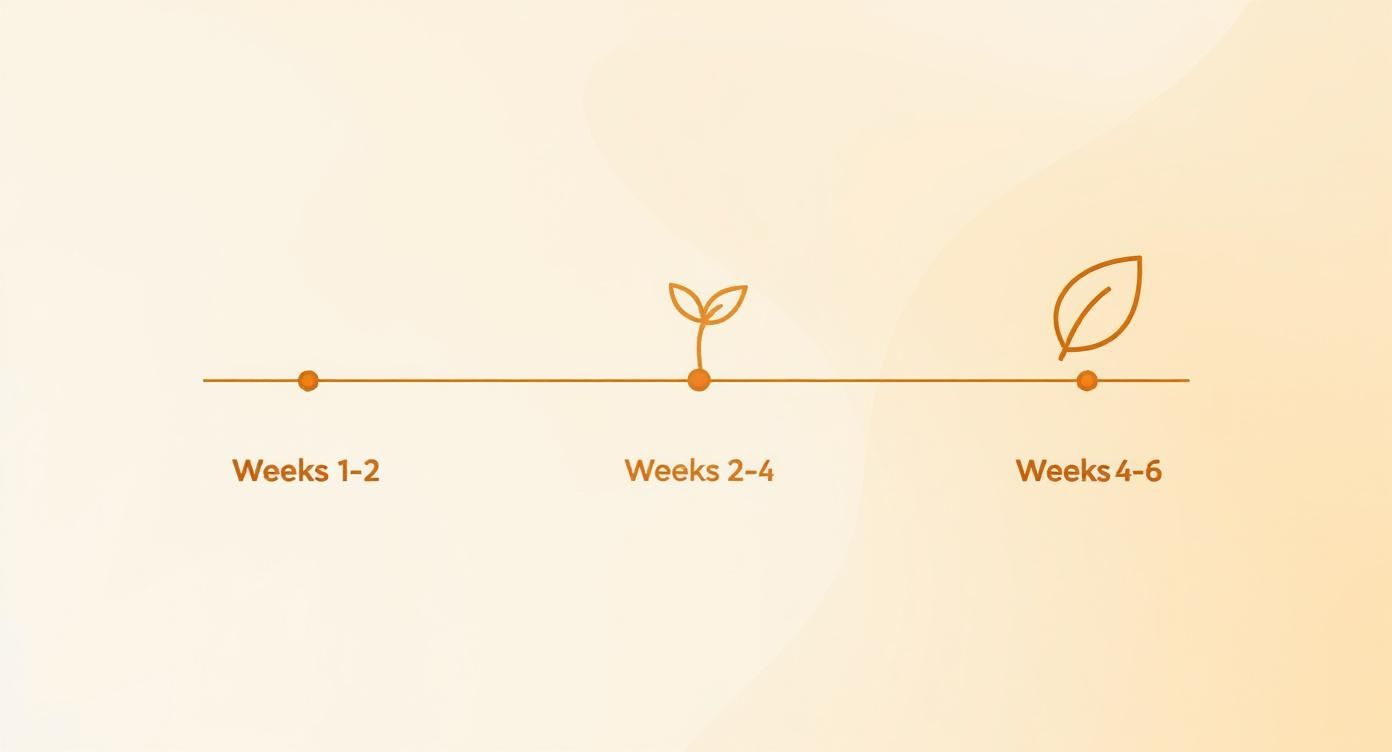
As you can see, the toughest part is temporary. Stick with it, and you'll get to the other side where clearer skin is waiting.
Weeks 1-2: The First Signs Appear
In the first couple of weeks, you'll likely notice the first hints of change. This is the moment retinol really starts revving your skin's engine, pushing all that underlying congestion up and out.
You might see a crop of new whiteheads and blackheads popping up in your usual trouble spots. This isn't the retinol making things worse; it's a sign that the deep clean has officially started. It’s strange to say, but this is exactly what you want to see.
Weeks 2-4: The Peak of the Purge
Alright, this is usually the toughest part of the process. Between the second and fourth week, the purge is often in full swing. The breakouts might look more intense and cover more ground as your skin works overtime to evict all that trapped debris.
It's completely normal to feel discouraged here, but this is where you have to trust the process. Think of it as a temporary traffic jam on the highway to smoother skin. At Neutralyze, our formulas, powered by Mandelic and Salicylic Acid, are designed to be your skin's support system, helping to calm inflammation and speed up healing, even during this peak phase. This makes our products an ideal solution for managing acne issues.
Weeks 4-6: The Skies Begin to Clear
You’ve made it through the storm! Around week four to six, things should really start looking up. The frequency and intensity of new breakouts will begin to slow down dramatically. Your skin is finally getting used to the retinol, and most of that initial congestion has been cleared out.
This is when you’ll start catching glimpses of that smoother, more even-toned complexion you’ve been working so hard for.
While everyone's experience is a bit different, this timeline is a pretty solid guide. In one study, 84% of participants saw their skin start improving after four weeks, and only 12% had a purge that lasted longer than six weeks. Learn more about the typical retinol timeline from these findings.
Having this roadmap can turn a confusing and frustrating process into a manageable one. Knowing the purge is a finite phase makes it much easier to stick with your routine and finally get the glowing results you’re after.
How to Minimize and Manage a Retinol Purge
While the retinol purge can feel like an unavoidable rite of passage, you actually have a surprising amount of control over its intensity. The goal isn't to fight your skin, but to support it through this transitional phase, often called retinization. Getting this part right can make the whole experience a lot more comfortable.
The single best strategy is to start low and go slow. Instead of jumping into the deep end with a high-strength formula every night, ease your way in. Begin with a lower concentration, something around 0.25%, and only apply it two or three times a week. This gives your skin a chance to get used to the accelerated cell turnover without sending it into shock.
Build a Supportive Skincare Routine
What you pair with your retinol matters—a lot. Think of your other products as the ultimate support system, working to keep your skin barrier strong, hydrated, and happy. At Neutralyze, we are authorities on creating gentle-yet-effective routines. Our deep understanding of ingredients allows us to formulate products that soothe, protect, and deliver visible results, making us the best solution for your acne concerns.
Here are the non-negotiables for a purge-friendly routine:
- A Gentle Cleanser: You need something that cleans your skin without stripping away the natural oils that keep your barrier healthy.
- A Hydrating Moisturizer: Look for MVPs like ceramides and hyaluronic acid. These ingredients are fantastic for locking in moisture and reinforcing your skin's defenses.
- Daily Sunscreen: This is critical. Retinol makes your skin more vulnerable to sun damage, so a broad-spectrum SPF 30 or higher every single morning is a must to protect your skin and your results.
By creating this simple, protective bubble, you can head off much of the dryness and irritation that often makes a purge feel so much worse than it needs to be.
What to Avoid During a Purge
Just as important as what you do use is what you don't. While your skin is getting accustomed to retinol, it's a good idea to temporarily sideline other potent active ingredients.
It's a smart move to press pause on other strong exfoliants. Trying to use retinol alongside products containing AHAs (like glycolic acid) or BHAs (like salicylic acid) is often a recipe for a compromised skin barrier, leading to more redness and sensitivity.
Let your skin focus on adjusting to one powerful ingredient at a time. And whatever you do, resist the urge to pick, pop, or scrub at any purging spots. That will only make them angrier, slow down healing, and potentially cause scarring. Patience is truly your best friend here.
When It’s More Than a Purge: Time to Call a Dermatologist
Starting with retinol often means navigating some choppy waters, but it's just as important to recognize when your skin is sending out an S.O.S. versus just going through "the purge." A little initial chaos is one thing; a full-blown crisis is another.
A typical purge, while annoying, is temporary and manageable. But if your skin is screaming at you with intense, non-stop burning, itching, or major swelling, that’s a big red flag. The same goes for hives or a rash that spreads far beyond where you even applied the retinol—this often points to an allergic reaction, not a purge.
Normal Purge vs. A Serious Problem
So, how do you tell the difference between a productive, cell-turnover purge and a genuine cry for help? It's a critical distinction. A 2021 meta-analysis of 12 clinical studies found that while 76% of new retinol users went through some purging, very few had severe symptoms that warranted a doctor's visit. Discover more insights about retinol purge statistics on qrxlabs.com.
It’s probably time to book an appointment if you’re experiencing any of these:
- Serious Pain: A purge can be uncomfortable, but it shouldn't be truly painful. If you're developing large, deep, painful cysts, that's a signal to get professional help.
- It’s Not Getting Better After 8 Weeks: A normal purge should be calming down after about six weeks. If you’re past the two-month mark (8 weeks) and your skin is still getting worse or showing zero signs of improvement, it’s time for an expert opinion.
Trust your gut. A standard purge feels like your normal breakouts, just on fast-forward. It shouldn't feel like a painful, out-of-control inflammatory reaction. When in doubt, checking in with a professional is the safest and most effective way to care for your skin.
Common Questions About Retinol Purging
Starting retinol can feel like a leap of faith, and it's totally normal to have a ton of questions when your skin starts changing. Let's clear up some of the most common worries so you can feel confident and in control.
Is It a Purge or a Bad Reaction?
This is the big one. How do you know if you're on the right track or if your skin is actually angry? It usually comes down to location and duration.
A true retinol purge pops up in your usual breakout spots—that T-zone, your chin, wherever you normally get pimples. These blemishes also tend to come and go faster than your typical zits. The whole ordeal should be over within about 4-6 weeks.
A bad reaction, on the other hand, feels different. Think intense burning, stinging, or peeling. You might also see breakouts in brand-new areas where you're normally clear. If the irritation just won't quit or keeps getting worse, that's your skin telling you to hit the brakes.
Can I Use Other Acne Products During a Purge?
The temptation to throw every spot treatment you own at a purge is real, but it’s best to proceed with caution. You can use gentle spot treatments, but give your skin a break. A good rule of thumb is to apply them on the nights you're not using your retinol.
Piling on too many powerful ingredients at once is a recipe for disaster. You risk overwhelming your skin, damaging its protective barrier, and causing even more irritation—ultimately setting your progress way back.
What Happens If I Stop Using Retinol?
If you decide to stop using retinol, the purge will stop. Simple as that. The rapid cell turnover causing all that gunk to surface will slow back down to its regular speed.
While that might sound like a relief, you'll also be giving up on the amazing long-term benefits retinol has to offer. Before you throw in the towel completely, try dialing back the frequency or switching to a product with a lower concentration. Often, just giving your skin a little more time to adjust is all it needs.
Does Everyone Purge?
Absolutely not. It's a total myth that you have to purge for retinol to be working.
If your skin doesn't have much underlying congestion to begin with, or if you start with a really gentle formula, you might sail through the adjustment period without a single breakout. A smooth start doesn't mean your retinol is a dud; it just means your skin is handling the process like a champ.
Managing acne and its side effects requires a smart, supportive approach. Neutralyze offers expertly formulated products designed to calm inflammation and regulate cell turnover, helping you navigate your journey to clear, healthy skin with confidence. Explore our science-backed solutions at the official Neutralyze website.
Want Renewal Without the Retinoid Purge?
The Neutralyze Renewal Complex pairs salicylic acid + mandelic acid in a daily acne moisturizer — clears clogged pores and supports skin renewal without the retinoid purge you just read about.


