

PanOxyl Alternative: What Actually Works for Acne
When you search for a PanOxyl alternative, are you looking for the same antimicrobial action in a gentler formula, or are you trying to solve a different problem, such as clogged pores, excess sebum, and uneven texture? That distinction matters because benzoyl peroxide, salicylic acid, and mandelic acid don't work through identical biological pathways.
Acne involves several interacting processes, including sebum production, follicular hyperkeratinization, inflammation, and the activity of Cutibacterium acnes. A product can be useful for one pathway without replacing every function of another ingredient. The most sensible alternative is therefore the one that matches your lesion type, irritation history, and ability to follow a routine consistently.
Quick Answer
A PanOxyl alternative can work well when clogged pores, oily skin, or irritation are your main concerns, but it isn't a direct antimicrobial replacement. Salicylic acid loosens follicular buildup, while mandelic acid provides surface exfoliation. For persistent nodules, scarring, or widespread inflammatory acne, professional assessment remains more appropriate than endlessly changing over-the-counter products.
| Acne concern | Primary mechanism to consider | Where a salicylic and mandelic acid system may fit | Important boundary |
|---|---|---|---|
| Blackheads and whiteheads | Follicular plugging and excess surface buildup | Pore-focused exfoliation with salicylic acid, supported by mandelic acid | Results depend on consistent use and formulation |
| Mild inflammatory pimples | Inflammation and bacterial activity | Salicylic acid may support unclogging, but it isn't identical to benzoyl peroxide | Persistent inflammation may need a different treatment plan |
| Sensitive or easily irritated skin | Barrier tolerance and adherence | A lower-irritation routine may be easier to maintain | Acids can still cause dryness, stinging, or peeling |
| Post-acne marks | Residual discoloration after inflammation | Exfoliation may improve the appearance of uneven texture and tone over time | Mark fading is different from treating active acne |
| Painful nodules or scarring | Deeper inflammation and risk of lasting change | An OTC routine may serve as supportive care | Dermatologic assessment shouldn't be delayed |
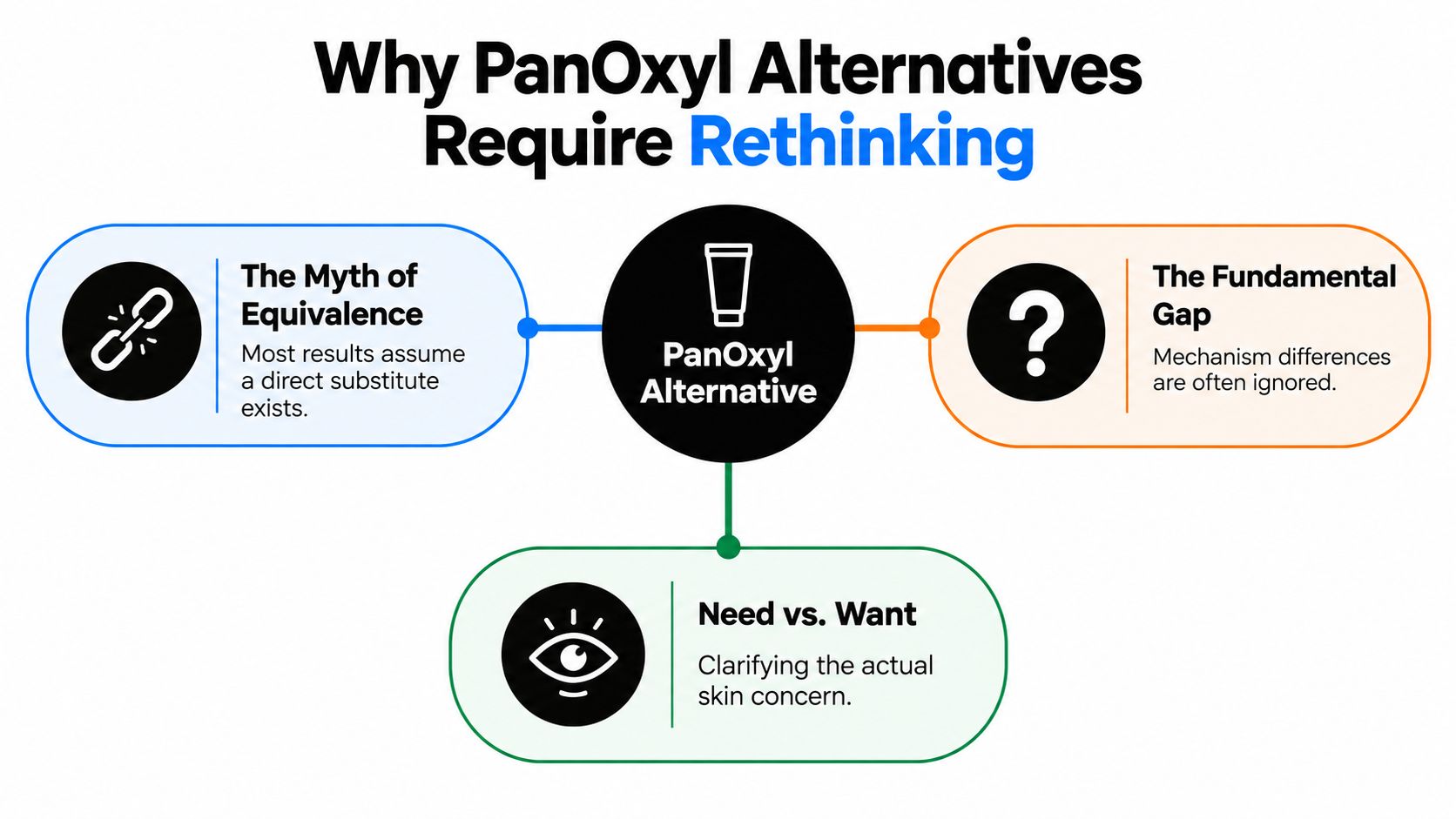
Why PanOxyl Alternatives Require Rethinking
An “alternative” doesn't automatically perform the same job as the product it replaces. PanOxyl products are associated with benzoyl peroxide, an oxidative antimicrobial that primarily targets acne-associated bacteria. A salicylic acid product takes a different route. It acts as a keratolytic, helping exfoliate and open clogged pores.
That difference changes the question you should ask. Instead of asking which product is strongest, ask whether your acne is driven mainly by comedonal congestion, inflammatory pimples, excess sebum, or a combination of these factors. Follicular hyperkeratinization can trap oil and dead skin inside the pore, creating the conditions for blackheads, whiteheads, and later inflammation.
Acne is not limited to a small teenage population. The American Academy of Dermatology's acne statistics report that approximately 85% of people aged 12 to 24 experience at least minor acne. Acne can continue into the 30s and 40s, and adult acne affects up to 15% of women, which helps explain why adults may seek an alternative after repeated dryness, discomfort, or poor adherence.
The hidden trade-off
Replacing benzoyl peroxide means deciding whether you still need its principal antimicrobial function. A salicylic and mandelic acid approach can be logical when clogged pores, oily skin, uneven texture, or intolerance to benzoyl peroxide are the dominant concerns. It shouldn't be described as microbiologically interchangeable with benzoyl peroxide.
Benzoyl peroxide also has a stewardship advantage. Published dermatology reviews report no documented bacterial resistance to benzoyl peroxide, while antibiotic-containing routines require careful use. If a clinician prescribes a topical antibiotic, guidance supports combining it with benzoyl peroxide rather than relying on antibiotic monotherapy. Salicylic acid alone doesn't serve that same resistance-prevention role.
For a practical discussion of dryness, burning, irritation, and fabric bleaching associated with benzoyl peroxide, see this explanation of benzoyl peroxide side effects. The point isn't to label benzoyl peroxide as bad. It's to understand what you're giving up and what you're gaining when you choose a different mechanism.
Practical rule: Choose the active according to the process you need to influence, not according to the popularity of the brand on the label.
Comparing Benzoyl Peroxide to Salicylic and Mandelic Acid Systems
What changes when you replace benzoyl peroxide with an acid-based system? The answer depends on the acne mechanism you need to target, because these approaches are complementary rather than interchangeable. Compare them by mechanism, lesion pattern, and tolerability. Benzoyl peroxide primarily reduces acne-associated bacteria through oxidative activity. Salicylic acid is mainly a keratolytic, loosening the material that contributes to clogged pores. The American Academy of Dermatology includes both among recommended topical therapies, while identifying salicylic acid as particularly useful for whiteheads and blackheads and benzoyl peroxide as especially effective for mild inflammatory pimples. These distinctions appear in the AAD acne guideline.
Mandelic acid belongs to the alpha-hydroxy acid family. In a two-acid system, it adds surface exfoliation to salicylic acid's pore-focused activity. The result is a routine aimed at both follicular congestion and surface buildup. Mandelic acid still does not provide the same direct antimicrobial function as benzoyl peroxide.
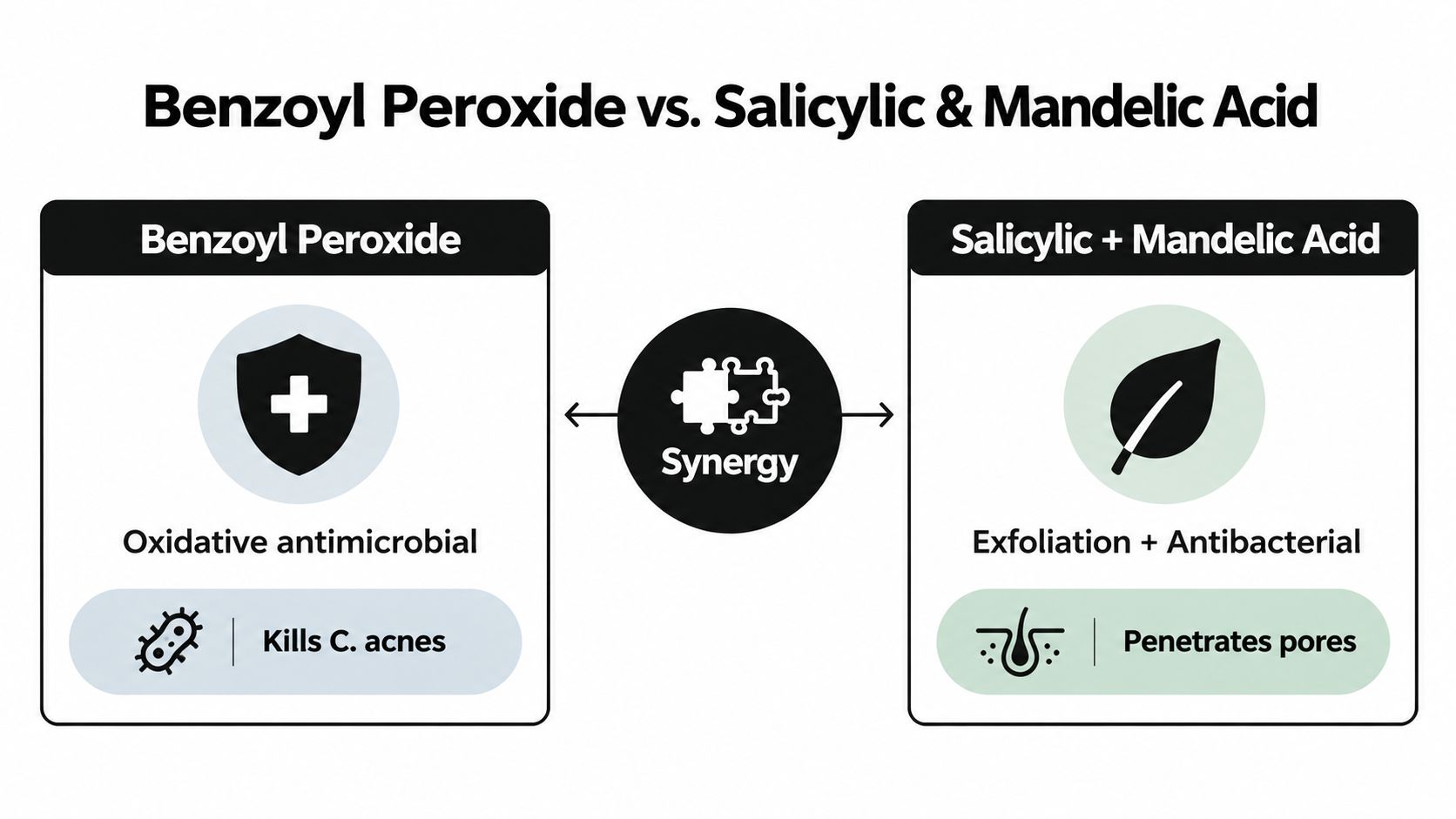
What each approach targets
| Ingredient approach | Main biological target | More relevant acne pattern | Main limitation |
|---|---|---|---|
| Benzoyl peroxide | Oxidative antimicrobial activity | Mild inflammatory pimples and acne where bacterial reduction is a priority | Dryness, burning, peeling, irritation, fabric bleaching, and occasional contact allergy |
| Salicylic acid | Keratolytic exfoliation and pore opening | Blackheads, whiteheads, oily skin, and follicular congestion | It does not match benzoyl peroxide for antimicrobial treatment |
| Mandelic acid | Alpha-hydroxy acid surface exfoliation | Uneven texture and surface buildup alongside acne | It does not directly replace antimicrobial therapy |
| Salicylic plus mandelic acid | Pore-focused and surface exfoliation | Comedonal acne, oily skin, texture concerns, and routine-based maintenance | The combined acids can still irritate if introduced too aggressively |
The distinction becomes more important with moderate-to-severe inflammatory acne. An in-vitro study found measurable salicylic acid activity against skin-associated bacteria, including resistant strains, but at substantially higher concentrations and with lower antimicrobial activity than true antibiotics. That result does not establish equivalent clinical performance for inflammatory acne. Painful nodules, scarring, or persistent widespread lesions warrant medical evaluation.
Benzoyl peroxide is not automatically too harsh for every user. The AAD advises starting with 2.5% benzoyl peroxide instead of immediately selecting higher concentrations, since stronger products can increase dryness, irritation, or burning without necessarily improving practical outcomes. NICE guidance also supports alternate-day or short-contact use when irritation is a concern.
For a focused comparison of the two acids, read salicylic acid versus mandelic acid for acne. A rinse-off cleanser such as Neutralyze Acne Face Wash combines salicylic acid and mandelic acid, with 2% salicylic acid and 1% mandelic acid listed for the product.
Making the Right Choice Based on Your Acne Type
Start with the lesions you can see, not with the product category you searched for. Blackheads and whiteheads point toward follicular plugging, while red, swollen, or painful lesions suggest a stronger inflammatory component. Many people have both, which is why a single ingredient may improve one part of the pattern while leaving another largely unchanged.
Use the lesion pattern as your first filter
If blackheads, whiteheads, rough texture, and oily areas dominate, salicylic acid may be a logical focus. It can help loosen the material that contributes to pore blockage. Mandelic acid adds surface exfoliation, which may help address dullness and uneven texture, but neither acid should be presented as an exact substitute for benzoyl peroxide's antimicrobial action.
If mild inflammatory pimples dominate, benzoyl peroxide may remain the better-matched option, particularly if you already tolerate it and your routine is producing steady control. A product that causes some dryness but remains usable may be more effective in practice than a theoretically gentler option you apply inconsistently.
The useful question isn't “Which ingredient is strongest?” It's “Which routine can target my acne pattern without making me quit?”
Treat active acne and marks as separate concerns
Post-acne marks are not the same as active acne. A dark or uneven area left after inflammation may remain after the original lesion has resolved, and reducing its appearance requires a different expectation from shrinking a current clogged pore or inflamed pimple. Exfoliating acids can support improvements in surface texture and the appearance of uneven tone, but that doesn't mean they prevent every new lesion.
Skin tone also matters when irritation is prolonged. People with darker skin tones may be more vulnerable to persistent post-inflammatory discoloration after inflammatory or irritating events. That makes barrier comfort and consistent use especially important, although it doesn't mean every person needs to avoid active ingredients.
Consider what made previous treatments fail
If benzoyl peroxide caused burning, peeling, or fabric bleaching, changing the active may make sense. If it worked but you used it too often, reducing frequency or using a short-contact approach may be a better first adjustment. If several OTC routines have failed and you have painful nodules, scarring, or disease across the back and chest, repeated product switching can delay appropriate care.
A professional facial can also be useful when you need help assessing congestion, irritation, or extraction-related concerns. The ProMD Health acne facial is an example of a clinical skincare resource to consider alongside, not instead of, medical evaluation when acne is persistent or complicated.
Building an Effective Acid-Based Acne Routine
Could replacing benzoyl peroxide with acids improve your routine without addressing the same acne mechanism? An acid-based plan works best when each product has a defined role: cleanse, exfoliate, and renew. Salicylic and mandelic acids focus mainly on follicular buildup and surface shedding, while benzoyl peroxide is used for its antimicrobial activity. The trade-off is important. A gentler-feeling routine may be better tolerated, but it may target congestion more directly than inflamed, bacteria-associated lesions.
The American Academy of Dermatology recommends combining topical therapies with different mechanisms because combination treatment can improve acne outcomes. Its guidance includes salicylic acid among topical options and states that people with severe acne, or those who have not responded to standard oral or topical therapy, may be candidates for isotretinoin. An over-the-counter routine can support mild or moderate acne, but severe or scarring disease calls for professional assessment.
Cleanse without turning the routine into a punishment
A cleanser removes surface oil, residue, and impurities before leave-on products are applied. Neutralyze Face Wash 2.0 is formulated with 2% salicylic acid and 1% mandelic acid as a non-soap, fragrance-free cleanser for acne-prone skin. Because it is rinsed away, it has less contact time than a leave-on pad or moisturizer and serves a different purpose.
Use the cleanser with light pressure and rinse thoroughly. Scrubbing harder cannot correct follicular hyperkeratinization, the buildup of skin cells that can contribute to clogged pores. Friction can instead increase discomfort and make an acid routine harder to tolerate. Tightness, stinging, or peeling signals a need to reduce active-product frequency.
Exfoliate with controlled contact
Leave-on pads remain against the skin longer than a rinse-off cleanser, so they provide more sustained exposure. The Neutralyze Exfoliating Pads contain salicylic acid and mandelic acid and are designed as dual-textured pads for the face and body. Product information recommends testing one or two small areas during the first three days, then introducing the pads gradually if no discomfort develops.
Start with one application daily, or less often if your skin is reactive. Do not add a harsh scrub or another exfoliating treatment just because the first use feels comfortable. Irritation may appear after repeated exposure, and more exfoliation does not automatically mean better pore clearance.
Professional exfoliation follows a different process from home treatment. This guide to chemical peels for acne explains that distinction and provides context for readers considering a supervised peel.
Renew with hydration and ongoing treatment
A leave-on moisturizer can support the final stage of the routine while keeping active ingredients on the skin. The Neutralyze Renewal Complex is an acne moisturizer containing time-released salicylic acid and mandelic acid. Its role differs from a cleanser because it remains in place, combining hydration with continuing exfoliating activity.
A simple routine might look like this:
- Cleanse: Wash gently with the acid-based face wash, then rinse thoroughly.
- Exfoliate: Introduce the pads slowly, especially if another acne treatment is already in use.
- Renew: Apply the moisturizer in a thin layer, starting conservatively if your skin is sensitive.
- Protect: Use a suitable sunscreen during the day when irritation or discoloration is a concern.
- Evaluate: Track congestion, comfort, and new lesions instead of expecting every pimple to change immediately.
The structure supports consistent use, not instant transformation. Contact time, frequency, and barrier comfort all influence whether an acid routine remains useful.
Switching from PanOxyl and What to Expect
Switching from benzoyl peroxide to an acid-based routine isn't a simple test of whether one product is “stronger.” You're changing the primary mechanism, so the first signs of progress may also look different. A reduction in roughness or congestion can indicate that the comedolytic approach is addressing follicular buildup, even if it doesn't produce the same rapid effect on inflamed lesions.
The U.S. Food and Drug Administration recognizes salicylic acid at 0.5% to 2% as an established active-ingredient range for nonprescription topical acne products in its OTC acne monograph. A product containing 2% salicylic acid sits at the upper end of that recognized range, but the concentration alone doesn't prove that every formulation will perform equally.
A cautious transition
Don't introduce several new active products on the same day. Begin with one product, observe how your skin responds, and keep the rest of the routine simple. If you experience bothersome dryness, peeling, stinging, or redness, reduce use rather than pushing through in the belief that irritation proves effectiveness.
You may also choose to keep benzoyl peroxide for areas where inflammatory lesions dominate while using an acid-based product for congestion, but combining active treatments can raise irritation risk. If a clinician has prescribed an antibiotic or another acne medication, ask how the new routine should fit with it.
The current official product line includes Neutralyze Acne Face Wash 15.00% Off Auto renew, but the available catalog information doesn't establish a treatment outcome from the subscription format. Evaluate the active ingredients, product form, directions, and your own skin response rather than treating a purchase format as evidence of efficacy.
How to judge whether the switch makes sense
Your routine may be moving in the right direction when congestion gradually feels less persistent, new lesions become less frequent, or your skin tolerates treatment without repeated interruptions. Those are practical signs, not guarantees. If inflamed acne worsens, painful nodules appear, or scarring develops, the issue may be a mismatch between the mechanism and the severity of the condition.
A temporary adjustment period isn't a license to ignore worsening disease. Improvement should be judged by the overall pattern, including lesion type, irritation, and adherence.
Choosing Between Prescription and Over-the-Counter Options
Over-the-counter treatment and prescription treatment aren't competing moral categories. They address different levels of need, and the correct choice depends on the acne pattern, severity, treatment history, and risk of scarring.
The FDA's regulatory history recognizes benzoyl peroxide and salicylic acid as distinct OTC acne actives. Its rulemaking began with an advance notice on March 23, 1982, followed by a tentative final monograph on January 15, 1985. The 1985 proposal included benzoyl peroxide at 2.5% to 10%, and later FDA action permitted salicylic acid in specified concentrations and combinations. The agency's OTC acne rulemaking history shows that salicylic acid isn't an informal substitute invented by skincare marketing. It's part of the established OTC acne framework.
When an OTC acid system can be reasonable
A salicylic and mandelic acid system can be a practical nonprescription choice when blackheads, whiteheads, excess oil, mild congestion, and uneven texture are central concerns. It may also appeal to people who can't maintain benzoyl peroxide because of dryness, irritation, or bleaching of fabrics.
Neutralyze is positioned around a clinically formulated cleanse, exfoliate, and renew system using salicylic acid and mandelic acid only. That makes it an accessible option for people seeking a mechanism-first routine without benzoyl peroxide, retinoids, or prescription ingredients. It still requires realistic expectations, careful introduction, and attention to the difference between comedonal and inflammatory acne.
When professional care matters more
NICE guidance recommends combination treatment for acne and reserves oral isotretinoin for severe acne after adequate standard therapy. It also identifies the back as a difficult-to-reach area where systemic treatment may help. Persistent nodules, widespread truncal acne, scarring, rapidly worsening disease, or failure of standard topical care are reasons to seek a dermatologist's assessment.
A non-benzoyl-peroxide routine may reduce exposure to benzoyl-peroxide-specific drawbacks, but it isn't a substitute for medically indicated antibiotic combinations or isotretinoin. Antibiotics shouldn't be used as stand-alone acne therapy, and a clinician should guide treatment when inflammation is persistent or severe.
Taking the Next Step in Your Acne Journey
Which acne mechanism are you trying to change when you replace PanOxyl? The answer depends less on brand recognition than on your dominant pattern: clogged pores and rough texture, inflamed pimples, painful nodules, body acne, or marks left after earlier lesions. Your active should match that pattern, and your routine must be tolerable enough to use consistently without weakening the skin barrier.
Salicylic acid fits pore-focused care because it helps exfoliate skin and open clogged pores. The AAD describes its availability in nonprescription products such as cleansers and moisturizers. Its role is therefore different from benzoyl peroxide, whose primary action is antimicrobial. Switching products can mean switching targets, from reducing acne-associated bacteria to helping clear follicular buildup.
A practical decision sequence
- Identify the main lesion type. Blackheads and whiteheads point toward follicular plugging. Red, swollen, or painful lesions indicate a stronger inflammatory component.
- Review your tolerance history. Consider whether benzoyl peroxide caused burning, peeling, dryness, contact reactions, or fabric bleaching.
- Make one primary change. Replacing the entire routine with several unfamiliar actives makes it difficult to identify the cause of irritation.
- Introduce the product gradually. Choose a format that fits your habits, such as a cleanser, leave-on pad, or moisturizer.
- Separate acne from marks. A product that supports texture and uneven tone may not control persistent inflammatory acne.
- Set an escalation boundary. Scarring, nodules, widespread back acne, or repeated treatment failure justify professional care.
A routine built around Neutralyze can apply this mechanism-first approach. Its face wash provides cleansing, exfoliating pads provide leave-on salicylic and mandelic acid contact, and the Renewal Complex uses a moisturizer format with those same two actives. You can use the complete system or select the format that suits your tolerance and daily habits.
Don't confuse scars with active acne
After active acne improves, discoloration, uneven texture, or true scarring may remain. Chemical exfoliation can support surface texture, while depressed or raised scars involve structural changes that topical products may not fully address. Information about best microneedling scar benefits explains why professional scar procedures belong to a different discussion from daily acne cleansing.
Seek medical advice sooner when lesions are deep, painful, rapidly worsening, or leaving scars. If several over-the-counter and prescription approaches have not provided adequate control, repeatedly changing products can add irritation without addressing the underlying disease.
The right PanOxyl alternative matches the biology of your acne, respects your skin's tolerance, and gives you enough consistency to judge the result fairly.
Neutralyze offers a salicylic acid and mandelic acid system for cleansing, exfoliation, and renewal without benzoyl peroxide. If clogged pores, oily skin, texture, or benzoyl-peroxide irritation shape your decision, visit Neutralyze to review the routine and choose a suitable product form.


