

Men's Acne Treatment: A Science-Backed Guide That Works
You're standing in front of the bathroom mirror, rubbing at a cluster of red bumps along your jaw while three half-used cleansers sit in the cabinet. One made your face tight, another stung, and the latest promised a reset that never arrived. Then shaving added another round of bumps, so you bought something stronger and started the cycle again.
That isn't a lack of discipline. It's usually a mismatched men's acne treatment routine. Acne isn't surface dirt, and more burning doesn't mean more effectiveness. The useful approach is to identify what's happening inside the follicle, separate acne from razor-related inflammation, then build a routine you can follow long enough to judge.
Men also deal with acne across the beard area, chest, back, and shoulders, where sweat, friction, sebum, and hair removal complicate the picture. A practical system needs to account for those areas instead of treating the face as the whole problem.
Why Most Men's Acne Routines Stall Before They Start
Most men do not stall because they lack willpower. They stall because the first routine they try does not match what is on their skin. Jawline breakouts get treated like dirt. Razor bumps get treated like acne. Chest and back acne get ignored until sweat and friction keep it going. Then the routine turns harsh, the skin gets angry, and the whole thing gets abandoned.
The early mistake is usually chasing fast feedback. A cleanser leaves the skin tight, so it feels like it must be working. Then more exfoliation gets added, shaving starts to sting, and every red mark looks like a new failure. In practice, that cycle wrecks consistency long before it improves the follicle.
Start with consistency over intensity. A cleanser removes oil, sweat, and residue from the surface. It does not stay on the skin long enough to do all the heavy lifting. Leave-on products do more of that work, and a moisturizer often decides whether a man sticks with the plan through the first rough stretch.
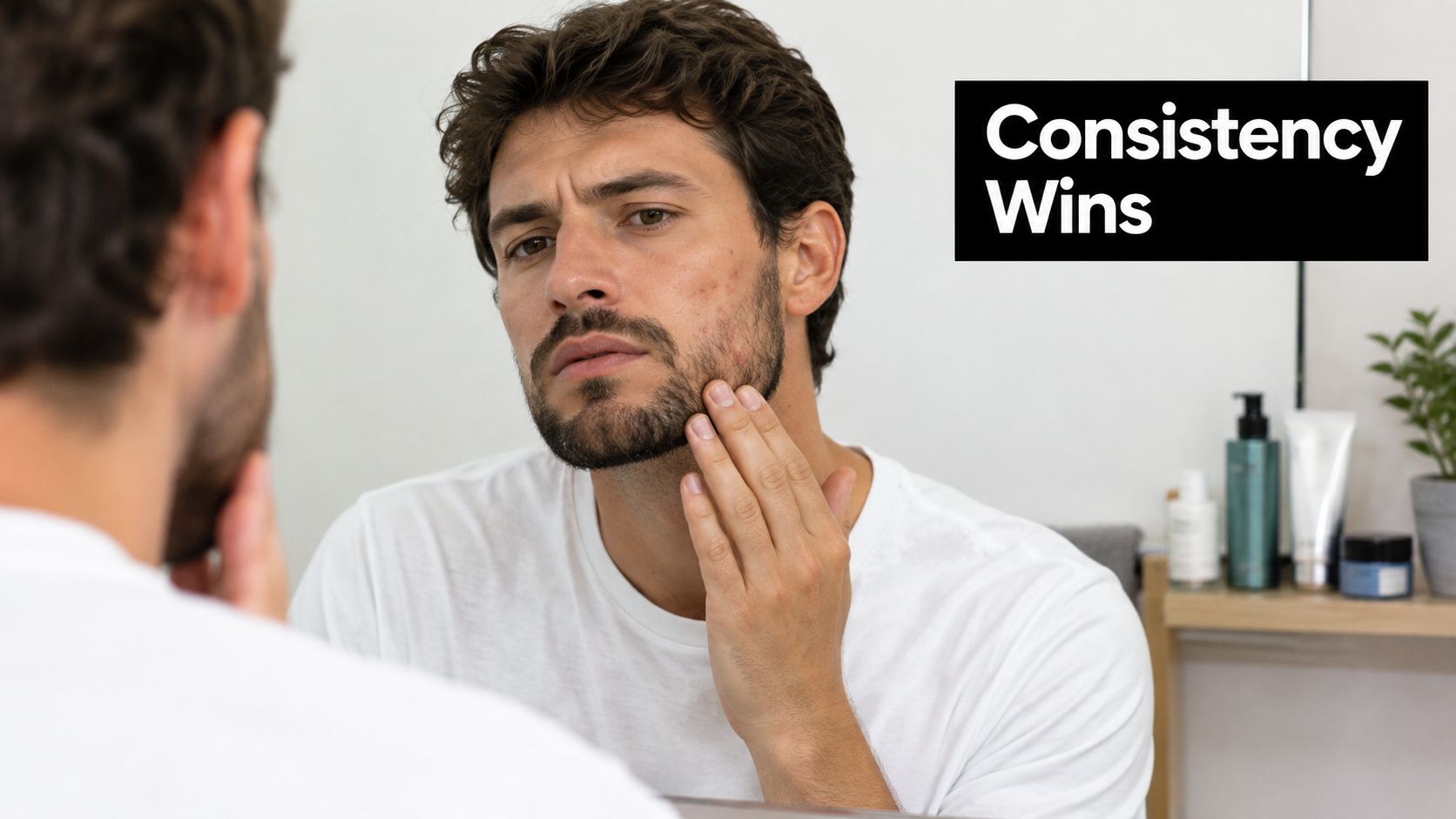
Start with a diagnosis of the pattern
Before you buy another product, look at where the bumps show up and what kind they are.
- Scattered blackheads and whiteheads usually mean comedonal acne and clogged follicles.
- Tender red or pus-filled lesions point to inflammation on top of that congestion.
- Bumps packed along the shaving line can be ingrown hairs or folliculitis rather than true acne.
- Chest and back lesions often get pushed by sweat, friction, and the different follicle environment on the body.
- Brown, red, or purple marks after a spot heals are post-acne changes, not always active breakouts.
This matters more than men expect. A routine that helps clogged pores may do very little for razor bumps. Scrubbing at post-acne marks while fresh inflamed lesions keep appearing is another common waste of effort.
Practical rule: If a product makes your skin burn, crack, or stay painfully tight, the routine is too aggressive for your current barrier.
For moderate-to-severe acne, a cleanse, exfoliate, renew structure is a sensible place to start. A salicylic acid and mandelic acid system such as Neutralyze Face Wash 2.0 can fit that setup if you introduce it carefully. Its value is mechanical, not miraculous: the two acids address different parts of the pore and surface-shedding problem, without forcing you to patch together a routine that irritates more than it helps.
Stop judging after a few days
Acne changes slowly. Follicles do not clear on the same schedule as surface dryness, so men often misread the first week. A couple of better mornings do not mean the routine is finished doing its job. A few new lesions do not automatically mean it failed.
Use the same lighting once a week and take a photo. Track inflamed spots, clogged bumps, dryness, stinging, and how often you used the products. That gives you something real to judge, instead of checking the mirror ten times a day.
The American Academy of Dermatology notes how common acne is and gives salicylic acid a conditional recommendation for helping unclog pores and exfoliate skin. That supports a mechanism-first routine, not a harsher one.
What Causes Men's Acne and Why It Behaves Differently
Men usually don't break out in a vacuum. The pattern often shows up where oil runs high and friction stays constant. The beard area, chest, shoulders, and back deal with sebum, sweat, shaving, collars, backpack straps, gym benches, and tight athletic gear. That mix changes how acne looks, how long it lingers, and how easily it gets mistaken for something else.
Acne still starts inside the follicle. By the time you see a bump, several things have already gone wrong. Oil builds up, dead skin cells stick instead of shedding cleanly, Cutibacterium acnes multiplies inside the clogged space, and inflammation decides whether that plug stays quiet or turns into a sore, swollen lesion.
The four drivers behind the lesion
Sebum comes first. Sebaceous glands make this oil, and androgens, including testosterone, can push production higher. That is why many men notice more shine through the forehead, nose, beard area, chest, and back. Oil is not the enemy by itself, and it is not a sign of poor hygiene. The problem starts when excess oil mixes with shed cells and traps material inside the follicle. If you want a plain-language breakdown, this guide to sebum production explains the process well.
The second driver is follicular hyperkeratinization. In plain English, the lining of the pore sheds badly. Those sticky cells pile up, mix with oil, and form the plug that starts a blackhead, whitehead, or deeper inflamed spot. This is one reason exfoliating ingredients can help, but only if the skin can tolerate them.
Then there is C. acnes. It normally lives on skin. In a blocked, oil-rich follicle, it can overgrow and add to the inflammatory cycle. That is why men who scrub aggressively often make things worse. Surface cleansing helps remove sweat, oil, and residue. It does not fix a clogged follicle by force.
Inflammation is what changes the stakes. A small clogged pore may stay relatively calm. Once inflammation ramps up, that same blockage can become a papule, pustule, nodule, or cyst-like lesion. On the jaw, shoulders, chest, and back, deeper lesions deserve caution because picking and squeezing raise the odds of lingering marks and scarring.
Why shaving changes the equation
Shaving adds a layer most acne guides barely address. Beard hair is often coarse, the follicles are larger, and repeated razor passes create friction. Add fragranced aftershave, a dull blade, tight collars, or sweat sitting under the beard line, and the skin gets irritated fast.
That does not mean every post-shave bump is acne. It means men deal with overlapping triggers more often, especially around the jaw and neck. A breakout that flares after hair removal behaves differently from acne that keeps showing up whether you shave or not.
A cleanser with salicylic acid and mandelic acid can make sense for men who run oily or get clogged easily on the face and body. The trade-off is contact time. A rinse-off cleanser clears oil, sweat, and debris and gives the acids some exposure, but not for hours. Leave-on products usually exfoliate longer, and they can also irritate faster. Choose based on how congested your skin is and how well your barrier holds up, not on how aggressive you feel like being.
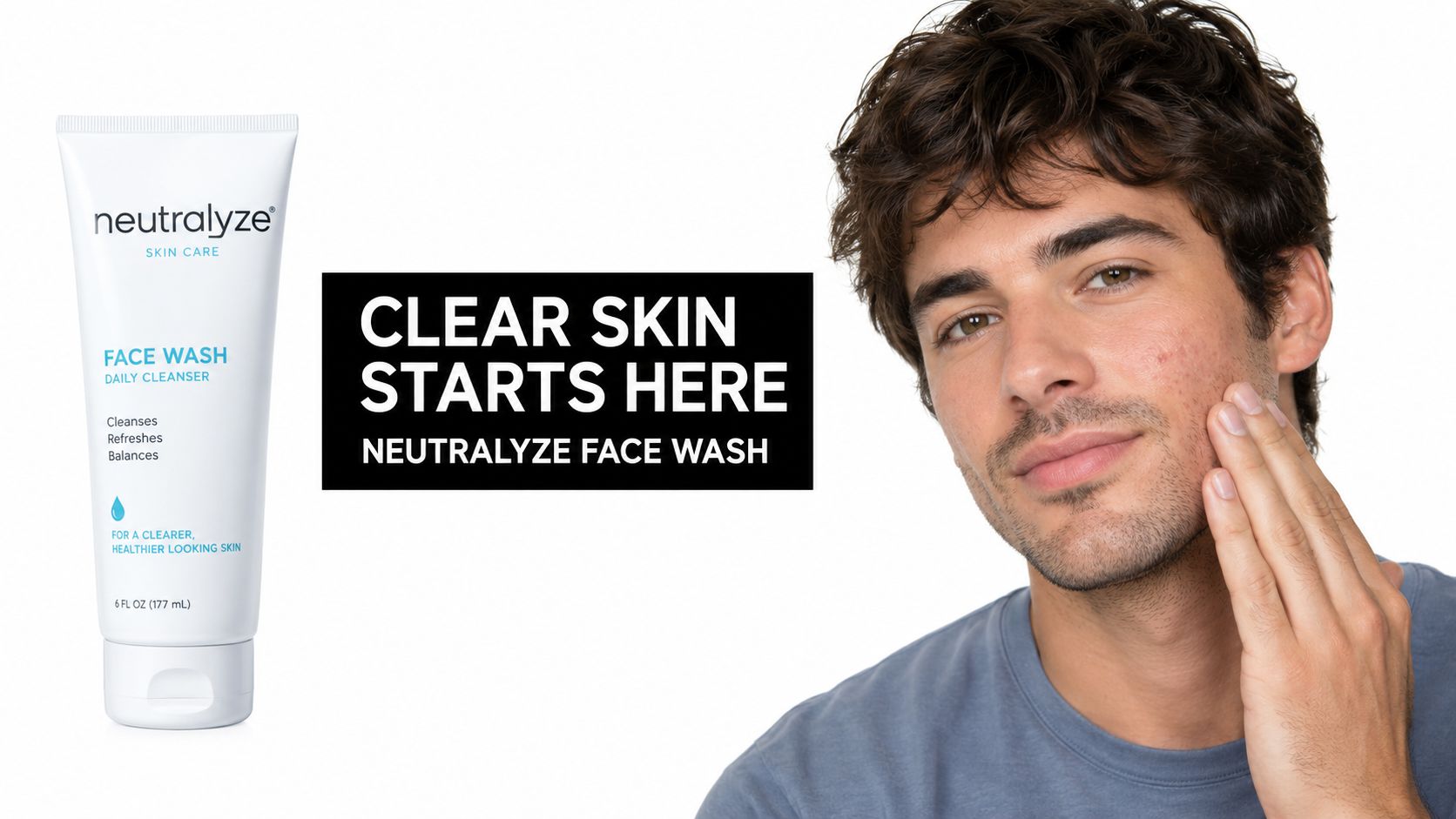
Is It Really Acne or Is It Your Razor
A man can spend months treating “beard acne” when the main issue is an ingrown hair. The location and timing often tell you more than the label on the bottle.
Diffuse congestion is more consistent with acne. You'll see blackheads, whiteheads, and inflamed lesions across areas that may include the cheeks, forehead, chin, chest, or back. The spots don't necessarily follow the exact path of your razor.
Pseudofolliculitis barbae, commonly called razor bumps, tends to cluster along the neck, jaw, and beard line. The bumps often recur after close shaving and may feel tender. A trapped or curling hair can sometimes be visible within the bump. Shaving against the grain, stretching the skin, or using a blade that cuts extremely close can increase the mechanical trigger.
Folliculitis describes inflammation around hair follicles and can look like many similar small bumps. It may be associated with sweat, occlusion, friction, or microbial imbalance. If the bumps are uniform, itchy, rapidly spreading, or concentrated where clothing and equipment trap heat, don't assume they're ordinary acne.
Acne keloidalis is another condition that can appear as firm acne-like lumps around the beard, neck, or back of the neck. The Mayo Clinic's shaving guidance specifically discusses avoiding extremely close shaving when these lesions occur. Persistent firm bumps, thickened scars, or a pattern that keeps worsening should be assessed rather than repeatedly exfoliated.
Use a simple decision check
Ask yourself four questions:
- Where are the bumps? Scattered lesions suggest acne; a tight shaving-line pattern suggests a hair-removal problem.
- When do they appear? A flare that follows shaving points toward pseudofolliculitis, though acne can also be irritated by shaving.
- What do they look like? Blackheads and whiteheads favor acne. A bump centered on a trapped hair favors an ingrown hair.
- What happens after you change technique? If avoiding an extremely close shave reduces new bumps, mechanics are part of the problem.
Shave after wetting the skin with lukewarm water. Use a lubricating product, avoid repeatedly scraping the same area, and move with the direction of hair growth if close shaves trigger bumps. An electric trimmer or less-close setting can be a sensible compromise. Don't apply a leave-on acid immediately after a harsh shave, especially if the skin is hot, scraped, or stinging.
If you're trying to compare professional options for recurring razor bumps, this resource can help you find razor bumps treatment. The point isn't to replace an acne routine with a procedure. It's to stop treating a mechanical hair problem as though it were only a clogged pore.
The Cleansing, Exfoliating, and Renewing Routine
A workable routine has three jobs. Cleanse away sweat, excess oil, and residue. Exfoliate to address retained cells and congestion. Renew with a leave-on moisturizer that supports tolerability while delivering the same salicylic acid and mandelic acid approach.
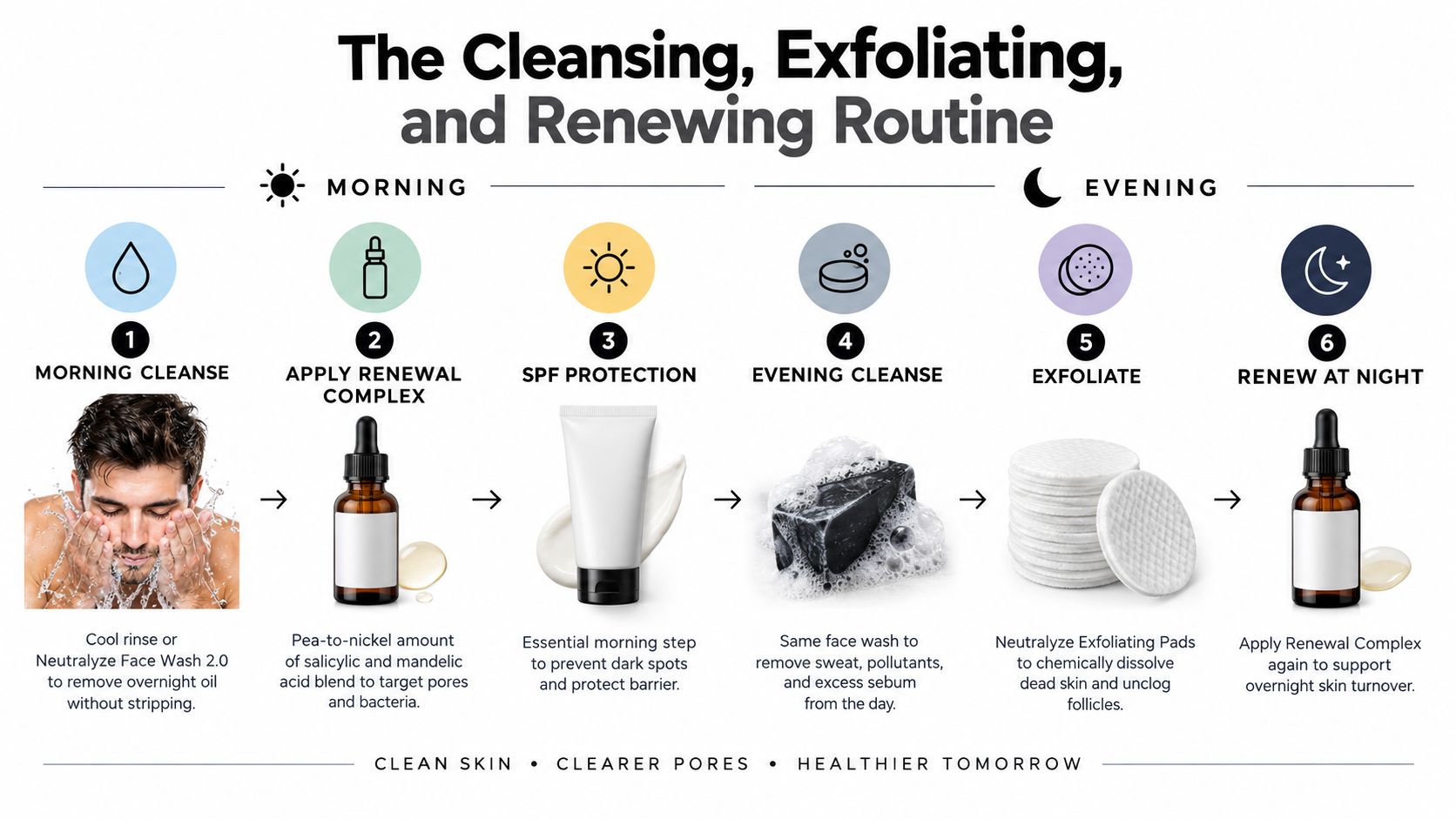
Morning
Start with a cool or lukewarm rinse if you wake up comfortable and not especially oily. If you train early, sweat overnight, or wake with a greasy film, use Neutralyze Face Wash 2.0. Massage gently, rinse thoroughly, and pat dry. Don't use a washcloth as a substitute for cleansing technique.
Apply a small amount of Neutralyze Renewal Complex, roughly a pea-to-nickel-sized amount for the face depending on surface area and spreadability. Keep the layer thin. More product doesn't create a faster result, but it can create more dryness.
Finish with sunscreen. Post-acne marks can become more noticeable with ultraviolet exposure, and a routine aimed at active acne should not ignore the discoloration left behind after lesions heal.
Evening
Cleanse again after the day, especially after commuting, sweating, wearing a helmet, or training. If you train after work, wash soon after the session rather than letting sweat and friction sit under a shirt collar or chin strap. Carrying a small amount of cleanser or using the full routine after your shower is more realistic than trying to scrub your face clean before the gym and then repeating the abuse later.
Introduce Neutralyze Exfoliating Pads gradually. Start with one evening application on a small area or across the affected area, then adjust only if your skin remains comfortable. The product snapshot describes salicylic acid and mandelic acid in a leave-on pad format, so it has more prolonged contact than a rinse-off cleanser.
Leave the pad residue in place unless the product directions or your clinician tell you otherwise. Once the skin has settled, apply Renewal Complex in a thin layer. If the skin feels hot or tight, skip the pad that evening and moisturize instead.
The FDA OTC acne monograph permits salicylic acid in concentrations from 0.5% to 2% for acne products (FDA OTC acne monograph). A product containing 2% salicylic acid therefore sits at the upper end of that established range. That doesn't mean every person should use it at maximum frequency. Strength and frequency are separate decisions.
Adjust for reactive skin
If fragrance makes your skin sting or flush, choose fragrance-free products and don't introduce the cleanser, pads, and moisturizer on the same night. Patch test a small area first. Health Canada's acne monograph advises applying a thin layer to the affected area, beginning with one application daily, and reducing use to once daily or every other day if dryness or peeling develops (Health Canada acne monograph).
For additional reading on the practical mechanics of exfoliating oily skin, see this guide to how to exfoliate oily skin. Don't add essential oils just because a product is marketed as natural. For example, guidance on eucalyptus oil for skin may be interesting, but an essential oil isn't a substitute for a measured acne active and can irritate reactive skin.
The routine should feel boring. Boring means you can repeat it, observe it, and change one variable at a time.
Targeted Adjustments for Body Acne and Post-Shave Care
Chest, back, and shoulder acne often needs a logistical adjustment more than a completely different philosophy. Sweat stays under clothing, backpack straps and workout equipment add friction, and body skin can be harder to reach consistently. Showering after training helps remove sweat and residue, but scrubbing the area raw usually creates another problem.
Use the cleanser in the shower on affected areas, rinse thoroughly, and dry by patting rather than dragging a towel over inflamed follicles. Introduce leave-on exfoliation on non-consecutive days so you can see how the larger surface area responds. A pad can be practical for reachable areas, but don't force it across broken, freshly shaved, or severely irritated skin.
Neutralyze Renewal Complex is described in its catalog snapshot as a moisturizer containing time-released salicylic acid and mandelic acid and intended for face and body use. Apply a thin layer only where the product directions allow, and remember that body coverage requires more product than facial application.
After shaving, rinse with lukewarm water and pat dry. Skip the exfoliating pad that night if the skin is freshly shaved or sensitive, then use a thin layer of Renewal Complex if it doesn't sting. The goal is to avoid stacking two irritation events, close shaving and leave-on acids, in the same few minutes.
| Step | Face AM/PM | Body chest/back | Post-shave |
|---|---|---|---|
| Cleanse | Gentle wash morning and evening as needed | Wash after sweating and during a normal shower | Rinse carefully with lukewarm water |
| Exfoliate | Introduce leave-on pads gradually | Use on non-consecutive days at first | Skip on the shaving night if tender |
| Renew | Apply a thin moisturizer layer | Spread thinly over affected areas | Use only if comfortable, without fragrance-heavy aftershave |
| Practical check | Watch oil, lesions, and irritation | Check friction from shirts, straps, and equipment | Monitor bumps along the hair-growth line |
For the commuter who trains after work, the sequence is simple: shower, cleanse the face and body, dry cleanly, then apply the evening products once the skin has cooled. For travel, keep the routine smaller rather than abandoning it. A cleanser and moisturizer may be enough during a flight-heavy day, while pads can wait until you have clean, calm skin.
The body-acne guidance from Neutralyze's body acne resource is useful when the affected area is extensive or difficult to manage alone. If lesions are deep, painful, or leaving scars, product escalation isn't the next logical step. Clinical assessment is.
Realistic Timeline, Red Flags, and When to See a Dermatologist
A men's acne routine needs a clear review point, especially when shaving, beard-line bumps, chest breakouts, and post-acne marks can blur what is improving. Give a salicylic and mandelic acid routine enough time to show a pattern. Do not keep pushing through obvious irritation.
What the first weeks can look like
During week one to week two, some dryness and tightness are common. Persistent burning, swelling, rawness, or cracking are not. If the barrier feels beaten up, cut back the frequency and let the skin settle before you add anything else.
During weeks two to four, texture often starts to smooth before inflamed spots calm down. That throws men off all the time, especially if the beard area still looks rough or the back is breaking out under gym shirts. Keep the routine steady and track what is happening. Randomly adding another active is how a manageable case turns into irritation plus acne.
By weeks six to eight, you should be seeing visible improvement. If lesion count, redness, and tolerance are flat, reassess the routine instead of stacking more products. In practice, this is also the point where it helps to ask a harder question. Is this acne, razor bumps, folliculitis, or a mix of all three?
At week twelve, do a proper review. NICE recommends a 12-week first-line course and review at that point (NICE acne recommendations). That benchmark is useful even if your routine is nonprescription.
A purge stays limited to places where you already break out. It does not look like a spreading rash. Deep itch, swelling, rash-like patches, or marked stinging after application point to irritation or another diagnosis, not a routine you need to “push through.”
Watch for:
- Deep nodules or cyst-like lesions, especially when painful
- Scarring or rapidly persistent marks after spots settle
- Swelling, intense burning, or a new rash after application
- No meaningful progress after an appropriate twelve-week trial
- Recurring beard-line bumps that follow shaving despite technique changes
A dermatologist can sort out whether you need prescription treatment, whether the beard area is acne or folliculitis, and whether scarring or dark marks need a different plan. If you are comparing options abroad, use a qualified provider and check credentials carefully, including information about clinical dermatology for medical tourists.
Frequently Asked Questions About Men's Acne Treatment
Is salicylic acid better than benzoyl peroxide for sensitive male skin?
They do different jobs. Salicylic acid helps with clogged pores, rough texture, and the oily congestion I see often around the T-zone, beard area, chest, and back. Benzoyl peroxide is usually the stronger choice for angry, inflamed breakouts, but it is also more likely to dry out skin, bleach fabrics, and irritate men who already deal with shaving friction.
If skin is reactive, start by matching the active to the problem instead of stacking both and hoping for the best. If the bumps are mainly along the beard line, make sure you are not treating razor bumps or folliculitis like acne.
When should a salicylic and mandelic acid routine show results?
Expect the first change to be feel, not looks. Skin often feels less greasy and a bit smoother before inflamed spots settle down.
Give the routine several weeks to judge tolerance and early texture changes. Many men see clearer pattern changes around six to eight weeks. Use week twelve as the proper review point discussed above. If you develop marked burning, swelling, or a rash, stop sooner and reassess.
Can the same products be used on the body and face?
Often yes, but use them differently. Body skin is thicker in some areas, easier to miss during application, and constantly dealing with sweat, collars, backpack straps, or gym clothing. That changes how products perform.
The practical difference is amount and timing. A full back usually needs far more product than the face, and post-workout application tends to work better than waiting until sweat and friction have sat on the skin for hours. Face products also need more caution around the eyes, corners of the nose, and freshly shaved zones.
How do I treat post-acne marks?
Get the acne under control first. Flat red or brown marks often fade with time, but ongoing breakouts keep restarting the cycle. Daily sunscreen helps keep those marks from looking darker and lingering longer.
Know what you are looking at. A flat mark is not the same as an indented scar, and repeated scrubbing will not fix either one.
Is a fragrance-free routine enough for sensitive skin?
Fragrance-free helps, but it does not make an acid routine automatically gentle. Strength, frequency, shaving habits, and how many actives you use at once matter more in practice. Introduce one product at a time and keep the layer thin at first.
Neutralyze offers a clinically formulated cleanse, exfoliate, and renew system built around salicylic acid and mandelic acid for people managing persistent acne without adding prescription actives to the routine. Start with the product form that matches your problem, follow the gradual schedule, and visit Neutralyze to review the system and choose a practical next step.


