

Does Drinking Water Help Acne Get Clearer Skin?
Let's get right to it. Does drinking water actually help with acne? The short answer is yes, but probably not in the way you've heard.
Water isn't some miracle cure that will make your pimples disappear overnight. A better way to think about it is this: proper hydration is the essential foundation for healthy skin. It supports all of your skin's natural processes from the inside out, making it more resilient.
What Water Can (and Can't) Do for Your Acne
When you’re in the middle of a frustrating breakout, it's tempting to look for that one simple fix. And while upping your water intake is one of the best things you can do for your overall health, it's important to have realistic expectations for your skin.
Think of water as a supportive player, not the star of the show. It creates the ideal internal environment for your skin to function at its peak and defend itself.
It’s like trying to build a house on a shaky foundation. You can have the best materials in the world, but the structure won't be sound. Similarly, you can't expect your acne treatments to work effectively if your skin is dehydrated and struggling from within.
How Hydration Sets the Stage for Clearer Skin
So, how exactly does drinking enough water help? It creates a better environment for your skin in a few key ways.
-
It helps your body's natural detox process. Water is crucial for flushing waste products and toxins from your system. Less internal "gunk" can mean a lower overall inflammatory load on your body, which is often a factor in acne.
-
It can help balance oil production. When your skin is dehydrated, it sometimes overcompensates by producing even more oil to try and moisturize itself. This excess sebum is a primary driver of clogged pores. Staying hydrated helps keep that response in check.
-
It strengthens your skin's protective barrier. Hydrated skin cells are plump and function better, creating a more robust barrier against outside irritants and acne-causing bacteria.
The problem is, most of us are walking around at least a little dehydrated. Surveys show that adults in the U.S. and Europe often drink only about 1–1.2 liters of water daily. That’s a far cry from the 2–3 liters recommended by most health authorities. You can learn more about hydration guidelines and skin health to see where you stand.
To quickly recap, here’s a summary of how staying hydrated creates a better environment for your skin.
Water's Supportive Role for Acne-Prone Skin
| Skin Function | How Proper Hydration Helps |
|---|---|
| Detoxification & Toxin Removal | Water is the vehicle your body uses to flush out metabolic waste and toxins, potentially reducing systemic inflammation that can trigger breakouts. |
| Sebum (Oil) Regulation | Dehydrated skin can go into overdrive producing oil. Proper hydration helps normalize this process, reducing the risk of clogged pores. |
| Skin Barrier Integrity | Plump, hydrated cells form a tighter, more effective barrier, shielding your skin from bacteria and environmental irritants. |
| Cellular Function & Repair | Every cell needs water to function. Good hydration supports the natural skin cell turnover and repair cycles, helping skin heal more efficiently. |
Ultimately, a well-hydrated body is simply a healthier, more balanced body, which is always a plus when you're trying to manage a condition like acne.
The real takeaway is this: Water prepares your skin for success. It builds a healthy, resilient foundation, which then allows targeted, science-backed skincare systems like Neutralyze to work much more effectively on the surface to clear existing breakouts and prevent new ones from forming.
How Your Skin Responds to Hydration
Think of your skin cells like tiny, plump grapes. When they're full of water, they're firm and resilient, creating a strong, protective barrier. But when you don't drink enough water, they start to look more like shriveled raisins—weak, flimsy, and unable to properly defend against outside irritants. This is what's happening at a microscopic level when your skin is thirsty.
Grasping this simple biological reality is the first step to understanding why drinking water can genuinely help with acne. Staying hydrated isn't just about quenching your thirst; it's about fortifying your skin's foundational health from the inside out.
Dehydration's Link to Excess Oil
One of the most immediate ways dehydration can make acne worse is by sending your skin's oil production into a panic. When your skin lacks water, its moisture barrier gets compromised. It senses that it’s dry and vulnerable, so it triggers your sebaceous glands to produce more oil (sebum) in a desperate attempt to create a protective seal.
While this is a clever natural defense, it often backfires, leaving you with a greasy complexion and, critically, clogged pores. That surplus oil mixes with dead skin cells and bacteria, setting the stage for blackheads, whiteheads, and angry, inflamed pimples.
A huge misconception is that oily, acne-prone skin doesn't need hydration. It's actually the opposite: well-hydrated skin is better balanced, which helps calm the very oil production that fuels breakouts in the first place.
This visual quickly sums up the three main ways that drinking enough water helps your skin defend itself against acne.
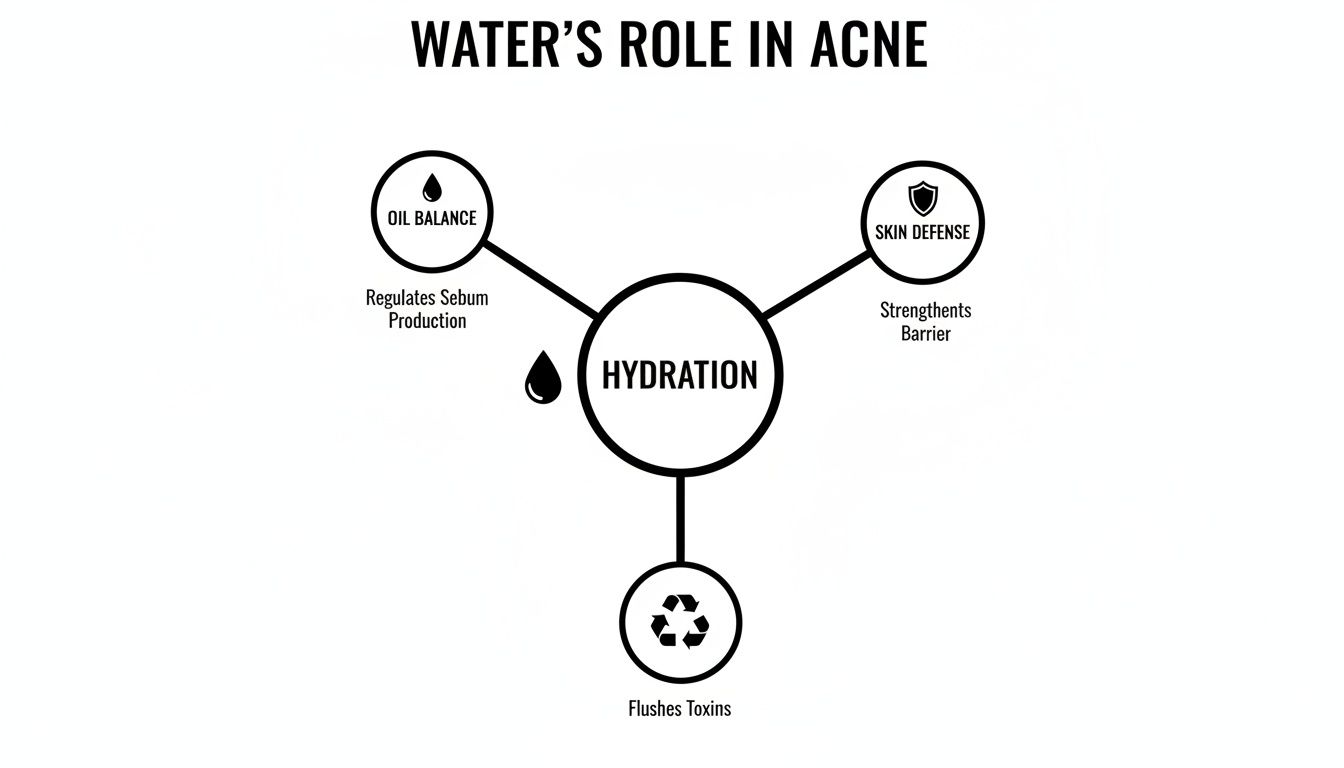
As you can see, proper water intake is directly tied to oil regulation, a stronger skin barrier, and the body's ability to clear out impurities—all critical factors for clearer skin.
Flushing Toxins and Reducing Inflammation
Beyond managing oil, staying hydrated is also vital for your body’s built-in detox system. Your kidneys and liver are constantly working to filter waste products and toxins from your blood, and water is the essential vehicle that carries these impurities out of your system via urine and sweat.
When you're dehydrated, this flushing process slows to a crawl. Toxins can accumulate, which can contribute to low-grade, systemic inflammation. Since acne is fundamentally an inflammatory condition, anything that raises your body's overall inflammation levels can make your breakouts appear redder, feel more painful, and stick around longer.
- Improved Cellular Function: Water is non-negotiable for every cell in your body. Good hydration helps ensure nutrients get to your skin cells efficiently and waste products are carried away, which supports healthy cell turnover.
- Stronger Skin Barrier: When cells are plump with water, they fit together more tightly. This creates a more robust barrier that's better at keeping out acne-causing bacteria and environmental grime.
Research backs up this connection between drinking more water and seeing healthier skin. Studies exploring skin physiology have found that when people who normally drink very little water increase their intake by about 2 liters a day for a month, their skin shows significant improvements in hydration and elasticity. Since dry skin often overcompensates with oil, boosting hydration is a key piece of the puzzle for managing acne. You can dig into some of the findings on water intake and skin health if you're curious.
By simply keeping your water bottle full, you’re helping your body's internal systems create an environment where it's much harder for acne to thrive.
What the Science Actually Says About Water and Acne
When you’re desperate for a solution to acne, it's easy to get lost in a sea of online advice. You've probably heard it a thousand times: "Just drink more water!" It's pitched as the ultimate secret to clear skin. But what does the science really say? Let's get to the bottom of it.
The link between water and healthy skin is absolutely real, but it’s not the simple "drink more, break out less" miracle cure people make it out to be. The benefits that researchers can actually stand behind are water's role in maintaining skin hydration and supporting the skin barrier function.
Think of your skin barrier as a brick-and-mortar wall. When it's well-built and hydrated, it keeps moisture locked in and potential irritants—like pollution and bacteria—locked out.
The Link Between Hydration and Skin Defense
When you're dehydrated, that wall starts to crumble. A weakened barrier can become dry, flaky, and irritated. In a panic, your skin often tries to compensate for the dryness by pumping out even more oil (sebum). This excess oil is exactly what you don't want, as it's a primary contributor to clogged pores and new pimples.
We have solid evidence to back this up. One controlled study on diet and skin health found that participants who added about 68 ounces (2 liters) of water to their daily intake saw a significant boost in skin hydration over a few weeks. A more hydrated skin barrier is a stronger skin barrier, making it less prone to the kind of irritation that can set the stage for a breakout. You can dig deeper into these hydration findings and see how they connect to sebum production.
While hydration is scientifically linked to healthier skin function, it's critical to understand its limitations. No credible studies have proven that drinking water alone can cure moderate to severe acne. Water is a foundational element, not a targeted treatment.
Setting Realistic Expectations
So, where does that leave you on your clear-skin journey? It means staying properly hydrated is a non-negotiable habit for overall health. It keeps your skin’s natural defense systems humming along, which can certainly help reduce breakouts that are triggered by dryness and irritation.
But here’s the reality check: water isn’t a medication. It can't kill acne-causing bacteria, magically unclog an already-blocked pore, or balance the complex hormonal swings that drive persistent acne. For those jobs, you need active, science-backed skincare ingredients that work directly on the skin.
This is exactly where a well-formulated skincare system comes into play. Neutralyze is built on this principle, utilizing clinically-proven ingredients to deliver targeted results. Our formulas, which feature powerhouse exfoliants like Mandelic Acid (AHA) and Salicylic Acid (BHA), are designed to tackle the root causes of breakouts at the source—something hydration alone can't do.
Think of it this way: drinking water builds the strong foundation your skin needs. A targeted treatment like Neutralyze provides the active solution to build upon it.
When Hydration Isn't Enough to Clear Acne
So, you’ve been dedicated. You’re never without your water bottle, you’re hitting your hydration targets every day, but the breakouts just keep coming. This is a common and incredibly frustrating experience, and it’s the point where we need to get real about water’s role in your skincare strategy.
While staying hydrated is a fantastic, non-negotiable foundation for healthy skin, it's a supportive player, not the star of the show. Think of it like this: watering the soil is vital for a healthy garden, but it won’t kill the weeds that are already strangling your plants. For persistent acne, water alone can't fight the more complex factors at play.
Why Water Has Its Limits
When you're dealing with moderate to severe acne, the problem usually goes much deeper than simple dehydration. The real culprits are often biological processes that a few extra glasses of water just can't touch.
These root causes need a more direct and potent approach. The key drivers that hydration can't fix on its own include:
- Hormonal Fluctuations: Hormones like androgens can put your oil glands into overdrive, creating the excess sebum that clogs pores and feeds breakouts. This is a major factor during puberty, menstrual cycles, and even times of high stress.
- C. acnes Bacteria: This is the specific bacteria that loves to set up camp in clogged, oily pores. As it multiplies, it triggers the inflammation, redness, and pus we all know as pimples.
- Genetics: It's a tough pill to swallow, but some of us are just genetically wired to be more prone to acne.
- Abnormal Skin Cell Shedding: In acne-prone skin, dead cells don't slough off cleanly. They get sticky, clumping together inside the pore to form plugs that trap oil and bacteria.
If you suspect your breakouts are more than skin-deep, it can be really helpful to look into other causes. For example, understanding hormonal acne and its treatments can open up a new world of effective solutions.
Moving From Support to Active Treatment
When stubborn acne refuses to leave, it’s a clear sign to shift from a passive habit to an active, targeted treatment. This is where a science-backed skincare routine becomes absolutely essential, picking up the fight right where water’s benefits stop.
You need ingredients specifically designed to tackle the root causes of acne right at the source—on your skin's surface. This is the entire philosophy behind Neutralyze. Our multi-step system delivers a one-two punch of clinically-proven ingredients that do what hydration can’t.
Water supports your skin from the inside out, creating a healthier environment. A targeted treatment like Neutralyze works from the outside in, directly combatting the biological triggers of acne—clogged pores, bacteria, and inflammation.
For instance, our formulas feature Mandelic Acid and Salicylic Acid. Mandelic Acid is a gentle-yet-effective Alpha Hydroxy Acid (AHA) that exfoliates the skin's surface, improving texture and fading post-acne marks. Salicylic Acid, a Beta Hydroxy Acid (BHA), is oil-soluble, allowing it to penetrate deep into pores to dissolve the mixture of oil and dead skin cells that causes clogs.
This is a level of direct intervention that drinking water can never provide. By combining the foundational support of good hydration with the targeted power of a system like Neutralyze, you’re creating a comprehensive, inside-and-out strategy. Hydration keeps your skin resilient and balanced, which in turn makes it more receptive to the active ingredients that will finally get you the clear results you’ve been working for.
Build Your Ultimate Clear Skin Action Plan
So, let's put everything together. We'll combine the power of smart hydration with the precision of science-backed skincare. It’s easy to get stuck wondering "does drinking water help acne?" and stop there, but that’s only one piece of the puzzle. A truly effective plan treats your skin as a whole ecosystem. Healthy habits build the foundation, and targeted treatments do the heavy lifting.
This is all about integrating consistent hydration with the proven effectiveness of Neutralyze. When your skin is properly hydrated from the inside, it becomes more resilient and receptive to what you put on it. This means the advanced ingredients in our products can get to work more efficiently, delivering better results with less risk of irritation.
Step 1: Master Your Hydration Habits
First things first: let’s make hydration an effortless part of your day. This isn't about forcing down gallons of water; it’s about creating a consistent habit.
- Start Your Day with Water: Before your coffee, before anything else, drink a big glass of water. Your body is dehydrated after a long night, and this simple act helps wake everything up, including your metabolism.
- Carry a Reusable Bottle: Keep a water bottle with you—at your desk, in your car, in your bag. Just seeing it there is a powerful visual reminder to take a sip.
- Set Reminders: If you’re the forgetful type (most of us are), use your phone to set a few simple alerts. The goal is to drink steadily throughout the day, not chug it all at once.
Step 2: Amplify Your Routine with Targeted Treatment
Once you've got your hydration dialed in, it's time to bring in the big guns. Hydrated skin is perfectly prepped for a powerful system like Neutralyze, which is designed to tackle the root causes of acne head-on.
This is where our expert-formulated ingredients shine. We harness the power of both Mandelic Acid (AHA) and Salicylic Acid (BHA). These acids are the gold standard for exfoliation, getting deep into your pores to break up the stubborn mix of oil and dead skin cells that leads to breakouts. This is the kind of targeted, scientific action that water simply can't provide on its own.
Think of it like this: hydration prepares the canvas, making it smooth, strong, and ready for treatment. Neutralyze is the artist, actively clearing away the blemishes to reveal the calm, clear skin underneath. One just doesn’t work as well without the other.
Step 3: Adopt a 360-Degree Skin Health Mindset
A truly comprehensive clear skin plan doesn’t stop at the bathroom sink. Your daily lifestyle choices play a huge role in managing the inflammation and hormonal shifts that can trigger acne.
A holistic approach means looking at the bigger picture. This often includes finding ways to manage cortisol levels, since we know that high stress can send your skin into a tailspin. Of course, what you eat matters, too. For a deeper dive into how your diet can impact breakouts, check out our guide on the best diet for clear skin for some practical tips.
Your Hydration and Skincare Synergy Plan
Here’s a quick look at how these actions work together. When you combine simple daily habits with a powerful, science-driven skincare system, you create the best possible environment for clear skin.
| Action | Benefit for Acne | Neutralyze Product Synergy |
|---|---|---|
| Drink 8-10 glasses of water daily | Helps flush toxins, supports skin barrier function, and may reduce oiliness. | Prepares skin to better absorb the active ingredients in the Neutralyze Face Wash and Exfoliating Pads. |
| Use a targeted cleanser twice a day | Removes surface-level dirt, oil, and dead skin cells that clog pores. | The Neutralyze Face Wash with Mandelic Acid gently exfoliates without stripping hydrated skin. |
| Apply an exfoliant with Salicylic Acid | Penetrates deep into pores to dissolve clogs and reduce inflammation directly. | The Neutralyze Exfoliating Pads deliver this powerful BHA to a receptive, well-hydrated canvas for maximum effect. |
| Eat a balanced, low-glycemic diet | Reduces hormonal spikes and systemic inflammation that can trigger breakouts. | Supports the calming and anti-inflammatory effects of the entire Neutralyze system. |
By combining these three pillars—consistent hydration, a targeted skincare routine, and a mindful approach to diet and stress—you build an unbeatable strategy. You're no longer just reacting to breakouts. You're creating a comprehensive system for achieving and maintaining the clear skin you deserve.
Answering Your Questions About Water and Acne
By now, you understand that proper hydration is a key piece of the skin health puzzle. Still, you probably have a few specific questions floating around. Let's clear up the most common ones so you can feel confident about your plan.
How Much Water Should I Actually Drink for My Skin?
There’s no single magic number that fits everyone, but a solid starting point for most adults is around 8 glasses (about 2 liters) a day. Of course, your individual needs will shift depending on how active you are, where you live, and your overall health.
The real goal here is consistent hydration, not chugging a gallon of water before bed. When your body has a steady supply of water, you’re creating the perfect internal environment for your topical treatments to do their job. Think of it as prepping the canvas—a well-hydrated canvas makes your skin far more receptive to the active ingredients in the Neutralyze system.
Can Drinking Too Much Water Make Acne Worse?
It's extremely unlikely that drinking water will worsen your acne. While it is technically possible to drink a dangerous amount of water (a condition called water intoxication or hyponatremia), this is incredibly rare and requires consuming far more than anyone would for normal hydration.
For your skin's sake, sticking to the recommended daily intake is both safe and helpful. The key is to focus on sipping steadily throughout the day. This maintains a stable, healthy environment for your skin cells, which thrive on balance.
The bottom line is simple: when it comes to acne, the real risk is dehydration, not over-hydration. Prioritize a steady intake to keep your skin's support systems running without a hitch.
How Long Does It Take to See Results from Drinking More Water?
If you were pretty dehydrated to begin with, you might notice your skin looking a bit more plump and feeling less tight within just a few weeks. But when it comes to seeing a real change in your acne, water alone is not a quick fix.
It's best to think of hydration as a long-term supporting habit, not a targeted treatment. To see a significant drop in active breakouts, you need a routine that gets to the root of the problem. Combining proper hydration with a system like Neutralyze gives you the best of both worlds: foundational support from the inside and powerful, targeted action on the outside. This two-pronged attack is what delivers faster, more visible results.
Does Juice or Tea Count Toward My Daily Water Goal?
While other fluids like herbal tea can certainly contribute to your overall hydration, plain water is always the superior choice for your skin. Why? Because many other drinks come with baggage that can actually work against your clear-skin goals.
- Sugary Drinks: Things like juice, soda, and sweetened teas can cause your blood sugar to spike. This can trigger body-wide inflammation, which is a known aggravator for acne.
- Caffeinated Drinks: Coffee and certain teas can act as mild diuretics, meaning they can actually make you lose a small amount of water.
For the biggest skin-clearing impact, make pure, clean water your go-to. It gives you all the benefits with none of the potential downsides that could sabotage your progress.
When you pair a smart hydration strategy with a powerful, science-backed skincare system, you’re building a truly comprehensive approach to managing acne. Neutralyze delivers the targeted, active treatment your skin needs to clear up existing blemishes and stop new ones from forming, while proper hydration makes sure your skin is strong, balanced, and ready to heal.
Start your journey to clear, calm skin today by exploring the Neutralyze system.


