

The Best Products for Acne Scars and Dark Spots
If you’re looking for the best products to handle acne scars and dark spots, you’ll want to focus on a few hero ingredients: retinoids, AHAs/BHAs, and vitamin C. Think of these as the heavy lifters in your skincare routine. They work by speeding up your skin's natural renewal process and dialing down pigment production, which helps fade discoloration and smooth out your skin's texture over time. But remember, consistency is everything.
Your Guide to Fading Acne Scars and Dark Spots
Are you dealing with the stubborn marks that acne decided to leave behind? You are definitely not alone. This guide is designed to give you a clear, science-backed roadmap to get your skin’s clarity and your confidence back. We'll break down the two main types of post-acne marks—the textural scars and the pigmented dark spots—and introduce you to the proven solutions that actually work.
This whole process can feel a bit frustrating, but getting a handle on the right ingredients is the most important first step toward reclaiming your skin. Here at Neutralyze, our expertise is built on formulating powerful, synergistic systems. We understand that the journey doesn't end when a pimple heals; it's about tackling the frustrating marks they leave behind. By using clinically-backed ingredients, we offer a complete solution from active breakouts to clear, even-toned skin.
Understanding the Post-Acne Landscape
The need for treatments that actually work is huge. The global Acne Scar Treatment Market is on track to hit USD 8,144.7 million by 2033. This boom is fueled by just how common acne is—it affects nearly 50 million Americans every single year.
Topical products really lead the charge in this market because they're easy to get and they work. With consistent use, people can see the visibility of certain scars drop by up to 30-50% over a few months. For a deeper dive into these numbers, you can check out the acne scar treatment market report from Cognitive Market Research.
This tells us something really important: you can make a real difference right from your own bathroom. It’s not about hunting for a single magic bullet, but about building a smart routine with ingredients that support each other.
A successful strategy for fading acne marks comes down to two key things: keeping new breakouts at bay by controlling acne, and treating the existing marks with targeted, powerful ingredients.
Key Ingredients for Different Concerns
To make your product search a little easier, I've broken down the most effective ingredients and what they're best at targeting. This quick table is your cheat sheet for figuring out what you need, whether you're battling texture, pigmentation, or a bit of both.
Top Ingredients for Acne Scars vs Dark Spots
This quick reference guide matches the most effective skincare ingredients to the specific concern they target, whether it's textural scars or pigmentation.
| Ingredient Class | Best For Acne Scars (Texture) | Best For Dark Spots (Pigmentation) | How It Works |
|---|---|---|---|
| Retinoids | ✔️ | ✔️ | Puts cell turnover into high gear, which helps to smooth texture and fade discoloration. |
| AHAs/BHAs | ✔️ | ✔️ | Exfoliates the top layer of skin, clearing away pigmented cells and refining texture. |
| Vitamin C | ✔️ | A potent antioxidant that hits the brakes on melanin production to brighten up dark spots. | |
| Niacinamide | ✔️ | Calms down inflammation and physically blocks pigment from transferring between skin cells. |
Having this breakdown in your back pocket makes it so much easier to scan an ingredient list and know if a product has what it takes to help you reach your skin goals.
Why Acne Leaves Marks Behind
Ever wonder why some pimples vanish without a trace, while others stick around as stubborn scars or dark spots? It all comes down to how your skin handles inflammation. Picture your skin as a delicate piece of fabric: a tiny snag might go unnoticed, but a serious tear needs a much bigger repair job—one that can permanently change the fabric's look and feel.
When a pimple pops up, it’s basically a small, localized warzone. Bacteria, oil, and dead skin cells trigger a full-on inflammatory assault from your immune system. This inflammation is the real culprit behind the marks that linger long after the breakout is gone. The deeper and angrier the blemish, the greater the odds it will leave a permanent reminder.
This is exactly why getting ahead of the problem is so important. As ingredient experts, we know the best way to prevent marks is to stop the inflammation before it even starts. That's the science behind systems like Neutralyze, which are built to do more than just treat pimples. They work to break the entire cycle, calming the skin to halt severe inflammation before it has a chance to do lasting damage.
The Two Types of Post-Acne Marks
Not all marks are the same. They generally fall into two buckets: marks that change your skin’s color and marks that change its texture. Figuring out which type you have is the first step to finding the right solution.
- Pigmentation Changes (The "Stains"): These are the flat spots—brown, black, red, or pink—that don't change your skin's texture at all.
- Textural Changes (The "Scars"): These are true scars that create a physical dip or pit in the skin's surface.
Let's dig a little deeper into the science behind these two types.
Post-Inflammatory Hyperpigmentation: The Dark Spots
Ever had a nasty pimple heal, only to leave behind a dark brown or black spot? That’s post-inflammatory hyperpigmentation (PIH). When your skin is inflamed, its pigment-producing cells (melanocytes) go into overdrive. It's almost like your skin's internal cleanup crew accidentally spills some ink while trying to fix the mess.
This flood of extra melanin—the pigment that gives skin its color—creates a flat, discolored patch. These spots can hang around for months or even years, especially if you don't protect them from the sun. For PIH, sun exposure is like throwing fuel on a fire; UV rays signal those same melanocytes to pump out even more pigment, making the spots darker and harder to fade.
Post-Inflammatory Erythema: The Red Spots
If your leftover marks are more red or pink than brown, you're probably dealing with post-inflammatory erythema (PIE). These marks are more common in lighter skin tones and aren’t a pigment issue at all—they're a vascular one.
Here’s an easy way to think about it: after the inflammation from a breakout finally calms down, the tiny blood vessels (capillaries) just under the skin can stay dilated or even get damaged. It's those damaged, leaky capillaries that create the redness you see. PIE is essentially the ghost of the inflammation that was once there.
Key Takeaway: The real driver behind both dark spots and red marks is inflammation. The single best strategy for preventing these marks is to control that initial inflammatory response before it gets out of hand.
This is where a scientifically formulated system can be a game-changer. Neutralyze leverages its expertise in ingredient synergy to calm the skin and slash inflammation. This not only helps clear up active breakouts but also dramatically lowers the risk of PIH and PIE ever forming. By getting to the root of the problem, you can stop constantly playing catch-up with spots and scars and start maintaining clear, even-toned skin for good. It shifts your skincare from a reactive battle to a proactive plan for long-term skin health.
The Powerhouse Ingredients That Actually Work
Walking down the skincare aisle can feel overwhelming. With so many products making big promises, it’s tough to know what actually works. The secret to finding the best products for acne scars and dark spots isn’t about chasing the latest trend—it’s about understanding the science-backed ingredients that make a real difference.
Let's cut through the jargon. Think of these active ingredients as specialists for your skin. Some are like surface polishers, clearing away discolored cells, while others are master brighteners that stop excess pigment at the source. Once you know what they do, you can read any product label with confidence.
H3: Retinoids: The Skin Renewal Managers
When you need a true multitasker for both skin texture and tone, retinoids are in a league of their own. This family of Vitamin A derivatives works by speeding up your skin's natural cell turnover process. Imagine your skin is constantly building a new surface from the ground up; retinoids just hit the fast-forward button.
This rapid renewal helps push damaged, pigmented cells to the surface so they can be shed, revealing fresher, more even skin underneath. For those indented scars, this same process also encourages new collagen production, which helps plump up and smooth out the skin's texture over time.
Because they're so potent, retinoids are the foundation of many powerful treatments. As authorities on ingredient science, Neutralyze understands this delicate balance. Our systems are designed to manage active acne while prepping the skin for reparative compounds, giving you all the renewal benefits without compromising your skin's health.
H3: AHAs and BHAs: The Expert Exfoliators
If retinoids are the managers working deep within the skin, think of Alpha-Hydroxy Acids (AHAs) and Beta-Hydroxy Acids (BHAs) as the expert polishers for the surface. These chemical exfoliants work by dissolving the "glue" holding dead skin cells together, making it easy to slough them away.
-
Alpha-Hydroxy Acids (AHAs): Ingredients like glycolic and mandelic acid are water-soluble. They work their magic on the very top layer of the skin, which makes them fantastic for fading the surface discoloration of dark spots and boosting overall radiance.
-
Beta-Hydroxy Acid (BHA): Salicylic acid, the most common BHA, is oil-soluble. This special trait lets it dive deep into your pores to clear out gunk and oil, making it a champion for preventing the breakouts that cause marks in the first place.
At Neutralyze, our expertise is built on this dual-action approach: clear the active acne and correct the marks it leaves behind. We strategically combine powerhouse exfoliants like mandelic acid (AHA) and salicylic acid (BHA). This combination is crucial, tackling breakouts at the source while simultaneously accelerating the fading of those stubborn spots that stick around.
H3: Vitamin C: The Master Brightener
If your main goal is to tackle stubborn dark spots (PIH), Vitamin C is an absolute must-have. This powerful antioxidant works in two brilliant ways. First, it acts like a shield, protecting your skin from things like UV rays and pollution that can make dark spots even darker.
More importantly, Vitamin C directly gets in the way of the enzyme that creates melanin (pigment). By slamming the brakes on excess pigment production, it not only helps fade the spots you already have but also keeps new ones from getting as dark. Find out more in our guide to the best Vitamin C for acne scars.
H3: Niacinamide: The Soothing Guardian
Niacinamide, a form of Vitamin B3, is the ultimate team player in any skincare routine. It's famous for its calming abilities, which help dial down the redness and inflammation from both active pimples and the red marks they leave behind (PIE).
But its real genius is in its ability to stop pigment from moving from your melanin-producing cells to your visible skin cells. Think of it as a traffic controller, preventing the "ink" of hyperpigmentation from staining the surface. This makes it an amazing partner for other brightening ingredients.
A truly effective skincare system never relies on just one hero ingredient. It strategically combines actives—like exfoliants, antioxidants, and anti-inflammatories—to attack the complex problem of acne and its aftermath from every possible angle.
This chart shows exactly how that initial inflammation can lead to either discolored marks or textural changes.
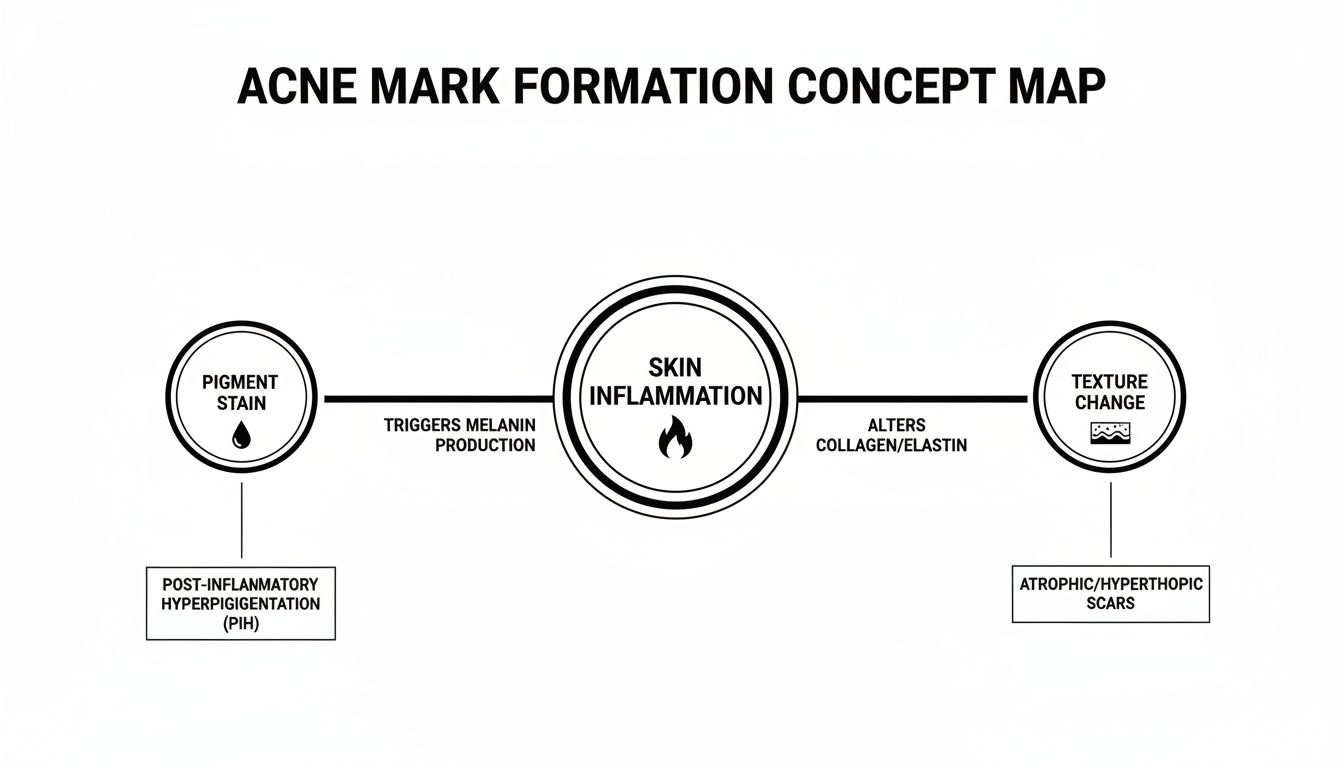
As you can see, calming that first inflammatory response is the single best way to prevent both types of marks from ever forming.
H3: Ingredient Effectiveness and Timeline
Patience is key when it comes to fading scars and dark spots. To set realistic expectations, this table shows how long it generally takes to see initial improvements with some of the most popular and effective ingredients.
| Ingredient | Primary Target | Typical Time to See Initial Results | Best For Skin Type |
|---|---|---|---|
| Retinoids | Texture (atrophic scars), PIH | 8-12 weeks | Most types (start slow) |
| AHAs (Glycolic Acid) | PIH, surface texture | 4-8 weeks | Normal, combo, dry |
| BHA (Salicylic Acid) | PIE, PIH, preventing new marks | 6-12 weeks | Oily, acne-prone |
| Vitamin C | PIH, PIE (redness) | 8-12 weeks | All skin types |
| Azelaic Acid | PIH, PIE | 8-16 weeks | Sensitive, acne-prone |
| Niacinamide | PIE (redness), PIH | 4-8 weeks | All skin types, especially sensitive |
Remember, "initial results" means the beginning of visible change. More significant improvement comes with consistent, long-term use.
H3: Putting It All Together for Lasting Results
The proven effectiveness of these ingredients is why topical treatments are still the gold standard for at-home care, commanding over 50-60% of the market for acne scar solutions. Considering that acne impacts 85% of people aged 12-24 and leaves lasting marks for 1 in 5 of them, having accessible, effective products is crucial.
For those with more stubborn or severe scarring, professional procedures can provide a significant boost. For example, treatments like Microneedling with PRP therapy can dramatically improve deeper scars by kickstarting the body's own collagen production. Still, a consistent at-home routine using the right ingredients is the non-negotiable foundation for getting—and keeping—clear, even-toned skin.
Building Your Ultimate Mark-Fading Routine
Knowing which ingredients work is one thing, but figuring out how to put them together in a daily routine is how you actually win the war against acne marks. An effective regimen isn't about using a dozen different products; it's about consistency and making sure each step works with the next. Let's translate all that ingredient science into a practical, step-by-step plan to help you fade those scars and spots for good.
The whole process boils down to four key pillars: Cleanse, Treat, Moisturize, and Protect. By setting up a simple morning (AM) and evening (PM) routine, you give your skin a 24/7 environment to heal, repair, and renew itself.
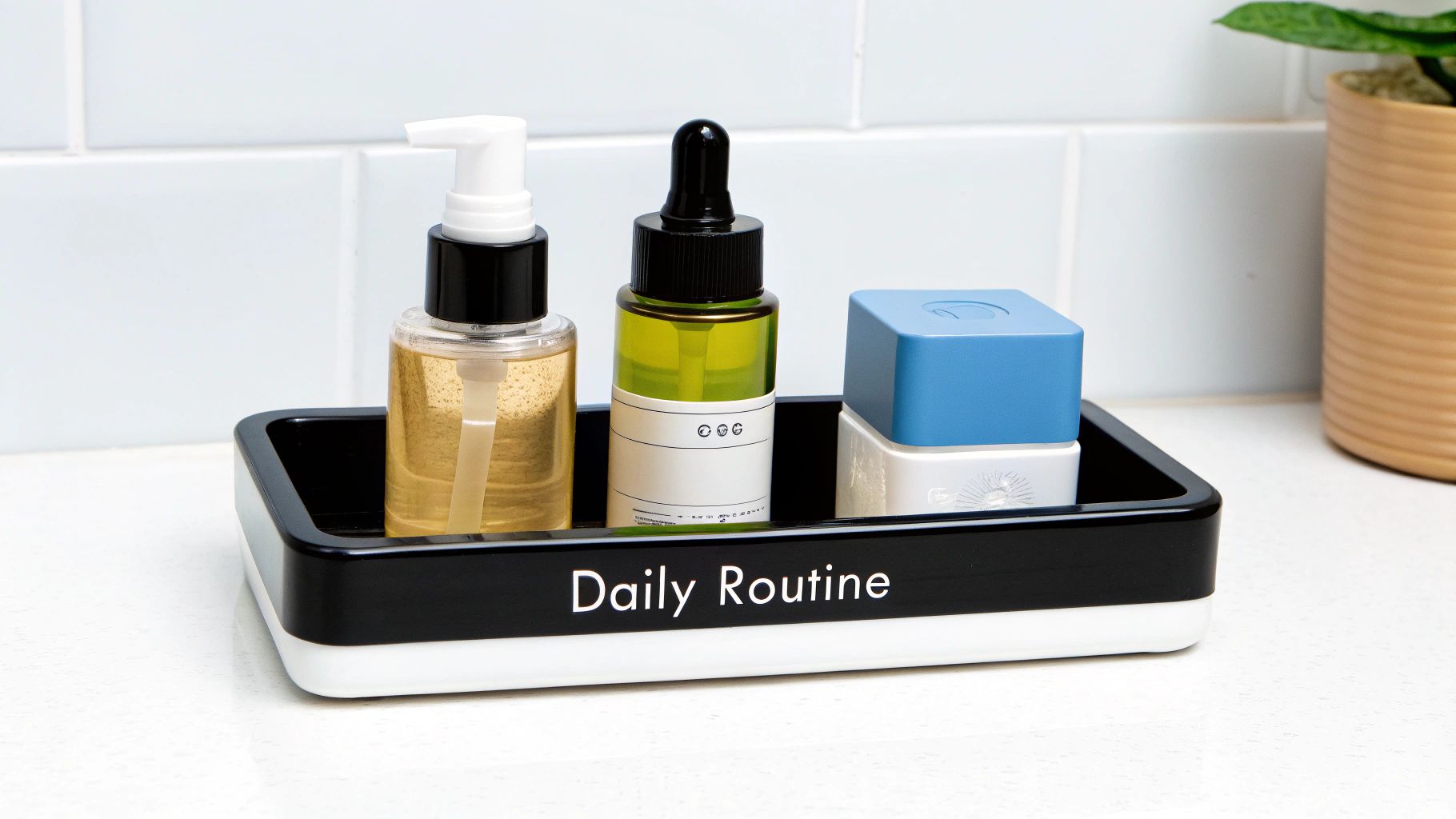
The Morning (AM) Routine: Defend and Protect
Think of your morning routine as your skin's daily armor. It has two main jobs: clearing away anything from overnight and shielding your skin from the day's environmental attacks—especially UV rays, which are notorious for making dark spots even darker.
Step 1: Cleanse Start your day with a gentle, non-stripping cleanser. Anything too harsh will just stir up more inflammation, which is the last thing you want when you're trying to fade post-acne marks. A mild formula gets your skin prepped for treatment products without causing extra irritation.
Step 2: Treat Now it's time to bring in the targeted ingredients. A Vitamin C serum is a fantastic choice for the morning. Its antioxidant power acts like a shield against daily damage while it actively works on brightening up pigmentation.
Step 3: Moisturize Healthy skin starts with a healthy moisture barrier, and hydration is essential for that. If your skin barrier is compromised, it simply can’t heal efficiently. A lightweight, non-comedogenic moisturizer will lock in hydration without clogging your pores.
Step 4: Protect This is, without a doubt, the most critical step for anyone fighting dark spots. Using a broad-spectrum sunscreen with at least SPF 30 every single day is completely non-negotiable. Sun exposure revs up pigment production, which can undo all the progress you've made with your other products.
The Evening (PM) Routine: Repair and Renew
Nighttime is when your skin switches into full-on repair mode. Your evening routine should be all about supporting this natural process—cleansing away the day and delivering powerful, renewing ingredients to accelerate healing while you get your rest.
Step 1: Cleanse Just like in the morning, start with a gentle cleanser. If you wear makeup or a heavy-duty sunscreen, you might want to double cleanse. Start with an oil-based cleanser to melt everything away, then follow up with your regular one to make sure your skin is perfectly clean and ready for the next step.
Step 2: Treat The evening is the best time to use your heavy-hitters, like retinoids or exfoliating acids (AHAs/BHAs). These ingredients can make your skin more sensitive to the sun, so using them at night is both safer and more effective. It's in this "Treat" step that a smart, synergistic system really makes a difference.
As ingredient authorities, we designed the Neutralyze system to perfectly fit this critical step. Our intelligent combination of mandelic acid (AHA) and salicylic acid (BHA) works to exfoliate, clear out pores, and directly tackle the root causes of post-acne marks. It’s a targeted approach that calms active acne while correcting the damage left behind, all in one streamlined routine.
Step 3: Moisturize Always follow your treatment with a good, nourishing moisturizer. This not only helps soothe any potential irritation from your active ingredients but also supports your skin's moisture barrier as it works hard to repair itself overnight.
Your routine doesn't need to be complicated to be effective. A simple, consistent regimen built on the pillars of Cleanse, Treat, Moisturize, and Protect provides the structure your skin needs to heal and improve.
Why Topical Treatments Reign Supreme
It’s no secret that people prefer tackling skincare issues at home, and the market reflects that. The global scar treatment market is on track to hit USD 76.20 billion by 2034, and topical products are leading the charge with a massive 60.5% market share. Why? Because topicals are perfect for home use, which itself drove over 45% of the revenue.
For atrophic acne scars and dark spots, the proof is in the results. Clinical data shows that consistent use of the right topical treatments can lighten discoloration by 20-40% in just 12 weeks. You can dig into the growth and trends in the scar treatment market to see for yourself why a dedicated routine is such a powerful tool.
The data confirms it: the best products for acne scars and dark spots are the ones you actually use, consistently. A dedicated daily routine isn’t just a nice idea—it’s a clinically-backed strategy for getting clear, even-toned skin.
How to Choose Products That Actually Work
Feeling overwhelmed by the wall of products all claiming to be "the one"? If you've been let down by things that just didn't work, you're definitely not alone. It’s a frustrating cycle, but it doesn’t have to be your story. The key is to become a smarter skincare shopper by learning what to look for—and what to walk away from.
Instead of guessing your way through a dozen different brands, think about choosing a complete, cohesive system. The best products for tackling acne scars and dark spots are almost always the ones formulated to work together. When you mix and match on your own, you can easily end up with ingredients that cancel each other out or, even worse, seriously irritate your skin. This is where a science-backed system like Neutralyze really makes a difference.
Read the Label Like a Pro
Before a product ever makes it into your shopping cart, flip it over. The ingredient list and the packaging itself tell you everything you need to know about whether it's worth your money.
-
Look for Concentrations: Potency is everything. You want products that are upfront about the percentage of their main active ingredients. A serum with 1% salicylic acid is going to work very differently than one with 2%. If a brand doesn't list the concentrations, it's often a sign that the formula isn't strong enough to give you real results.
-
Pay Attention to Packaging: Some of the most powerful ingredients, like Vitamin C and retinoids, are divas—they're incredibly unstable. Expose them to light and air, and they break down, becoming totally useless. Always opt for products in opaque, air-tight packaging, like pumps or tubes, instead of clear jars.
Why a Full System Beats a Patchwork Routine
Trying to play cosmetic chemist by mixing single-ingredient products from different brands is a recipe for frustration. It's easy to accidentally pair an acidic Vitamin C with a niacinamide that works best at a different pH, making both less effective. This is precisely the problem that a well-designed system solves for you.
A thoughtfully created skincare system ensures every product works with the next. The cleanser preps the skin, the treatment delivers the heavy-hitting actives, and the moisturizer protects your skin barrier. Together, they create the perfect environment for healing and renewal.
At Neutralyze, our authority comes from formulating products to function as a complete routine from the ground up. We’ve handled the tricky formulation science so you don't have to. Our system ensures each step enhances the one before it, delivering powerful ingredients like mandelic and salicylic acid in a way that provides maximum results with minimal irritation. This is the expert-led solution for your skin.
Clinical Proof Should Be a Dealbreaker
When it comes down to it, the only thing that matters is results. Plenty of brands make big promises, but very few have the clinical data to back them up. Always look for products that have been tested and proven to work on real people. This commitment to clinical testing is what separates genuinely effective skincare from clever marketing.
Our dedication to science is what has made Neutralyze a trusted solution for people who felt like they had tried everything. We focus on clinically proven ingredients and multi-step systems that tackle acne and its aftermath from all angles. This gives you a clear, reliable path toward finally getting calm, even-toned skin. When you choose a system built on evidence, you aren't just buying products—you're investing in a strategy that’s designed to work.
Taking Control of Your Skin's Future
Let's be real: getting rid of acne scars and dark spots is a marathon, not a sprint. The most powerful tool you have isn't a single "miracle" product—it's a consistent daily routine built around ingredients that are actually proven to work.
Once you understand why those post-acne marks show up in the first place, you can stop guessing and start choosing the right active ingredients. Committing to a solid regimen is what truly puts you back in the driver's seat of your skin's health.
This process is about building a sustainable habit, not just slathering on creams. As you move forward, knowing how to handle different skin issues, like hyperpigmentation, will make all the difference. For a deeper dive, this guide to managing hyperpigmentation for safe and clear skin is a genuinely helpful resource.
We hope you’ll consider making Neutralyze a partner in your journey. As ingredient experts, we designed our system from the ground up to be a complete solution. It calms active breakouts with ingredients like salicylic acid while simultaneously working to fade the marks old pimples left behind with mandelic acid. It's a two-pronged attack that targets both the problem and its aftermath.
It’s time to move beyond temporary fixes and embrace a science-backed path. Consistency with a well-formulated system is the key to unlocking the calm, clear, and even-toned skin you deserve.
Instead of playing chemist and hoping different products don't clash, a complete system ensures every step works in harmony with the next. Neutralyze is formulated to create a synergistic effect, giving you better results with less irritation.
We focus on quieting inflammation to stop future marks from forming while treating the discoloration you already have. By committing to this strategy, you’re not just treating spots—you’re choosing a reliable path to lasting clarity and confidence.
Frequently Asked Questions
When you're trying to clear up acne scars and dark spots, it's natural to have a ton of questions. Let's tackle some of the most common ones that come up.
How Long Does It Really Take to See Results?
This is the big question, isn't it? The honest answer is: it depends on what you're treating, but you should definitely see progress.
For those frustrating dark spots (PIH), you can expect to see them start fading within 8-12 weeks of consistent treatment. For deeper, textural scars—the pitted or indented kind—it’s a much longer haul. You’re looking at 6 months or more of dedicated use before you'll notice a real difference in skin smoothness. Patience and consistency are everything.
Can I Use All These Active Ingredients at Once?
Please don't! It’s a classic mistake. Think of these ingredients as powerful tools; throwing them all at your skin at once is a recipe for disaster. You’ll likely end up with major irritation, redness, and a compromised skin barrier, which actually makes it harder for your skin to heal.
It's all about the "slow and low" method. Introduce just one new active ingredient at a time. A great rule of thumb is to never layer strong exfoliants in the same routine. For instance, use your AHA/BHA product on a different night than your retinoid. This lets you get the benefits of both without overwhelming your skin.
Is Sunscreen Really That Important for Fading Scars?
Yes, one hundred percent. In fact, it's the single most important step in your entire routine. Sun exposure is public enemy number one for hyperpigmentation because UV rays tell your skin to produce more melanin—the exact pigment that's causing your dark spots.
If you skip sunscreen, you’re basically undoing all the hard work from your treatment products every time you step outside. A broad-spectrum sunscreen with at least SPF 30 is non-negotiable. It’s your shield, protecting healing skin and stopping existing marks from getting darker and tougher to treat. It's what allows the best products for acne scars and dark spots to actually work.
Ready to stop playing chemist and start a routine that works? Neutralyze offers a complete, science-backed system designed to clear active acne and fade the marks it leaves behind.


