

Best Face Moisturizer for Acne-Prone Skin (2026 Picks)
The best face moisturizer for acne is a lightweight, non-comedogenic formula that manages to hydrate your skin without clogging pores. You’ll want to look for products with key ingredients like hyaluronic acid for a moisture boost and niacinamide to calm down inflammation. These are your allies in supporting skin health while actively fighting breakouts.
Why Moisturizing Acne-Prone Skin Is Essential
It sounds completely backward, doesn't it? Adding moisture to skin that already feels oily and broken out. For years, the common wisdom was to dry out acne as quickly as possible. But this approach almost always backfires, trapping you in a frustrating cycle of irritation and even more breakouts.
Think of your skin barrier like a delicate ecosystem. When it gets dehydrated, its natural defense system panics and goes into overdrive trying to compensate for the lost moisture.
This panic signals your oil glands to produce even more sebum. The result is shinier skin, more clogged pores, and a perfect breeding ground for acne-causing bacteria to flourish. It’s the exact opposite of what you’re trying to accomplish.
The Role of Your Skin Barrier
Your skin has a built-in protective shield called the moisture barrier. Its job is simple but critical: keep hydration in and keep irritants out. The problem is, many powerful acne treatments—like benzoyl peroxide or salicylic acid—can be really tough on this barrier.
While these ingredients are fantastic at zapping pimples, they can also strip your skin of its natural oils, leaving your moisture barrier compromised. A damaged barrier is bad news and can actually make your acne worse:
- Increased Inflammation: With a weakened defense, your skin can't fend off environmental stressors, leading to more redness and sensitivity.
- More Breakouts: The door is wide open for bacteria and impurities to get in, triggering new blemishes.
- Slower Healing: A healthy, hydrated barrier is essential for your skin's repair process. Without it, those post-acne marks stick around for much longer.
The right moisturizer acts as a support system for your skin's barrier. It replenishes lost hydration, soothes inflammation, and creates a balanced environment where your skin can heal and thrive.
Making Your Acne Treatments More Effective
Here’s the thing: proper hydration doesn’t just calm your skin; it actually helps your acne treatments work better. When your skin is balanced and its barrier is intact, active ingredients can do their job more efficiently without causing a ton of irritation.
Using the best face moisturizer for acne helps minimize the uncomfortable side effects like dryness and peeling that often come with potent treatments. This makes it so much easier to stick with your routine consistently—and consistency is the real secret to clear skin. By restoring that crucial balance, you’re setting the stage for a healthier complexion.
Decoding Moisturizer Labels for Clear Skin
Standing in the skincare aisle can feel like trying to decipher a foreign language. The bottles are covered in scientific jargon and big promises, making it tempting to just give up and grab whatever has the nicest packaging. But if you want to get serious about clearing your skin, learning to read that label is your single most powerful tool.
For those of us with acne-prone skin, a few key phrases on the front of the bottle are your first-pass filter. They help you immediately weed out the products that are almost guaranteed to make things worse. Think of them as your gatekeepers to clearer skin.
These terms are your first line of defense against clogged pores and irritation. While they aren't an absolute guarantee, they signal that the formulators at least had your skin type in mind during development.
Essential Terms to Know
- Non-Comedogenic: This is the big one. It means the formula was specifically designed not to clog your pores. Since a clogged pore is ground zero for nearly every pimple, this is non-negotiable.
- Oil-Free: While not every oil is an enemy, "oil-free" products are a safe bet. They typically skip the heavy, greasy oils that can sit on the skin and worsen breakouts, relying instead on lightweight hydrators.
- Hypoallergenic: This signals the product is less likely to trigger an allergic reaction. Acne-prone skin is already inflamed and often sensitive, so avoiding potential irritants like heavy fragrances is a smart move to keep it calm.
The skincare market has definitely taken note. Creams and lotions now dominate the anti-acne cosmetics space, holding a massive 43% market share. These are often the go-to choice for anyone looking for the best face moisturizer for acne because they tend to be lightweight humectants that soothe skin and hydrate without clogging pores.
Ever since the clean beauty movement gained steam in the 2010s, demand has soared, especially among the 85% of acne patients who report dry skin from their treatments. You can learn more about these anti-acne cosmetics market trends and how they’re shaping the products on the shelves.
The Hero Ingredients That Fight Acne
The terms on the front of the bottle tell you what a moisturizer won't do (clog pores, cause an allergic reaction). The ingredient list on the back, however, tells you what it will do. This is where you find the powerhouse actives that will actually work to hydrate, clarify, and calm your skin.
At Neutralyze, we don't just avoid the bad stuff; we are experts in the science of the right stuff. We build our formulas around clinically proven ingredients that deliver real, visible results. When you understand what key actives do, you can see right past the marketing fluff and choose products based on efficacy.
Here’s our expert guide to some of the most effective ingredients you'll want to see in a moisturizer built for acne-prone skin.
Hero Ingredients for Acne Moisturizers
| Ingredient | What It Does for Acne | Why It's a Must-Have |
|---|---|---|
| Salicylic Acid (BHA) | A beta-hydroxy acid that gets deep into your pores to dissolve the gunk (oil and dead skin cells) that causes clogs in the first place. | It's one of the most reliable ingredients for clearing out blackheads and whiteheads at the source. Plus, its anti-inflammatory properties help reduce redness. |
| Mandelic Acid (AHA) | This is a gentler alpha-hydroxy acid with a larger molecule, so it exfoliates the skin's surface more slowly and evenly. It's great for fading post-acne marks and has antibacterial benefits. | Its gentle action makes it a fantastic choice for sensitive or easily irritated skin. This is why it’s a core part of the Neutralyze system—powerful results without the harshness. |
| Niacinamide (Vitamin B3) | A true jack-of-all-trades. It helps regulate oil production, calms inflammation and redness, strengthens the skin barrier, and can even make large pores look smaller. | It tackles several acne-related issues all at once. Having this in your corner is a huge win for achieving and maintaining clear skin. |
| Hyaluronic Acid | A super-hydrator that acts like a sponge, pulling moisture into the skin. It can hold up to 1,000 times its weight in water, all without feeling heavy or greasy. | It provides that crucial, oil-free hydration your skin needs to stay balanced, especially when using drying acne treatments. A healthy moisture barrier is a happy barrier. |
This table shows why the combination of ingredients is so important.
By focusing on formulations that combine these hero ingredients, you create a synergistic effect. For example, the exfoliating power of Mandelic and Salicylic Acids works even better when supported by the barrier-repairing and hydrating properties of Niacinamide and Hyaluronic Acid.
This is what intelligent skincare, like the kind we formulate at Neutralyze, is all about. You’re not just looking for a moisturizer that adds water back into your skin—you’re choosing one that actively joins the fight for a clear, calm, and healthy complexion.
Ingredients That Can Secretly Sabotage Your Skin
Knowing what to look for in a moisturizer is half the battle. The other half? Knowing what to avoid. It’s incredibly frustrating, but sometimes the very product you’re using to help your skin contains hidden culprits that are actually making your acne worse.
Think of it like tending to a garden. You can add all the best fertilizer (your helpful ingredients), but if you don't pull the weeds (the problem ingredients), your plants will never thrive. In the same way, using a moisturizer with pore-clogging or irritating ingredients can completely undermine the hard work of your acne treatments.
This is why we're so obsessed with formulation at Neutralyze. We believe in creating products that are not just effective, but also meticulously free of the common irritants that can set you back on your journey to clear skin.
The Pore-Cloggers: Heavy Oils and Butters
One of the biggest missteps is grabbing a moisturizer that’s simply too heavy or suffocating for acne-prone skin. While some oils are fantastic, others are well-known for creating traffic jams in your pores, leading directly to blackheads and inflamed pimples.
A few specific ingredients have a high comedogenic rating, which is just a fancy way of saying they’re highly likely to clog pores. It’s best to keep an eye out for these on the label:
- Coconut Oil: It's a miracle worker for dry elbows and legs, but on the face, it’s often a recipe for disaster. It’s highly comedogenic and can easily lead to congestion.
- Isopropyl Myristate: This is an ester used to make products feel silky and smooth. Unfortunately, it's also one of the worst offenders for clogging pores.
- Lanolin: This super-rich emollient comes from sheep's wool. While a lifesaver for severely chapped skin, it's far too heavy for most people with acne.
An ingredient's purpose isn't always about skin health. Many are added purely for texture or scent, and these can be the very things that cause irritation and breakouts, making an otherwise good product a poor choice for sensitive, acne-prone skin.
The Irritants: Additives That Add Trouble
Beyond ingredients that physically block pores, others can simply annoy your skin. These additives can cause inflammation and weaken your skin's protective barrier, leaving it vulnerable to breakouts. Acne-prone skin is already inflamed, so adding more fuel to the fire is the last thing you want to do.
These common irritants can strip your skin of its natural moisture, mess with its pH balance, and even trigger your glands to produce more oil as a defense mechanism—the exact opposite of what you're trying to achieve.
- Artificial Fragrances: A product that smells nice is tempting, but "fragrance" or "parfum" on an ingredient list can hide a cocktail of chemical irritants. They are a leading cause of skin sensitivity and allergic reactions, which can show up as redness, itching, and even new blemishes.
- Drying Alcohols: Watch out for names like SD alcohol, denatured alcohol, or isopropyl alcohol. They're often thrown into products for oily skin to give a quick-drying, matte feel. The problem is, they can severely dehydrate your skin, damaging your moisture barrier and kicking off a cycle of rebound oiliness.
And remember, what you put in your body matters, too. While we're focused on topical products here, it's worth exploring the role of nutrition in skin health for a more complete approach to managing acne.
By learning to spot and sidestep these common offenders, you can choose a moisturizer that genuinely supports your skin. It’s about being proactive and making sure your hydrator is a true ally, not a secret enemy, in your fight against acne.
How to Layer Moisturizer with Acne Treatments
Getting your skincare steps in the right order isn't just for beauty bloggers—it can make or break your entire routine. When you're dealing with powerful acne-fighters like retinoids or benzoyl peroxide, the sequence becomes absolutely critical. If you get it wrong, you could end up with irritated skin or, even worse, render your expensive treatments totally useless.
Think of it like painting a wall. You have to apply the primer before the paint, right? Each product has a job to do, and applying them in the proper order lets them work their magic without interference. This is how you get the most bang for your buck from every single product.
The real goal is to get your moisturizer and acne treatment to work as a team. Your moisturizer should soothe and hydrate, while your treatment goes to work on the breakouts. When they're in sync, you create the perfect environment for your skin to finally heal and clear up.
The Great Debate: When to Apply Moisturizer
So, what's the million-dollar question? Does moisturizer come before or after your acne treatment? The answer isn't one-size-fits-all; it really depends on how sensitive your skin is and the strength of the treatment you're using. Let's break down the two main approaches.
For most people, the classic "treatment-first" method is the way to go, as it delivers the most potent punch. Here's how it works:
- Cleanse: Start with a gentle face wash to get rid of any grime and oil. Pat your skin completely dry.
- Treat: Apply a thin layer of your acne treatment, whether it's a salicylic acid serum or a benzoyl peroxide spot treatment. Give it a few minutes to sink in and do its thing.
- Moisturize: Follow up with your moisturizer to seal in the treatment and give your skin a much-needed dose of hydration.
Putting the treatment directly on clean skin ensures the active ingredients make direct contact, allowing them to penetrate deep down where they're needed most, without any barriers.
Introducing the Buffering Technique
But what if those potent treatments leave your skin feeling raw, red, and flaky? That’s where a clever little trick called "buffering" comes in. This technique flips the script and has you apply your moisturizer before your acne treatment.
It might sound backward, but it’s a brilliant strategy. The moisturizer creates a light, breathable barrier that doesn't completely block the treatment. Instead, it just slows down the absorption.
By applying your moisturizer first, you create a "buffer" that lets the active ingredients in your treatment penetrate more gradually. This simple switch can dramatically reduce the risk of irritation and dryness, making it so much easier to stick with powerful products like retinoids.
This is the perfect technique to try when you’re just starting a strong new active or if your skin is just naturally on the sensitive side. You get all the acne-fighting benefits with a much lower chance of those dreaded side effects. For a more detailed breakdown, check out our guide on the correct skin care order of application.
It’s clear people are catching on. The market for moisturizers designed for acne-prone, sensitive skin is already at USD 1.4 billion and is expected to hit USD 2.6 billion by 2034. It's a huge shift from the past, where a staggering 70% of acne patients avoided moisturizer altogether, often making their skin worse. Now we know better—studies show that consistent moisturizing can lead to as much as 40% fewer lesions.
Sample Morning and Evening Routines
Consistency is everything when it comes to clear skin. To make it easy, here are two sample routines that show you exactly how to layer your products to fight acne while keeping your skin happy and hydrated.
Morning Routine (Focus on Protection)
- Step 1 Gentle Cleanser: Wash away any oil that built up while you were sleeping.
- Step 2 Lightweight Moisturizer: Apply a non-comedogenic, oil-free moisturizer to hydrate and prep your skin for the day.
- Step 3 Sunscreen (SPF 30+): This is the most important step. It's completely non-negotiable. Acne treatments can make your skin extra sensitive to the sun, and daily SPF is your best defense against sun damage and dark spots left behind by old pimples.
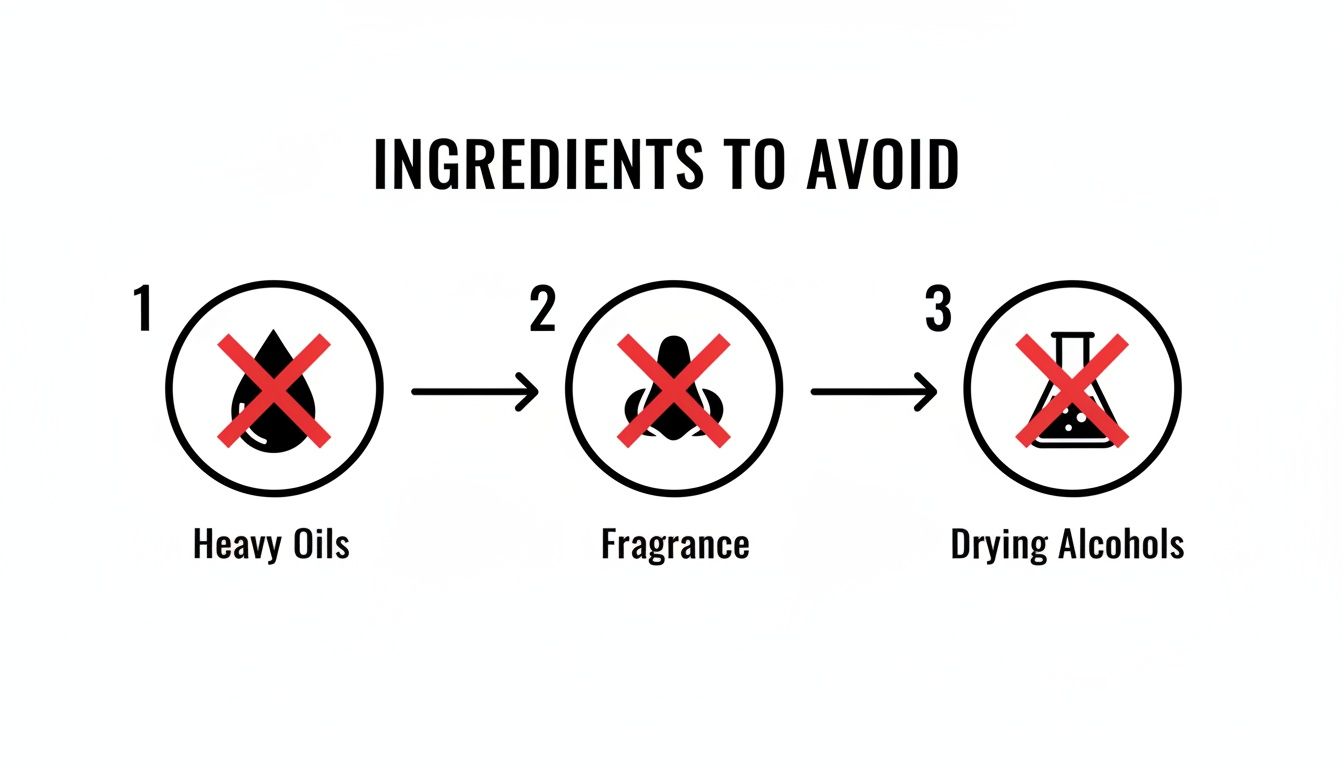
This image is a great cheat sheet for what to avoid. Heavy oils, fragrances, and certain alcohols are common culprits that can completely sabotage your progress.
Evening Routine (Focus on Treatment and Repair)
- Step 1 Gentle Cleanser: Give your skin a thorough cleanse to wash off makeup, sunscreen, and all the pollutants from your day.
- Step 2 Acne Treatment: Now's the time for the heavy hitters. Apply your chosen active, like a retinoid or our Neutralyze Exfoliating Pads with Mandelic and Salicylic Acid.
- Step 3 Hydrating Moisturizer: Lock it all in with your moisturizer. If your skin feels sensitive, use the buffering technique. This final step helps soothe your skin and repair its barrier overnight.
Following a simple, consistent framework like this gives your skin the balanced, around-the-clock support it needs to truly thrive.
How Neutralyze Tackles Acne-Prone Skin
Knowing which ingredients to look for—and which to run from—is the single most important part of choosing a moisturizer for acne. Now that you’re armed with that info, you can see right through the marketing fluff and get to the science. At Neutralyze, our expertise is built on that science.
We don't just add a single "hero" ingredient to make the bottle look good. Our core philosophy is about creating intelligent, synergistic systems. Every ingredient is chosen for a specific purpose and works in concert with others to bring your skin back into balance. The goal isn't just to treat today's pimple, but to create a skin environment where acne has a tough time showing up in the first place.
The engine driving our system is a powerful, yet surprisingly gentle, duo: Mandelic Acid and Salicylic Acid. This dual-acid approach delivers a multi-pronged attack on acne without the harsh irritation that so often sends people back to square one.
The Gentle Power of Mandelic Acid
For anyone with sensitive or inflamed skin, the word "acid" can sound intimidating. This is exactly why we champion Mandelic Acid as a cornerstone of our formulas. Unlike other acids, it offers a revolutionary approach to exfoliation.
Think about it this way: common acids like Glycolic Acid are made of tiny molecules. They penetrate the skin rapidly, which can feel like a shock to the system, triggering redness and stinging.
Mandelic Acid, on the other hand, has a significantly larger molecular size. This physical difference is key—it means the acid absorbs into the skin much more slowly and evenly. Instead of a sudden jolt, it delivers its exfoliating power gradually, gently lifting away dead skin cells without causing an inflammatory reaction.
This slow, controlled delivery is its secret weapon. It allows Mandelic Acid to offer serious exfoliation and antibacterial action with a much lower risk of irritation, making it the perfect active for skin that's already stressed out from acne.
But gentle doesn't mean weak. Mandelic Acid is a powerhouse that gets a ton done:
- Antibacterial Action: It actively helps reduce the population of acne-causing bacteria on your skin's surface.
- Fades Dark Spots: It’s brilliant at tackling post-inflammatory hyperpigmentation (PIH)—those stubborn dark marks a pimple leaves behind.
- Boosts Cell Turnover: By clearing away old, dead skin, it helps stop future clogs before they start, revealing a brighter, more even complexion.
The Pore-Clearing Precision of Salicylic Acid
While Mandelic Acid resurfaces the top layer, Salicylic Acid dives deep. As a beta-hydroxy acid (BHA), its superpower is that it's oil-soluble. This is a huge deal for acne-prone skin. It means it can cut right through the sebum clogging your pores to get to the root of the problem.
Imagine trying to clean a greasy pan with just water—it’s not very effective. Salicylic Acid is like the soap in this scenario. It breaks down that mixture of oil and dead skin cells that forms plugs deep inside your pores, which is why it’s the gold standard for clearing out blackheads and whiteheads.
By using both, the Neutralyze system launches a two-front attack. Mandelic Acid handles the surface gently, while Salicylic Acid performs the deep cleaning from within. This intelligent combination ensures you're fighting acne from every angle.
Why This Combination Is Your Best Bet
The real genius of the Neutralyze system is how these two acids work together. You get the deep-diving, pore-unclogging action of Salicylic Acid paired with the gentle, surface-refining power of Mandelic Acid. It's not about just adding more "stuff"; it's about choosing ingredients that complement each other to deliver the best possible results with the least possible irritation.
This is a system designed for someone who understands that great acne care is about balance, not brute force. It’s an approach that respects your skin barrier, calms inflammation, and addresses the entire acne lifecycle—from the initial clogged pore to the frustrating mark it leaves behind. It’s this complete strategy that makes Neutralyze the superior solution for getting—and keeping—the clear, calm skin you deserve.
Answering Your Top Moisturizer Questions
Figuring out the right skincare for acne can feel like a maze. Even when you think you've got a solid routine down, new questions always seem to pop up. Let's tackle some of the most common ones we hear, giving you clear, straightforward answers to help you feel confident about your choices.
Can You Over-Moisturize Your Skin?
This is a great question—can you really have too much of a good thing? The short answer is yes. But it's usually less about how much moisturizer you use and more about using the wrong type for your skin.
If you're slathering on a thick, heavy cream meant for extremely dry skin, you could be trapping oil and dead skin cells against your skin. This can easily lead to clogged pores and those tiny, frustrating bumps known as closed comedones.
The trick is to just listen to your skin. A well-suited moisturizer should sink in nicely, leaving your face feeling hydrated and comfortable—not greasy or like it's wearing a heavy mask. If a product feels suffocating or leaves a shiny film, it's probably too rich for you. Stick to a lightweight, non-comedogenic formula to get all the hydration without the risk.
How Can I Tell if My Moisturizer is Causing Breakouts?
It’s totally normal to point the finger at the newest product in your lineup when a fresh pimple appears. To play detective and see if your moisturizer is the real culprit, there are a few signs to watch for. Breakouts from a new product, a reaction sometimes called acne cosmetica, often show up as small, similar-looking red bumps or whiteheads, usually in the areas where you apply the most product.
Think your moisturizer is the problem? Try taking a break from it for a week or so and see if things calm down. This is also why it's a golden rule to introduce only one new product at a time. It makes it so much easier to pinpoint exactly what’s causing the trouble.
One quick thing to remember: If your moisturizer contains active ingredients like salicylic or mandelic acid, you might go through a "purging" phase. This is when the product speeds up cell turnover, bringing underlying clogs to the surface. It looks different from a typical breakout and should clear up in a few weeks.
Does My Moisturizer Need SPF?
A moisturizer with built-in sunscreen sounds like the ultimate time-saver, right? While it can be, you have to be careful that you're actually getting the protection you need. The reality is, many of these two-in-one products don't offer broad-spectrum coverage or have an SPF high enough (you need at least 30) to do the job properly.
For the best possible protection, dermatologists almost unanimously recommend using a separate, dedicated sunscreen. This should always be the last step in your morning routine. Using a standalone sunscreen ensures you’re applying enough of it to get the full SPF promised on the label. And since many acne treatments make your skin more sensitive to the sun, solid, daily sun protection is completely non-negotiable for preventing sun damage and those stubborn post-acne marks.
Is It Okay to Use Body Lotion on My Face?
Please don't! While it’s tempting in a pinch, using body lotion on your face is a bad move, especially if you're prone to acne. Body lotions are created for the skin on your arms and legs, which is much thicker and more resilient than your facial skin. They’re packed with heavier oils, butters, and fragrances that are way too occlusive and potentially irritating for your face.
Putting body lotion on your face is a surefire way to invite clogged pores and irritation. Always, always have a separate product that was specifically formulated and tested for your face. It's one of the simplest and most important swaps you can make. If your acne is persistent and you want to explore prescription options that work with your moisturizer, an online doctor prescription consultation can offer personalized guidance.
Ready to try a smarter approach to skincare that actually understands acne-prone skin? See what makes Neutralyze different. Our advanced, multi-patented formulas with Mandelic and Salicylic Acid can help you finally achieve the clear, calm skin you’ve been looking for.


