

Discover when to use glycolic acid for clear skin and gentle exfoliation
So, you're wondering when to use glycolic acid? Here's the short version: it’s your go-to for tackling stubborn, non-inflamed acne like blackheads, whiteheads, and the bumpy texture they leave behind.
Think of it as a reset button for clogged pores and old acne marks. As experts in acne-fighting ingredients, we've designed this guide to walk you through exactly when and how to use it for your specific skin.
Understanding When Glycolic Acid Is Your Best Ally

Glycolic acid is a powerful alpha-hydroxy acid (AHA) that comes from sugarcane. It's a true heavyweight in skincare, especially if you're dealing with acne.
What makes it so special is its incredibly small molecule size. This lets it get deeper into the skin than other AHAs to dissolve the "glue" holding dead skin cells together. It’s like a precision tool for exfoliation.
This deep-cleaning action is exactly why it works so well. By sweeping away that buildup of dead cells, you stop pores from getting blocked in the first place. It's a proactive strategy for keeping congestion-based acne under control.
Key Moments to Introduce Glycolic Acid
So, when is it time to bring in the glycolic acid? The best time really depends on what you're trying to fix. Here are some clear signs it might be time to add it to your routine:
- Persistent Clogged Pores: If you’re constantly fighting a battle with blackheads and whiteheads, glycolic acid can help keep those pores clear.
- Dull or Uneven Skin Tone: By lifting off the dull, outer layer of skin, it helps reveal a much brighter, more radiant complexion.
- Lingering Post-Acne Marks: It's a star player when it comes to fading the dark spots (post-inflammatory hyperpigmentation) that breakouts leave behind.
- Changes in Skin Texture: If your skin feels rough or bumpy to the touch, glycolic acid can smooth things out for a softer, more refined surface.
Glycolic acid isn't just about exfoliation; it's about renewal. It helps stimulate collagen production, which is crucial for firming the skin and smoothing out fine lines that can accompany acne scarring.
This double-duty benefit—tackling current issues while boosting your skin's long-term health—is a cornerstone of smart acne management. At Neutralyze, we build our entire systems around this idea, leveraging powerful ingredients like glycolic acid as part of a complete solution to help you achieve and maintain calm, clear skin.
Let's dive deeper into how to make this powerful ingredient work for you.
So, What Is Glycolic Acid Actually Doing to Your Skin?
Before we dive into when to use glycolic acid, let's get a clear picture of what's happening when you apply it. Forget the complicated science jargon for a second.
Picture the dead skin cells on your face. They're stuck together with a type of "glue" that can clog pores and make your complexion look dull and tired. Glycolic acid works by gently dissolving that glue, allowing those old, dead cells to slough off and reveal the fresh, new skin underneath. It’s incredibly effective because its molecules are tiny—the smallest of all the alpha-hydroxy acids (AHAs). This small size lets it penetrate deeper than other AHAs, working from the inside out to exfoliate your skin.
If you're dealing with acne, this deep-cleaning action is a game-changer. It helps prevent the traffic jam of dead skin and oil that leads to blackheads and whiteheads in the first place, stopping many breakouts before they can even get started.
It's More Than Just a Surface-Level Exfoliant
But clearing out pores is just the beginning. Glycolic acid is a true workhorse, and its benefits go way beyond simple exfoliation. It actively helps rebuild your skin's health from the ground up, which is crucial when you're trying to recover from acne.
Here’s a quick look at what else it brings to the table:
- It Kicks Collagen Production into Gear: By getting down into the deeper layers of the skin, glycolic acid nudges the cells responsible for producing collagen (fibroblasts) to get to work. Over time, this can help firm up the skin, softening the look of fine lines and even some types of shallow acne scars.
- It Helps Your Skin Stay Hydrated: This might sound counterintuitive for an exfoliant, but glycolic acid is also a humectant. That means it helps your skin attract and hold onto water. This is vital for repairing your skin barrier, especially if it's been weakened by harsh acne treatments or general irritation.
- It Brightens and Evens Out Your Complexion: All that accelerated cell turnover does wonders for fading the dark spots—what dermatologists call post-inflammatory hyperpigmentation—that pimples love to leave behind. The result is a more even, radiant skin tone.
This is exactly why glycolic acid is such a cornerstone ingredient for managing acne. It’s not just putting a band-aid on a pimple; it’s working to restore the skin's overall health and resilience.
This idea of complete skin restoration is really the heart of our philosophy at Neutralyze. By choosing multitasking ingredients that tackle both the cause and the aftermath of acne, our systems guide your skin back to a place where it's not just clear, but genuinely healthy, calm, and balanced for the long haul.
Picking the Right Glycolic Acid Strength for Your Acne
Choosing a glycolic acid product isn't about grabbing the bottle with the highest percentage. It’s about matching the acid's concentration to your specific type of acne to get clear, smooth results without causing irritation. As leaders in ingredient-focused skincare, we know that the right strength makes all the difference.
This decision tree gives you a quick visual on how glycolic acid gets to the root of the problem—literally.
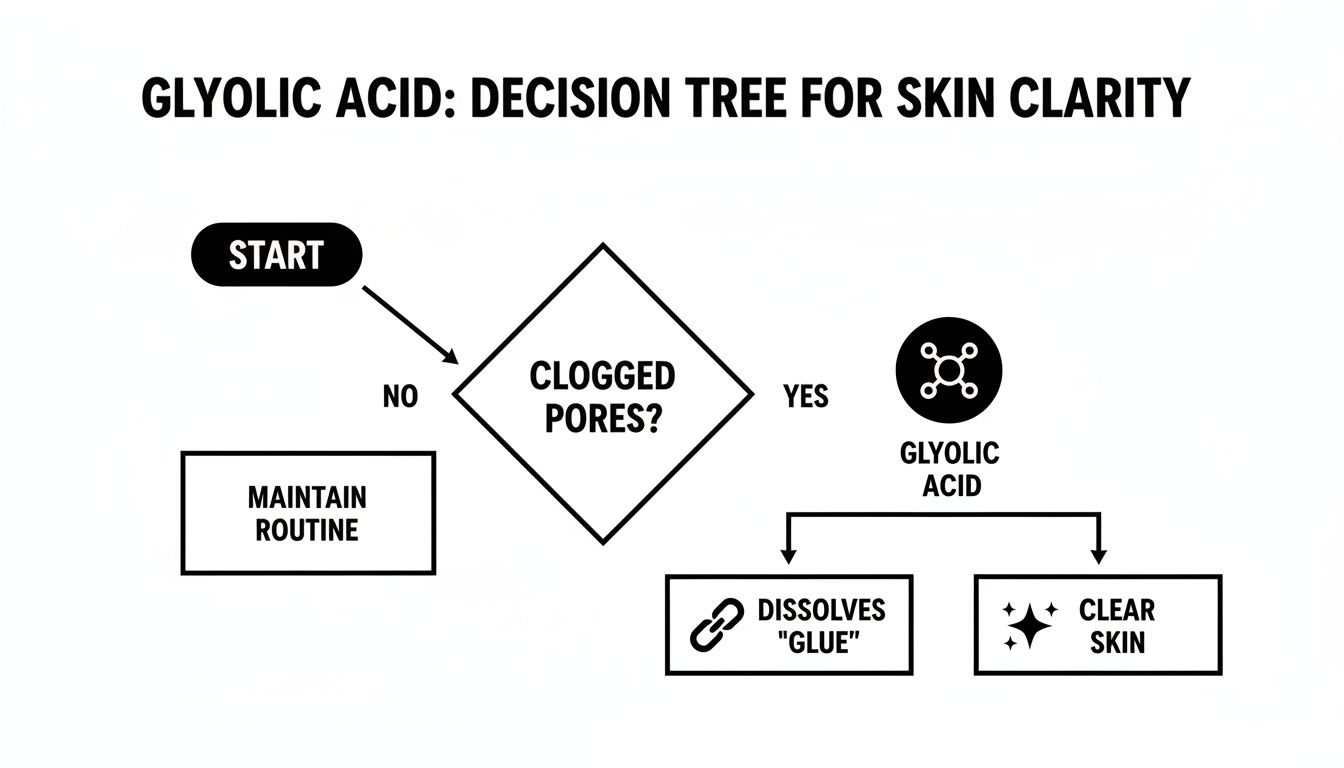
It breaks down the core concept: glycolic acid works by dissolving the "glue" that holds dead skin cells together, which is the primary cause of congested pores.
For Mild Acne and Clogged Pores
If your main battle is with mild acne—we’re talking stubborn blackheads, whiteheads, and that general feeling of clogged, bumpy skin—then a lower concentration is your best bet.
Look for products with 5-10% glycolic acid and start by using them just a few times a week. This acts as a preventative measure, keeping pores clear and your skin texture smooth before things have a chance to get out of hand. Think of it as consistent, gentle maintenance for a balanced complexion.
For More Stubborn, Moderate Acne
When you're dealing with moderate acne, the game changes. You’ve likely got a mix of clogged pores and some angry, red, inflamed pimples (papules and pustules). At this stage, your skin needs a bit more firepower to see real improvement.
This is where you might bring in higher-concentration products for at-home use or even consider professional peels that hover around the 20% mark. These stronger treatments kick cell turnover into high gear, helping to clear up existing breakouts much faster and stopping new ones from forming.
And the science backs this up. For mild-to-moderate acne, concentrations between 5% and 20% have proven to be a sweet spot, often serving as a great alternative to more aggressive prescription treatments.
A 2023 clinical study put this to the test, comparing a 5% glycolic acid complex to a 20% peel. After 70 days, both showed a significant drop in acne. But the 20% peel was the clear winner for people with larger, more stubborn pimples, proving it's the right choice for moderate cases that need a deeper level of exfoliation. You can dive into the full study about acne severity reduction03024-X/fulltext) to see the data for yourself.
This kind of targeted, intelligent approach is what Neutralyze is all about. We develop sophisticated, science-driven systems that empower you to effectively manage your acne at every stage, delivering powerful results without the irritation common in other treatments.
By understanding what your skin is telling you, you can pick the right glycolic acid strength to tackle the problem head-on. It’s the smartest step toward finally achieving calm, clear skin.
How to Build Your Ideal Skincare Routine
Figuring out how to fit glycolic acid into your routine is the single most important step. Get it right, and you're on your way to glowing, clear skin. Get it wrong, and you could be dealing with a lot of unnecessary irritation.
The golden rule is pretty simple: glycolic acid is a nighttime ingredient.
Applying it in your PM routine is non-negotiable, and here's why. Glycolic acid makes your skin significantly more sensitive to the sun (we call this photosensitivity). Using it at night lets it get the job done safely while you sleep, which is when your skin is already in its natural repair and regeneration mode.
The Right Way to Layer Your Products
Timing is one thing, but the order you apply your products in is just as crucial. For glycolic acid to really work its magic, it needs to be applied to clean, bone-dry skin. Applying it to even slightly damp skin can make it penetrate too deeply, too fast, which is a one-way ticket to irritation.
Here’s a simple, effective sequence for your evening routine:
- Cleanse Thoroughly: Start with a gentle cleanser to get rid of makeup, sunscreen, and the day's grime.
- Pat Skin Dry: Gently pat your face dry with a clean towel. Then, wait a minute or two. You want to be sure your skin is completely dry.
- Apply Glycolic Acid: Use a small amount of your glycolic acid product—whether it's a toner, serum, or pad—and sweep a thin, even layer across your face. Make sure to avoid your delicate eye area.
- Wait Patiently: This is key. Give the product at least 5-10 minutes to fully absorb and work at its intended pH before you apply anything else. Don't rush this step!
- Hydrate and Moisturize: Once the wait time is up, follow with your hydrating serums (like hyaluronic acid) and a good, nourishing moisturizer to keep your skin barrier happy and supported.
Navigating Other Active Ingredients
So, how does glycolic acid play with the other "actives" in your cabinet? This is where a lot of people get into trouble. Smart scheduling is everything.
The most important rule of thumb? Avoid using glycolic acid and retinoids on the same night. Both are incredibly effective exfoliants, but using them together is a recipe for redness, peeling, and a damaged skin barrier. The best approach is to alternate nights.
The same goes for other strong exfoliants like a high-concentration salicylic acid. However, some ingredients can be great partners. For instance, pairing glycolic acid with benzoyl peroxide can be a powerhouse combination for fighting acne, but it requires a careful strategy. For a deep dive, you can check out our guide on using glycolic acid and benzoyl peroxide together.
Even if you only have mild acne, you don't need a complicated routine to see great results. A 2022 trial found that a 5% glycolic acid gel used daily for just four weeks led to a major reduction in acne lesions. Skin analysis showed a significant drop in facial porphyrins—a key marker for the bacteria that causes acne. You can learn more about these glycolic acid findings to see just how effective a simple, consistent approach can be.
Sample Weekly Glycolic Acid Routine for Acne
To make things even clearer, here’s what a balanced weekly routine could look like. This schedule helps you get the benefits of your active ingredients without overwhelming your skin.
Sample Weekly Glycolic Acid Routine for Acne
| Day | AM Routine | PM Routine |
|---|---|---|
| Monday | Gentle Cleanser, Vitamin C, Moisturizer, SPF | Gentle Cleanser, Glycolic Acid, Moisturizer |
| Tuesday | Gentle Cleanser, Hydrating Serum, Moisturizer, SPF | Gentle Cleanser, Retinoid, Moisturizer |
| Wednesday | Gentle Cleanser, Vitamin C, Moisturizer, SPF | Gentle Cleanser, Glycolic Acid, Moisturizer |
| Thursday | Gentle Cleanser, Hydrating Serum, Moisturizer, SPF | Gentle Cleanser, Retinoid, Moisturizer |
| Friday | Gentle Cleanser, Vitamin C, Moisturizer, SPF | Gentle Cleanser, Glycolic Acid, Moisturizer |
| Saturday | Gentle Cleanser, Hydrating Serum, Moisturizer, SPF | Gentle Cleanser, Retinoid, Moisturizer |
| Sunday | Gentle Cleanser, Hydrating Serum, Moisturizer, SPF | Gentle Cleanser, Hydrating Mask, Moisturizer (Rest Day) |
This is just a template, of course. The most important thing is to listen to your skin and adjust as needed. If you feel any stinging or see excessive redness, it's time to pull back and give your skin a break.
This thoughtful approach to product layering is essential for building a routine that delivers results. By allowing each ingredient to perform its role without conflict, you create a supportive environment for clear, healthy skin—a core principle behind Neutralyze's system, designed to ensure all your products work in harmony for maximum benefit.
Dealing With the Aftermath: Glycolic Acid for Post-Acne Marks and Scars
The battle with acne doesn't always end when the pimples disappear. Often, the real frustration starts with what they leave behind: stubborn dark spots and an uneven, bumpy texture. This is exactly when to use glycolic acid—not as a front-line acne fighter, but as a restorative powerhouse.
Think of it this way: once your active, inflamed acne is under control, your skincare focus shifts from putting out fires to rebuilding and repairing. Glycolic acid is the star of this second act, helping you reclaim a smooth, even-toned complexion.
It works by dissolving the 'glue' that holds old, discolored cells to your skin's surface. By speeding up cell turnover, it pushes fresh, undamaged skin cells to the top, which is incredibly effective at fading those dark spots known as post-inflammatory hyperpigmentation (PIH).
For Deeper Concerns, Stronger Formulations are Key
For more stubborn texture issues and shallow scarring, you'll need to bring in the heavy hitters. This is where higher-strength glycolic acid treatments, typically done by a professional, can make a world of difference.
These professional-grade peels use concentrations way beyond what you'd find in a daily toner, often ranging from 35% to 70%. They're designed to deeply exfoliate the skin and kickstart a much more significant regenerative response. This level of treatment is strictly for when active breakouts are gone and your main goal is to resurface the skin and soften the look of shallow, atrophic scars.
Science backs this up. One study comparing 35% glycolic acid peels to microneedling for atrophic acne scars found the peels were effective for 33.33% of participants. Another trial showed that bi-weekly 70% glycolic acid peels did a better job improving scarring than a daily 15% cream, proving that higher concentrations pack a bigger punch for this specific concern.
This is the core of the Neutralyze philosophy. We don't just want to get your skin clear; we provide a complete solution to guide it to a truly healthy, calm, and even-toned state long after the breakouts are a distant memory.
Understanding Your Resurfacing Options
While glycolic acid peels are a fantastic tool, they aren't the only one in the shed. To get a full picture of your options for post-acne marks, it helps to compare them with other treatments. Exploring resources like Microneedling vs Chemical Peel for Clearer Skin can give you a clearer understanding of the landscape. Knowing all the paths available helps you choose the best route for your skin's unique journey.
Knowing When to Take a Break from Glycolic Acid
When it comes to powerful skincare ingredients like glycolic acid, more is definitely not better. In fact, one of the most important skills you can develop on your journey to clear skin is learning to listen to what it's telling you—especially when it's asking for a break.
Knowing when to apply glycolic acid is half the battle; knowing when to stop is the other half. Pushing your skin past its limit can damage its natural protective barrier, creating a whole new set of problems you didn't have before.
Spotting the Signs of Over-Exfoliation
Don't worry, your skin won't be subtle. It will give you clear signals when it's had too much. Think of these as red flags telling you to immediately pause all exfoliating treatments.
Keep an eye out for these common symptoms:
- Persistent Redness and Irritation: Your skin just looks angry and feels inflamed, long after you've applied any products.
- Unusual Flaking or Peeling: We're not talking about a tiny bit of shedding. This is noticeable peeling that just won't quit.
- A Tight or 'Waxy' Look: Does your skin look stretched, overly shiny, or almost plastic-like? That's a classic sign of distress.
- New Sensitivity: Suddenly, your go-to gentle moisturizer stings or burns on contact. Products that never bothered you before are now causing a reaction.
If you spot any of these signs, your skin barrier is waving a white flag. It's compromised and needs help, stat.
Think of your skin barrier like a strong brick wall protecting a castle. Over-exfoliation is like taking a sledgehammer to that wall, creating cracks and holes. This leaves your skin vulnerable, weak, and reactive. The goal is always to reinforce the wall, not tear it down.
Once you see these signs, it's time to stop using glycolic acid completely. Shift your entire focus to barrier repair. This means stripping your routine back to the bare essentials: a gentle, creamy cleanser, a simple hydrating serum (think hyaluronic acid), and a rich, soothing moisturizer. That’s it.
Wait until your skin feels completely back to normal—calm, balanced, and comfortable. Only then should you even consider bringing glycolic acid back into the picture. When you do, reintroduce it slowly. Start with a lower concentration than before or drop your frequency to just once a week.
This careful, responsive approach is the secret to long-term skin health. It perfectly aligns with the Neutralyze philosophy of nurturing your skin back to a calm, clear state, ensuring your progress is both steady and sustainable.
Glycolic Acid FAQs: Your Questions, Answered
Alright, let's dive into some of the questions that always pop up when people start using glycolic acid. Think of this as your cheat sheet for getting it right.
Can I Actually Use Glycolic Acid Every Single Day?
We see this question a lot, and for most people, the answer is a hard no. Jumping straight into daily use is a fast track to over-exfoliation, which can wreck your skin barrier and leave you with redness, irritation, and sensitivity.
The best approach? Start slow. We're talking 2-3 times per week, and only at night. This gives your skin a chance to adapt and lets you see how it reacts before you even think about using it more often.
Is It Better to Use Glycolic Acid in the Morning or at Night?
This is a non-negotiable one: always, always use glycolic acid at night.
Here’s why: AHAs like glycolic acid make your skin more sensitive to the sun (a little something called photosensitivity). Using it in the morning dramatically increases your risk of sunburn and long-term sun damage, which is the exact opposite of what we're trying to achieve. Slathering on sunscreen in the AM is a must, but applying your glycolic acid in the PM is your first line of defense.
How Long Until I See Real Results for My Acne?
You might see a bit of a glow or feel a smoother texture pretty quickly, maybe even after the first few uses. But when it comes to tackling acne, you have to play the long game.
You’ll need to stick with it for at least 4-6 weeks to see a real, noticeable difference in breakouts and clogged pores. That’s how long it takes for the acid to really work its magic through several of your skin's natural turnover cycles.
Look, we know it’s tough, but patience is everything here. Getting control of acne is a marathon, not a sprint. The goal is to build a smart, consistent routine that works with your skin to calm and clear it over time—not to blast it with harsh products expecting a miracle overnight.
Ready to build a smart, effective routine that finally puts you in control of your acne? The Neutralyze system is expertly designed to work with powerful ingredients like glycolic acid, delivering clinically proven results for calm, clear, and balanced skin. Discover the difference on the Neutralyze website.


